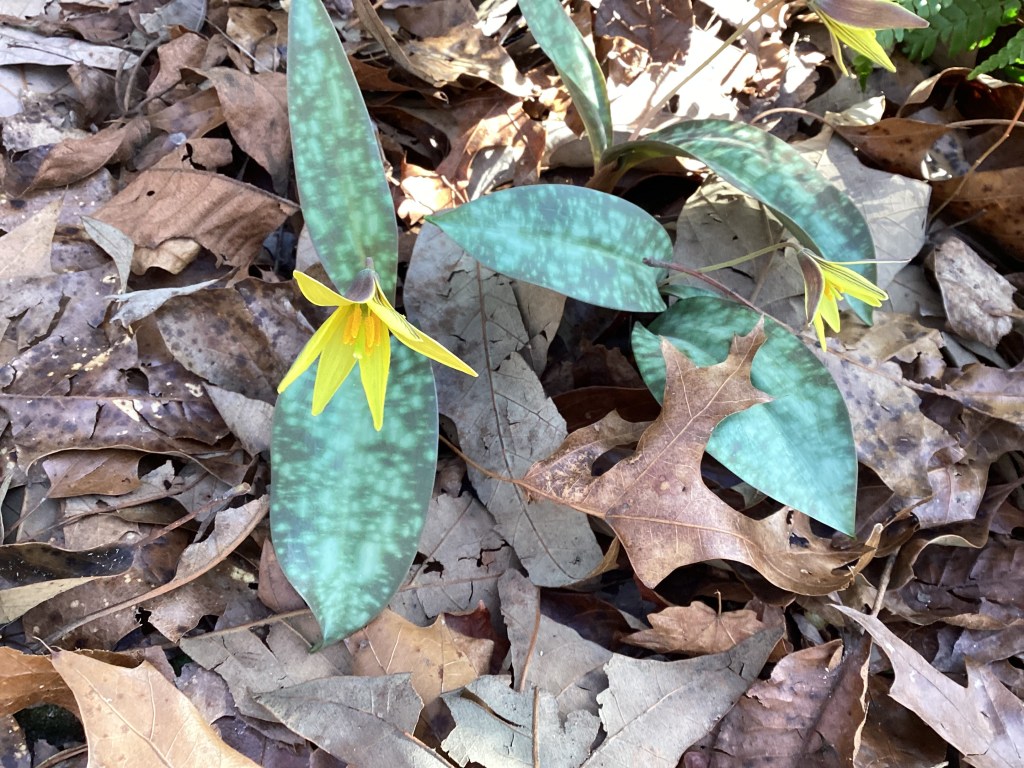
Ok, it isn’t meteorological Spring yet, but don’t tell that to the native plants, because they don’t care. Here we have a Trout Lily (Erythroniumamericanum), the first of the native perennials to bloom in the Southern Appalachians. This is a signal to go trout fishing, traditionally, as the Dogwood blooms are a sign to go bass fishing. I’m down with both of those.
The temp this morning is exactly 32 degrees F, and whether it gets below that again this Spring is unknown. Our last frost date varies from February to March normally, and I already have cold hardy vegetables growing. And I also have a few potatoes in the ground. Even without a groundhog to help, I’m thinking this is going to be an early Spring.
When people involved in Sloyd (crafts) work hear the name of the central Swedish town of Mora, they immediately think of knives. Though Mora knives are made for just about every purpose knives can be used for, from Culinary to Military, they are best known for their woodcarving knives. The use of laminated steel blades in wood carving knives has been at the top of the Mora innovations.
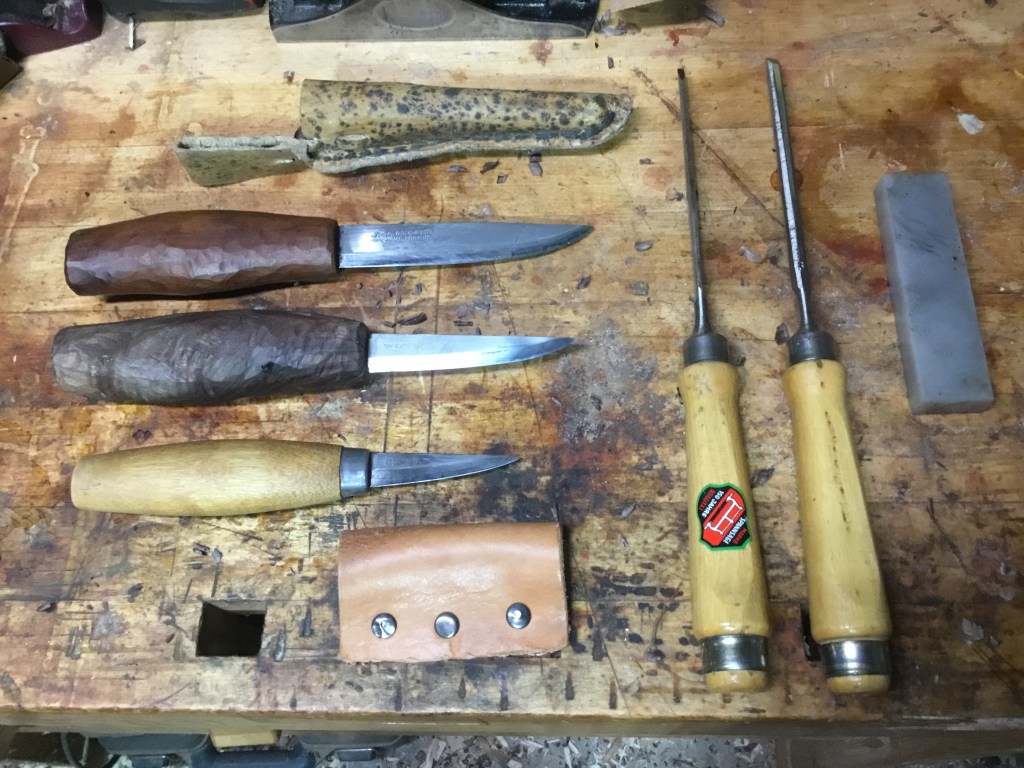
Pictured above are three different generations of Mora knives, and from two different categories. From top to bottom they are as follows: the top knife is an older Mora utility knife, roughly of the length of the current No. 2 knife; the middle knife is the No. 106 carving knife; and the bottom one is the No. 120 carving knife. The differences are as follows.
The #2 knife is a dual purpose craft/utility knife that has a 4 1/4″ long blade. This older model, which I am guessing is 15+ years old, has a laminated blade with a very hard (harder than stainless) carbon steel middle layer. Such a hardened metal by itself would be exceedingly brittle and prone to breaking, hence the two softer and more flexible outside layers. I made the Black Cherry handle–more about that later. Newer versions of the #2 do not have the laminated blade.
The #106 carving knife is brand new, and a perfect length 3 1/4″ carving specialist. The homemade handle is a piece of Black Walnut crotch, with contrary grain that should be just about indestructible. The new brand name the blank is sold under is Morakniv, following the merger of the two leading knife making companies of the town.
The small #120 detail knife has a blade 2 1/4″ long. This version has the standard factory made Birch handle, a signature of Mora knives. This knife is somewhere between the vintage of the other two, and has the name Erik Frost-Mora, on the blade. The birch handled knives are sold around the globe.
Other items pictured are some bevel edged chisels and an Arkansas stone. The Arkansas stone is of the translucent grade, with a grit rating of 1200+. This or some similar sharpening device is absolutely vital to keeping a carving quality edge sharp. A good strop also helps.
If you would like to undertake handle making for your carving knives, these two chisels are the ticket. The narrow one is 2mm, and the wider one is 6mm. The 2mm chisel is the primary mortising tool, and the 6mm is a supplement. These are old German made Spannsäge chisels, though said company has been bought out, but the two sizes are still manufactured by Kirschen (“Two Cherries” in English), and are readily available.
Lastly, there are the homemade sheaths. The top one is a traditional design, sewn around a plastic insert, and the last is a rough and ready cover made to keep my fingers safe when the knife is in its tool roll. I should have included my cut resistant gloves as well, but all carvers know about those.
 Southern Fusion Cooking