How to Put the Hammer Down on Big Chicken

The AI [Avian Influenza] virus is most often transmitted from one infected flock to another flock by infected birds, people or equipment.

North Carolina State University

In yet another amazing display of smoke and mirrors, the British government has banned free range chickens, and therefore, free range eggs. This rather transparent ploy came as many large indoor factory farms suffered bird flu outbreaks, which the government blamed on free range flocks, which strangely enough, were not experiencing the same levels of infection. Free range eggs, however, had taken over two-thirds of the consumer market in the UK, with five large grocery market chains selling nothing but free range eggs. Now that market share will be shifted back to factory farmed eggs.

This is the politics of Big Chicken–if you can’t beat the competition, have the government shut them down.

And it isn’t just free range chickens that are taking the blame–there are also those pesky wild birds. The following quote came from the NPR website, under the title of “A worrisome new bird flu is spreading in American birds and may be here to stay.” Here’s what one of the people who head Big Chicken in the US has to say–

“So I think I am kind of holding my breath this month,” says Denise Heard, director of research programs for the U.S. Poultry & Egg Association.

The virus has a number of ways to get from wild birds into poultry, says Heard. Since the last outbreak, the industry has worked to educate farmers about how to protect their flocks.

“Wild migratory waterfowl are always flying over the top and when they poop, that poop gets on the ground,” she says, explaining that the virus can then get tracked into bird houses on boots or inadvertently moved from farm to farm on vehicles.

Heard says there currently seems to be less spread of the virus from farm to farm than was seen during the last major outbreak. Instead, there are more isolated cases popping up, perhaps because wild birds are bringing the viruses to farms and backyard flocks.

NPR, April 9, 2022

There is just enough truth here that it makes the idea of 5 million chicken mega-farms being composed of “bird houses” more than particularly hilarious. Migratory waterfowl do in fact suffer from bird flu, but they don’t die at nearly the death rates that battery caged chickens suffer. The slip-up comes when Ms. Heard says the virus is “moved from farm to farm,” which will be obvious when spring migration ends, and the disease just keeps on trucking.

My crystal ball tells me the next scapegoat will be backyard flocks. After all, of the more than 13 million diseased and culled poultry that Iowa had in March 2022, 53 were from backyard flocks. Just do the math. The interwebs is already full of do’s and don’ts for local chicken. Big Chicken gets a pass.

However, don’t expect anything from Big Chicken except higher prices, windfall profits, and the same low quality products. Therefore, I am proposing a Joel Salatin, aka the world’s most famous farmer, style solution to the problem: do nothing, as long as part of the nothing includes buying none of their products. Salatin, who is the right kind of conservative, in that he works to conserve the environment, says you can protest, lobby, and write all the letters that you want, but if you still buy those McNuggets regularly, Big Chicken just doesn’t care.

So the next time an industry plays the old look over here, not there, game, just assume they have something to hide. I know where my eggs come from, and its from our big chickens, but not Big Chicken.


Favorite Turning Tools, English Edition–Ashley Iles Tools for Foot Powered Lathes

Word for Today–Heaviosity

These may just look like two overgrown turning tools, and in fact, they are. The roughing gouge in the foreground–#6 sweep–is 1 1/2″–and the straight chisel is 2″. Their size is suited for their purpose, which is turning green wood on a treadle lathe, be it reciprocating, or continually spinning in one direction (“Treadle”-think foot powered version of the conventional electric lathe).

To my knowledge, Ashley Iles is the only major tool manufacturer to offer a complete set of turning tools for foot (human) powered lathes. I already had a set of four carbon steel turning tools, and these two, a couple of small spindle gouges, and some adapted straight chisels, rounded out the set. I bought both of these from across the pond, and the service offered by English tools sellers ranges from excellent to magnificent.

A Well Made Bevel

What distinguishes these tools from conventional turning tools? The bevels for one. The roughing chisel’s primary bevel is around 25 degrees, similar to a bench chisel. The edges of the bevel are ground into a triangle to keep the tool from snagging on the work as it turns. This is a cutting tool, not the typical turning scraper.

As is the shallow sweep roughing gouge. It has a similar bevel angle, and the size and sweep distinguish it from other similar gouges–my 1″ roughing gouge has a #11 sweep. I just purchased the shallow sweep one, and though the tools originally were available unhandled (my chisel has a rough and ready home made maple handle, which I scarfed out when the only turning chisel I had was a skew), this one arrived with a fine beech handle.

Finally, these tools are made from easily sharpened carbon tool steel. One reason is, that they need to be good and sharp, to avoid creating mostly sawdust. A extra bonus is that carbon steel is much less expensive than the usual high speed steel of high end turning tools.

The entire line of these tools are available from Classic Hand Tools in England. They can be purchased a la carte, or the entire set of six can be had for about $205. Several of these tools, including the shallow gouge, are unavailable in the States . Shipping is fast, and airmail is reasonable. In fact, my total for the gouge was less than it would have been for an equivalent tool here, if such a thing existed (the Iles deep roughing gouge, which is sold here, would be 5-10 dollars more if bought in the US). On top of that, no one knows how to package a tool like the Brits.

With Five Million Chickens on One Farm, What Could Possibly Go Wrong?

Actually, there were two farms in Iowa that had more than five million chickens each. Were. Iowa, the largest egg producer in the US, obviously is interested in quantity rather than quality. Now they have 10.3 million fewer chickens because of just two mega-farms, all in the space of one month.

Factory farms are justifiably notorious for the use of battery cages for chickens, that are too small for the chickens to even turn around. Disease will spread throughout an entire population of birds in no time due to the overcrowded conditions. But the Iowa Secretary of Agriculture thinks he has found the true culprits in this story–wild birds.

The theory is that asymptomatic migratory birds transmit bird flu to chickens that are locked up tight from both reporters and wild birds. As imaginative as I usually am, I am at a loss to see how this transmission occurs, short of crows with crowbars. Even sabotage by the Animal Liberation Front sounds more plausible (ALF has the most unintentionally humorous website on this planet).

Anyway, the numbers, via the Iowa Capital Dispatch

March 17–5.3 million chickens to be culled from one farm

March 31–5 million chickens to be culled from another farm

I foresee more to come. Those pesky wild birds are everywhere.

Growing Mushrooms, Part Five–A Cornucopia of Mushrooms

Branched Oyster

As soon as I saw that the Latin name for Branched Oyster mushroom was Pleurotus cornucopiae, I had to grow some. This is a widely sought after variety well known to mushroom foragers, as it has an enormous range in the wild, and in many locales, can be found all year. Once again, the substrate here is just used coffee grounds with their filters.

The container is the difference. That’s a one gallon glass canister that was made in the US, and costs the princely sum of ten bucks. If someone had set out to design the perfect mushroom growing container, they could have done no better. The lid is left cracked open slightly as the mycelium expands, removed daily for the water spritzing, and then replaced to maintain humidity.It obviously comes off permanently when the young shrooms reach the top of the container.

The Mushrooms Two Days Earlier

Commercial growers in this country use plastic grow bags, which like all plastics, end up in our enormous waste stream. The glass canisters, with proper treatment, could last for generations. As far as single use plastics go, just remember P.I.E.–Plastic Is Evil. Last week, for the first time, plastic microbeads were found in some dude’s bloodstream.

Maple Fry Fork

Maple and Walnut

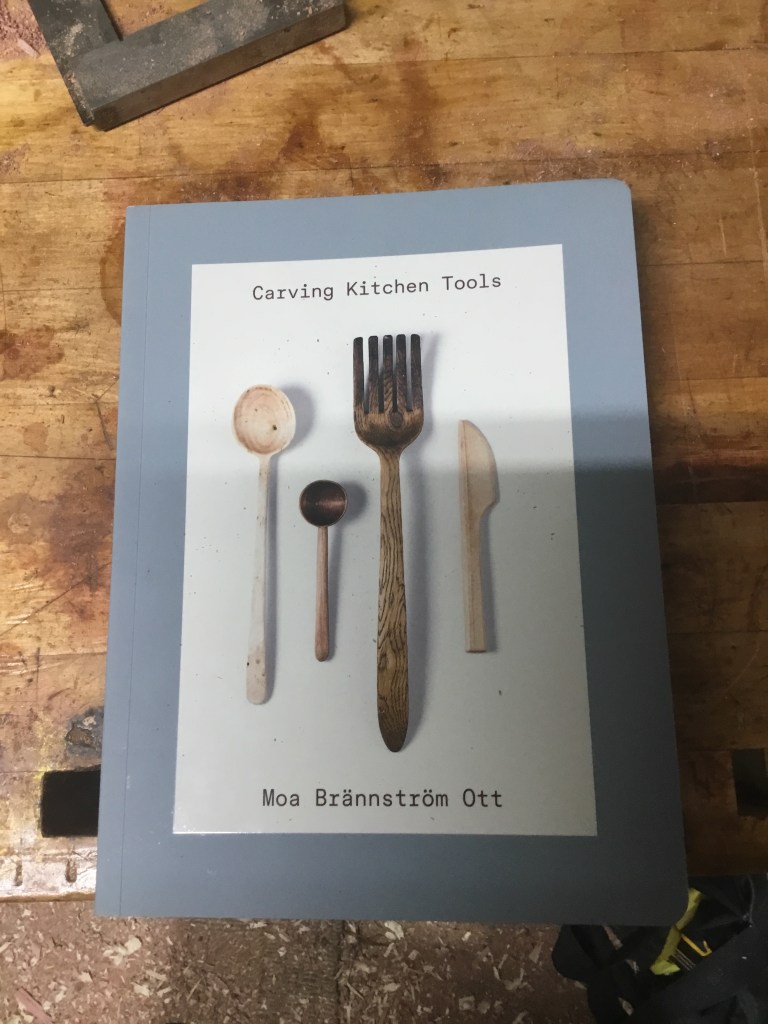
I wasn’t familiar with the Swedish term “fry fork” until this year (Google translate says that the Swedish is “stek gaffel,” for what that’s worth). I ran across it in the new English edition of Carving Kitchen Tools, by Moa Brännström Ott. I was so intrigued by this book that I made sure that it arrived on the first day of publication, 2/1/2022.

Spoons, Fry Fork, Butter Knife

I made my fry fork before I knew there was such a thing. It excels at flipping bacon, and most of all, making soft scrambled eggs. Here’s how to make them, from a French farmhouse, to the great writer Elizabeth David, who learned the technique there, to her student Jane Grigson. That’s how cooking works.

Soft Scrambled Eggs

Eggs (One per person)

Sea Salt

Olive oil

That’s it. The trick is in the cooking. I like carbon steel pans for this, as they heat up fast, and cool off quickly.

Give the eggs a thorough beating, and heat up the olive oil in the pan at high heat. As soon as the oil begins to spread out, starts moving around and forming thin layers at the point of the heated surface, and thicker layers elsewhere, turn the heat to the lowest possible setting, and take a break. When the oil has returned to an even surface, pour in the beaten eggs. Then do nothing.

What, no running around like in a cooking competition? This is more Zen than that. When the eggs begin to set, slowly separate and turn the curds to the desired size. Serve the eggs while they are still moist–no rubber eggs here.

The fry fork is just the tool for this dish. Carved from green Maple, I call mine the trident style for obvious reasons. If Neptune wants to banish me to ten years of roaming the eastern Mediterranean in an Odyssey, eating great seafood, kicking butt and taking names, and generally playing ancient Greek James Bond, I’m down with that-especially if I get to slaughter all the local scumbags, who are eating my food and drinking my wine, when I finally get back to my home city. No wonder that poem is still so popular.

Making Oil Wax Finishes

Cooking the Finish

First, to clear up a common confusion between paste waxes and oil wax finishes. Strangely enough, a paste wax is a surface polish, and an oil finish is a drying oil based finish that soaks/penetrates into the wood, and eventually dries into a polymerized surface. Two examples follow.

When wax is melted with a solvent, say terps, mineral spirits, or citrus solvent, it becomes a paste wax, or a pure wax held in solution by a solvent. When wax is melted by a heated oil, sometimes in combination with a solvent, it becomes an oil wax finish. Time for some specific examples.

Melting away in my Trangia 25 cookset (still less than $100, alcohol stove included), is some oil finish composed of 4 oz of Walnut oil (highest oil content of any drying oil), 2 oz Beeswax and Carnauba wax, and a teaspoon of Citrus solvent. This is definitely the best smelling finish I have ever cooked, and should be durable as well. Here’s the Roman workbench with a couple of coats on it.

Still needs Four More Legs

The Citrus solvent idea came from Christopher Schwartz, who uses a 3-1 ratio of oil to wax. I tend to go with 2-1, but to save time, I should have dissolved the Carnauba wax in the Citrus solvent before adding the oil and beeswax. I applied the finish with a high tech applier, an old smart wool sock that has a big hole in it.

The possible combinations are almost endless:

Oils I have used–

Walnut Oil (my favorite)

Polymerized (heated) Linseed Oil

Oils to experiment with–

Sunflower seed oil

Tung oil

I have made mass quantities of paste wax with Tung oil, to the point that I have run out of it, as well as the Citrus solvent. Time to make a shopping list.

Waxes I have used–

Beeswax

Carnauba wax

Note to self–Dissolve the Carnauba wax in Citrus solvent first, then add the oil.

Waxes to experiment with–

Candelilla wax

Bayberry wax

Candalilla wax fascinates me, as it is not as hard as rock hard Carnauba, but harder than soft beeswax. One day I will look up the technical specs. I once owned somewhere between a few hundred to a few thousand wax myrtle bushes, growing wild on a twenty acre farm in south Alabama. The seeds are the source of Bayberry wax. If I had known what I was doing back then, my whole house could smell like a Bayberry candle now.

Want Jumbo Eggs? Raise Jumbo Chickens

Double Extra Large

Our Barred Rock chickens have passed their third birthday, and are still churning out some eggs. Not only that, but they continue increasing in magnitude. Here are the USDA grades for eggs:

Size or Weight ClassMinimum net weight per dozen
Jumbo30 ounces
Extra Large27 ounces
Large24 ounces
Medium21 ounces
Small18 ounces
Peewee15 ounces

Notice these are per dozen sizes. Therefore I have deduced the per egg sizes. I just give the three largest:

Jumbo–2.5 oz per egg

Extra large–2.25 oz per egg

Large–2 oz per egg

Obviously the grades are divided by increments of .25 oz, which makes perfect sense, but these grades are intended for commercial producers. For home growers who sell a few eggs, I propose a couple of new marketing categories:

Double Extra Jumbo–3 oz per egg

Extra Jumbo–2.75 per egg

The Jumbo is considered a rarity in the commercial market, but two out of a random dozen of our eggs that I weighed were Jumbo eggs, and one was a 2x. This size was not at all unusual:

Extra Jumbo

Using these new size categories could mean a few extra bucks at the farmer’s market this year, for growers of quality eggs. I think we will have a couple of 2x jumbo eggs for breakfast today.

Favorite Woodworking Planes, Part Honorary 14–Gage #14 Fore Plane

The Original

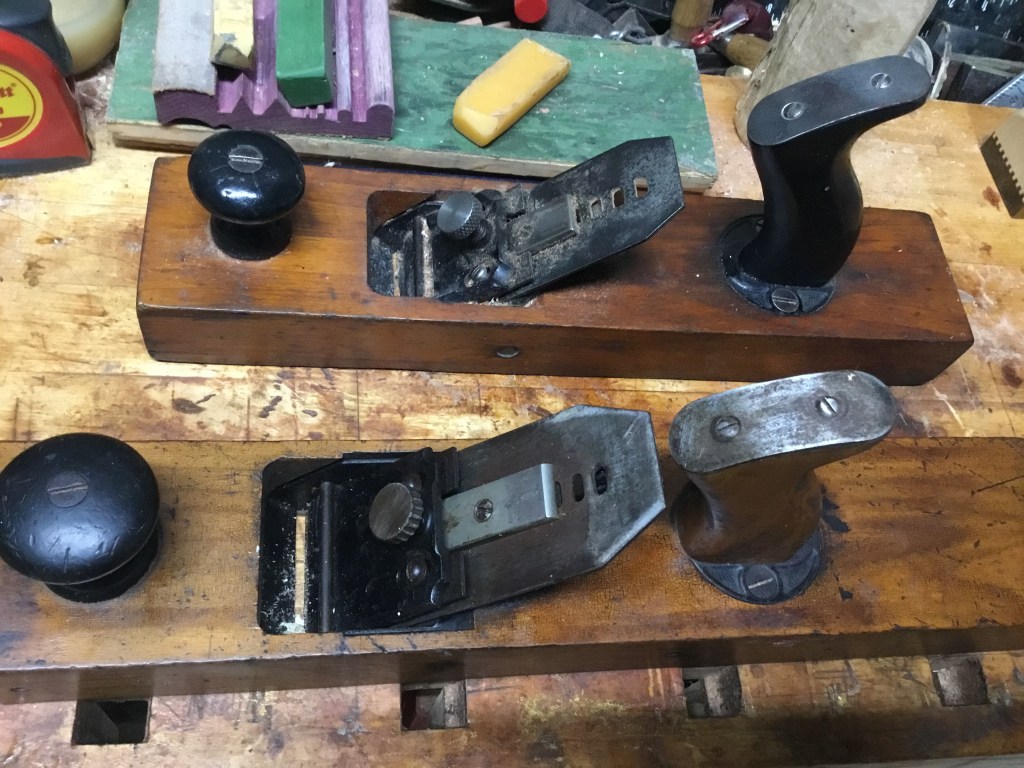
My collection of Gage planes is now probably complete. I have two Stanley Gage planes, and now one of the original Gage planes, the first two a smoothing and a jack plane, the latter being an 18″ long Fore plane. This one is probably in better condition than the first two.

My plan is the following, and I have a schedule of about a year for it. I have all the windows for a good sized detached workshop, all of which cost between $1.50 and $2.00 each (long story). Each has never been used, and just need a good home. Thanks to the recent tornado, I have enough lumber for said workshop, that only needs to be milled, including pine, white oak, black (a form of red) oak, and assorted other hardwoods. Logical conclusion–new workshop, with Gage planes.

Here are the two different styles side by side:

19th v. 20th Century

The differences between the two manufacturer’s planes are mostly stylistic and cosmetic. The handles are beefie, on the old Gage, while the more stylish handles on the Stanley Gage were prone to breakage, as one of mine has a decent sized chip out of the tote. This handle is not likely to be broken:

Now that’s a Tote

I’ve thought of these as cabinetmaker’s planes, as opposed to the Stanley philosophy of the jack of all trades planes. The Gage could easily stand up to everyday use in a production cabinetmaker’s shop. Apparently that was their main market.

But not this specimen. It may have been used, but the blade had never been sharpened, as it still had the original hollow ground bevel on it. That sharpened quickly, but then the back had never been flattened. Flattening the back of a nineteenth century plane blade is not my favorite pastime.

I said my collection is “probably” complete. If the price is right, and the condition is as good as this one, it quickly becomes an investment instead of a collection. Maybe I should become a plane flipper, instead of just someone who has a bunch of flipping planes.

Outdoor Kitchen, Part Catastrophe–Destruction and Reconstruction

Yikes!

On 2/23, Melanie Jane’s birthday, we were hit by a small tornado. Our house had negligible damage, but the outdoor kitchen got whacked by a 60+ year old pine. Notice that the brick oven was strong enough to break said pine in two. Alas, the pine took down the roof and about one half of the oven. All this means is I get the chance to rebuild it even fancier than it already was.

Three weeks later, the scene is different. No pine, except for firewood, and no debris. I have over a thousand new bricks, and literally a ton of sand to make mortar with. I have an unlimited amount of yellow pine to cut into lumber, and the new roof is going to be made of pine shingles, split out by yours truly. I even pulled out my old broad axe to make pieces parts with.

Cross Section of a Brick Oven

I re-laid the fire bricks, and even found a spare one. So this was only a part catastrophe. I’m going to be such a busy man that I should probably make a list–rebuilt oven, new enclosure with pine shingles, and then world culinary domination. Maybe I should relax and read some Walden instead, like the magnificent conclusion to the chapter “Where I Lived, and What I Lived For:”

Time is but the stream I go afishing in. I drink at it; but while I drink I see the sandy bottom and detect how shallow it is. Its thin current slides away but eternity remains. I would drink deeper; fish in the sky, whose bottom is pebbly with stars. I cannot count one. I know not the first let- ter of the alphabet. I have always been regretting that I was not as wise as the day I was born. The intellect is a cleaver; it discerns and rifts its way into the secret of things. I do not wish to be any more busy with my hands than is necessary. My head is hands and feet. I feel all my best faculties concentrated in it. My instinct tells me that my head is an organ for burrowing, as some creatures use their snout and fore paws, and with it I would mine and burrow my way through these hills. I think that the richest vein is somewhere hereabouts; so by the divining-rod and thin rising vapors, I judge; and here I will begin to mine.

HD Thoreau

Like HD, my head is hands and feet. It’s time to put them all to work.

Send Ukraine Aid, and Russia US Factory Farmed Chicken

Talk about chemical and biological warfare! I am taking my idea from Steve Ellis, the founder of the Chipotle restaurant chain. In the early 2000’s, McDonalds owned a 90 percent share of Chipotle. That was when they made the mistake of inviting Mr. Lee to tour one of their chicken producing farms in the South.

To get to the point, Lee said it was absolutely the most disgusting sight that he had “ever seen in his life.” Soon thereafter, McDonalds sold off all of its stake in Chipotle.

The trick is to make a great diplomatic offer of free chicken to Russia, to be supplied by McDonalds. In fact, also re-open all the now closed McDonalds in Russia. Both Vlad and Ronald McDonald will be happy, as well as all the cardiac specialists in Russia. Their business will boom.

A modest proposal, endorsed by both Big Pharm and Big Chicken. I know of a couple of senators that I can likely get on board as well, like the one from Alabama who said we absolutely have to help the Uranian people-his spelling, not mine.

OffGuardian

because facts really should be sacred

Ruth Blogs Here

Or not, depending on my mood

A Haven for Book Lovers

I am just a girl who loves reading and talking about books

what sandra thinks

because I've got to tell someone.

LadiesWhoLunchReviews,etc

a little lunch, a little wine, a LOT of talking!

Margaret and Helen

Best Friends for Sixty Years and Counting...

talltalesfromchiconia

Tales of quilting, gardening and cooking from the Kingdom of Chiconia

Cyranny's Cove

Refuge of an assumed danophile...

Exiled Rebels

Serving BL since 2017

this is... The Neighborhood

the Story within the Story

Beauty lies within yourself

The only impossible journey in life is you never begin!! ~Tanvir Kaur

Southern Fusion Cooking

Country Living in the Southern Appalachians, USA--A little of this, a lot of that

Discover WordPress

A daily selection of the best content published on WordPress, collected for you by humans who love to read.

The Atavist Magazine

Country Living in the Southern Appalachians, USA--A little of this, a lot of that

Longreads

Longreads : The best longform stories on the web

WordPress.com News

The latest news on WordPress.com and the WordPress community.