
For your cooking pleasure, a smattering of breakfast recipes.
For your cooking pleasure, a smattering of breakfast recipes.

Seriously, a post about how to scramble eggs? I would have thought the same thing a few years ago, before the great English food writer Elizabeth David caught my eye. Jane Grigson, an equally talented writer, gave me my first account of David, in what has become one of my all time favorite books, published under various titles, but now sold as Charcuterie and French Pork Cookery. There, Grigson discusses several of David’s recipes from her book French Country Cooking. I immediately bought a three books in one collection of her work, published by the appropriately named Biscuit Books. I now own four of her books, each better than the last.
David hated overly complex and pretentious food, and instead focused on the real thing, such as perfectly scrambled eggs. Her method is superb, taken from a French country cook. The secret is to cook the eggs at the lowest temperature possible, which is something of an antithesis to the more common get your stove as hot as a flamethrower approach. Here’s my paraphrase. This is a two person version.
Ingredients
2 Eggs, Beaten
Salt and Pepper
Heat up a skillet coated with olive oil–I like these Lodge carbon steel ones. Turn the stove down to minimum temp, and let the skillet cool off for a bit. Then pour in the seasoned eggs, and do nothing. Wait until the egg begins to set, and s-l-o-w-l-y stir the eggs with a fork. I always prefer wood utensils, so I made my own.
The eggs should cook slowly, so it is much simpler to serve it at the soft, creamy stage that is the goal of using this method. After a couple of tries, cooking this way will become second nature. It doesn’t hurt any to begin with quality pasture raised eggs, either.

I may be the only person in North America who puts dried mushrooms on my Christmas list every year. First on the list are Morels, as they are something of an extravagance, and are five times more expensive than dried Porcini mushrooms.
I always get Morels from the Left Coast, from Pistol River Mushrooms in Oregon, and the quality is always superb. My two favorite Morel dishes are Turkey Breasts in Morel Cream Sauce, and this Morel Omelette. As it was a holiday this July 4th, why not go for the gold?
Ingredients
2-3 large Morels, rehydrated and chopped
Morel Water
1 sweet Pepper, chopped
3 Scallions, chopped
3 Eggs
1/4 cup diced Ham
1/2 cup shredded Cheddar Cheese
Parsley
Salt and Pepper
Diced tomatoes are also great in this, but I forgot to add them. Begin by cooking the pepper and the white part of the chopped scallion in olive oil. Then add the morels. In the meantime, mix the rest of the ingredients together, including the green parts of the scallion. When the veg is cooked, pour in the egg mixture, and have a 400 degree F oven ready. No omelette folding or flipping here.
After the egg mixture has started to set up, throw the whole thing in the oven. Have a cup of coffee and chicory, and listen to Beethoven or Wagner. Then take it out when it’s firm, and serve a couple of people with this. An English muffin goes well with it.
I never use all of the Morel water, as it is always full of grit from the wild harvested fungi. I should start using the method described by Marcella Hazan in the priceless Essentials of Classic Italian Cooking. There she describes how Italians will filter dirty mushroom soaking water through paper towels or a fine strainer, and save it for soups and stocks. Now that’s what you call a food culture.

We have bought new potatoes three weeks in a row at the Festhalle, our local Farmer’s market, and they really don’t resemble supermarket potatoes in taste, even expensive organic ones. So don’t cook them like supermarket potatoes. Those in the picture are regular Red and Yukon golds.
My favorite cooking method for these: frying. Shocking to hear that from a Southerner. Cut into small cubes is best. These are especially good in the classic Farmer’s Omelet.
Next in line is the classic boiled new potatoes, served in a giant pool of butter and salt. For god’s sake don’t peel these–cook them as is.
In another week or two, I may turn into Mr. Potato Head.

Time for a chemistry experiment for big kids! This one involves heat, a liquid, and some acid. The result is money in your pocket and some great food in your belly.
Homemade Ricotta
1-2 Quarts organic Whole Milk
Acid (2 Tablespoons Lemon Juice or Vinegar, 1/2 Teaspoon Citric Acid)
Optional: Salt, Cream, Herbs
Tools needed are a large non-reactive pan ( I use a stainless steel lined copper one), a colander, and some cheesecloth. Pour the milk into the pan, and add the acid. Stir thoroughly once, and bring the milk up to 170-190 degrees. Ultra pasteurized milk works fine with citric acid, though I have not tried it with any other of the acids. The heat/acid combo causes the milk solids (curds) to separate from most of the liquid-instead of using a thermometer, you can just watch the transformation take place, as it reaches the maximum effect when the milk begins to boil right around the edges of the pan. At this point, turn off the heat, cover the pan, and let sit for at least five minutes.
Place the cheesecloth in the colander in the sink, or in a bowl, if you want to save the liquid portion, which is known as the whey. No whey? Yes whey. Pour the cheese mixture into the cheesecloth (a single layer of cheesecloth is sufficient). Let drain for a minute or two, tie up the cheesecloth and hang the ricotta to drain–I just hang it off the faucet on my kitchen sink. I leave it for an hour or more, and take it down to cook with it or store it. It should look like the above picture.
The manifold uses for ricotta are well documented, and it can be used for any meal–try some in scrambled eggs sometime. As a teaser, I’ll give notice that I will eventually post my favorite ricotta recipe, Penne alla Pastora, in the future. It’s so complicated that it has a total of five ingredients.
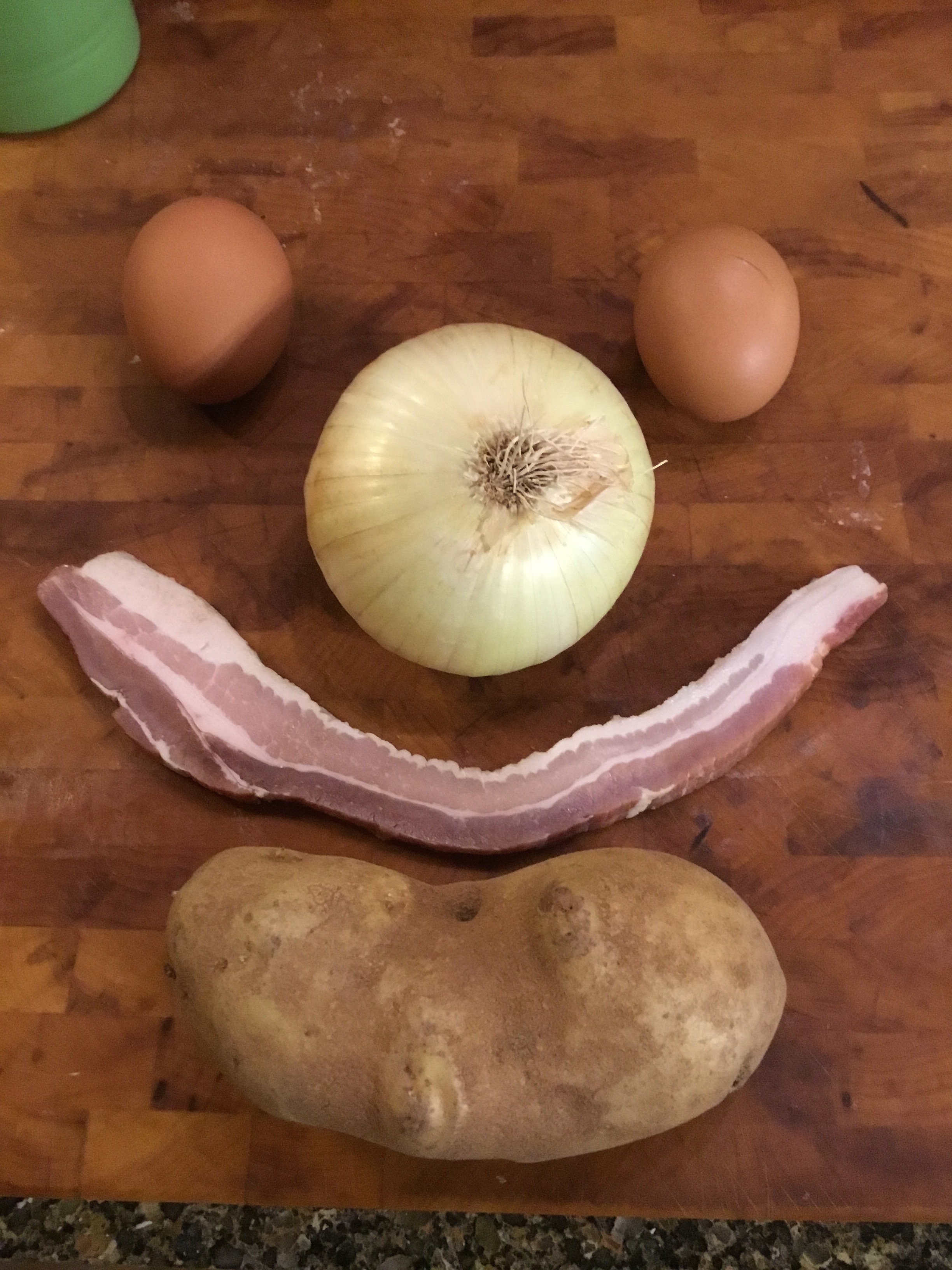
What we have here is a slightly southern-ed up version of the classic German all around dish. Though it is thought of as a breakfast item on this side of the pond, it is excellent at any meal. This is a meal for two here, but it can be scaled up to practically any level.
Ingredients
One Slice of Bacon
One Large Potato, cubed
One-Half of an Onion, chopped
Two Eggs
Salt and Pepper
In a heavy cast iron skillet, cook the bacon until it is crisp. Remove the bacon from the skillet, and add the cubed potato while the bacon fat is still hot. If necessary, add some olive oil, though this is usually not necessary. Salt and Pepper. Fry the potatoes until brown, and add the onions. At the same time, pre-heat your oven to 400 degrees. Chop the bacon into small pieces, and add when the onion is almost softened.
Here’s where the Southern accent comes in. Instead of beating the eggs, place the eggs-fried egg, sunny side up style, on opposite sides of the pan. As soon as the eggs begin to set, pop the whole thing into the 400 degree oven. Keep a close watch, and serve while the yolks are still runny, if you want a dish where there won’t be any leftovers. It’s easier to clean up that way.
The variations on this dish are limitless. Add country ham, chives, scallions, garlic, green garlic, chopped tomatoes, fresh herbs, or anything else that you have on hand. Adapt it to the seasonal ingredients. That’s what good cooking is all about, anyway.
because facts really should be sacred
Or not, depending on my mood
I am just a girl who loves reading and talking about books
because I've got to tell someone.
a little lunch, a little wine, a LOT of talking!
Best Friends for Sixty Years and Counting...
Tales of quilting, gardening and cooking from the Kingdom of Chiconia
Refuge of an assumed danophile...
Serving BL since 2017
the Story within the Story
The only impossible journey in life is you never begin!! ~Tanvir Kaur
Country Living in the Southern Appalachians, USA--A little of this, a lot of that
A daily selection of the best content published on WordPress, collected for you by humans who love to read.
Country Living in the Southern Appalachians, USA--A little of this, a lot of that
Longreads : The best longform stories on the web
The latest news on WordPress.com and the WordPress community.
 Southern Fusion Cooking