If you have a chop saw or a mitre saw, this is a thirty second project. I have what is probably a lifetime supply of 4″ pvc pipe, left over from the idiots who did our plumbing (they had our main drain running uphill). All I bought was this 4″ wye joint, and some test caps, instead of the more expensive plug ends. It’s only going to hold some chicken feed.
Total cost for this project was less than $15. It cost $250 to get my uphill drain fixed. This can be made in any size, but this one is small, to be fitted into our small coop. Next years project–a pen extension, another coop, and some Bresse chickens. Also an incubator, which I intend to build myself.
I had to include a gratuitous set of my old German tools in the picture, and my new 2″ bowl gouge, from PA. That thing can do some serious damage.
I knew that ISA Brown chickens grew fast, but these have gotten so big in such a short time that it’s almost scary. As stated before, this variety was the brain child of the French Minister of Agriculture in 1975. It is now apparent that he was bent on world chicken domination by the French (think of Volaille de Bresse, the famous blue legged meat chicken from Bresse, which a few years ago sold for forty dollars a bird in London).
So the French wanted the best eggs, to go along with the finest chicken meat, and they wanted mass quantities. Though the heritage of these birds is considered a corporate secret, it is apparent that a large part of the genetic line is the Rhode Island Red chicken. Apparently the Rhode Island White is also involved, as the roosters of these birds are always white.
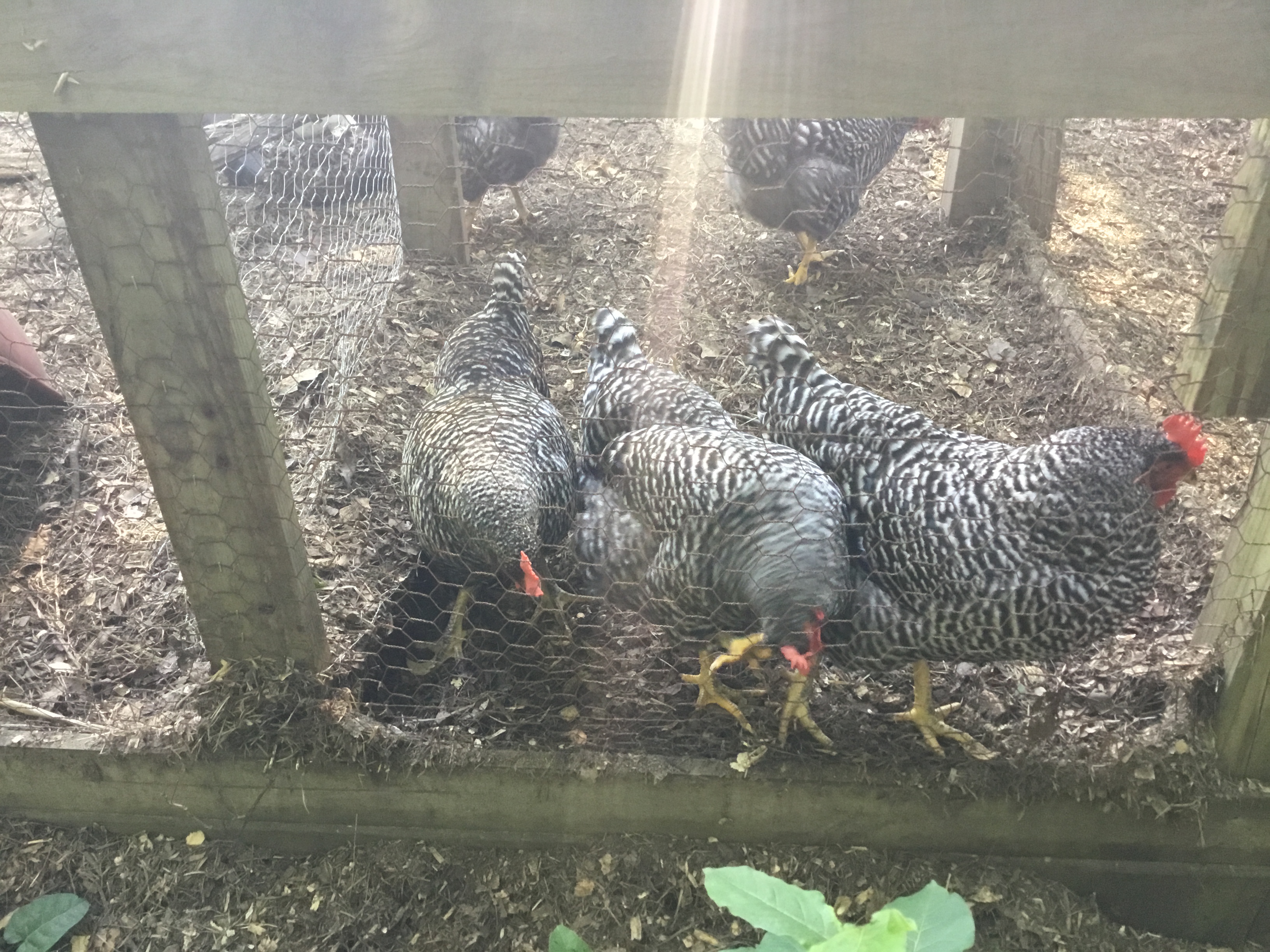
And talk about hyper! The big fat Barred Rocks we have don’t even try to chase them anymore, as they can lap those big birds in one circuit around the big coop. They are also great at thieving the food out of the Rock’s giant feeder. Today’s project is making them a feeder of comparable size, out of PVC pipe. Film at eleven.
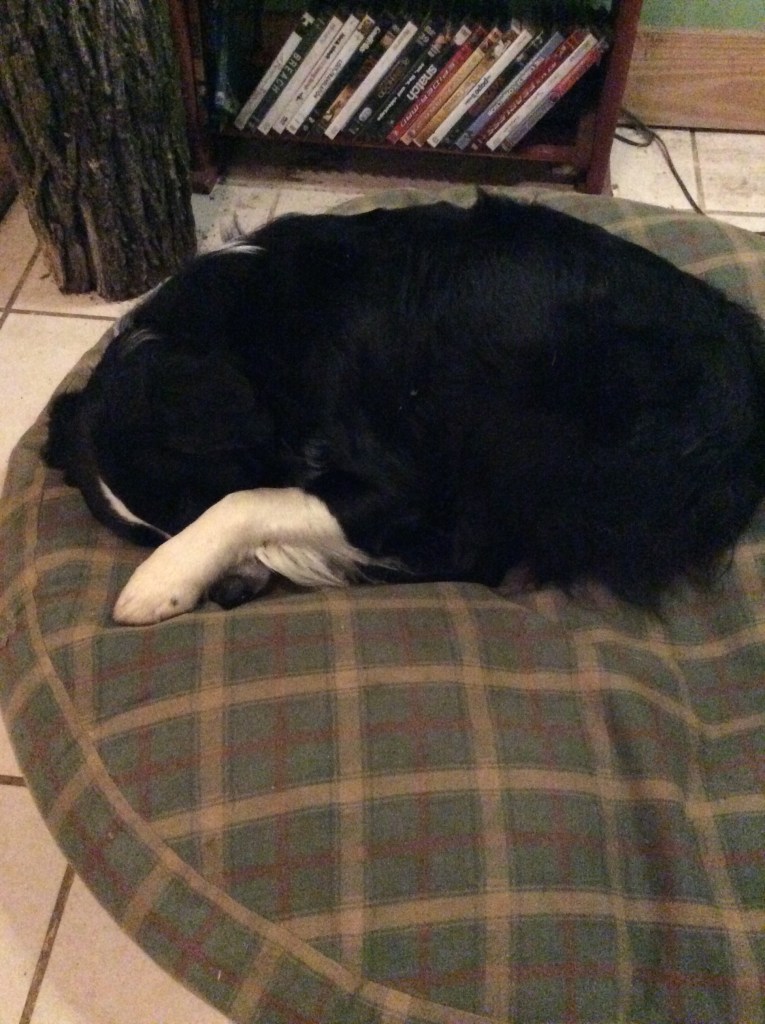
Siegfried the dog up there is as tired of Hoya! as I am. Don’t inject yourself with Lysol, eat Tide Pods, drink bleach, or try to pour Clorox into your butt. Clorox won’t run uphill anyway. There is this thing called gravity, that Sir Isaac explained to us all.
Hoya! is the term popularized by the great congress person Mo Udall from Arizona, who allegedly had it yelled at him every time he made a promise to his Native American constituents. Then he learned that Hoya! was the stuff you didn’t want to step in inside the horse pen. At least they didn’t call him Walking Eagle, which is a bird so full of stuff that it can’t fly. Only it’s not stuff. It’s more like Hoya!
So I will bore you with another quiche recipe, after that rant, just because I read someone on the interwebs who described herself as a “classically trained chef,” making a Spinach Quiche with a frozen supermarket crust, and a package of frozen spinach. My classical training came from my grandmother Lily, and she would have beaten the Hoya! out of me if I had suggested such a thing. Her specialties were wild rabbit and dumplings, fried rabbit with gravy, fried chicken, any greens (collards, turnip, mustard), and cinnamon rolls. She also made pancakes without a pan.
The last one was the money shot. She would crank up her potbellied coal stove, and wipe off the top with one of her flour sack towels (which she made with her foot powered Singer sewing machine). Then the butter went on, directly on the top, and then the batter she kept in her 1940’s era GE fridge, which she had painted multiple times. The pancakes were always superb, served with Alaga syrup, on Blue Ridge plates. She never bought anything she couldn’t make herself. Old school reigns supreme.
At any rate, here is my completely homemade Spinach Quiche. It’s a springtime thing around here.
8 ounces Swiss Cheese, cubed, plus some Pecorino Romano
1 cup cooked local FRESH Spinach
4 Eggs, grown by yours truly (actually, my chickens)
Heavy Cream (Enough to fill the crust)
Salt and Pepper
Nutmeg
The spinach is cooked in butter. I could only find King Arthur bread flour, and Gazunga, it made the best crust I have ever eaten. Lily would have been quite proud. And one of my uncles once ate an entire pan of her cinnamon rolls, in one sitting. They were that good. He had to take a nap afterward.
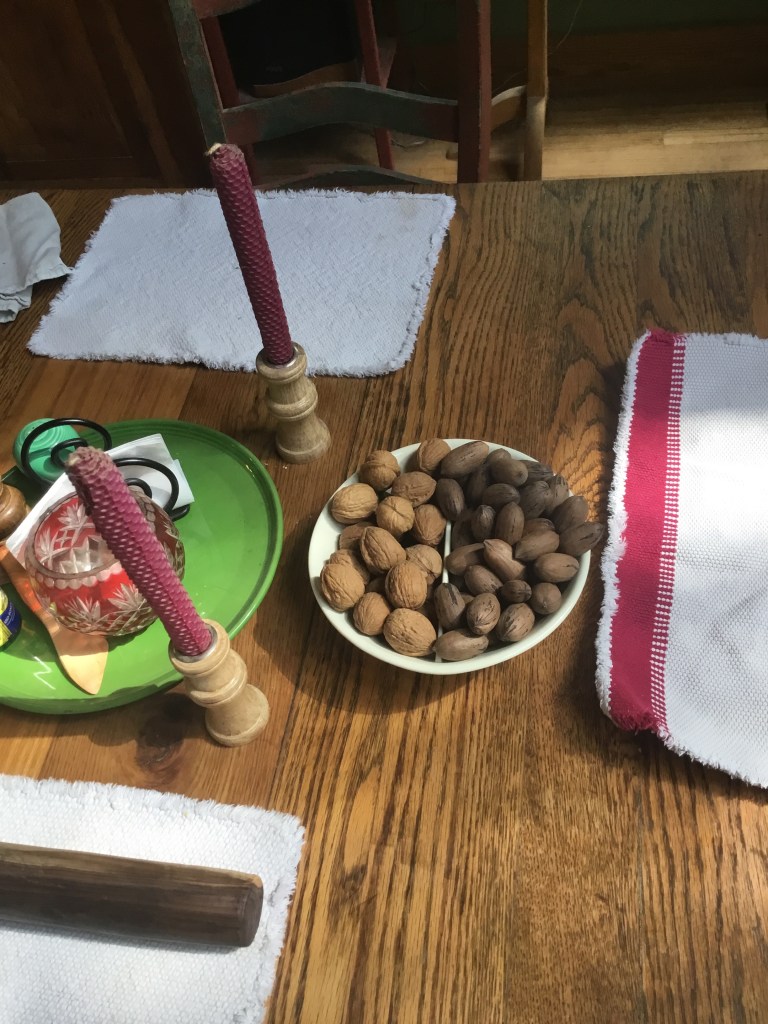
By the way, I bought all of her Blue Ridge plates, made in Tennessee, after she died. I have added to the collection. Here’s my latest addition.
That divided bowl is a beauty. It’s Stanhome Ivy pattern. I made the candlesticks, and the students at Berea College in Kentucky hand wove the placemats. Now it’s time to crack some nuts. Literally.
I went to my local chicken purveyor with the intent of buying four Rhode Island Red chicks to add to my flock. They had a grand total of one Rhode Island Red chick. Therefore, I went with a descendant of theirs, the hybrid ISA Brown. Et Mon Dieu, the chicken turned out to have been developed in la belle France.
Technically, all chickens are hybrids anyway, though many breeds have been established for many years, and one generation looks much like the previous one. Apparently that is not true with these birds, though that could easily be just Monsanto like agit-prop disseminated by the company that owns the patent on this bird. Considering that it has been around since 1978, someone has obviously bred some of these fowl, and it would be interesting to find some stories based on first hand experience.
At any rate, the story began in 1975 with the French Ministry of Agriculture, the head of which was determined to produce a first rate bird for commercial Big Chicken. The project was headed by the firm Institut de Sélection Animale, which is where the name ISA comes from. Three years later, these birds were the result, a hybrid of many varieties, though which ones are considered a trade secret; but the most notable one is the Rhode Island Red.
As a bird designed for Big Chicken, these chicks mature quickly and lay eggs at a fast and furious rate. They are variously said to be short lived, or disease prone, but it is hard to believe that Big Chicken would fall in love with a sickly bird: disposable, yes, but sickly, no. A few small owners say they can live as long as eight years, if given proper care, instead of stuck in a battery cage. As it turns out, this variety has become a favorite with backyard chicken growers, though my chickens are actually in my front yard.
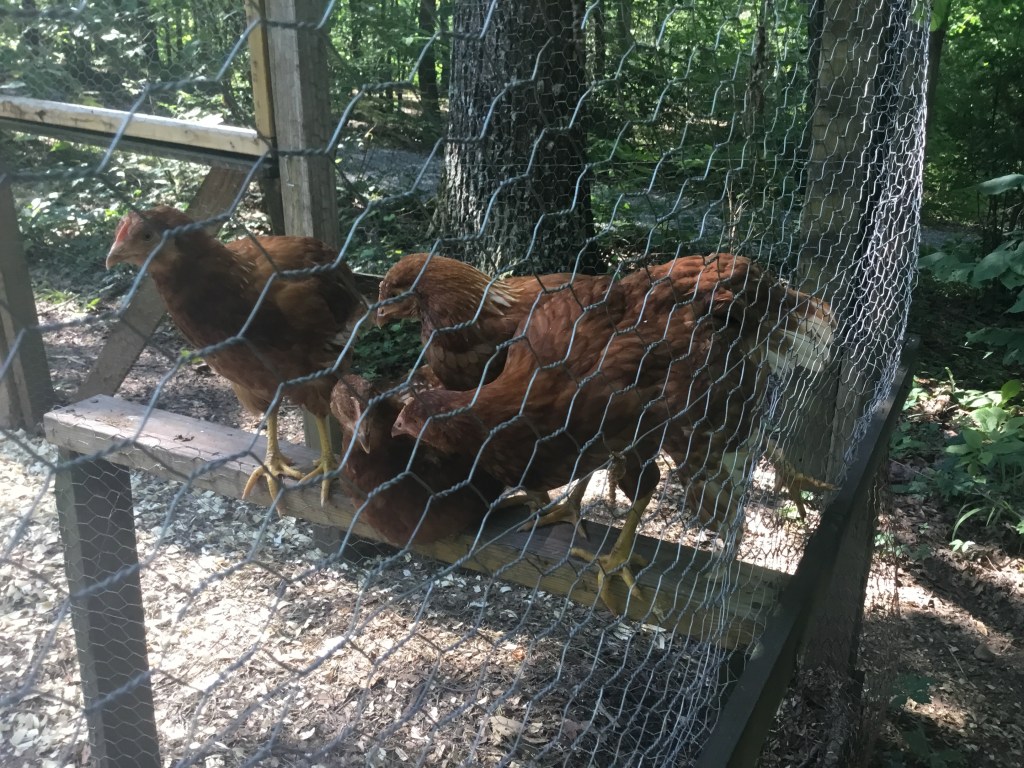
One of the best things about this bird is that it is a sex-link chicken, which means the sexes are different colors. Therefore, if the chick is brown, it is a hen; if it is white, it is a rooster. Thus, these four are definitely hens.
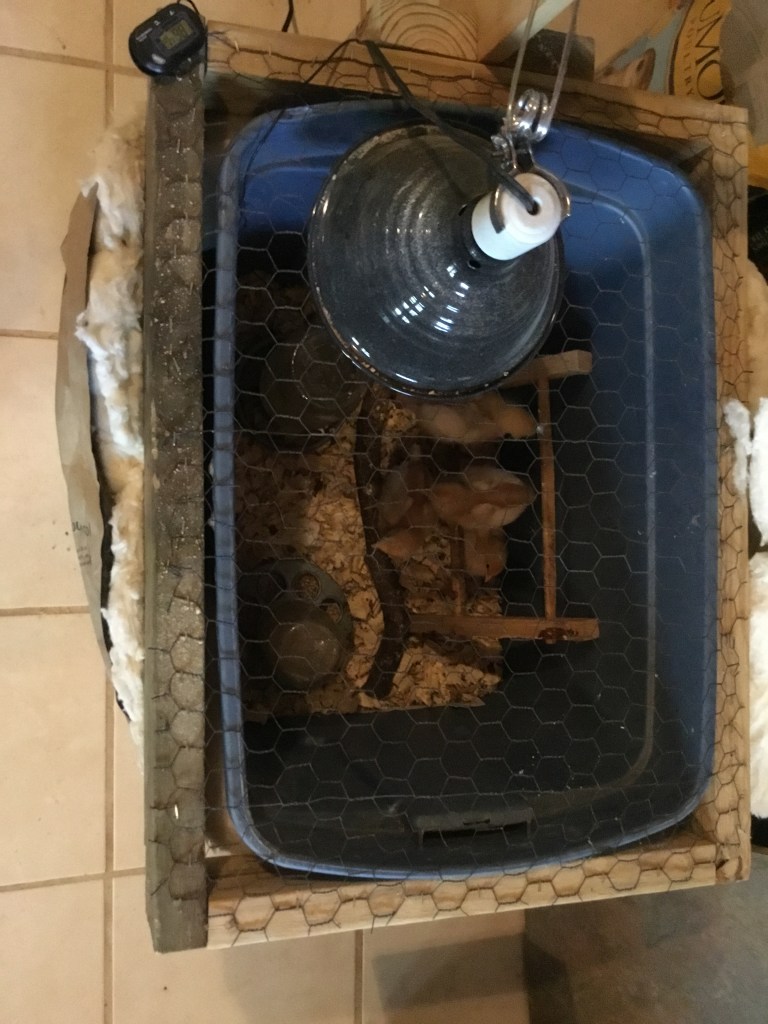
After a week here, they are already flying around the brooder, though there isn’t much runway space in that plastic container. I still put a lid on the insulated contraption to keep them from flying around our basement, or getting burned by the heat lamp.
The Heat is On
I have already found them on the top perch, or just cold chilling, sitting on top of the water or feed jars. This morning all four were practicing flying at the same time, which resulted in some spectacular crashes.
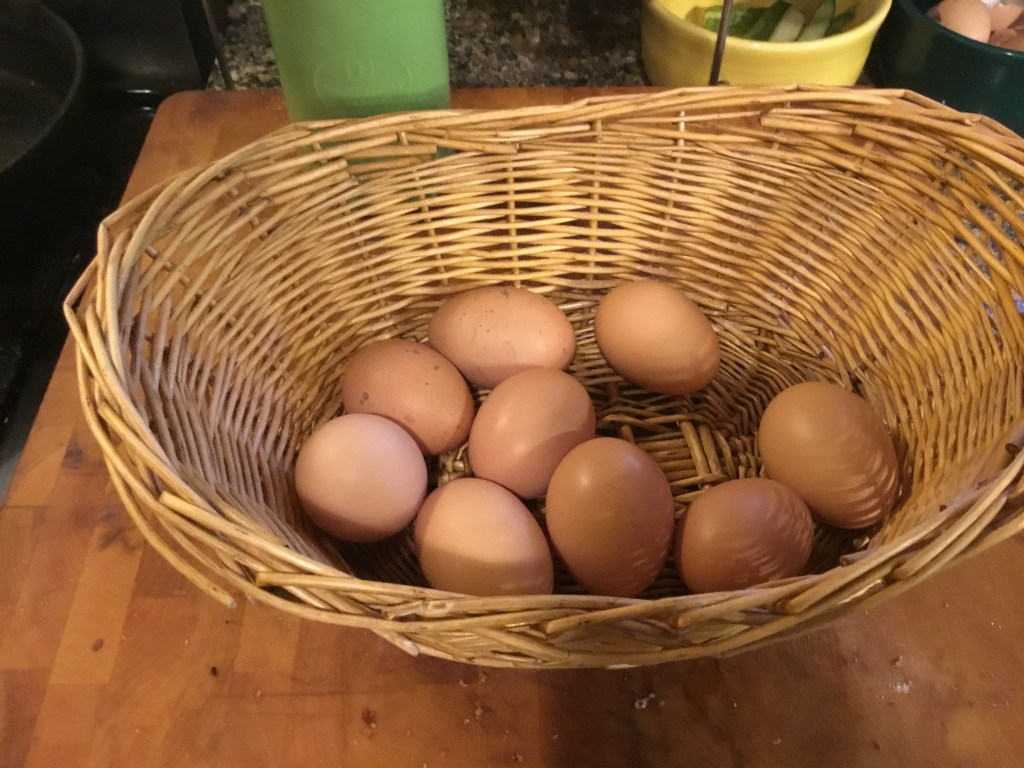
Chances are good that my in-laws are in line for some free eggs, as we already regularly have three dozen sitting around our kitchen. Eggs, that is, not in-laws.
Even though we are down to four hens, after two of ours were killed by the neighborhood Bloodhound, we still can’t eat all the eggs they produce. At last count we had 27 eggs, and the number expands daily. So naturally, we are going to buy more baby chicks, four Rhode Island Reds, as an insurance policy against any more dog attacks. Excess is the American way.
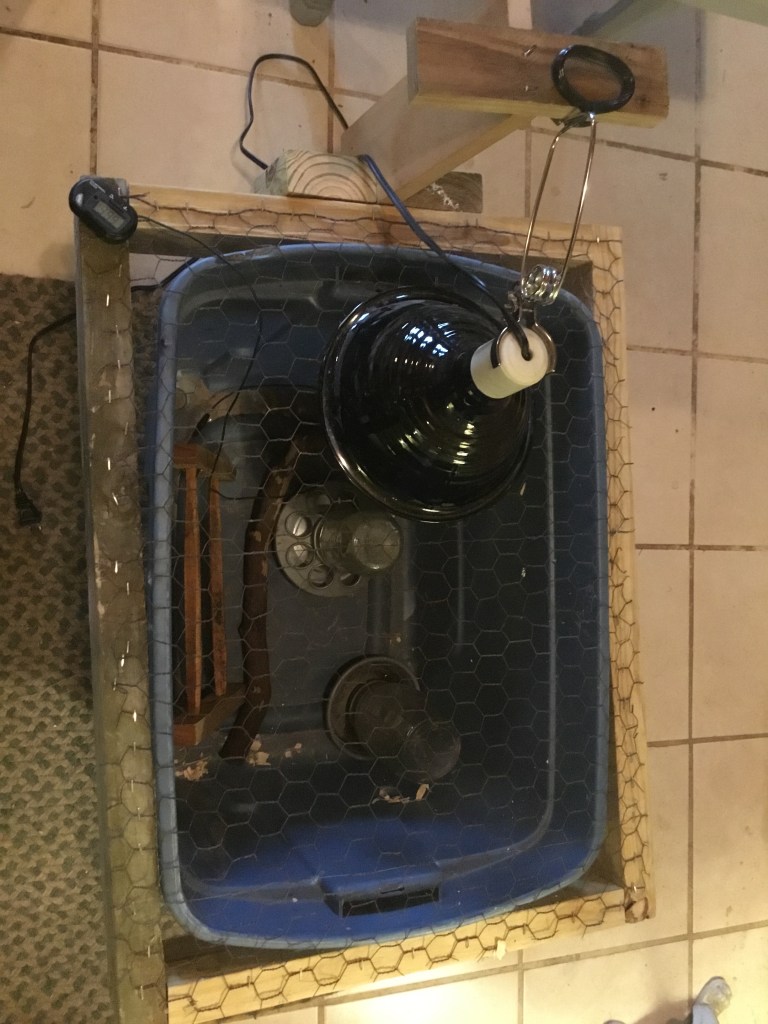
My brooder design is the product of some research. It consists of a plastic storage container, a lid made of scrap wood and chicken wire, a couple of commercial feeder/waterer devices, some perches, and a heat lamp. Each was chosen for a reason.
After I stopped laughing at all the experts on the internet who said that plastic boxes were more of a fire hazard than cardboard boxes, I quickly decided the real fire hazard was the heat source, which is usually an infrared heat lamp bulb. I went instead with a ceramic “lizard light,” which is a standby for reptile owners. Mine has both a heat control and a digital thermometer, and it emits no light, so the chickens do not lose their ever important circadian rhythm. The ceramic socket on the lamp is also a must, as those lamps get roasting hot, and melted plastic socket is a disaster. The chicks stay plenty warm with this lamp.
Warm and Safe
The waterer and feeder are both Little Giant brand, made by Miller in the US. They are superb, and all you need are some mason jars to go with them.
The last part of the chick’s crib are the two perches. The long one is some drift wood of Mountain Laurel. The big practice one I made from scrap trim. Waste not, want not.
The bottom will be lined with newsprint, then paper towels, then pine shavings. The chicks will be able to scratch, perch, eat, and drink. Kind of like me. And then I had a McGyver moment.
Extra Insulation
If it gets really cold, I just pull out this old countertop piece to keep the heat in. Now Melanie Jane and I can sit in the basement and watch Law and Order, while the chicks grow up next to books such as History and Class Consciousness, A Southern Renaissance, and The Savage Mind. That last one was written in French, and the title is possibly the greatest pun in history. LaPensée Sauvage can mean either The Savage Mind, or Pansies for Thought.
So we will have chicks chirping behind us, while we are entertained by the semi-fictional mayhem of NYC. Another favorite book of mine is The Country and the City. I’ll take the country, and the city can remain an image on the TV.
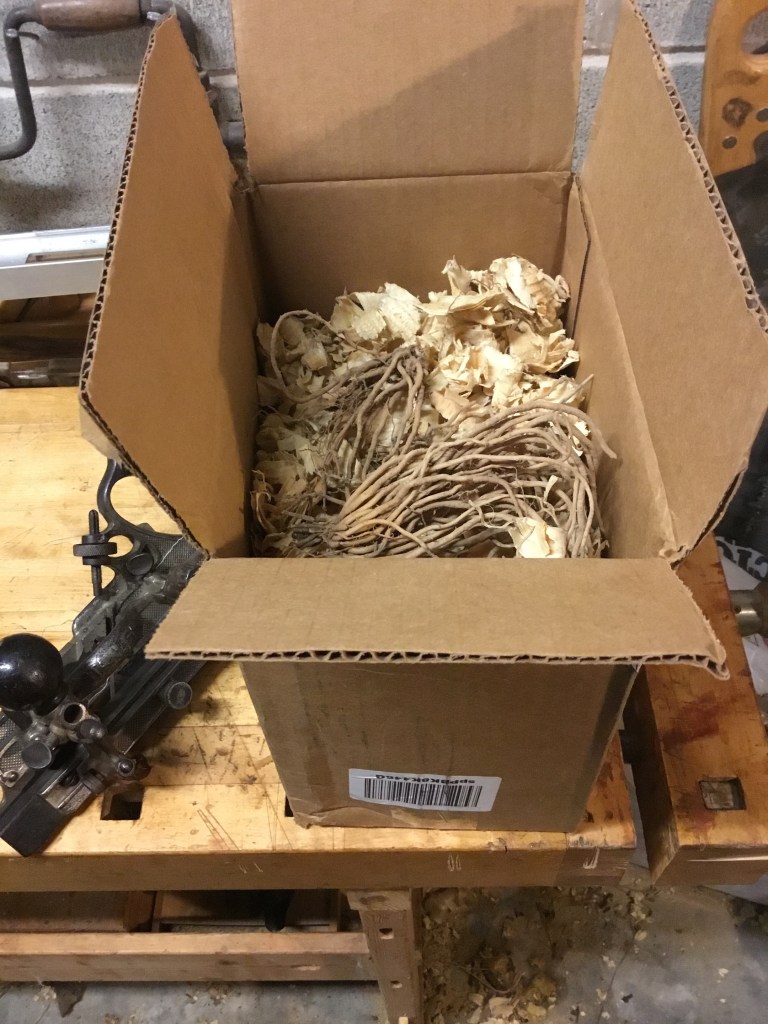
This will be the fourth time I’ve planted asparagus crowns, aka roots, and these are two years old, which will give us a good decade of Asparagus spears every spring. This year, however, I have the secret weapon that my family used when I was very young, and that would be well composted chicken manure. We had the finest patch of Asparagus in several counties.
As the temps are to be in the upper 50’s F this weekend, it will be a good time for a labor intensive project. The crowns need to be planted fairly deep, around six inches, and spread out properly. My garden is mostly sand, which means they need to be planted even a little deeper than usual.
I bought these crowns from Amazon for a ridiculously low price, and to my surprise, they shipped from Shanghai, China. Amazon has even outsourced vegetables. I was amused to learn this week that our corporate overlord Bezos had his phone hacked by the Saudi royal family. That will teach him about dealing with other royalty.
I’ll soak my crowns in water tomorrow, and plant on Saturday. To quote the great Wendell Berry,
“Eating ends the annual drama of the food economy that begins with planting and birth.”
Then I will try to find out the Chinese term for Spargelzeit, which is German for Asparagus time.
After putting it off for years, I finally learned how to make mayo. It turned out to be very simple, IF you have fresh eggs, and a stand mixer. I am being slowly covered by an avalanche of eggs, coming from our chicks, and I have a 30+ year old Kitchenaid, so it was time for this confluence to happen. This recipe also let me get rid of three eggs. Read some of Julia Child’s thoughts and experiences making mayo, for pointers.
Ingredients (all should be at room temperature)
3 Eggs (not just yolks)
Salt to Taste
Juice of half a Lemon
1 and 1/2 cups of Vegetable Oil (I used Peanut)
Most recipes call for a mild olive oil, but I live in peanut, not olive, country, so I went local. It worked well–the best supermarket brand of mayo uses soybean oil!
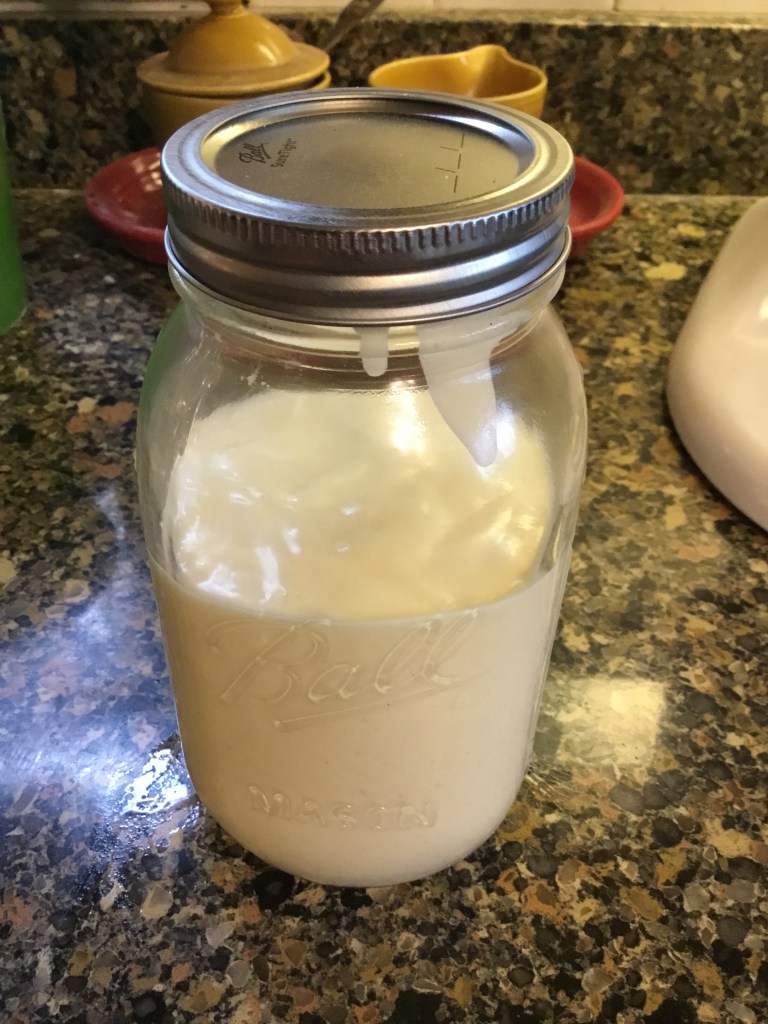
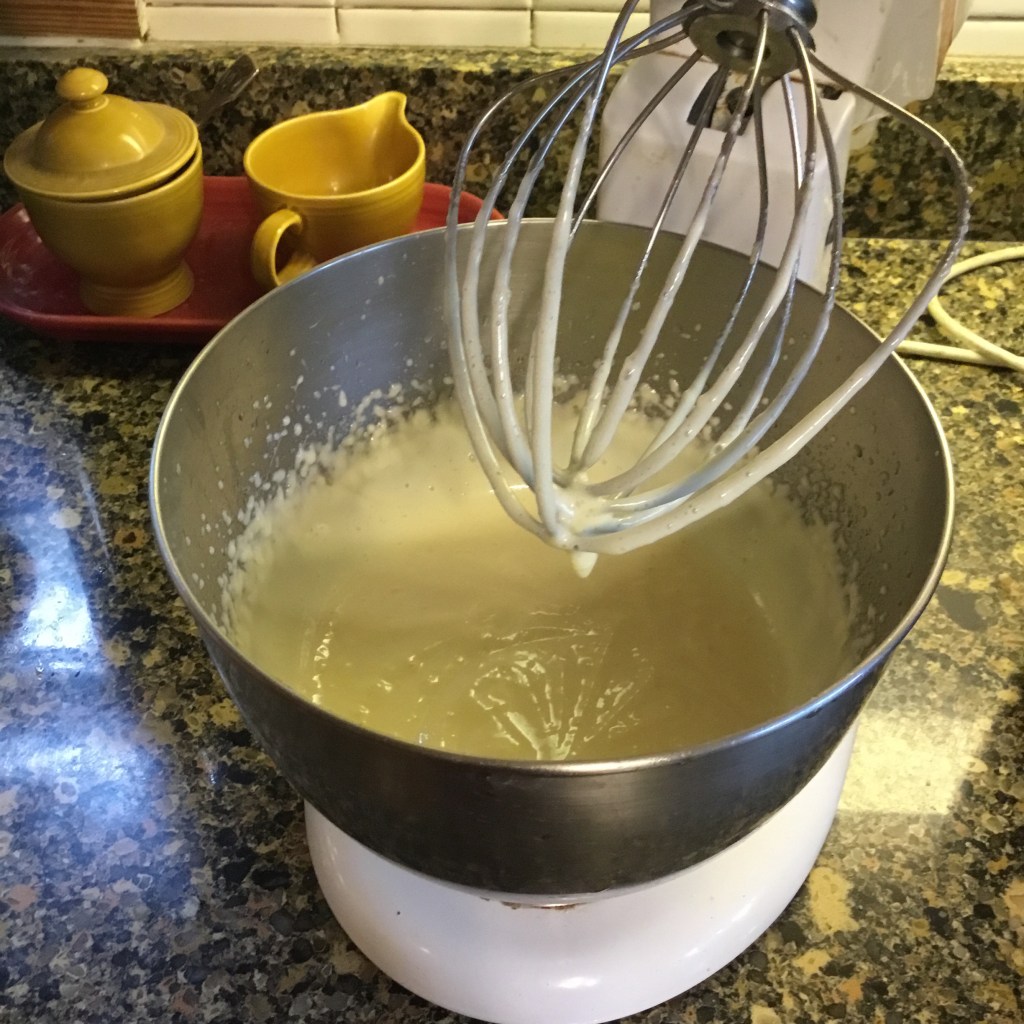
Grab the wire whisk attachment for the stand mixer, and beat the hell out of the eggs, at highest speed, for a couple of minutes. Add the lemon juice and salt, and then SLOWLY add the oil, a drop at a time at first. The more oil you add, the thicker the mayo will get, until you add too much, which apparently causes the mayo to break. If it does, throw in another egg, and slog on.
This process takes some time, but the result is this-3/4 of a quart of mayo.
Now I have another processed food to take off my grocery list. The chickens get an extra treat today.
The great Calvin Trillin once joked that the national Thanksgiving dish should be Spaghetti Carbonara, instead of turkey. I decided to make some, because of that, and I hated it. We still have turkey for Thanksgiving.
Then last week, Melanie Jane said we had to use some of the increasing pile of eggs that our chicks produce, and she found a recipe from Lidia Bastianich for Linguine alla Carbonara. I made it, and it was literally one of the best things I have ever eaten.
The difference? Instead of supermarket bacon and eggs, I had local fresh bacon which I had marinated myself, and eggs from our chicks. The dish is very simple to make.
Ingredients
Pasta Water (Water as salty as sea water)
Linguine (dry or fresh)
Two slices of thick Bacon
1/2 of a small Onion, chopped
Chicken Stock
Two Egg Yolks
Grated Parmesan Cheese
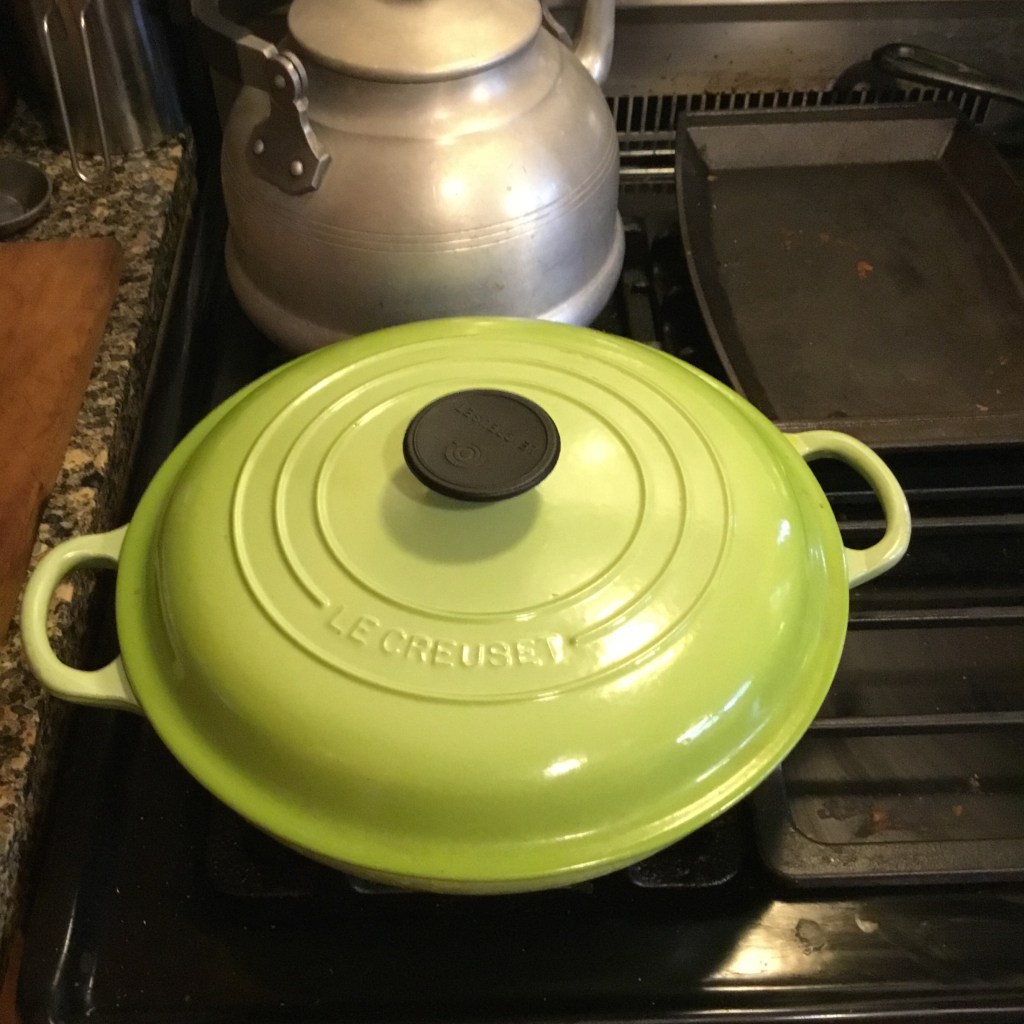
This sextet of ingredients will taste like a symphony if cooked properly. Start with the pasta water, and fry the bacon in a brasier/pasta pan (not pot). Here’s ours, but a skillet will work fine as well.
That’s French for Crucible
The ladies who own our local Le Creuset store in Birmingham picked this one out for me, so my addled brain was not taxed. When I told them it was a present for my sweetie, they went through an entire stack of boxes, to find the best one. I left as a happy consumer.
Fry the bacon while the pasta is cooking. Remove the bacon when it is crisp, but keep the fat, and cook the onions in that. Add a little chicken stock, and I mean a little, and add the chopped bacon, and the pasta (strained) once it becomes al dente. Is Al Dente related to Al Fresco?
Stir those together, and then here comes the only tricky part. Turn off the stove and add the raw yolks. Yes, I said raw yolks. If the heat is just right, the hot sauce and pasta will cook the yolks. If too hot, you have scrambled egg pasta. Too cool, and it’s yuck city.
Grate some good Parmesan over the whole thing, and there you have it. I splurged on some real Reggiano. That didn’t hurt any either.
As long as our chicks keep clucking, this is on the permanent menu. I had five eggs from six birds yesterday, and it appears home made mayo is the next project. Or anything else that uses eggs.
I have been amazed by the number of stories about mildewed eggs on the interwebs, about eggs that have mildewed both on the inside and outside of the shell. While I am certain that could happen if you left the eggs out for six months or a year or so, I have this to say about that–Hoya!
As a teen, I gathered upwards of a thousand eggs, literally ever day, as we had ten thousand chickens who laid hatching eggs. We were forbidden from washing the eggs by our corporate masters, as that would have affected the hatching rate. We never had a single egg with mildew, and I am guessing that I personally gathered tens of thousands of eggs.
Now that I have downsized to a flock of six happy chicks, I read a quote from a chicken prof who said that eggs taken out of a fridge and then stored in the kitchen, would mildew. Hoya! Anything will mildew if you leave it out long enough.
Chickens always win a Stare Down with Emma the Aussie
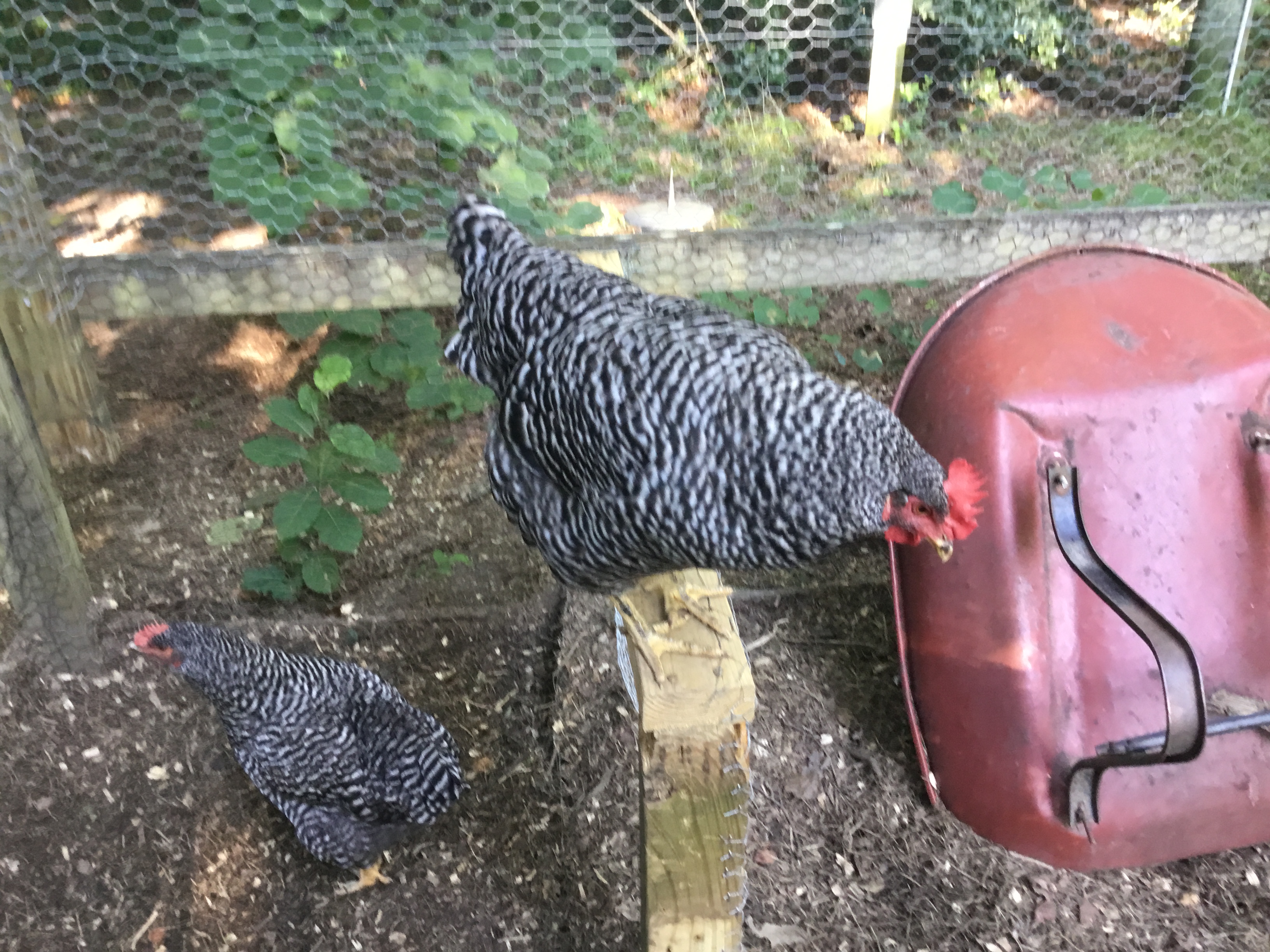
We had our first four egg day, just as our six Barred Rock hens were about to hit the six month old mark. I imagine that will be the usual output of eggs, using the one egg per day and a half, per chicken, rule.
I am the Ruler of the Roost
Those two are Big Tail and Little tail. Though allegedly the same age, the developmental difference between the two is obvious. And there is even one thing they like better than their red wheelbarrow.
Earth Movers
My compost bin! I fill it up at least once a week, and they empty it out in no time. I still expect to have some of the richest compost in history, except that I will have to track it down, as they scatter it throughout the pen.
Coop, or Co-op?
At night they all cram into this pre-fab coop, which was made by Innovation Pet. It’s very clever, and was designed by some real chicken experts. Not actual chickens, but humans who are experts on chickens. It cost much less than what it would have taken me to build something similar. I did sit it on a foundation of 4x4s, which turned out to be an excellent idea, as we had an unbelievably wet spring.
At a later date, I will expound upon my mostly home made watering and feeding devices, two of which are partially visible in this picture. Until then, peace out.







 Southern Fusion Cooking