
Cast Iron Cookware-Materials and Methods for Seasoning

cast ironHere’s a touchy subject if ever there was one, a place where only angels-and fools-dare to tread. However, the above picture of our wall of cast iron will have to serve as evidence that I know whereof I speak. That’s one heavy batterie de cuisine. By the way, the small skillet hanging on the upper left is almost forty years old, but could pass as about a year old.

However, I am going to avoid absolute pronouncements and merely discuss the merits of various materials and methods. Think of seasoning cast iron as analogous to painting a wall. Unless you’re Jackson Pollack, you want to apply thin, even, layers of finish. Here are the top four choices for oils (fats) to use.

Materials

  • Traditionalist’s Choice: Animal Fat.  I’m fairly old school, so I personally use lard, BUT lard that I have slowly rendered myself from locally grown pigs. A section from the Purdue University Pork Industry Handbook , “Pork and Pork Quality” (PIH 128), notes that pork fat is a good source of linoleic acid, a main component of the “drying oils” (aka, oils that transform into a polymer), that will be discussed below. Without wandering off into the forests of chemistry, that is an acid that allows lard to form a polymeric surface (the molecules link together), when exposed to a combination of heat and oxygen. It’s the same way traditional oil paint dries. A. D. Livingston, in his Cast Iron Cooking, is a strong proponent of animal fat, noting that pioneers even used such things as bear fat for seasoning. If you have some extra bear fat in the fridge, go for it.
  • Expert’s Choice: Flaxseed/Linseed oil. Essentially the two are the same thing, but Flaxseed is usually a raw oil marketed for culinary purposes, while Linseed oil comes in various forms, and is intended for wood finishing, or for making oil paints. It is the most famous of the drying oils. In oil painting, this is the oil of choice, as it provides a smoother finish (See Painting Materials, a scholarly text for artists from 1942. We’re in some seriously nerdy territory now). Flaxseed oil is the best for cast iron, raw linseed second, and polymerized linseed oil, which has been heated so that it will dry faster, would be a third choice. I use a food grade “Danish Oil” (polymerized linseed oil) for wooden spoon and bowl finishes, and the brand I use (Tried and True) is also approved for cutting boards. Never ever use boiled linseed oil, which contains as many toxic chemicals as an EPA Superfund site.
  • Two Other Drying Oils: Safflower and Walnut Oils. I have not used these on cast iron, but they are highly rated as drying oils. Safflower has the benefit of being inexpensive and widely available. I have used Walnut oil as a wood finish, and unlike linseed oil, the smell is wonderful. The finish is fantastic as well. Walnut oil has almost twice the oil content of any other non-synthetic oil, so a little goes a long way. Allegedly, it was Leonardo da Vinci’s secret weapon when it came to making oil paints. If you have any left over, make salad dressing with it, or start forging a copy of the Mona Lisa.

Soybean oil and poppyseed oil are also drying oils, but try and find some non-GMO soybean oil at the same price as safflower oil. After you have put an almost invisibly thin coat of oil on some cast iron, what are you going to do? Cook it. Here’s three methods.

Methods

  • Top of the Stove, Bro. This one requires the most attention, but it is the method of choice for seasoning carbon steel pans, and will work with cast iron as well. Disconnect the smoke detector, apply the material thinly, heat it right up to smoking point, take the pan off the heat, wipe it down, and let it cool off. Repeat until you have the finish you want. By the way, don’t disconnect the smoke detector.
  • Bake it. By far the most common method, and recommended by manufacturers such as Lodge, in South Pittsburg, Tennessee. Apply the material, place the pan upside down in the oven, and bake at a high temp for an hour. I’d go with 500 degrees F. Repeat, and apply another coat of oil, if the finish is not sticky to the touch. If it is, bake it for another hour, without additional oil. If it’s sticky after that, scour the pan and begin all over. You’ve been a Jackson Pollock with your oil, which is not a good thing.
  • Burn it. “Like any other Primitive would,” to quote Neil Young from a different context. As with most things, there is a right way and a wrong way to do this. I have seen videos of people throwing a cold skillet into a fire, straight onto a bed of glowing hot coals, which is the cooking equivalent of What Not to Wear. Thermal shock is one of the few things that will ruin cast iron. I prefer to put my cast iron in my brick oven as my fire is just beginning to burn. Eventually, I will push it up into the coals, as the fire begins to burn down. Then I let it cool for hours, or even overnight. If it’s an older piece of cookware, this method serves the double purpose of seasoning, and burning the grunge off of the exterior.

So choose the combination that you like, and be patient. If you pay attention, and take care of your cookware, eventually you will achieve this finish:
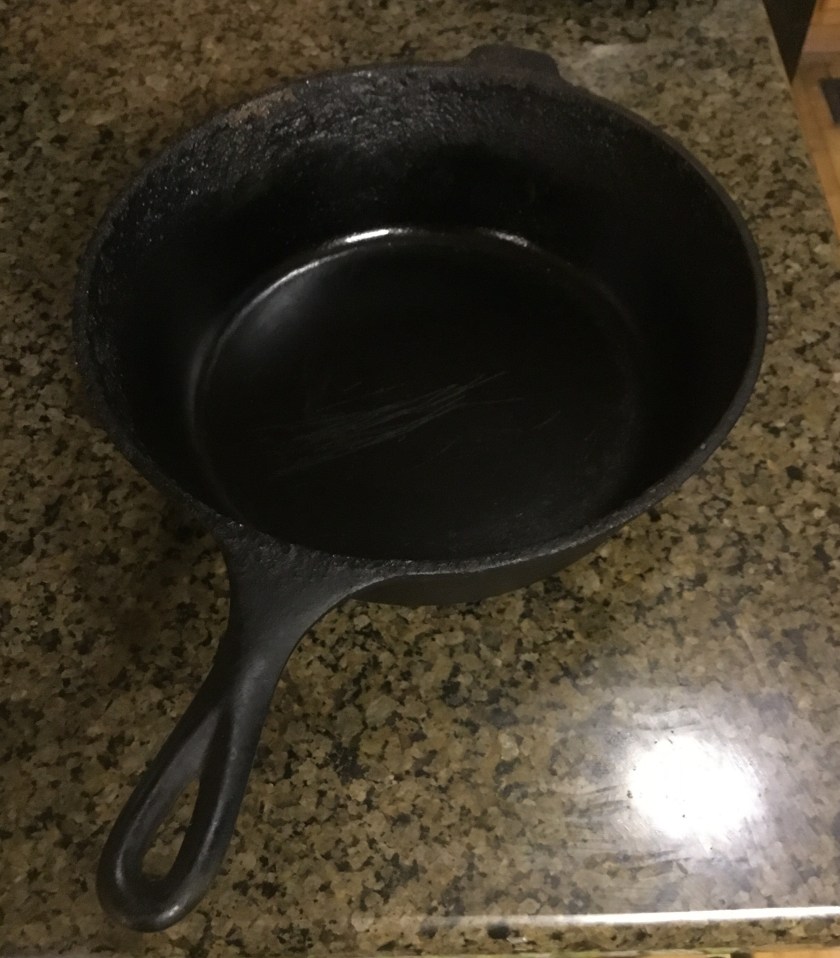
Chicken Fryer

A couple of decades of frying chicken has left a little grunge at the top of this fryer, but the business part of this piece is a pure slick polymer. The scratch is the result of an unfortunate use of a metal utensil years ago, and so I now use only wooden ones I have made myself. (Not that I would brag or anything, but I have one featured in the book A Gathering of Spoons: The Design Gallery of the World’s Most Stunning Wooden Art Spoonsby Norman D. Stevens.)

Let’s finish with a couple of often disputed topics. The first is cooking acidic foods, like tomatoes, in cast iron. Of course you can. You’re cooking on a polymerized surface, not bare cast iron. The dish will taste metallic if cooked in an unseasoned pan, but no one should be cooking in an unseasoned pan anyway. I have cooked literally hundreds of dishes of Chicken Creole and Chicken Piquant in my favorite skillet, and both have tomatoes, and the second additionally has white wine and olives. I’ve made both in some of my wife’s fancy copper pans, and the result wasn’t nearly as tasty. Go figure.

The last question is of great import, which is how to clean and maintain cast iron cookware once it is seasoned. A. D. Livingston became an absolutist when working at the nuclear lab in Oak Ridge, Tennessee, after hearing of a skillet that had not been washed in over a hundred years–only wiped clean. He allows rinsing with hot running water is acceptable, but that is it. Others say a drop of dish washing liquid is fine. My experience is that properly seasoned cast iron can withstand anything but steel wool, or one of those copper scrubbing thingys. Even food that might have stuck on comes off easily, unless allowed to dry out on to the pan. Even then a few minutes of soaking will do the job, and if you are impatient, try A. D.’s method of boiling off the offensive bits of food.

In short, chose whatever method serves you best. Back in the day, people just went with what they had. Things appear to have turned out alright.

James Hemings, the Godfather of Southern Cooking–and of American Fine Dining

If you have never heard of James Hemings, it’s not your fault. Blame it on an educational system that has historical amnesia. Just to give a hint of what James did, he introduced the following dishes to the newly minted United States: French style ice cream (the kind everyone eats now), crème brûlèe, pommes frites (french fries), and best of all, macaroni and cheese. Essentially, all the cornerstones of a healthy diet.

To put it bluntly, James Hemings was the enslaved servant of Thomas Jefferson, despite the fact that he was actually the half-brother of Jefferson’s wife, Martha Wayles Jefferson. (If you would like a complete history of the Hemings family, read Annette Gordon-Reed’s superb The Hemingses of MonticelloAn American Family.) Jefferson “inherited” the entire Hemings family upon the death of his father in law. Despite that beginning, James would become the person who was arguably the first classically trained chef from North America.

In 1784, shortly after the death of his wife Martha, Jefferson was dispatched to Paris as Minister to France, and to help Benjamin Franklin and John Adams negotiate with the French government for support of the new nation which they had helped create. The group that left for France had to be one of the strangest family groupings in American history: Jefferson, his twelve year old daughter Martha “Patsy” Jefferson, and nineteen year old James Hemings, who Jefferson referred to in one letter as “my servant.” Jefferson’s goal was for James to train as a French chef. Regardless of the goal, when James stepped foot on French soil, he was free, slavery being illegal in France.

Upon arriving in Paris, James immediately apprenticed with a caterer named Combeaux, at Thomas Jefferson’s expense. Realizing that he could claim his freedom, James made a deal with Jefferson, that his enslavement become an “apprenticeship” instead, and that he be granted his freedom after a number of years. Jefferson agreed, and additionally, paid James a salary that was more than double that of a well placed Parisian servant. James’ second apprenticeship was at the estate of the prince de Condé, Chantilly, which included a stable that could accommodate 240 horses, and had what was considered the finest kitchen and chef de cuisine in France. The apprenticeship was remarkably expensive. Jefferson paid for it anyway.

By the end of 1788 James Hemings himself was the chef de cuisine at the Jefferson residence in the Hôtel de Langeac on the Champs-Elysées, which served as a de facto American Embassy in Paris. James hired a tutor to help make him completely fluent in French, and had the pleasure of seeing his younger sister Sally arrive in Paris, as a servant and companion to Jefferson’s youngest daughter Polly. By August of 1789 James served his first famous dinner, which included a six hour long marathon discussion between Jefferson, the Marquis de Lafayette, and seven other Frenchmen, who, according to Jefferson, invited themselves over; as Lafayette told him, they would like “to ask a dinner of me.” Their topic of discussion was the ever growing French Revolution. Although, apparently, there was more drinking than eating, Jefferson considered the evening to be a great success.

Then came June 20, 1790, back in the States, and what is sometimes called the dinner table compromise, or alternately, the greatest meal in American history. The first functioning Federal government was installed, and Secretary of State Jefferson and Secretary of Treasury Alexander Hamilton agreed on little. However, the question of war time debt overlapped their respective positions, as most of the states’ debts were to foreign institutions. Jefferson and Hamilton agreed that the debt the states carried and could not pay, could, in fact, cause the collapse of the new government.

Jefferson decided that this problem could best be solved over a meal prepared by James Hemings. Jefferson hosted the meal at his apartment in New York, the then seat of the government. The staff of Monticello, along with writer Charles Cerami, has made up a mock menu for the meal, based on what Jefferson typically ate (this information comes from the excellent book Thomas Jefferson’s Crème Brûlée, by Thomas J. Craughwell):

  • Green Salad with Wine Jelly
  • Capon stuffed with truffles, artichoke (artichokes are still grown at Monticello), chestnuts, and Virginia ham. It was served with an apple brandy sauce.
  • A Top Round Beef Roast and Veal Knuckle, served with onions, carrots, bacon, and garnished with parsley and thyme
  • Small plates of confections
  • Vanilla Ice Cream inside a puff pastry

Naturally this would need five bottles of wine to go with it, concluding with a bottle of Champagne to accompany the dessert. And there it is, fusion cooking, with mostly local ingredients prepared using mostly French techniques, though the beef and veal were cooked for hours in an old American stand-by, a cast iron dutch oven. Thankfully, James Madison was also present to help tackle this feast.

The solution to the debt dilemma was this. Jefferson agreed to Hamilton’s idea that the Feds assume the states’ war debts. Jefferson, knowing that a financially stable state like Virginia would never go along with such an idea, proposed that the national capitol be moved to the South, as compensation. Madison’s job was to get the bills through Congress. Thus modern America was born, over dessert and ice cream, and multiple bottles of wine.

James Hemings returned to Monticello, and taught his brother Peter how to cook in the French fashion. Peter also became a master brewer later, and ran the brewery at Monticello. After James had successfully taught Peter the necessary cooking skills, he was finally granted his freedom in 1796, the requirements of his “apprenticeship” having been fulfilled.

One last episode remains in this story. Soon after Jefferson was inaugurated as President in 1801, he had an intermediary contact James, who was working in nearby Baltimore, and offer him the job as the first chef de cuisine at the brand new White House. James was hesitant, and Jefferson indicated that he did not want to pressure him into the job. James did return to Monticello in the fall, and ran the kitchen there for one last time. By late October, James Hemings was dead, from an apparent suicide.

After asking for confirmation of this report, Jefferson received the following reply from his acquaintance William Evans:

Sir,

I received your favour of the 1st Instant, and am sorry to inform you that the report respecting James Hennings Having commited an act of Suicide is true. I made every enquiry at the time this melancholy circumstance took place, the result of which was, that he had been delirious for Some days previous to his having commited the act, and it was the General opinion that drinking too freely was the cause, I am Sir

Your obedient Servant

William Evans

This strangely modern tale of substance abuse claiming a chef’s life in no ways changes the influence James Hemings had on American, and particularly Southern, cooking. In 1824 Jefferson relative Mary Randolph published the South’s first great cookbook, The Virginia Housewife. Included in the book is a recipe for ice cream (the first published in the US), and a recipe for”Macaroni,” where the other main ingredients are milk and cheese.

Where could those ideas possibly have come from?

Welcome to Southern Fusion Cooking

Southern Fusion Cooking is dedicated to both all things Southern and all things cooking. We have recipes, but we also have history. This is not just an exploration of “How to Make Cornbread,” but an investigation of all the traditions that have contributed to Southern cuisine–be they African, European, Indigenous, or more recently, Asian. The train is leaving the station, so jump on board.

OffGuardian

because facts really should be sacred

Ruth Blogs Here

Or not, depending on my mood

A Haven for Book Lovers

I am just a girl who loves reading and talking about books

what sandra thinks

because I've got to tell someone.

LadiesWhoLunchReviews,etc

a little lunch, a little wine, a LOT of talking!

Margaret and Helen

Best Friends for Sixty Years and Counting...

talltalesfromchiconia

Tales of quilting, gardening and cooking from the Kingdom of Chiconia

Cyranny's Cove

Refuge of an assumed danophile...

Exiled Rebels

Serving BL since 2017

this is... The Neighborhood

the Story within the Story

Beauty lies within yourself

The only impossible journey in life is you never begin!! ~Tanvir Kaur

Southern Fusion Cooking

Country Living in the Southern Appalachians, USA--A little of this, a lot of that

Discover WordPress

A daily selection of the best content published on WordPress, collected for you by humans who love to read.

The Atavist Magazine

Country Living in the Southern Appalachians, USA--A little of this, a lot of that

Longreads

Longreads : The best longform stories on the web

WordPress.com News

The latest news on WordPress.com and the WordPress community.