Cornbread and Cornbread Dressing

Recipes

A cornbread and a cornbread dressing recipe here.

Bama Cornbread

1 cup fine McEwen cornmeal (or other finely ground cornmeal)

3/4 cup milk

1 egg

1 teaspoon baking powder

1/4 teaspoon baking soda

1/2 teaspoon salt

Mix this up with dry ingredients first, and then the milk and egg. Pour it into a roasting hot, oiled cast iron skillet, into a 425 degree oven. The quality of the cornmeal is the key here. Double the recipe for a family meal.

Bama Cornbread Dressing

One double recipe of Bama Cornbread, crumbled (see above)

2 cups croutons

2 cups onions and celery, cooked

Handful of rehydrated dried Porcini mushrooms, cooked in butter, chopped

1/2 stick of melted butter

2 eggs

Chicken stock (at least one cup)

Salt and Pepper to taste

Sage, sage, and more sage

Cook at 350 degrees. This is a seat of the pants recipe. I like lots and lots of sage and mushrooms. Recycle into turkey or chicken and dressing after the first meal. That’s a layer of leftover meat, topped with a layer of dressing. Add extra stock to the dressing when making the recycled dish.

Great Southern Cookbooks, Part One–The Virginia Housewife, by Mary Randolph (1824)

Virginia Housewife Facsimile

We began with the best food book, so why not go next to the first cookbook? Buy the Dover Publications print facsimile from Amazon, or your local bookstore, or download a text only version from Project Gutenberg.

Praised by writers as diverse as James Beard and chef Jose Andres, Mary Randolph wrote the first Southern cookbook, and what is arguably the first completely American cookbook. What makes this book so special? It is a fascinating historical and culinary fusion document. Many of the recipes are familiar and accessible, especially to Southern cooks, and others are exotic and challenging. Chef Andres says he still serves her gazpacho at one of his restaurants. Which begs the question–what is a Virginia housewife doing serving gazpacho in 1824?

Mary Randolph was no typical Virginia housewife. She was an entrepreneur, an executive chef, and a chef de cuisine, all at the same time. Her husband David Randolph was fired from his cushy government job by his second cousin, President Thomas Jefferson, for being a worthless crooked Federalist party lowlife. (Strangely enough, Mary Randolph’s father was raised in the household of Peter Jefferson, who just happened to be the father of Thomas Jefferson.)

Mary, who counted among her ancestors a woman named Pocahontas, in order to support the family, became a business woman. (Can stories get any better than this?) She opened a boarding house in Richmond, Virginia, in 1807, for “Ladies and Gentlemen.” The main attraction of this establishment was the magnificent food, which I will address shortly. Mary, notably, WAS NOT A COOK. Here’s how much time she spent in the kitchen, according to the Introduction to the book:

When the kitchen breakfast is over, and the cook has put all things in their proper places, the mistress should go in to give her orders. Let all the articles intended for the dinner,  pass in review before her: have the butter, sugar, flour, meal. lard, given out in proper quantities; the catsup, spice, wine, whatever may be wanted for each dish, measured to the cook. The mistress must tax her own memory with all this: we have no right to expect slaves or hired servants to be more attentive to our interest than we ourselves are: they will never recollect these little articles until they are going to use them; the mistress must then be called out, and thus have the horrible drudgery of keeping house all day, when one hour devoted to it in the morning, would release her from trouble until the next day.

Anyone who has worked in a commercial kitchen, such as myself, will recognize the brigade de cuisine. The boss tells you what to do, and you do it. Also notice the mise en place: everything is in order, and in it’s place. Notice that the slaves and hired servants are put on the same level. Arguably, Mary Randolph was the first American celebrity chef, as the book went through nineteen printings in less than forty years. If current celebrity chefs were as honest as her, we would have a more realistic picture of the restaurant business.

The Food

Man, did those people eat well! As Joel Salatin, the world’s most famous farmer, who also lives in Virginia, loves to point out, our diet is much less diverse now than it was a hundred years ago. What about two hundred years ago? Turtle, rabbit, eight or nine species of fish, goose, duck, woodcocks, brains, and eyes were all on the menu, as well as about thirty different varieties of vegetables. From the recipe, “Mock Turtle Soup of Calf’s Head,” “The eyes are a great delicacy.”

Here’s where the fusion part really kicks in. Recipes in the book encompass cuisines from the native American, American, African, and European, as well as some Caribbean regions. French and Spanish recipes are well represented. African vegetables such as okra and field peas are mentioned, right alongside potatoes and English peas. My only editorial comment will be to assure Northern writers that African “yams” are not grown in the South, but that the word is a synonym for sweet potatoes, which came from Central or South America. (I have even read that slaves brought tomatoes to the South!)

I will cook a few of these recipes in the next few weeks, and reveal the results in a new Recipe section. The first will be “Corn Meal Bread,” which is not cornbread, but a yeast leavened bread made with corn meal.

Undoubtedly a good deal of this book can be said to be influenced by the great chef James Hemings, but the extent of that influence is impossible to determine. Two of his signature dishes, ice cream and Macs and cheese, make their first American appearance here.

Corn Meal–Better Know a Southern Staple

GrinderThis is an actual native American original ingredient. And these are the remains of an archaic native American corn grinder, which came from just a few miles downriver from my house.

Corn, another one of those invaders from Mexico, has been ground into meal around here for awhile. It’s a damn good thing there were no ICE corn police in place way back when, or there would be no cornbread, corn muffins, hush puppies, hoe cakes, cornbread dressing, or cornhole tosses. Which brings me to my favorite cornmeal story.

Back in the 1970’s, or so the story goes, there was a locally famous meat and three restaurant in Tarrant City, Alabama. A meat and three serves a protein and three vegetables/side dishes, for all the foreigners reading this. The restaurant happened to be across Alabama Route 79 from a gigantic limestone quarry, and you could eat there, and enjoy dynamite blasts, all at the same time.

An elderly friend of mine swears this is true. He went to lunch there one day, and there was a tarp over the roof, and a giant hole in the ceiling. Despite that, lunch service went on as usual.

He sat down at his usual table, and ordered fried chicken livers, fried okra, blackeyed peas, and bread pudding. After his favorite waitress took the order, he asked why there was a hole in the roof and the ceiling.

“Way-l,” she said, “They uzed too much dynymite over at the kwarry. A bold-er shot all the wayz across tha rode. Hit came thru the roof and lit in the sweet rolls.” This was across one of the busiest roads in the state.

“So what are you going to do?” he said.

“Serve corn muffins instead,” was her answer.

Corn muffins. It’s what’s for lunch.

Storage

All cornmeal needs to be stored properly, as it has a good deal of fat and protein that will go rancid. Refrigerate in a zip-lock bag for short term storage, though a freezer is a better place for it in the long run.

Types

Cornmeal comes in various colors, but yellow is the most common. The main difference is in the grind–how it was ground, and by what. Commercial cornmeals are often ground at a high heat level, which is not so good for the flavor. Traditionalists use stone ground meal, though not necessarily ground in one of those grinders in the above picture. Stone ground is normally whole grain, so it really really needs refrigeration.

Grinds

This is the rub, right here. There’s coarse, medium, and fine, depending on the source. Every miller has a different label, and many don’t bother with the distinction on grinds. Look for one that does. I’m going to use the example of Coosa Valley Milling, in Wilsonville, Alabama. For those of you who don’t know your geography, that’s only a few miles from Harpersville. Alright, it’s just south of Birmingham.

Fine
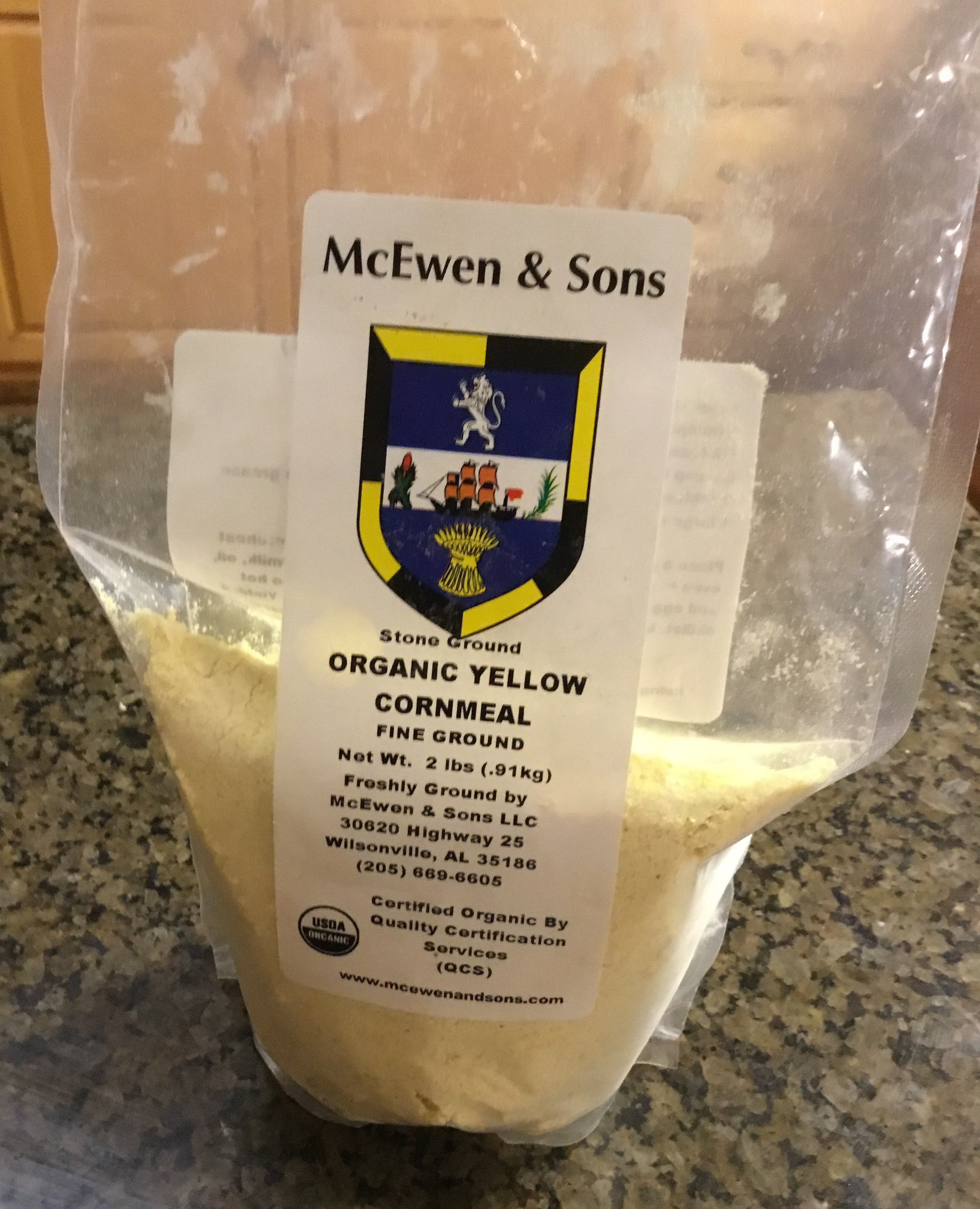
Fine groundUnlike many people, this is my go to grind. Most people add wheat flour to their cornbread, but not me. This powder fine grind is easily the best I’ve ever seen. It’s made by a great family company as well.

Coarse

Coarse ground

This one is the work horse grind, with something of the consistency of sawdust. That’s why I put it on my workbench. (Clever, eh?) Great for Hush Puppies and other crunchy things. It’s usually cut with flour when used to make cornbread.

Recipes

A cornbread and a cornbread dressing recipe here.

Bama Cornbread

1 cup fine McEwen cornmeal

3/4 cup milk

1 egg

1 teaspoon baking powder

1/4 teaspoon baking soda

1/2 teaspoon salt

Mix this up and put in a roasting hot, oiled cast iron skillet, into a 400 degree oven. The quality of the cornmeal is the key here. Double the recipe for a family meal.

Bama Cornbread Dressing

One double recipe of Bama Cornbread, crumbled (see above)

2 cups croutons

2 cups cooked onions and celery

Handful of rehydrated dried Porcini mushrooms, cooked in butter, chopped

1/2 stick of melted butter

2 eggs

Chicken stock (at least one cup)

Salt and Pepper to taste

Sage, sage, and more sage

Cook at 350 degrees. This is a seat of the pants recipe. I like lots and lots of sage and mushrooms. Recycle into turkey or chicken and dressing after the first meal.

Here are the testimonials about McEwen products, from famous chefs across the country. You can read about the awards they have won. Their eggs are fantastic as well, but you’ll have to drive to Wilsonville for those.

 

OffGuardian

because facts really should be sacred

Ruth Blogs Here

Or not, depending on my mood

A Haven for Book Lovers

I am just a girl who loves reading and talking about books

what sandra thinks

because I've got to tell someone.

LadiesWhoLunchReviews,etc

a little lunch, a little wine, a LOT of talking!

Margaret and Helen

Best Friends for Sixty Years and Counting...

talltalesfromchiconia

Tales of quilting, gardening and cooking from the Kingdom of Chiconia

Cyranny's Cove

Refuge of an assumed danophile...

Exiled Rebels

Serving BL since 2017

this is... The Neighborhood

the Story within the Story

Beauty lies within yourself

The only impossible journey in life is you never begin!! ~Tanvir Kaur

Southern Fusion Cooking

Country Living in the Southern Appalachians, USA--A little of this, a lot of that

Discover WordPress

A daily selection of the best content published on WordPress, collected for you by humans who love to read.

The Atavist Magazine

Country Living in the Southern Appalachians, USA--A little of this, a lot of that

Longreads

Longreads : The best longform stories on the web

WordPress.com News

The latest news on WordPress.com and the WordPress community.