Stewed Chicken, Brown Sauce

Ok, Greatest Southern Cookbook

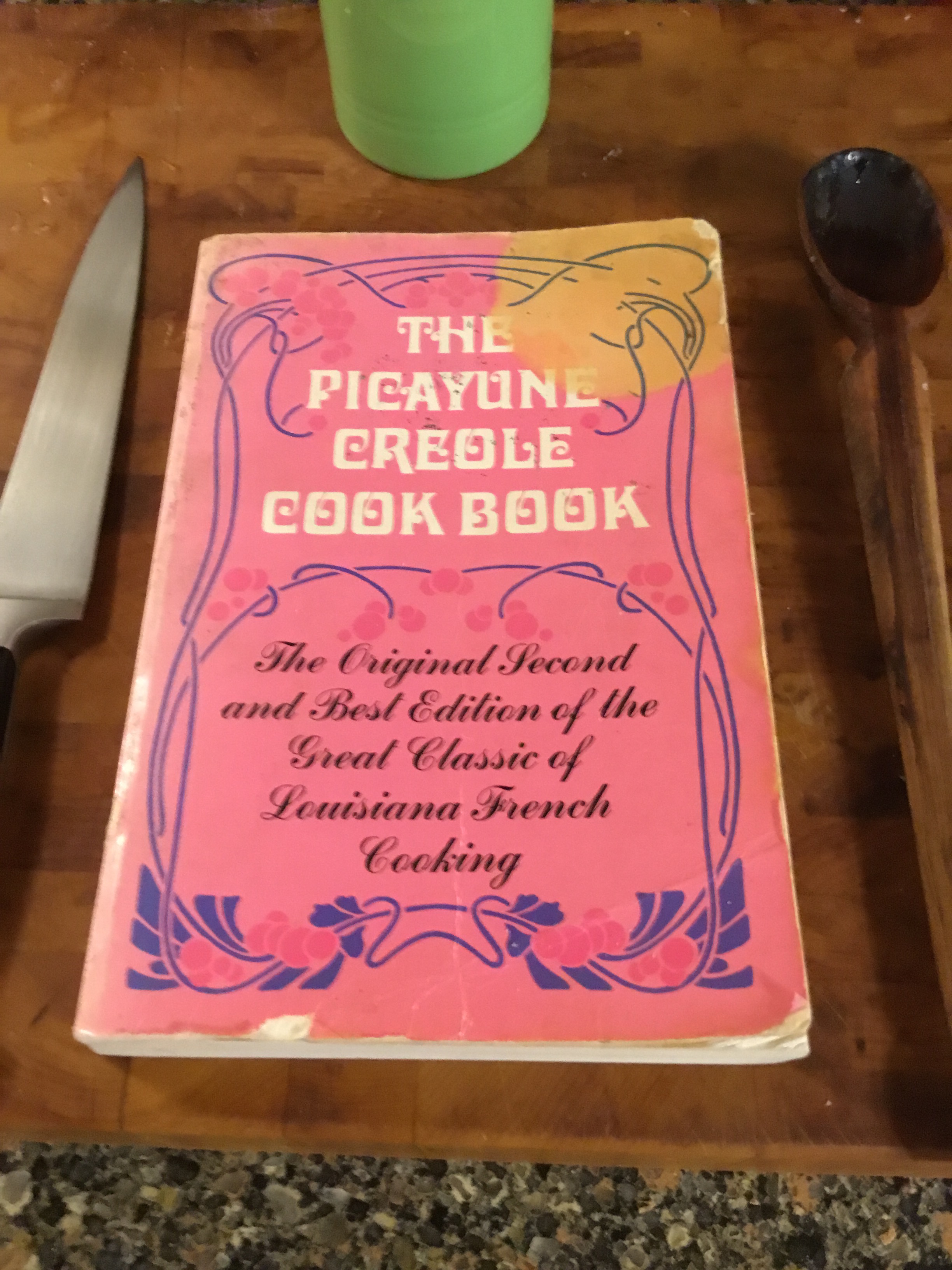
What we have here is yet another recipe from the magnificent Picayune Creole Cook Book. I should start with a quote from the book itself about this dish: “It is a simple, elegant dish, within the means of everyone.” At least everyone who has a chicken in their pot. We always refer to this dish as just “Brown Sauce Chicken.”

I am going to get all Frenchified on you, as the cookbook gives the recipe names in both English and French. This is also “Fricassée de Volaille, Sauce Brune.” This is an important distinction as a Fricassee is a distinctive method of cooking.

The original recipe uses a whole chicken cut up, including the liver, heart, and gizzards, so think of this as a chicken cooked in its own giblet gravy. Mine is a simpler version for two people, as usual.

Stewed Chicken, Brown Sauce

1 Chicken Breast, preferably bone in and skin on

1/2 Onion

1 Tablespoon Lard, Oil, or Butter

1 Tablespoon Flour

1 sprig Thyme and Parsley

1 Bay Leaf

Salt and Pepper

Begin by cooking the onions in the fat (lard, oil, butter) until soft. I always use the heaviest cast iron skillet I have, but that’s just me. Then add the flour and make a brown roux with it. A roux, aka “Creole Napalm,” is really a matter of practice and patience. A brown roux should be dark brown, the darker, the better the taste. Whatever you do, don’t stop stirring, or let this stuff splatter on you. When satisfied, add the chicken, and brown it as well.

Here comes the fun part. Add stock or water, herbs, and seasonings, and stir well. Cover the pot and simmer for thirty minutes or so on your stove’s lowest setting (mine is 600 btu’s), or an hour for a whole chicken, and you’re done. Check frequently to make sure that the chicken does not stick, or “lay on,” as we like to say. Serve with rice, preferably Louisiana rice, or pasta. Potatoes will also work.

This dish is simple and amazingly good. It’s also a perfect way to practice your skills as a Fricassee cook.

Chicken Sauté a la Créole

Great cookbook, or greatest cookbook? The latest reprint is available from Amazon.

I have made the following recipe from this cookbook literally more than a hundred times. Here’s what the Times Picayune had to say about it, when it is made properly:

You will then have a dish for which any old Creole would go on foot from Carrollton to the Barracks, a distance of fifteen miles, merely to get a taste of.

And now this is the modern version, that doesn’t require two whole chickens or two large onions. It’s for two people.

1 Chicken Breast

1/2 Onion

1/2 Sweet Pepper

1 Clove Garlic

1 Tablespoon Peanut Oil

1 Tablespoon Flour

1 Pint of Tomatoes

White Wine for de-glazing

Salt and Pepper

Thyme and Oregano

Heat the oil in a thick cast iron skillet, and add the flour. It’s time to make a roux! That’s what thickens the Creole sauce. I’m channeling Marcelle Bienvenu, who wrote another great cookbook, Who’s Your Mama, Are You Catholic, and Can You Make a Roux?

A “blonde” roux is preferable for this dish, so stir the flour until it browns only slightly. Add the chicken and let it brown nicely. A bone in, skin on, breast is preferred

When the chicken is browned, add the onions and pepper, which should be finely diced. When they are softened, add the garlic. Then de-glaze the pan with white wine.

Now it’s time for a little technique: milling tomatoes, using the finest insert that comes with the food mill. 

Moulinex #1 Food Mill

Truthfully, this step is optional, but the end result is a seed free sauce of superior texture and taste. It doesn’t hurt to have some home canned, locally grown, tomatoes to mill, as pictured. Just crank the tomatoes right over the skillet. I’ll do a deep dive into food mills eventually–they are a French invention, and the best ones are still made there.

Once the tomatoes are milled, season with salt, pepper, and herbs. Once the sauce is simmering, put a lid on the skillet and turn it down to the lowest setting possible, the lower, the better. Just add water or stock as it cooks down. In forty minutes or so, you have a dish worth walking fifteen miles for. And that is just to taste it.

Coffee and Chicory–Better Know a Southern Staple

Coffee 1A hot homemade English Muffin, and homemade Fig Preserves, and an old Cafetière of Coffee and Chicory. Breakfast!

When I left the farm in Good Hope, Alabama, for college, I knew that there were people who drank coffee without chicory in it, but I had never met one, as far as I knew. It could have been because I didn’t drink coffee, or even alcohol. Then when I started graduate school, and entered into the teaching profession at the same time, I found I needed something to wake me up in the morning, and put me to sleep at night. My girlfriend Melanie Jane and I headed out for the Kroger’s in Tuscaloosa, on a mission, after my first class. We left there with two new items in our buggy: some Luzianne Coffee and Chicory, and a bottle of BV Beau Rosé. Being an adult wasn’t all bad.

The other thing we bought at about the same time is a cookbook that is still my favorite, the 1901 edition of The Picayune Creole Cookbook, from New Orleans. For years the only two cookbooks we owned were that, and The Joy of Cooking (it should be noted that Irma Rombauer, who wrote the original Joy, was from St. Louis, which is sometimes considered to be Southern, though usually not). Truthfully, those two books, and a little curiosity, is all a cook needs. However, the very first recipe in the Picayune Creole Cookbook is Café à la Créole: Creole Coffee.

Though chicory is not mentioned in the recipe, the praises lavished on coffee are next level. Coffee “supported the old age of Voltaire,” and I challenge anyone else to find a cookbook that begins with a reference to Voltaire (a bust of Voltaire welcomes visitors to the entrance hall at Monticello). I have to throw in another quote about a French writer, this one by Henry James: Honoré de Balzac could not have written so many novels without “deep potations of coffee,” allegedly around fifty cups per day. But here is the real kicker from the recipe:

Coffee is now regarded by physicians as an auxiliary food substance, as retarding the waste of nerve tissue and acting with peculiarly strengthening effect upon the nervous and vascular systems.

Coffee. It’s what’s for breakfast. As much as I have drunk, I should live to be two thousand years old.

Now, New Orleans Creole Coffee is most famous for it’s various coffee and chicory concoctions, and just one producer has at least six varieties of coffee and chicory to choose from. Chicory is a southern European plant with blue flowers, from the Aster family, though the part used in the beverage is the roasted root. Chicory root has claims of medicinal qualities about it that would have made the writers of The Picayune Creole Cookbook blush.

chicory-root-001

This marriage of African coffee bean and European roasted herb root made it to France in 1801, and was well entrenched in N. O. by the time of the Civil War blockade. According to Smithsonian Magazine, folks from New Orleans tried everything from acorns to beets as additives and fillers for their coffee, in order to stretch out their supply. Apparently Coffee and Chicory tasted better than Coffee and Acorns.

If you are brave enough to try this incredibly smooth, addicting drink, locals throughout the South recommend just about everything available. The general consensus is that there are two favorites: Community Coffee Coffee and Chicory, and Union Coffee and Chicory. Consider all other brands as tied for third, and they all have slight variations in flavor. Prices vary widely, so do a little searching before purchasing. I personally buy the 32 oz. bags of Community Coffee Coffee and Chicory, but I probably should consider coffee rehab.

If you have a super special coffee variety already that you have sworn allegiance to, say, something grown only on three acres on a mountain in Jamaica, and picked only by left handed Ganja smokers, despair not. Chicory is sold widely, and even Community Coffee sells bags of it. Mix one part of chicory, with three parts of your Ganja smoker picked Jamaican primo, and there you have it. That’s the standard mix ratio, but experimentation is encouraged. Believe it or not, instant chicory is also available, for fans of instant coffee.

Now, naturally, to the world famous Cafe du Monde in the French Quarter of New Orleans. Starbucks it ain’t. Unless you want your coffee cold or frozen, you have two choices: black Coffee and Chicory, or Cafe au Lait, which is half strong Coffee and Chicory, and half hot milk. No lattes, no frappuccinos, and definitely no pumpkin spice. If you go there and ask for a doughnut and some pumpkin spiced coffee, please have the word “TOURIST” tatooed across your forehead first.

OffGuardian

because facts really should be sacred

Ruth Blogs Here

Or not, depending on my mood

A Haven for Book Lovers

I am just a girl who loves reading and talking about books

what sandra thinks

because I've got to tell someone.

LadiesWhoLunchReviews,etc

a little lunch, a little wine, a LOT of talking!

Margaret and Helen

Best Friends for Sixty Years and Counting...

talltalesfromchiconia

Tales of quilting, gardening and cooking from the Kingdom of Chiconia

Cyranny's Cove

Refuge of an assumed danophile...

Exiled Rebels

Serving BL since 2017

this is... The Neighborhood

the Story within the Story

Beauty lies within yourself

The only impossible journey in life is you never begin!! ~Tanvir Kaur

Southern Fusion Cooking

Country Living in the Southern Appalachians, USA--A little of this, a lot of that

Discover WordPress

A daily selection of the best content published on WordPress, collected for you by humans who love to read.

The Atavist Magazine

Country Living in the Southern Appalachians, USA--A little of this, a lot of that

Longreads

Longreads : The best longform stories on the web

WordPress.com News

The latest news on WordPress.com and the WordPress community.