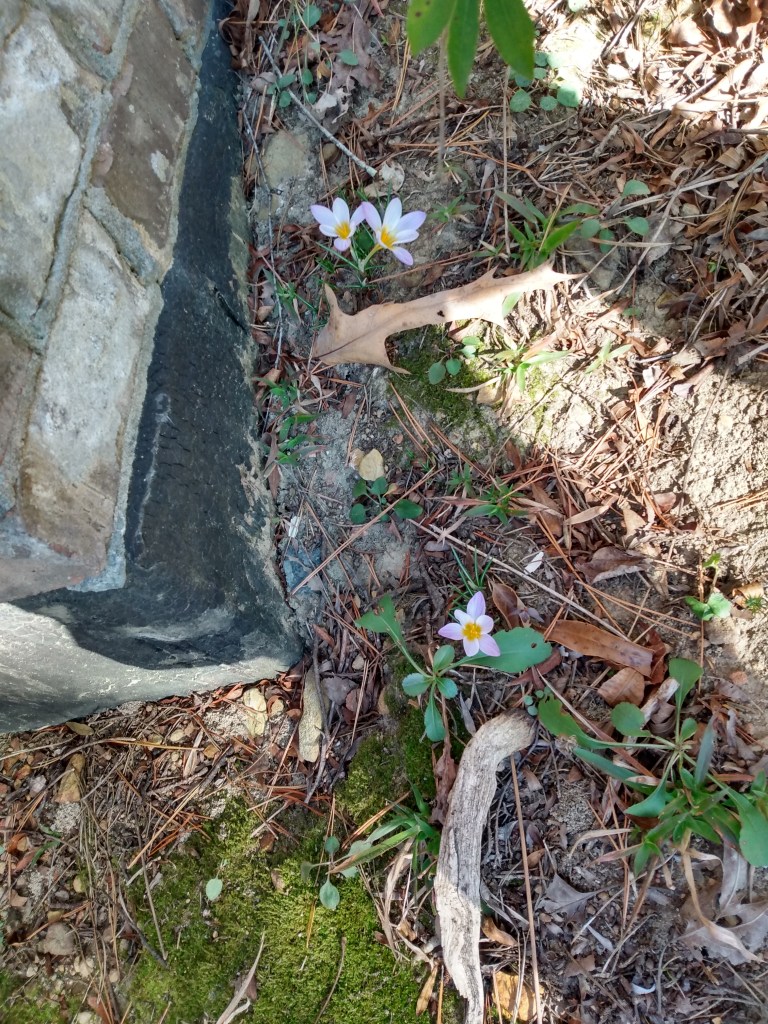
January 1, 2026
On December 31, 2025, these were just buds–purple, yes, but closed. The sun comes out January 1, and surprise-blooms on the first day of the year. A good portent? Maybe. However, early is always better than never.

January 1, 2026
On December 31, 2025, these were just buds–purple, yes, but closed. The sun comes out January 1, and surprise-blooms on the first day of the year. A good portent? Maybe. However, early is always better than never.

The color for today is yellow.
Above is an impressive specimen of the Florida Flame Azalea (Rhododendron austrinum) that is estimated to be somewhere between 15 to 18 feet tall. Its native range is southern Mississippi, Alabama, Georgia, and northern Florida. Despite its Deep South home, it is hardy all the way into USDA hardiness zone 6a.
This plant is just off of the northern side of our deck, which is about twelve feet tall above the patio below. It is good couple to five feet above that level, which is the basis for the estimated height. I planted it around twenty years ago.
Unlike many native azaleas, these are reliable bloomers year after year–none of that one year on, one year off behavior. It only needs a little supplementary water every summer in order to be happy. And when it is happy, every Spring you will be happy as well.

Rhododendron Flammeum
We have a new winner for the earliest blooming native Rhododendron, Oconee Azalea (Rhododendron Flammeum). The usual winner, year after year, is the pink to white Piedmont Azalea (Rhododendron canescens). This year, it was a virtual tie.
Why this year? We had a cold spell in mid February which set back the Piedmont azaleas. Then we had a warm March which brought the Oconee azaleas on fast. Another factor could be the placement of this particular Oconee azalea. It’s very sheltered from the north by a large Camellia, and from the east by our brick oven. To the northwest is our tall house. There could hardly be a location better than that.
Time for a close up:
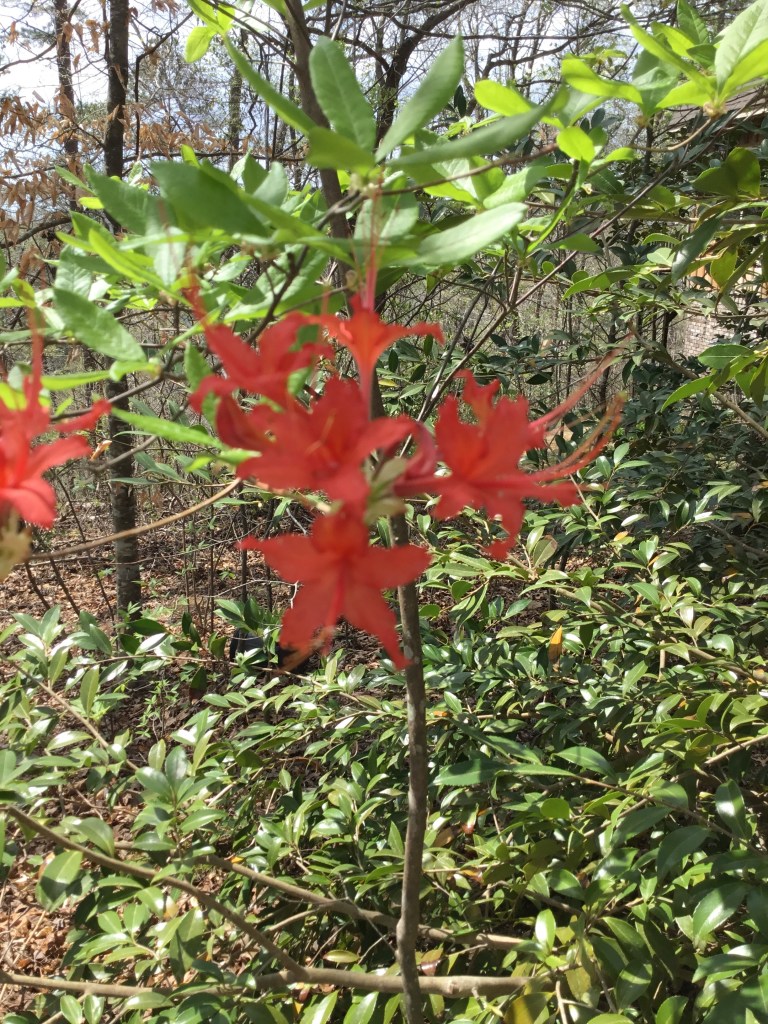
The color is not quite as red as the picture, but it is pretty close. Our other Oconees, which are about to bloom, are more orange and yellow than this one. However, as red is my favorite color, this blooming first gets Spring off with a bang.
Taters, Precious
My late, lamented Mother in Law Agnes Olga always had the same question for us during any February visit—“Do you have your potatoes in the ground yet?” She always had the same look of disappointment when we answered no.
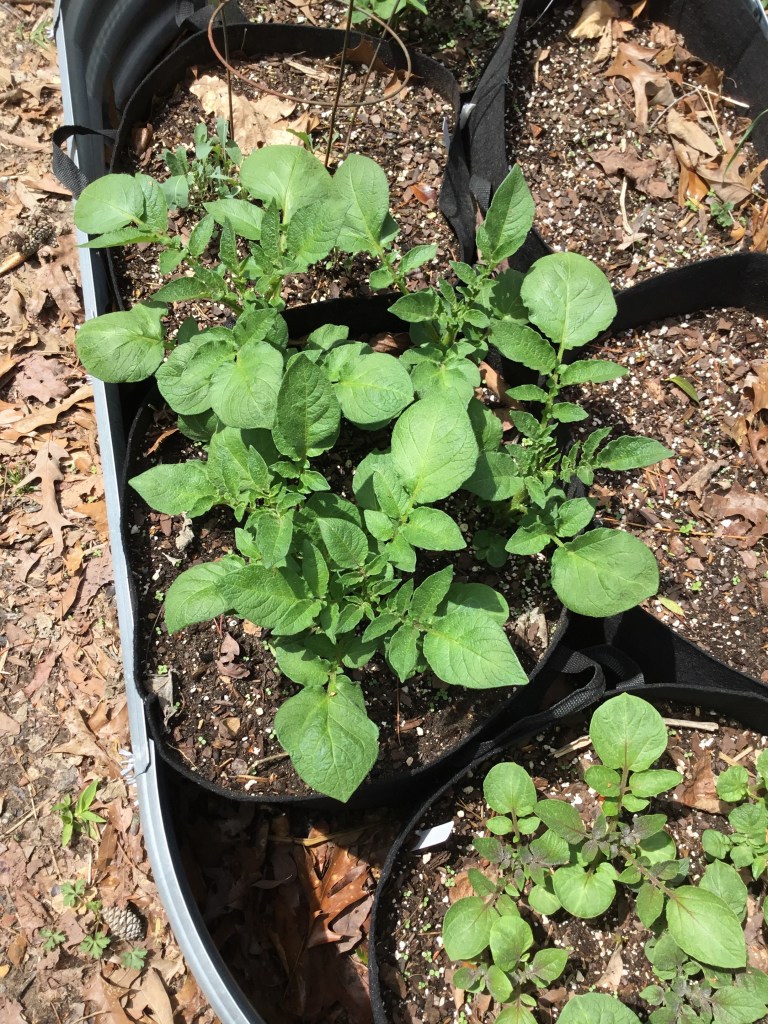
This year I finally got organized and planted potatoes early, on Groundhog’s Day. (For any foreigners, that’s on February 2.) We had a couple of hard freezes after that, but nothing a row cover couldn’t handle.
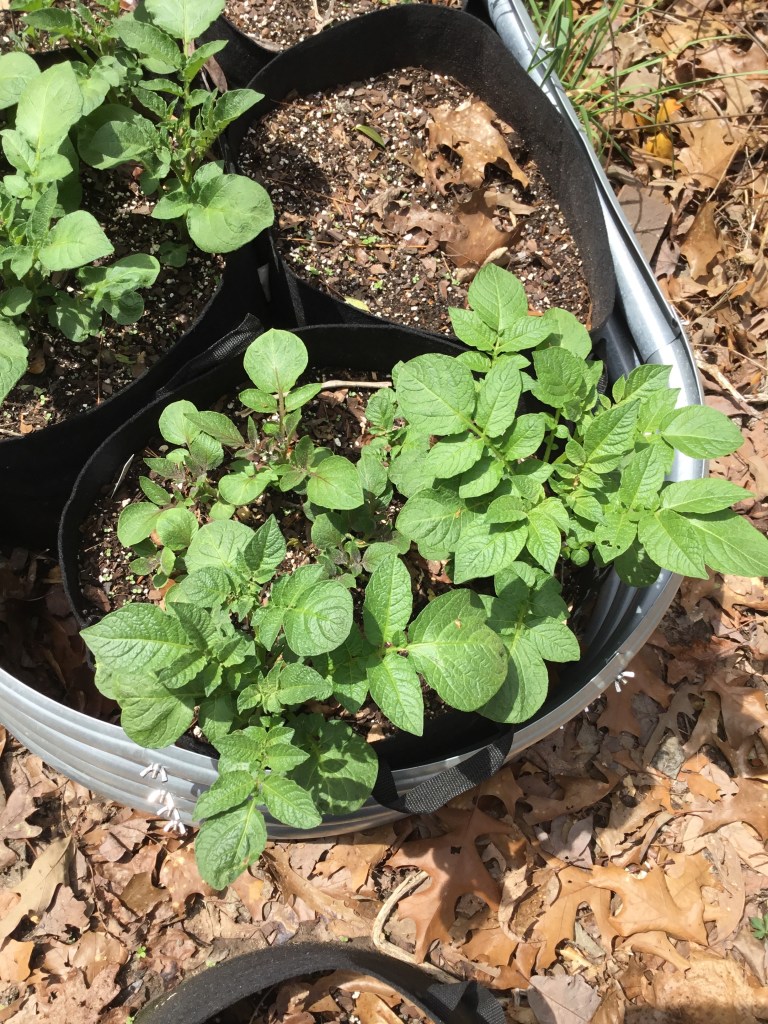
These two ten gallon grow bags are Russet (large) potatoes. We have an additional three grow bags of fingerling potatoes, two of which are also coming up. The third can’t be far behind.
These potatoes should be enough to get us through the summer. There will be some sorely disappointed farmers at the Festhalle farmer’s market.

This year’s Trout Lily (Erythronium americanum) bloom in our rock garden is quite spectacular. Each bloom is from a separate plant, though all have divided from one single transplant. That is, over a space of about ten years.
High temps next week will be near 80 degrees F, and vegetable seeds are germinating like crazy. Spring is here, and goodbye to Winter.

The Big One
We’ve grown Basil for decades, but have branched out from just Sweet Basil to local Italian varieties, such as basilico Genovese, the type used to make the most famous pesto. This beast is a new one this year—basilico Toscano, or Tuscan basil. It turned out to be even larger than advertised.
We ran across this variety when shopping in the OF Richter herb website. Strangely enough, Melanie also has a relative named OF Richter, but he ives in Alabama, not Canada. The description said leavers up to five inches long. Maybe in Canada, but would you believe eight here in the South?
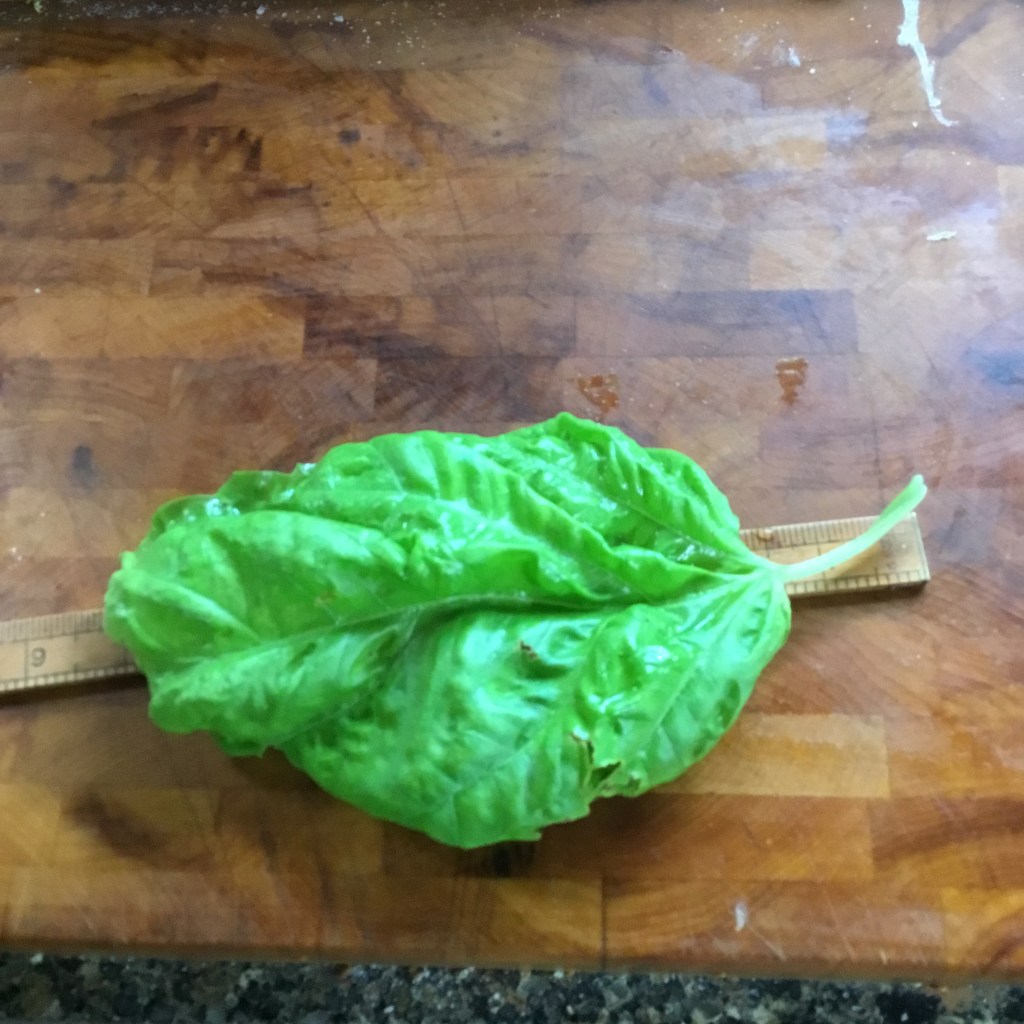
Ocular Proof
Good thing I’m making Creole Sauce tonight–Basil will come in handy.
February 24, 2024
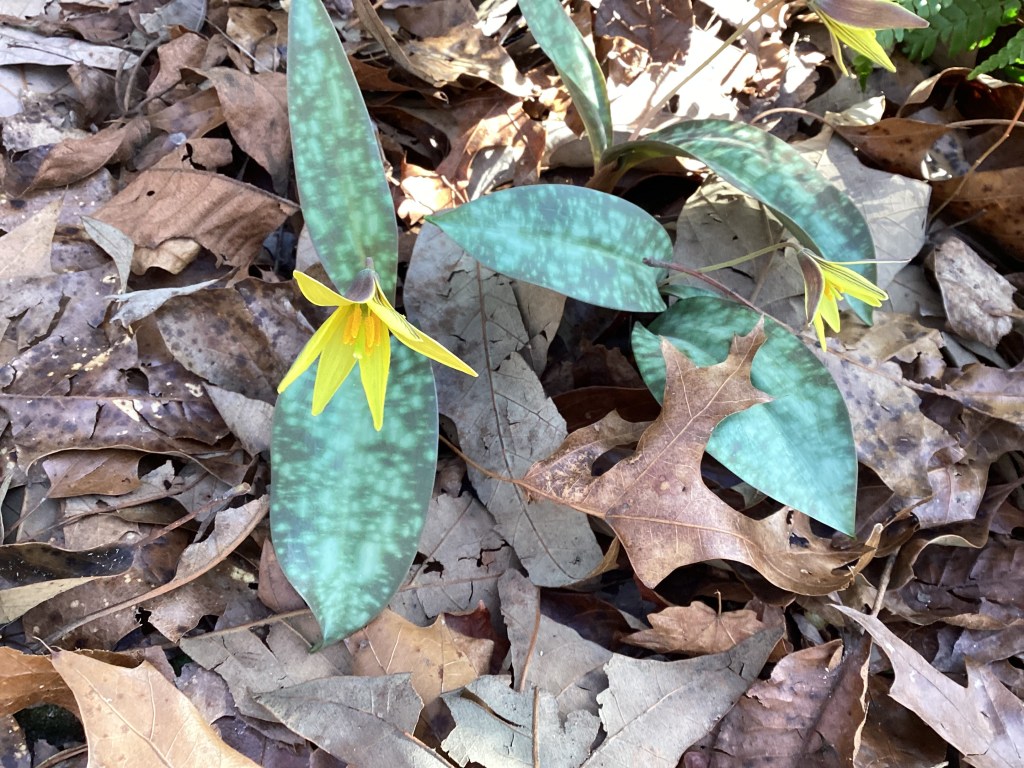
Ok, it isn’t meteorological Spring yet, but don’t tell that to the native plants, because they don’t care. Here we have a Trout Lily (Erythronium americanum), the first of the native perennials to bloom in the Southern Appalachians. This is a signal to go trout fishing, traditionally, as the Dogwood blooms are a sign to go bass fishing. I’m down with both of those.
The temp this morning is exactly 32 degrees F, and whether it gets below that again this Spring is unknown. Our last frost date varies from February to March normally, and I already have cold hardy vegetables growing. And I also have a few potatoes in the ground. Even without a groundhog to help, I’m thinking this is going to be an early Spring.

Lilium michauxii
This native Southern beauty has something of a reputation as being a rarity, but we have had it on both properties we have owned in Alabama, at opposite ends of the state. The fact that it blooms during the hottest part of the summer, when few people are wandering around in the woods, might explain its rep.
This Turk’s Cap like lily was discovered by eighteenth century French botanist and explorer Andre Michaux. It thrives in poor sandy soil. Unfortunately it is also a favorite food of rabbits, especially our small dog sized Swamp Rabbits. To have one bloom like this is a rarity even among our couple of acres colony of plants.
Another problem with cultivating this lily, is that it is only possible by growing it from seed. Reputedly, it is impossible to transplant, unlike other Lily species. Ben Pace, right hand man of Fred Galle at Callaway Gardens in Georgia, said they tried to transplant almost fifty of them before they gave it up. They always ended up with nothing but a handful of bulb scales. Therefore, we leave ours to grow in the wild, as they always have.

Let’s Eat!
June is one of the best times of the year to buy fresh locally grown produce. The omelette pictured above is all local save one ingredient, some bacon. Because we grew two of the main ingredients ourselves, this cost pennies compared to supermarket bought ingredients. I won’t mention that it is also about a thousand times better. This recipe serves two.
Ingredients
1 or 2 slices Bacon
Sliced Fingerling Potatoes
1/4 diced Onion
I diced Tomato
Salt and Pepper
Cook the bacon until most of the fat is rendered from it. Remove from the skillet, and add the sliced fingerlings. We grew these in 10 gallon grow bags, and once you go grow bags, you never grow back. We have enough taters now to take us on into the fall. Salt here well and fry until brown.
Add the onions and tomato, and turn on the oven to 400 degrees F. When the onions appear to be almost done, add two eggs. These are our homegrown ones.
When the white begin to harden, throw the whole thing into the oven. Now is paranoia time-Am I going to overcook them? There’s nothing worse than turning a good fresh egg into a golf ball. Shake the skillet occasionally until you get the desired score on the jiggle test. Then halve this beauty and thanks nature’s God for her/his bounty.
I like my eggs with some hot sauce, and I am currently on the fence between two Tabasco sauces–the Chipotle and the mild Jalapeño (Green) Sauce. Maybe I should try both at the same time.

Most gardeners in USDA Zone 7 or higher could easily have a set up like this.
For our Winter garden this year I went with all container plantings. It was a good thing too–when the bomb cyclone hit in December, and our temps went down to 8.9 degrees F, I just wheeled three cart loads of plants into our 60 degree basement, left them there for a couple of days, and then brought them back out. We will now have fresh greens until spring planting, which actually begins this week.
Pictured is a mixed planting of lettuces, spinach, boy choy, radishes, onions, chard, collards, kale, and one container with a mesclun mix that includes arugula. The potting soil is 95% composted chicken manure, a by product of our egg layers, that produce a more than steady supply of it. The spinach quiche we made was the perfect combination of their products.
Grand total of the expenses for this garden was $20 for seeds. I’m going to splurge and spend $40 on the summer version, which will easily be double this size. You won’t hear any complaints about the price of lettuce from me.
because facts really should be sacred
Or not, depending on my mood
I am just a girl who loves reading and talking about books
because I've got to tell someone.
a little lunch, a little wine, a LOT of talking!
Best Friends for Sixty Years and Counting...
Tales of quilting, gardening and cooking from the Kingdom of Chiconia
Refuge of an assumed danophile...
Serving BL since 2017
the Story within the Story
The only impossible journey in life is you never begin!! ~Tanvir Kaur
Country Living in the Southern Appalachians, USA--A little of this, a lot of that
A daily selection of the best content published on WordPress, collected for you by humans who love to read.
Country Living in the Southern Appalachians, USA--A little of this, a lot of that
Longreads : The best longform stories on the web
The latest news on WordPress.com and the WordPress community.
 Southern Fusion Cooking