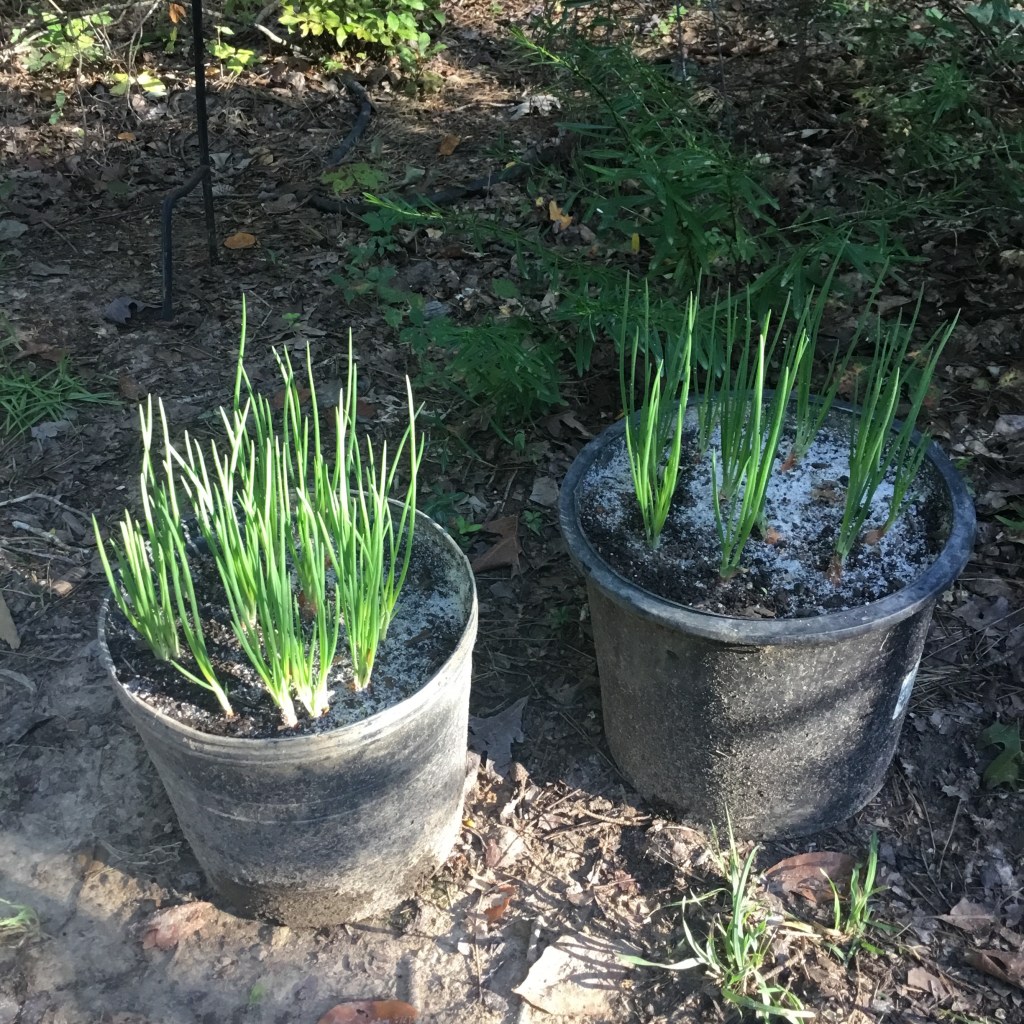
I’itoi onions are the kind of vegetable that could make the owner of a Chia pet jealous.Brought to the desert Southwest by Jesuit missionaries around 1699 to 1700, the I’toi proved to be ideal for the type of agriculture practiced by the native Tohono O’odham peoples, known as Ak cin, which means watching for summertime monsoon rains. When rain was coming, crops such as these onions were planted, and the onions sprouted to edible size in a small number of days.
My two miniature Sonoran Deserts in a pot are a combination of well composted chicken manure with a couple of handfuls of masonry sand. Growing in containers will insure that the desert onions will have plenty of drainage when we receive one of our monsoon level rains. Having grown these before, I know it also won’t be long before these onions will be ready to be divided, and we will be in onions forever, unless we neglect them.
I’itoi onions can be used as something of a giant version of chives, by clipping just the green parts. They also can be used, Louisiana style, as a fast growing shallot. As a plant that has made it on this side of the pond for over three hundred years, it is an heirloom among heirlooms.
It takes more than a few white clouds to make these Cyclamen blooms–it takes a sho nuff deluge. 1.8″ of rain on August 11 brought these jewels back to life, and they will bloom from now until the equally spectacular leaves emerge sometime this fall.
“White Cloud” is one of the Cloud series of Cyclamen cultivars, with white blooms and silver veined leaves–we also grow the “Silver Cloud” Cyclamen, which has pink flowers and similar evergreen leaves. A single plant can sell for $7 to around $50. We paid $6.95.
The good news is these cultivars come true from seed, and re-seed prolifically–we now have these plants scattered all through our rock garden, and the plant below the rocks is a seedling. The silver Christmas tree looking leaves are equally impressive, even if they remind me of those incredibly hideous silver tinsel fake Christmas trees from the seventies. Some things you just can’t forget–ugly is just as memorable as beauty.
Our local Farmer’s market, held at the Festhalle, has been busy this summer, purely because of the excellent produce and value, compared to jacked up super market prices And people still keep arguing that transportation costs don’t result in higher prices. Check the price of gas, because Scotty did not beam that food to Publix.
Every ingredient, save for two, came from either the Festhalle or our front yard. I’ll differentiate those in the ingredients list.
Ingredients
1 tablespoon Italian Olive oil
1/2 medium Onion, Chopped (Festhalle)
1 sweet Pepper (Homegrown}
4 plum Tomatoes, Chopped (Festhalle)
2 Oyster Mushrooms (Festhalle)
Saute the onions, peppers, and mushrooms in the olive oil, and when done add the tomatoes and cook for a further minute. Mix together—
3 extra large Eggs (Homegrown)
1/2 cup shredded Vermont Cheddar Cheese
Chopped Parsley (Homegrown)
Sea Salt and Pepper
Pour the egg mixture into the veg, and cook this frittata style–let the eggs begin to set, and then throw the skillet into a 400 degree F oven, until the omelette is done to your liking. Alas, poor supermarket. Only two imported items, from Italy and Vermont. Wait, the cast iron skillet is from Tennessee, another exotic foreign country.
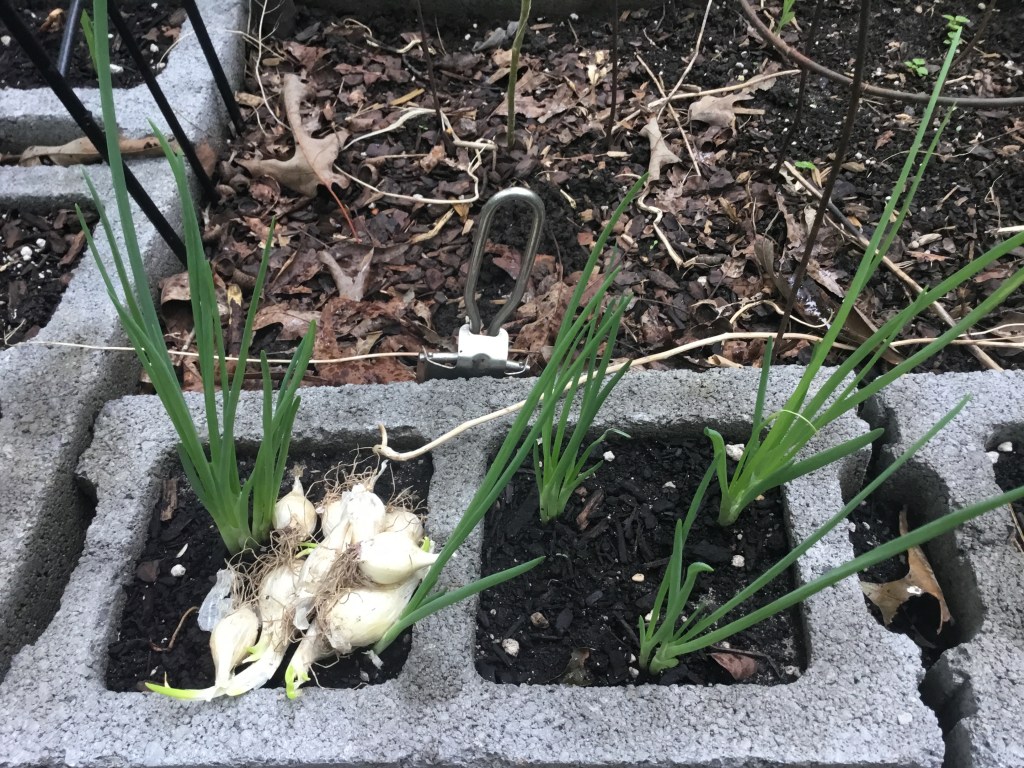
The first planting of Josette shallots worked out so well I had to order another bag. All told, I will have 22 Josettes planted in four cinder block “raised beds.” I saw this idea at some gardening site on the inter webs, and had a pile of free cinder blocks lying around, and had to try it. With a little potting soil, presto, instant raised bed.
Now that Allium cepa has been divided into two large groups, bulb onions and multipliers, I am going to refer to all multipliers as shallots, in the great Gulf Coast tradition. My next multiplier purchase will be some of the Southwestern I’itoi onion, an heirloom that was brought from Spain, circa 1699.
This exercise has led me to mentally compile a list of onions, leeks, and garlic that are suitable for permaculture. In short, I buy them once, and then propagate them myself. So far I have in mind five onions, two leeks, and two garlics. When they are all in the ground I will report back.
As this plant has at least three common names, I’m going with the most provocative, and yet the most historically accurate one (if you want the whole scoop, read the long discussion from 2008 on Nola.com about the issue). Creole food expert Poppy Tooker of New Orleans believes the original ones from France were actually shallots, but that only the green parts of the plants were used, and that eventually any green onion became known as a “shallot.” Here she is–
I believe in all those original old Creole recipes, people were actually using shallot tops, because they were growing them like that out in their garden, then, later, probably buying them in whole bunches with a little oniony part on the bottom and the green onion part on the top. . .I really believe this is the truth, and why we call them shallots instead of scallions or green onions or spring onions.
Poppy Tooker
Common names of plants are really only as useful as nicknames anyway, so this debate is about as important as what your dog’s name really is–is one of our Aussies named Siegfried, or is it Ziggy? Either way, he’s still a dog.
This plant does have a provenance of sorts, as the person I bought these bulbs from wrote “I obtained a start about 1972 from an elderly Creole gentleman in Golden Meadow Louisiana.” That’s good enough for me.
I think of these scrawny things when I hear multiplier onion.
Ready for Replanting
These are the common yellow multiplier, which come in various varieties. Fortunately, scientists have come to the rescue, and reclassified all onions and shallots as just Allium cepa, with different types. Now to the questions of whether or not Elephant garlic is really garlic: Hint: it isn’t. A scallion? Different species also. For now.
June was a good month for rain, if you like it all at once. All but a fraction of our rain came in two days, followed by fryingly hot weeks of no rain at all. Near the first of the month we had a day of practically non-stop rain, with four+ inches recorded here (Birmingham had an all time record of seven+ inches that same day). Then we had two weeks without rain. Then one night after a day where every storm missed us by just a few miles, the rain came all at once, with .7″ in the space of thirty minutes or so.
Some sleepers awoke after that. Here are two who had a good drink at the same time–a Rain Lily and some Cyclamen. Both are my kind of bulbs, in that you plant them and then forget about them. No fertilizer needed, no irrigation needed. Just act surprised when they finally bloom.
Rain Lilies, members of the species Zephyranthes that bloom after a drenching, are all plants from the Americas. The pink variety is a native of Cuba, and thus benefits from a hurricane or two every summer, which as well benefits from our increasingly sub-tropical climate (nine months out of the year). We also grow the Southern native Atamasco Lily, a spring blooming plant that will naturalize in most areas of the South.
The Eurasian hardy Cyclamen is a whole other story. I planted the two most common species, along with some very fancy cultivars, beginning some twenty years ago, and they have surrounded two sides of our house. Technically they grow from plate-like corms, instead of scaly bulbs, and they grow larger and larger for upwards of a hundred years. In fact, just to the left of the pictured bloom, you can see the black surface of the corm, which appears to be at least eight inches wide. Their green leaves in the winter are an added benefit to the unexpected outbursts of blooms.
Another drenching is finally headed our way today, and besides the rain and cooler air, I have to guess what, when, and where, the next blooms will be.
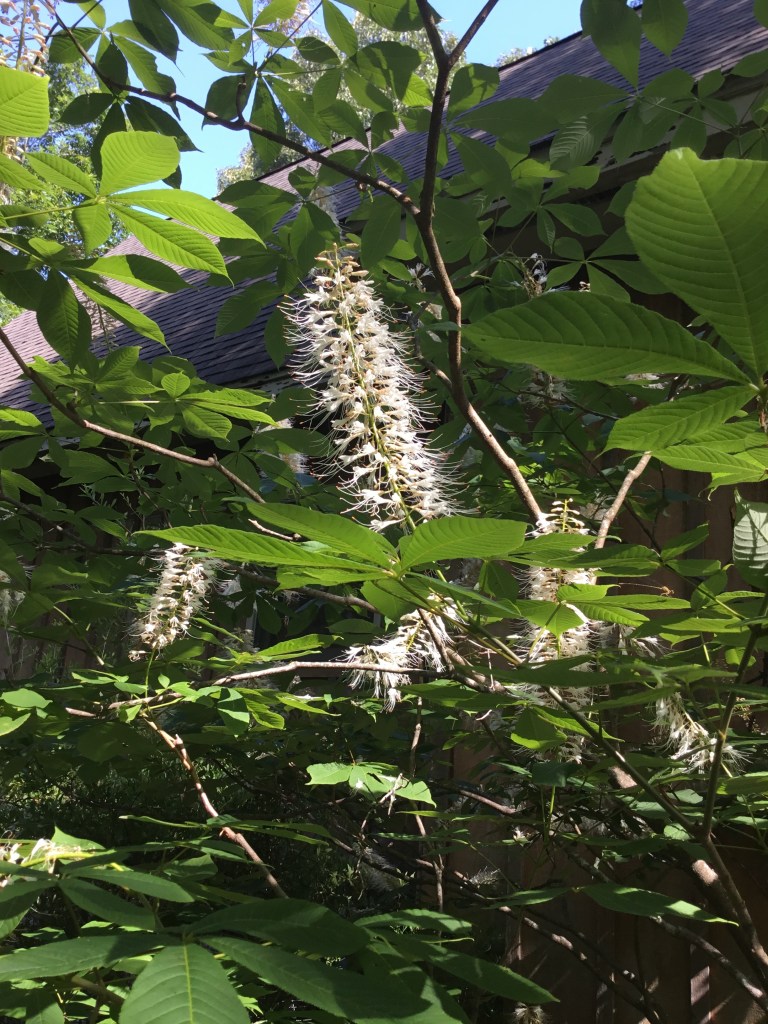
Need a late spring/summer blooming temperate forest shrub? This native could be the ticket. Two varieties of this species spread out the bloom period for a potential month and a half, and the plant doesn’t care if the highs are in the seventies, or like today, in the nineties.
In the wild, Bottlebrush Buckeye is found primarily in Alabama and Georgia, but it is now grown in Zones 4-8. The plant pictured is the earlier blooming “species” variety that was at peak bloom last week, when it was pummeled by 4+inches of rain in one day, and it still looks as pictured. Soon the second variety, often sold as var. Serotina, will begin to bloom, and will continue blooming into July. We have one of those as well, and it will bloom into July. Northern gardeners have reported later periods of bloom stretching into August.
A huge population of wild var. Serotina plants are growing just about three miles from here, south of Garden City, right along the edges of US Highway 31. Every few years Alabama Power will cut them down to the ground under the power line that runs to Blount Springs, which somehow or other rejuvenates the plants. Within in a few years the blooms will be spectacular, with limestone boulders interspersed with hundred foot long colonies of plants, and blooms hanging out over the road from steep hillsides. Unfortunately this section of highway is known for some spectacular wrecks, though they have never been attributed to drivers rubbernecking the plants.
As soon as I saw that the Latin name for Branched Oyster mushroom was Pleurotus cornucopiae, I had to grow some. This is a widely sought after variety well known to mushroom foragers, as it has an enormous range in the wild, and in many locales, can be found all year. Once again, the substrate here is just used coffee grounds with their filters.
The container is the difference. That’s a one gallon glass canister that was made in the US, and costs the princely sum of ten bucks. If someone had set out to design the perfect mushroom growing container, they could have done no better. The lid is left cracked open slightly as the mycelium expands, removed daily for the water spritzing, and then replaced to maintain humidity.It obviously comes off permanently when the young shrooms reach the top of the container.
The Mushrooms Two Days Earlier
Commercial growers in this country use plastic grow bags, which like all plastics, end up in our enormous waste stream. The glass canisters, with proper treatment, could last for generations. As far as single use plastics go, just remember P.I.E.–Plastic Is Evil. Last week, for the first time, plastic microbeads were found in some dude’s bloodstream.
I admit to being skeptical of the sites on the inter webs that claim you can grow mushrooms from stems on moist cardboard, but I will kiss your butt on Twentieth Street in Birmingham if they’re not right. Those white furry things you see are mycelium, which are the mushroom equivalent of roots–only they grow incredibly fast. In fact, oyster mushrooms will feed on almost any kind of cellulose, including cardboard.
Being of an experimental nature, and having a workshop full of hardwood sawdust, I decided to try this. The base of this mixture is about three fourths of a cup of sawdust. On top of that is a layer of Amazon box cardboard. Then there are two clumps of King Blue Oyster mushroom bases, from the Oyster mushrooms that I recently grew. Both clumps cloned themselves, and when they hit the sawdust, it was all she wrote.
Another moist layer of cardboard is on the top, and I fear that it is not aware of the death penalty that it faces. Mushrooms are more like animals than vegetables, and Oyster mushrooms are documented to have killed both nematodes and various bacteria, and then eat them. And then, all things made of wood are on the menu.
I did manage to kill off a sourdough starter that I nursed for more than a decade, but that was just negligence. As we both love fresh mushrooms, I think these are keepers. So there it is–$13.99 for a lifetime supply of mushrooms, plus some ingredients that would have ended up in the compost bin.
Barbara Kingsolver, in her great book Animal, Vegetable, Miracle, describes her family’s “Harvest Day,” when they would dispatch a few turkeys and chickens to meet their maker, and also to say hello to the freezer. Later, her young daughter Lily won a 4-H award for a presentation called “You Can’t Run Away on Harvest Day.” So true.
Especially if you are harvesting mushrooms. Their mycelium may run, but not so for the edible parts. We only needed a couple of these for breakfast, so I took the two largest ones from the back.
Enough for Two People
The goal was to turn these into part of an Omelette, and here is the process. This is for two people.
Oyster Mushroom Omelette
Ingredients
2 jumbo or 3 medium Eggs
2 large Oyster Mushrooms
1/2 large French Shallot
Shredded Cheddar Cheese
Salt and Pepper
Olive Oil
Simple enough, but not as much as it seems. The first step is to sauté the Shroom and Shallot, both of which have been chopped. However, remove the caps from the stems of the mushrooms before chopping. Even with a hybrid mushroom like these King Blue monsters, the stem is still harder and chewier than the caps. So cook them in this order.
Using your favorite omelette skillet, and naturally ours is cast iron, sauté the stems in olive oil until they begin to soften. Then and only then add the caps and shallot, and cook only briefly, as shallots are easy to burn. These just happen to be echalote traditionelle longue, straight outta France. Those were recently the subject of more than one political controversy.
In the early 2000’s some air headed US politicians banned several food imports from France, including shallots, in an attempt to score cheap political points–fortunately now they are on to similarly idiotic ideas, like banning vaccine mandates, books, and CRT. I never knew that cathode ray tubes were that bad. At least these short attention span dudes forgot about the dangers of shallots.
When the shallots and shrooms have cooked just the right length, add a mixture of eggs and cheese. Cook briefly on the stove top, and then throw the whole thing in the oven, and cook until the omelette firms up. Our oven was pre-heated, because were eating the following with this:
Drop Biscuits
We served the biscuits with:
Strawberry Preserves
Naturally the preserves were made by yours truly. It makes a great combination, and disappeared quickly. We also still check the weather on our old Trinitron tv, which is only hooked up to an antenna. It’s CRT has withstood the years without fail.