Due to the ever increasing vagaries of our climate, no doubt caused by Anthropogenic Climate Disruption (the technical term for Global Warming), our herb gardening is now confined to containers. We have one sage plant that is at least ten years old, and it has to be root bound like nobody’s business. Then I saw this plant, with the German name of Berggarten (Mountain Garden), at our local plant seller. That made it a done deal.
Yikes! I planted it in this giant Mexican terra cotta container with a white Martagon lily, and the sage began growing like it was trying to escape back to the mountains of Deutschland. (I probably should add that the plant is in fact named after one of the gardens of Herrenhausen Palace in Hanover, Lower Saxony, which is not on a mountain). The interwebs descriptions call the plant “compact.” Draw your own conclusion.
Fortunately, the taste of this plant equals its magnitude. No holiday around here is complete without some cornbread dressing that tastes of sage as much as it does of cornbread. I can see a serious herb drying project in my near future.
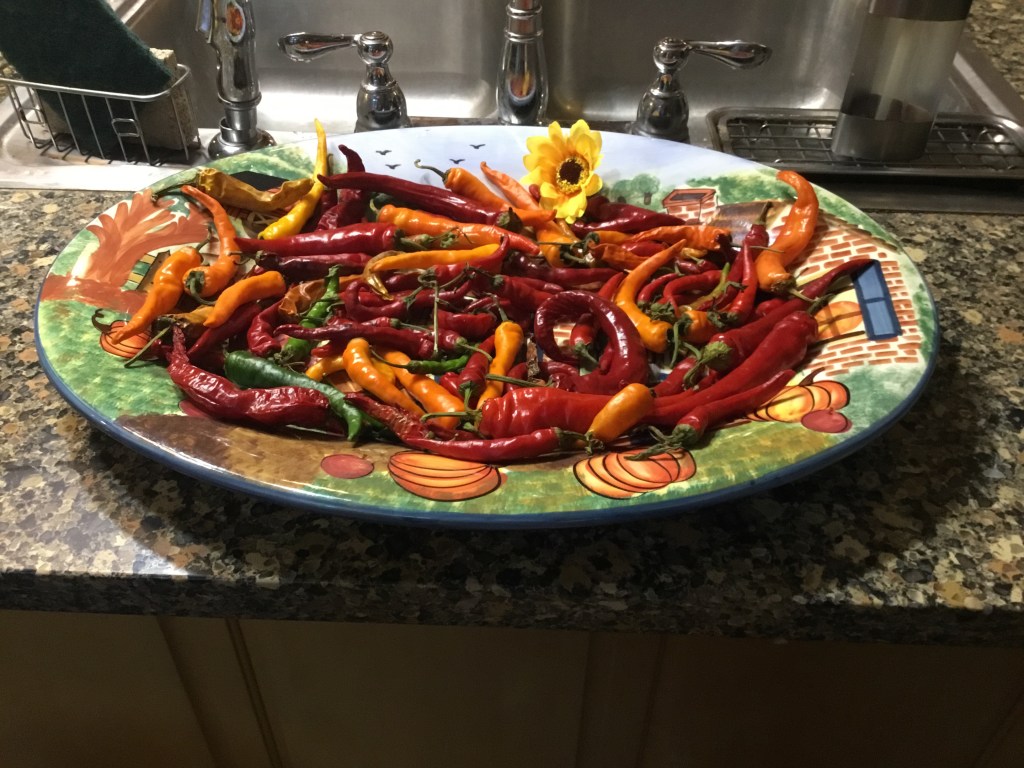
Like every addict, you have to eventually confess about your addiction. That plate tells you that I am addicted to pepper flakes.
This year I am drying my own, with a nice mixture of kinds hot and really hot. Really hot include Cayenne, Tabasco, and Royal Black. Serrano is hot, but not like the first three. The mildest is the old standard Cowhorn pepper. These are all local.
After they are dried, they take a couple of trips through the old Enterprise #602 grinder.
Pizza!
What does MJ do but dive into a scrap pile cabinet of hers, and comes out with a pepper flake shaker–THAT HAS PEPPERS ON IT. Nothing to do this weekend but fire up the brick oven.
Our chicken run is 16′ by 24,’ or 384 square feet, which is the size of an apartment in some cities. It houses eight hens, and they make sure to inspect every inch of it daily.
I just completely cleaned out both coops this weekend, and added ten gallons of pine shavings to various places. MJ was mowing with our electric mower, and added three bags of grass clippings and dried leaves. Those birds will be busy for days.
We have four sections to the run, the junkyard/compost bin, the run itself, and the large and small coop. I’ll describe each in turn.
Junk Yard/ Compost Bin
Junk in the Run
By far the favorite place for the birds to hang is the compost bin and junkyard combination. It’s small and shady, and the compost draws in bugs and worms. I did upgrade the mailbox nest by putting a scrap 2×4 in front of where the door once was, to keep the birds from scratching out all of the shavings as soon as I put them in there. It worked, as I found three eggs in there this morning.
Junkyard Chicks
The Run
Chicken Run with Running Chicken
The run itself takes up about two thirds of the enclosure. It has three watering stations, and the ground is usually covered in shavings and clippings at this time of year. There’s room here for the birds to run, flap their wings, and scratch for hours. In dry weather I also dump out various food for them to scrounge around and find. If I want to start a real chicken riot, I’ll stand on the outside, and throw small chunks of various goodies in there, one after another. To the fastest bird goes the spoils.
The Big Coop
Snack Time at the Big Coop
This decent sized pre-fab coop easily houses six grown chickens at night, and we fill it with four Barred Rocks and two ISA Browns. The browns have taken over the top part of the coop, which leaves three quarters of it to the Rocks. This coop is also right next to the junkyard, so the birds can pop in for a quick bite at any time. My two additions are a homemade PVC feeder, and a one gallon watering jug made from a Sterilite container, which has been drilled and fitted with five little automatic, spring loaded watering devices. The foundation is 4×4’s, another addition of mine, so this thing is not going anywhere.
The Small Coop
Cozy for Two Birds
The small coop is a snug fit for two grown birds, but they have food, water, and a comfy perching area in the top section. This doubles a rabbit hutch, so it didn’t come with a nesting and perching area in the top section. I made both out of wood from my scrap pile. the next step is to double the 4×4 foundation, which will give an extra 3 1/2″ of head room in the lower section.
Any future plans? No more layers in the near future, unless a dog breaks in again, and kills a few. Plans for next spring are tentative, but the idea is to have another pen, with a door into this one, to raise that famous meat bird that originated in Bresse, France, that has blue legs. I would also like a breeding population of those. so I can hatch out my own. Fortunately, a farmer in Mississippi has a good genetics line from birds he imported from France. It may be time for road trip next spring.
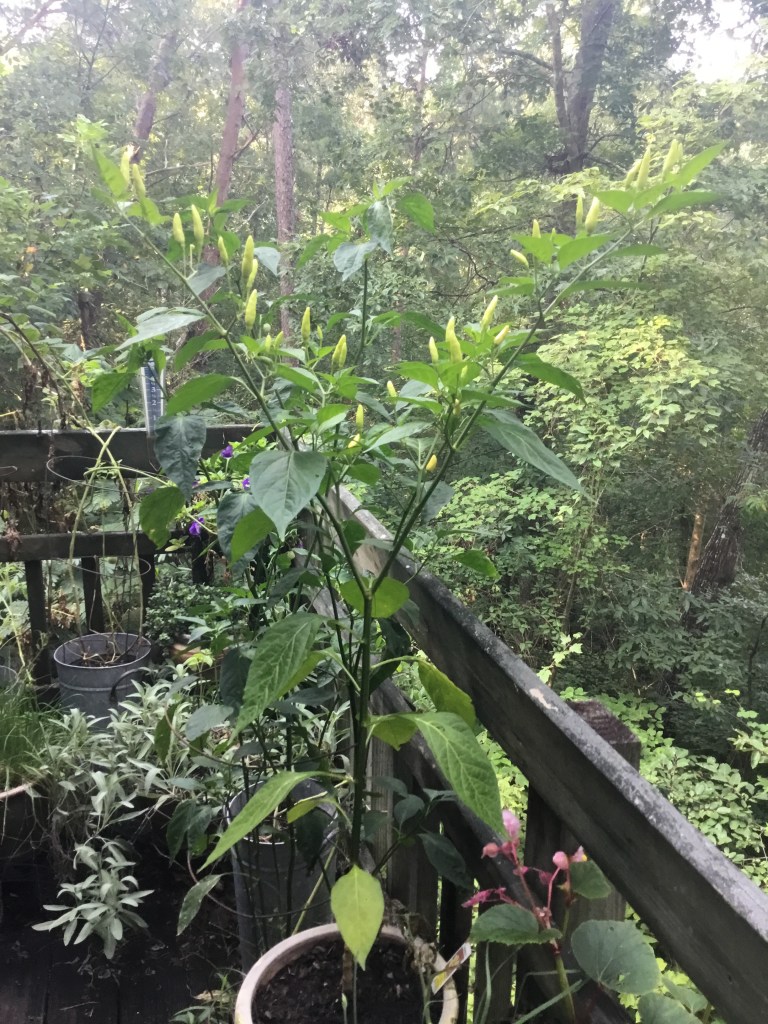
Peppers Galore. The View from our Deck. Sage in the background
Everyone who has used the Southern classic Tabasco Sauce knows that it is dark red. Imagine my surprise when I went to our local vegetable plant seller in the spring, and found that he was selling orange Tabasco pepper plants. I can never resist growing strange new crops–I also have a row of red broom corn, which is actually a plant from the sorghum family.
This was the result.
Future Pepper Flakes
That little reddish orange pepper is the first ripe Tabasco. It’s probably as hot as that whole Serrano that is right below it. I don’t know how this will work, but my goal is to dry all these, and make multi-colored pepper flakes with them. Then I can make some psychedelic sausages.
André Michaux was one more botanist, gardener, and traveler. He was the Royal Botanist to French King Louis XVI, (that is, before the King misplaced his head), and botanized all over Eastern America, Canada, Persia, and parts of the Indian Ocean. Among his friends were Ben Franklin, William Bartram, and Thomas Jefferson. This Southern lily is among the many things he discovered.
We have been fortunate enough to have owned two properties where these were native. That’s a good thing, as these are practically impossible to transplant. I got that info from Ben Pace of Callaway Gardens in Georgia, where he said they killed about twenty of these before they finally gave up on them.
This, however, is the first yellow one I have seen. The more common color is orange. If this makes seed, I will try and plant more. Deer and rabbit love to eat these things, so I will just have to play wait and see on the seed angle. (Note: I just noticed that it has been eaten. Correction! MJ found it for me, as it was hiding in the maples, and it has a seed pod on it!)
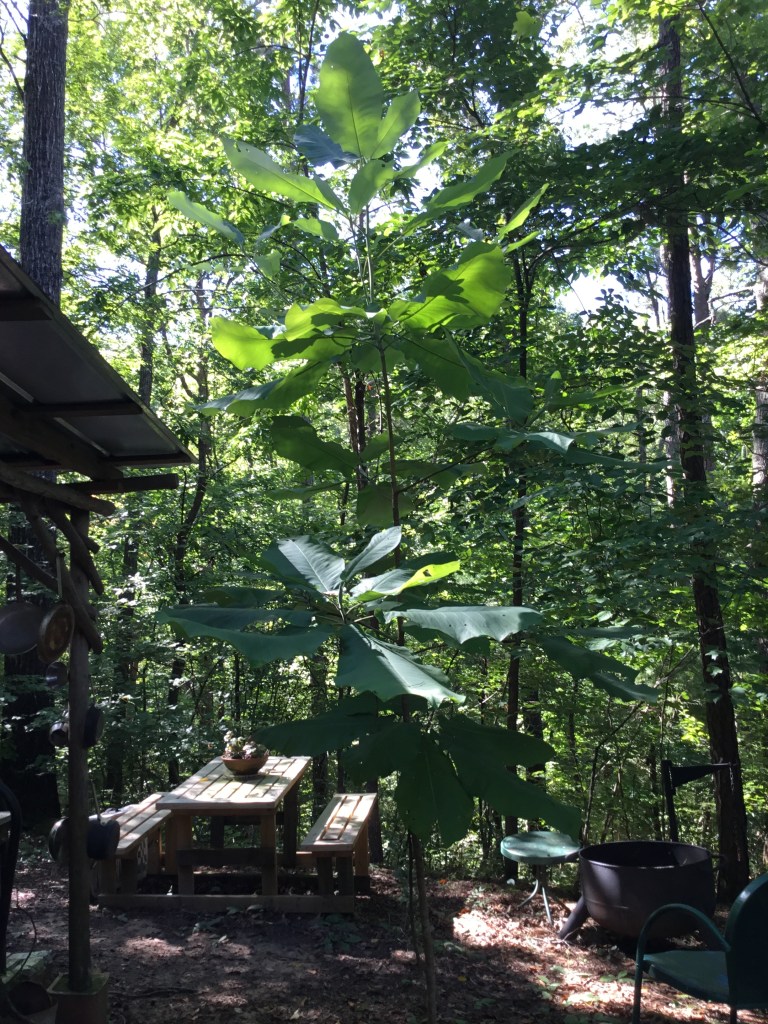
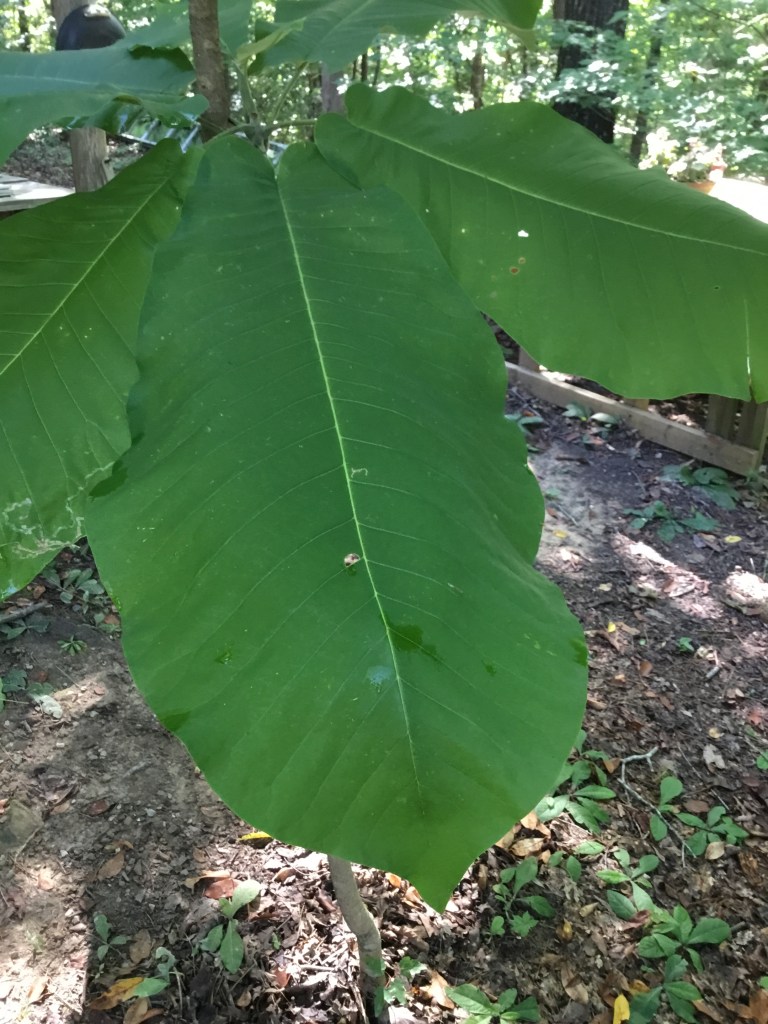
While I’m on the subject of Michaux, here’s another plant he discovered–Big Leaved Magnolia (Magnolia macrophylla). It has the largest leaves and flowers of any plant in North America.
Shade for the Outdoor Kitchen
There is even a legendary yellow flowered version that is found in Alabama. I have seen one of the trees said to have yellow flowers but not while it was in bloom. It’s location is a deep dark secret.
Now that’s a Leaf
Easy to grow, but hard to find, these are too big for even a deer to eat.
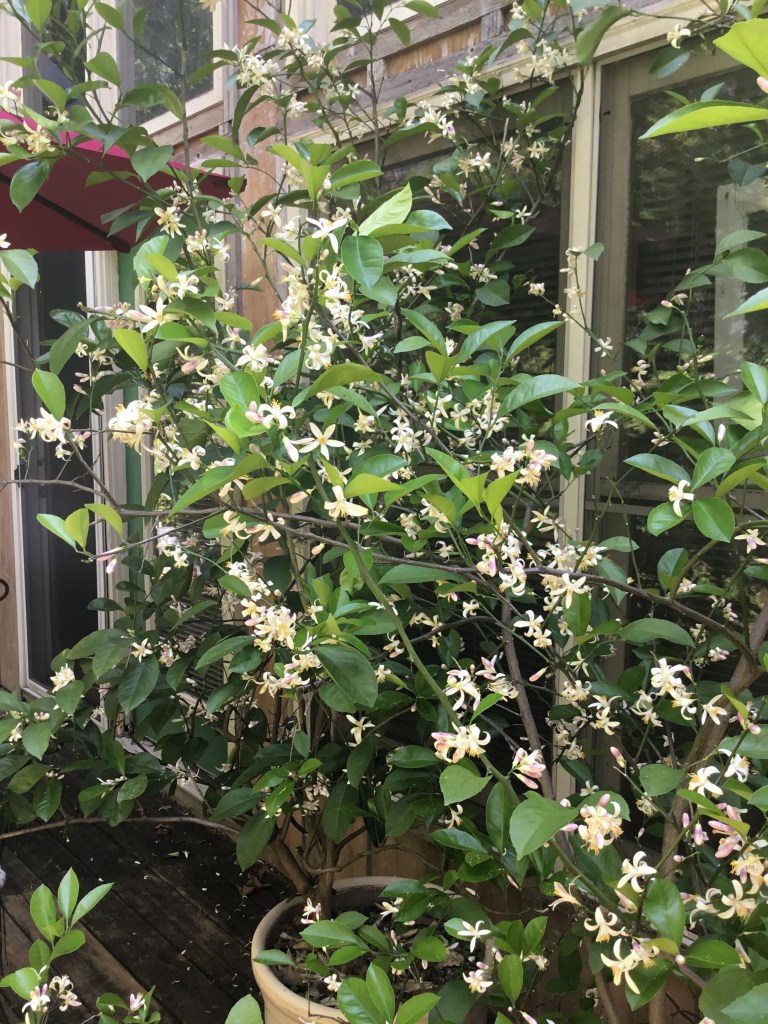
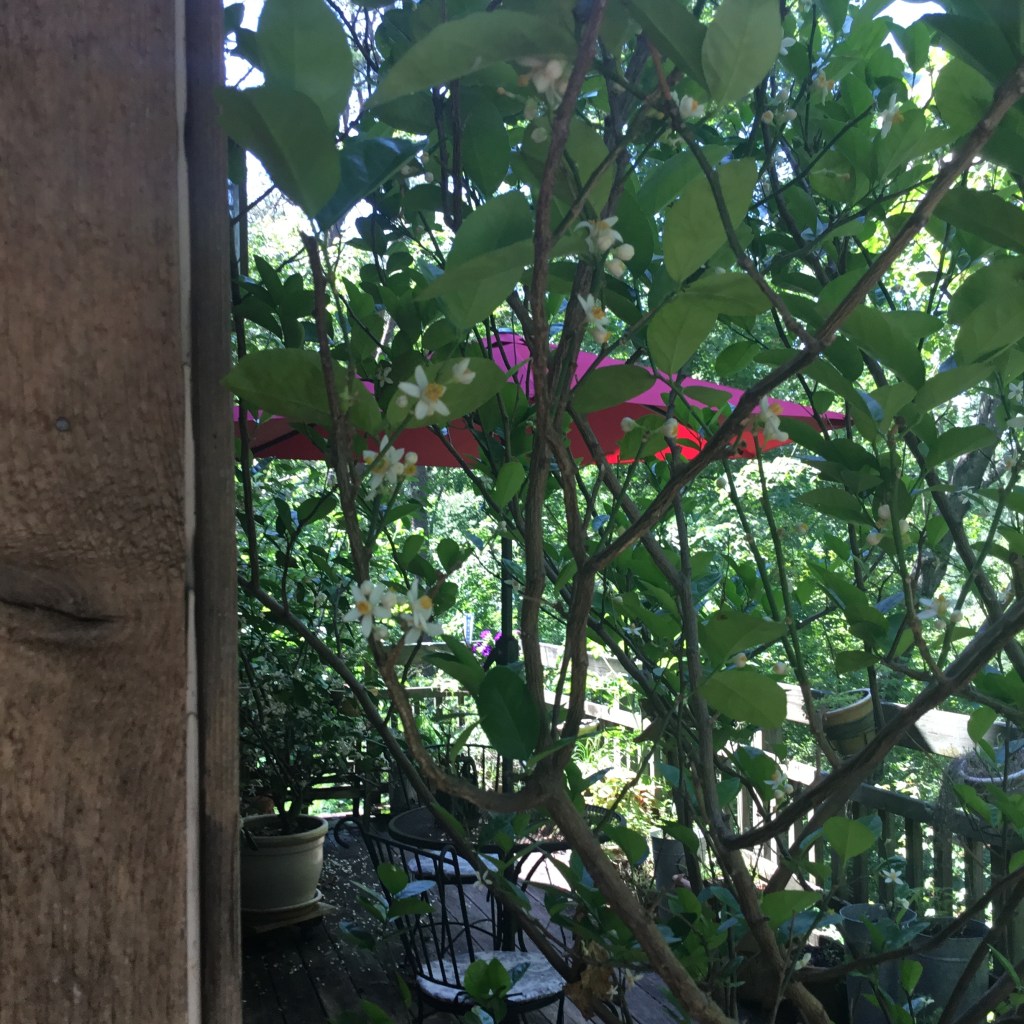
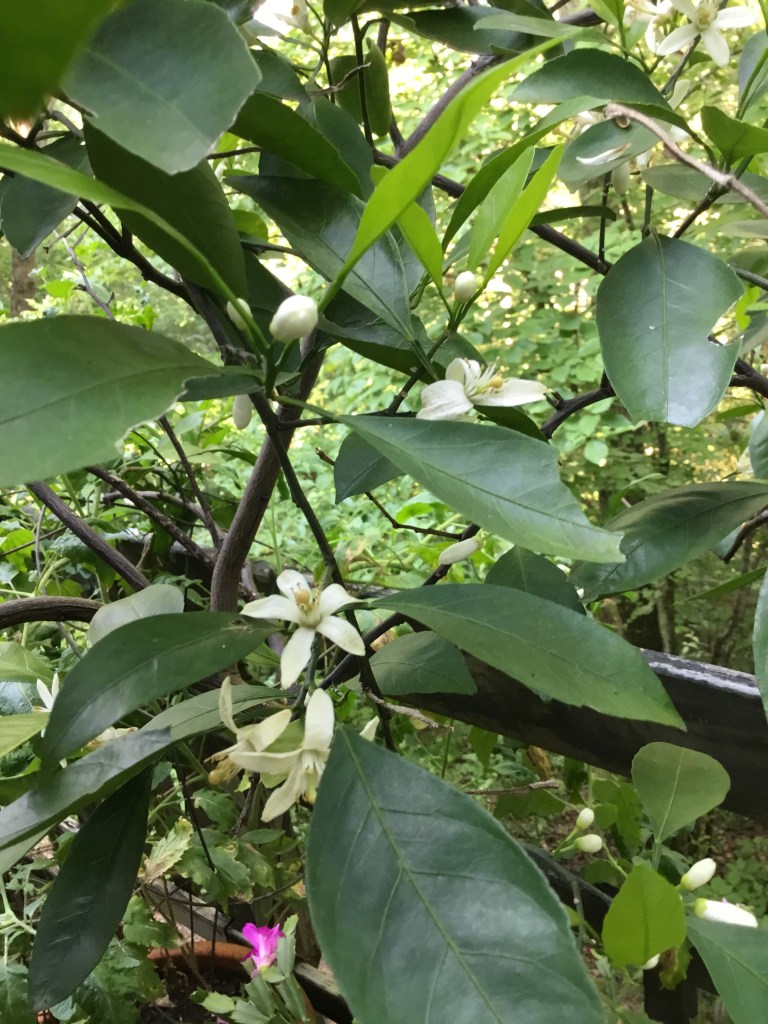
MJ’s mastery of citrus continues, as we have two Meyer lemons that are completely covered in blooms, at least three hundred to five hundred blooms or so. People don’t associate the Appalachians with citrus, but just bring them indoors in containers in the winter (Goethe wrote that they did the same thing in Germany, and that was over two hundred years ago). We’ll end up with only a few lemons, but we usually have enough to last us most of one year, until the next crop comes in. We freeze the surplus.
Key Lime Pie Waiting to Happen
The Key Lime is our most reliable producer of fruit, and we have had over 150 limes in one year, from just his one plant. We still have a bag full of these in the freezer. Beer with lime, anyone?
Orange Blossom Special
The Satsuma Mandarin Orange is the least productive of the plants, but the smell of the blooms is spectacular. This is grown widely on the Gulf Coast, as it is quite hardy for a citrus. There is even a town called Satsuma in south AL. The best Satsumas come from Plaquemines Parish in LA, which is just south of New Orleans. They even have their own Orange Festival.
Finally, MJ has some cuttings of Meyer Lemon started, and she doles those out to her family. All I can say is that growing citrus from cuttings is not for people with short attention spans. MJ has a waiting list of more than one year.
Whenever the fresh tomatoes start rolling in, I always think about the great book by Barbara Kingsolver, Animal, Vegetable, Miracle, and the chapter that she titled, “Life in a Red State: August.” The title is overdetermined, as she was referring to the circumstance that she was living in Virginia at a time when it was run by right wingers, and the fact that she had so many tomatoes that she could not even see the surface of her countertops. That’s a serious canning job.
We timed using our last quart of MJ’s home canned tomatoes perfectly, as we used them last weekend to make sauce for our brick oven pizza. Then guess what, the new fresh tomatoes start rolling in. These are all local, and some came from around ten feet from our front door. The light colored ones are Bella Rosa, that we grew on our deck.
The purple ones we bought at the Festhalle Farmer’s Market, from the same farmer who grew that crate of tomatoes that are my logo. I suspect that they are Cherokee Purple, a great tasting tomato, as his daughter, who handled the sale, had dyed her hair purple. A farm girl has to do what a farm girl has to do.
Barbara Kingsolver writes that most farmer’s vote conservative because of the risk involved in farming–one bad crop or bad season, and you’re toast. I would add a lack of decent education in rural areas is a great contributor. After spending twenty nine years in the education system which is now the worst in the US, I can say that we have worked hard to become last overall. Irony alert.
I will instead concentrate on maters, having given up on learnin’, except for my own. We have a state run by looney tunes characters, except that they have no humor, which is not a good combination.
Tater digging time has arrived down here, and there will be lots of them. The first few plants yielded four different taters.
There are two yellow varieties in the bucket, and they are Gold Rush, and the standby Yukon Gold. The reds are Norland Red, which is quite attractive, so much so that I think I will eat them. The classic Russet rounds out this group.
I did very little for these roots except treat them with soil sulphur, to keep them from rotting, and a handful of organic fertilizer. With that little effort, we will be in taters for the rest of the summer. That’s taters, not tatters, though I do a really great Mick Jagger imitation, singing “Shattered.”
If you have a chop saw or a mitre saw, this is a thirty second project. I have what is probably a lifetime supply of 4″ pvc pipe, left over from the idiots who did our plumbing (they had our main drain running uphill). All I bought was this 4″ wye joint, and some test caps, instead of the more expensive plug ends. It’s only going to hold some chicken feed.
Total cost for this project was less than $15. It cost $250 to get my uphill drain fixed. This can be made in any size, but this one is small, to be fitted into our small coop. Next years project–a pen extension, another coop, and some Bresse chickens. Also an incubator, which I intend to build myself.
I had to include a gratuitous set of my old German tools in the picture, and my new 2″ bowl gouge, from PA. That thing can do some serious damage.
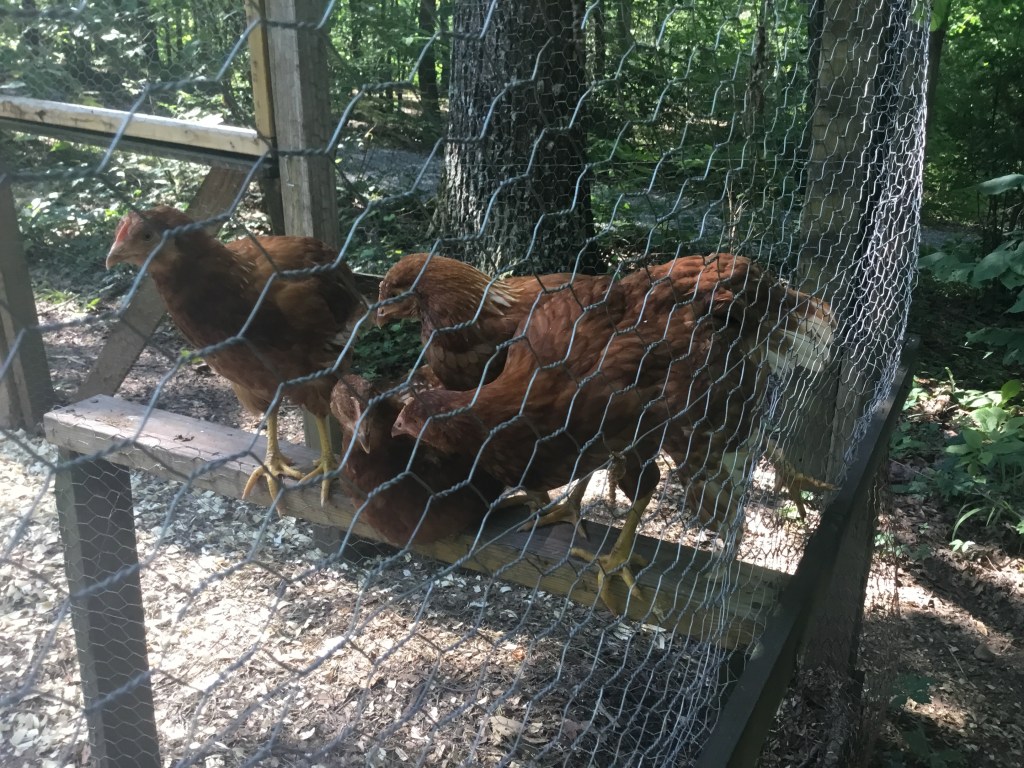
I knew that ISA Brown chickens grew fast, but these have gotten so big in such a short time that it’s almost scary. As stated before, this variety was the brain child of the French Minister of Agriculture in 1975. It is now apparent that he was bent on world chicken domination by the French (think of Volaille de Bresse, the famous blue legged meat chicken from Bresse, which a few years ago sold for forty dollars a bird in London).
So the French wanted the best eggs, to go along with the finest chicken meat, and they wanted mass quantities. Though the heritage of these birds is considered a corporate secret, it is apparent that a large part of the genetic line is the Rhode Island Red chicken. Apparently the Rhode Island White is also involved, as the roosters of these birds are always white.
And talk about hyper! The big fat Barred Rocks we have don’t even try to chase them anymore, as they can lap those big birds in one circuit around the big coop. They are also great at thieving the food out of the Rock’s giant feeder. Today’s project is making them a feeder of comparable size, out of PVC pipe. Film at eleven.








 Southern Fusion Cooking