Italian Food in a Tube

Pasta, Please

Having received three books on Tuscan cooking for Christmas, I am now even more against processed or imported food than before, and in favor of nothing but local food. However, there is always an exception to every rule, and these Italian ingredients in a tube are mine. The packaging is minimal, the product stays fresh forever, and these will turn any bland dish into something tasty.

The Pesto paste is basil, sunflower and olive oil, salt, pine nuts, and garlic. Having made pesto in the past with sunflower kernels instead of pine nuts, due to the cost of pine nuts, this is a winner. A small amount of this is all that’s needed in most pasta sauces.

The Garlic puree is, well, pureed garlic with oil. I grow garlic, but sometimes a tube snatched out of the fridge is much easier than chopping and smashing. It is also very inexpensive, and there is no jar to clutter up things.

My favorite, however, is the tomato paste in a tube. Even our local supermarket carries one brand of this. The triple concentrated version in the picture is a superb product. I use it to fortify sauces made from our sometimes watery local tomatoes, instead of cooking the sauce down for an inordinate amount of time. The double concentrated paste will work as well, but has less of a punch.

So there we have the Italian flag, which is often referred to as basil, garlic, and tomato, because of the colors of three favorite Italian ingredients (sometimes mozzarella is used instead of garlic). All this just makes me crave for a pizza margherita.

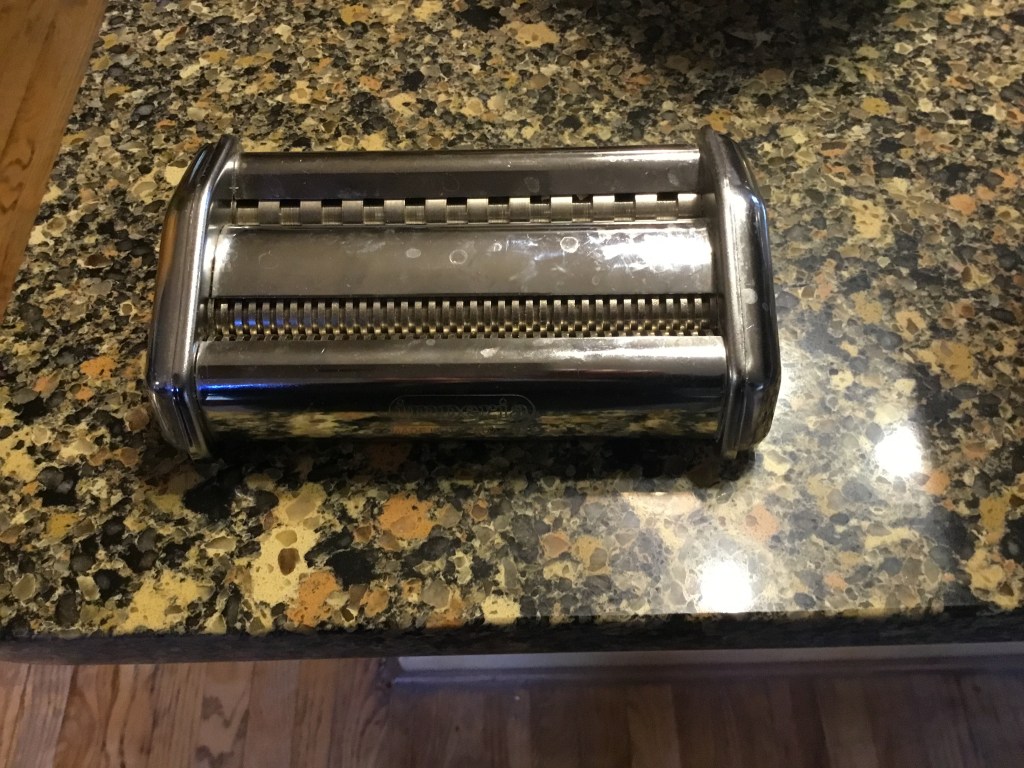
Imperia 150 Pasta Machine

Get the Sauce Ready

Thomas Jefferson loved pasta. He and his chef James Hemings are said to have introduced macs and cheese–or at very least, popularized it– to North America, and for years he and his family imported pounds and pounds of pasta every year from Italy. Undoubtedly, the first American recipe for macs and cheese was in one of his relative’s cookbooks, Mary Randolph’s 1824 book, The Virginia Housewife.

Jefferson also owned a pasta machine, which was purchased in Naples. His description of it is as follows:

The best maccaroni in Italy is made with a particular sort of flour called Semola, in Naples: but in almost every shop a different sort of flour is commonly used; for, provided the flour be of a good quality, and not ground extremely fine, it will always do very well. A paste is made with flour, water and less yeast than is used for making bread. This paste is then put, by little at a time, viz. about 5. or 6. lb. each time into a round iron box ABC, the under part of which is perforated with holes, through which the paste, when pressed by the screw DEF, comes out, and forms the Maccaroni g.g.g. which, when sufficiently long, are cut and spread to dry. The screw is turned by a lever inserted into the hole K, of which there are 4. or 6. It is evident that on turning the screw one way, the cylindrical part F. which fits the iron box or mortar perfectly well, must press upon the paste and must force it out of the holes. LLM. is a strong wooden frame, properly fastened to the wall, floor and cieling of the room.

N.O. is a figure, on a larger scale, of some of the holes in the iron plate, where all the black is solid, and the rest open. The real plate has a great many holes, and is screwed to the box or mortar: or rather there is a set of plates which may be changed at will, with holes of different shapes and sizes for the different sorts of Maccaroni.

Papers of Thomas Jefferson

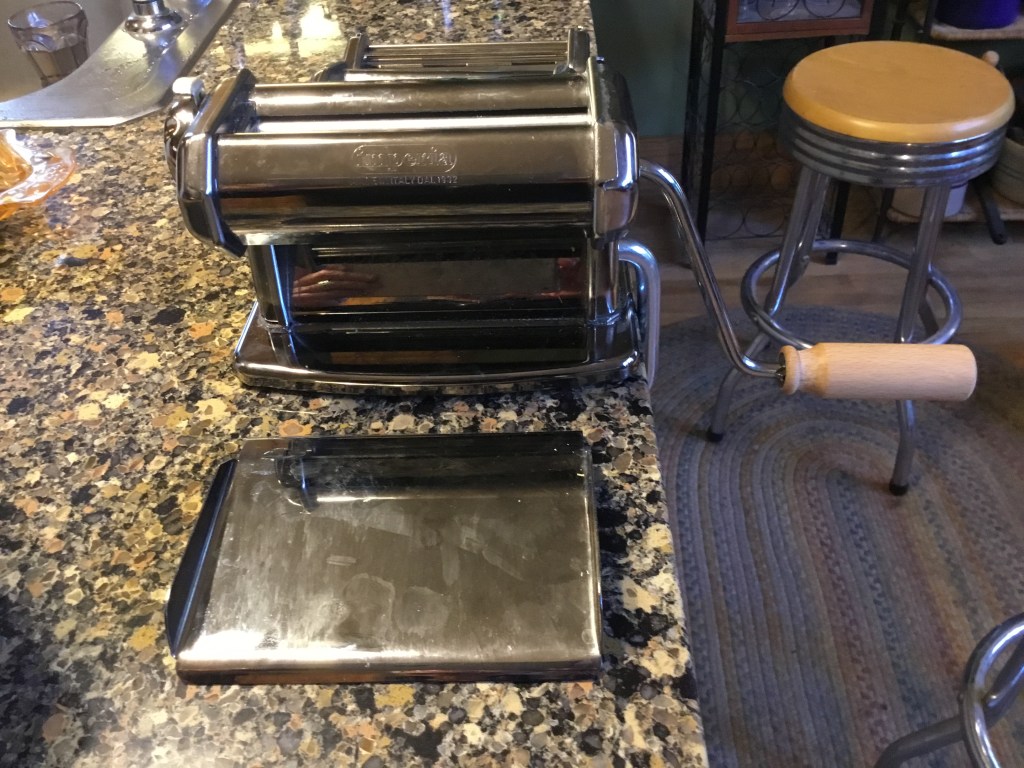
So even back in the day there were machines for making pasta, and the Greeks said that the god Hephaestus/Vulcan himself made the first one. I’ll stick with this Italian made Imperia machine.

Double Cutter

The double cutters are particularly handy, and this one makes both spaghetti and linguini. A large number of single cutters are available also.

Single Cutter

This cutter makes pappardelle, a nice thick pasta for equally thick sauces. The machine itself can make sheet pasta in six different thicknesses.

Parts and Pieces

The machine did not come with an instruction manual (naturally), so I had to jimmy with it to see the options. The dough tray clips to the front, which is the side the sheet pasta comes out of. The front will also hold a single cutter. The back side works best with the double cutter. Or, you could just leave all that stuff off, and make sheet pasta at the thinnest setting, or even dumplings, at the thickest setting.

Lasagna Sheet

Bill Buford wrote that the Italian introduction of the egg into pasta making was their greatest contribution. I nominate this machine for second place.

Tortelli alla Maremmana

A Healthy Plate of Pasta

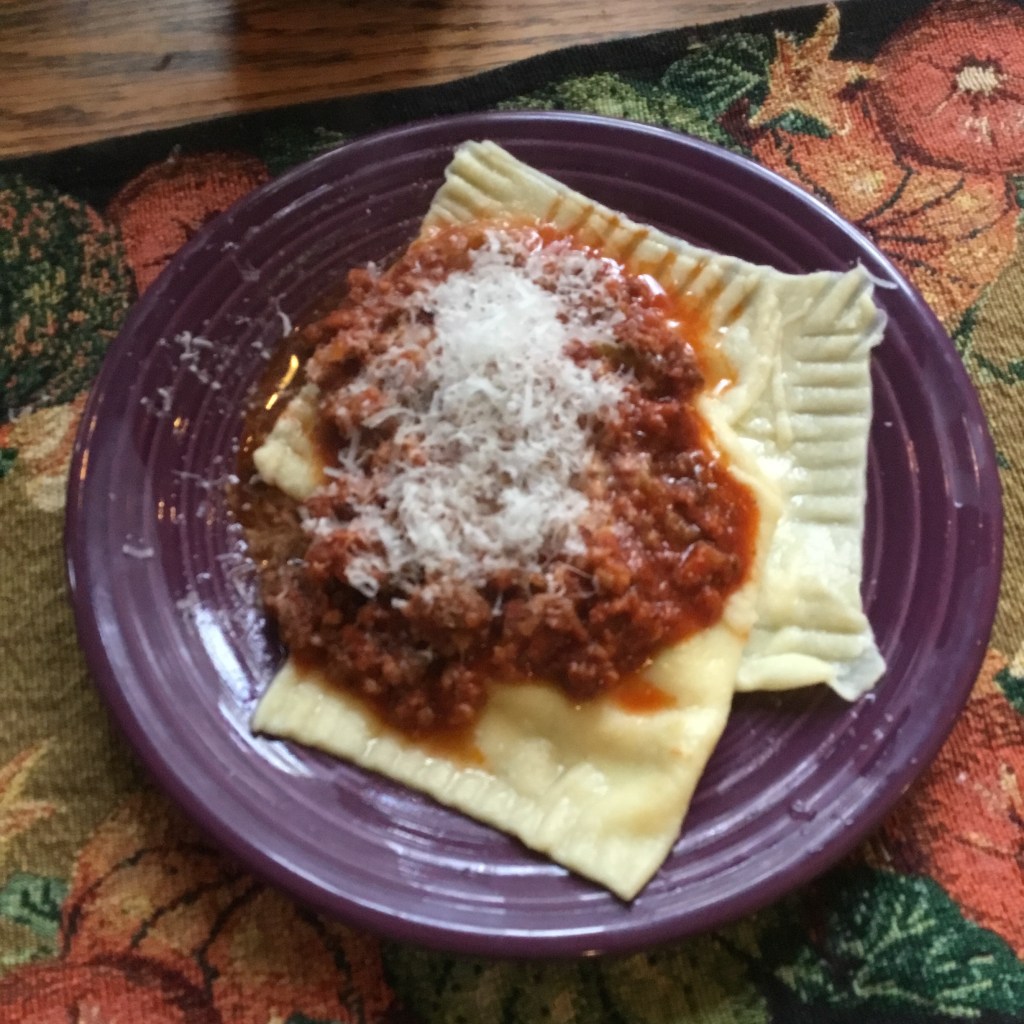
Having become fascinated with the parallels between Tuscan and Southern cooking, I decided to make a dish that has entire food festivals dedicated to it–tortelli, or tordelli. They are made in a bewildering number of fashions, and with many local fillings, so I ad libbed and made my own version, with some honking big tortelli, with a sauce approximating a Tuscan meat sauce. The result is incredibly rich and tasty.

Meat Sauce with Fresh Tomatoes

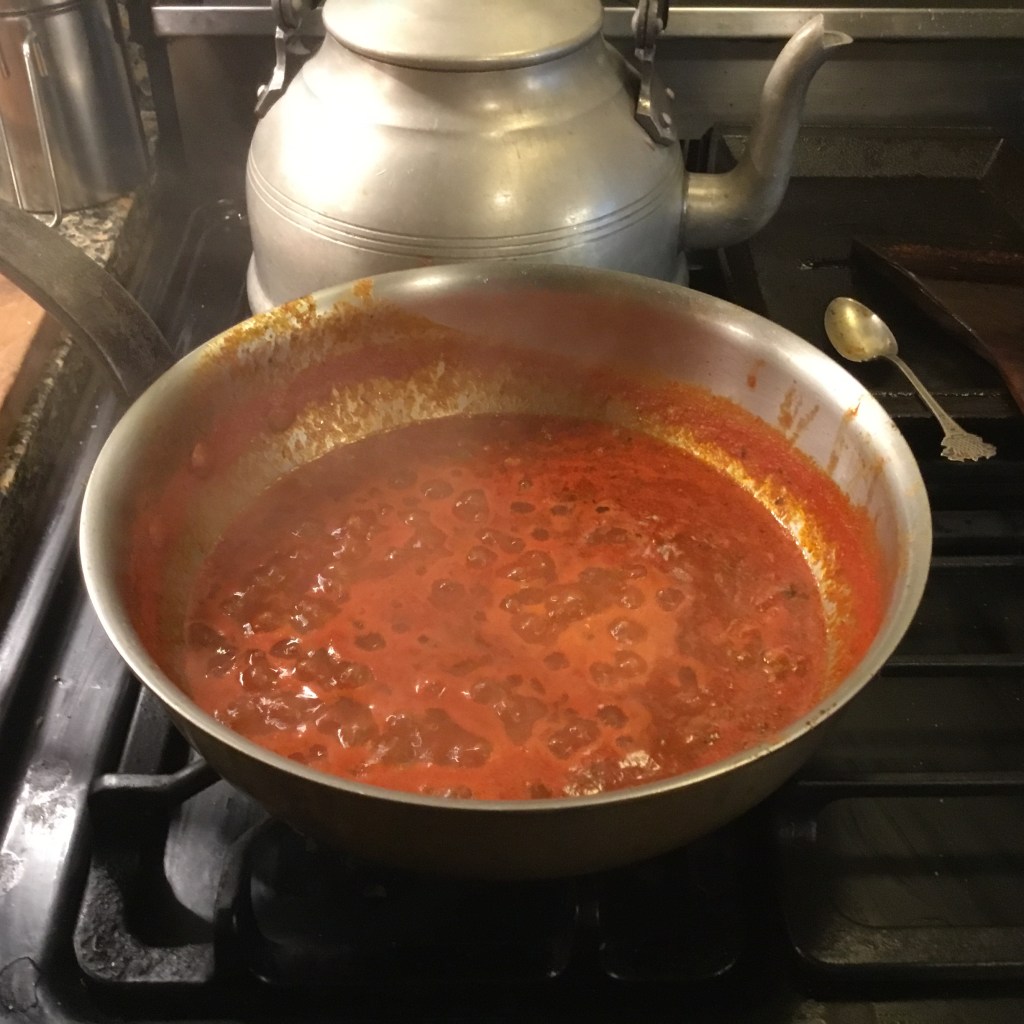
This is a typical meat sauce, and the quantities are determined by how many tortelli you need to sauce. I only had four, so I used fewer tomatoes, and piled on the meat. Saute some onion and pepper in olive oil, and then add the fresh tomatoes (I milled mine in a food mill, so they were peeled and seeded at the same time). The Tuscans would use chopped meat in a sauce like this, but I had homemade Italian Sausage, and some hamburger I ground myself, so I browned those in a skillet, and added those to the sauce. My customizing was to add some oregano, and two actual Italian ingredients, both of which come in tubes like toothpaste tubes, which are tomato paste and garlic paste. Naturally, there is also salt and pepper in it.

Fall Greens

The filling for the tortlli is as simple as you want to make it, but I used the traditional greens and ricotta combo. The Tuscans use everything from spinach to thistle, but we had fresh kale at the Festhalle farmer’s market, so I went with that. I wilted it in olive oil, shredded it, and added it to some homemade ricotta.

Lots of Filling

The judgement call comes when you decide how big to make the tortelli, and in what shape. I went by the Tuscan saying that tortelli should have a “wide footprint,” so I made mine big enough that just two would cover a plate. I also used a technique that I had never seen before, that was on an Italian website. I started with homemade sheet pasta.

DIY Tortelli

I cut fairly wide strips of this pasta, about twice as long as wide. The next trick is to put a spoon full of filling on one side, and then fold the pasta over itself. This eliminates the fiddly business of cutting the pasta into squares, making the tortelli, and then trimming them yet again with ravioli cutter. I just put water around the bottom edge, and used the back of a fork to form a waterproof seal. Tortelli should be boiled in water as salty as the sea for ten to twelve minutes, strained, plated and topped with sauce. Add some grated parmesan, and have your own festival. We did.

Linguine alla Carbonara

The great Calvin Trillin once joked that the national Thanksgiving dish should be Spaghetti Carbonara, instead of turkey. I decided to make some, because of that, and I hated it. We still have turkey for Thanksgiving.

Then last week, Melanie Jane said we had to use some of the increasing pile of eggs that our chicks produce, and she found a recipe from Lidia Bastianich for Linguine alla Carbonara. I made it, and it was literally one of the best things I have ever eaten.

The difference? Instead of supermarket bacon and eggs, I had local fresh bacon which I had marinated myself, and eggs from our chicks. The dish is very simple to make.

Ingredients

Pasta Water (Water as salty as sea water)

Linguine (dry or fresh)

Two slices of thick Bacon

1/2 of a small Onion, chopped

Chicken Stock

Two Egg Yolks

Grated Parmesan Cheese

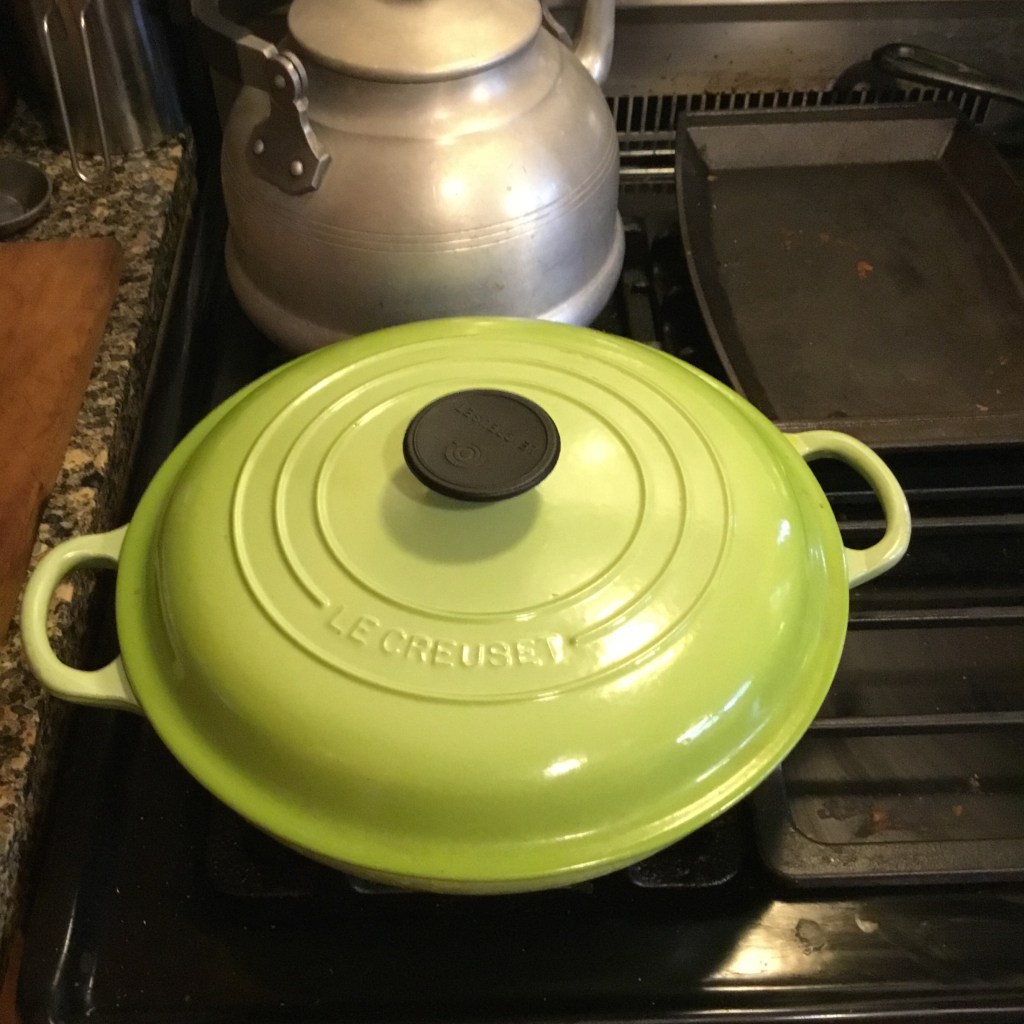
This sextet of ingredients will taste like a symphony if cooked properly. Start with the pasta water, and fry the bacon in a brasier/pasta pan (not pot). Here’s ours, but a skillet will work fine as well.

That’s French for Crucible

The ladies who own our local Le Creuset store in Birmingham picked this one out for me, so my addled brain was not taxed. When I told them it was a present for my sweetie, they went through an entire stack of boxes, to find the best one. I left as a happy consumer.

Fry the bacon while the pasta is cooking. Remove the bacon when it is crisp, but keep the fat, and cook the onions in that. Add a little chicken stock, and I mean a little, and add the chopped bacon, and the pasta (strained) once it becomes al dente. Is Al Dente related to Al Fresco?

Stir those together, and then here comes the only tricky part. Turn off the stove and add the raw yolks. Yes, I said raw yolks. If the heat is just right, the hot sauce and pasta will cook the yolks. If too hot, you have scrambled egg pasta. Too cool, and it’s yuck city.

Grate some good Parmesan over the whole thing, and there you have it. I splurged on some real Reggiano. That didn’t hurt any either.

As long as our chicks keep clucking, this is on the permanent menu. I had five eggs from six birds yesterday, and it appears home made mayo is the next project. Or anything else that uses eggs.

Brick Oven: Building and Maintaining a Fire

Fire Walk with Me–Twin Peaks

There actually is a process involved in building and maintaining a fire in a brick oven. Begin with completely dry soft wood, and then add hardwood if you want to build up a bed of hot coals. Here I start with yellow pine, and then go to a pine/oak mixture. We might as well start at the beginning.

More than Fahrenheit 451

Aristotle said a good plot had a beginning, a middle, and an end, in his Poetics; a good brick oven fire begins in the front, is pushed to middle, and then to the back. This is especially true for all applications involving cooking meat or pizza.

TV chefs will bring out something dramatic to light a fire, like a propane blow torch. I use two cardboard egg cartons and one match. The results are the same–fire.

All this with just One Match

Time for a break now that the fire has been pushed to the middle of the oven. This tool keeps me in firewood.

Sometimes Technology is Good

That’s a 24 volt electric chainsaw. I liked it so much I bought a 24 volt weed whacker, and a 60 volt lawnmower to go with it. I charge up the batteries with a solar generator, which is in turn charged by a single 100 watt solar panel. I’m inching toward sustainability, and did I mention the thirty percent tax credit on solar panels and batteries?

Mmmm. Vidalia Onions

Push the fire to the back, and sweep and mop for pizza. A pie with sliced Vidalia onions makes all the work worth it. And I get to play with matches, and a chainsaw.

Pizza

Green, White, and Red–It’s either an Italian Flag, or Pizza Margherita

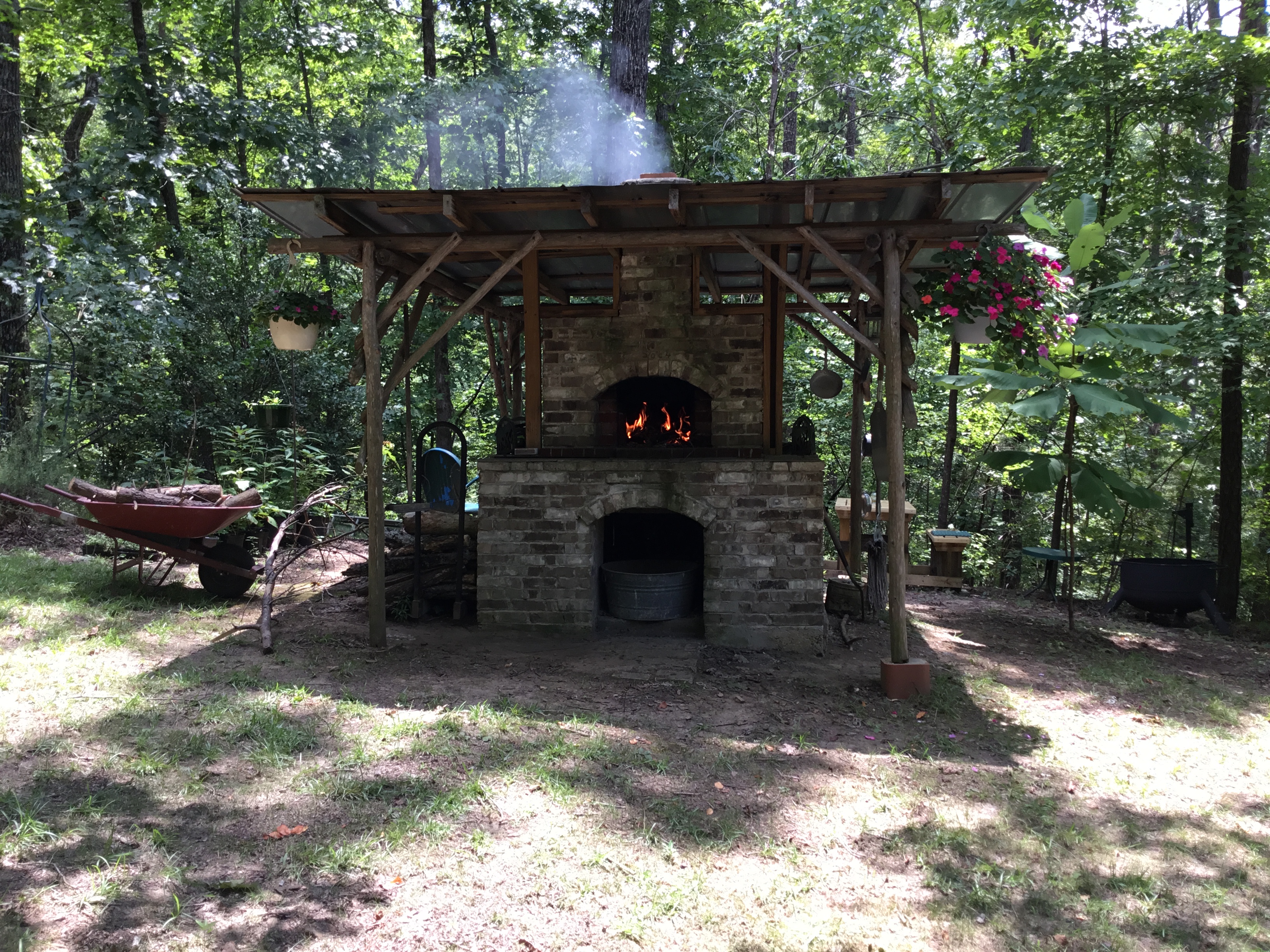
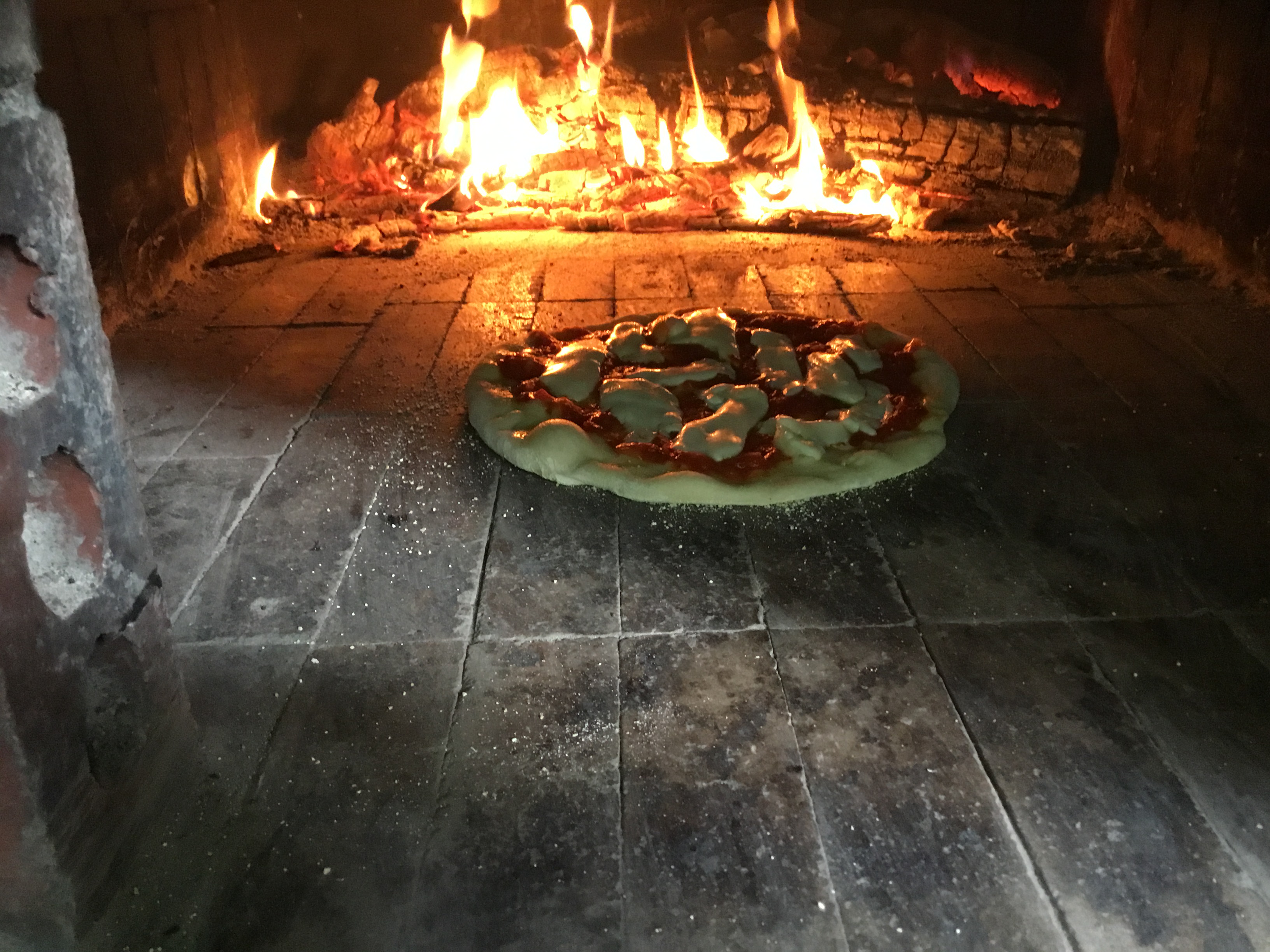
The forecast for Sunday was for a high of only 93 degrees F, so I decided to build a 900 degree F fire, and cook a couple of pizzas. Why the hell not?

Speaking of Hell, Dante would have Loved this

Fortunately, I spent most of my time indoors, making the crust and sauce. I will do a step by step explanation of this process in a series of posts, but here’s an outline of what to do. I will also give an alternative cooking method, for those who do not have a bakery-sized brick oven. The following is for a Pizza Margherita, one of the originals, and still the best.

Ingredients

Dough for two Pizza Crusts–1 1/2 cups OO Italian Flour, salt, water, yeast

Pizza Sauce, preferably made with Italian or locally grown Tomatoes

Italian Mozzarella Cheese

Fresh Basil

The basil goes on after the pizza comes out of the oven. It probably wouldn’t look too sporty, otherwise, after a couple of minutes of this.

Out of the Saucepan, and into the Fire

Other than eating this, the best part is smelling the basil cook on top of the really really hot pizza, right out of the brick oven. Simple and complex–the heart of a good pizza.

Herr Orff, one of my German Professors at the University of Alabama, came to class one Monday, and said, “I had some of that food that you people eat every weekend. What do you call it? Pit-sa. It was very good.” That actually is the correct pronunciation of the word pizza-if you’re German. Good thing he didn’t eat one of these. He might never have gone back to Deutschland.

Italiano

Believe it are not, according to latitude, we are farther south than Italy. However, Italian food can be simple and complex at the same time, just like Southern. Much of our cuisine is also based on la cucina povera, or poor people’s food. So here’s a Southern take on a few Italian classics.

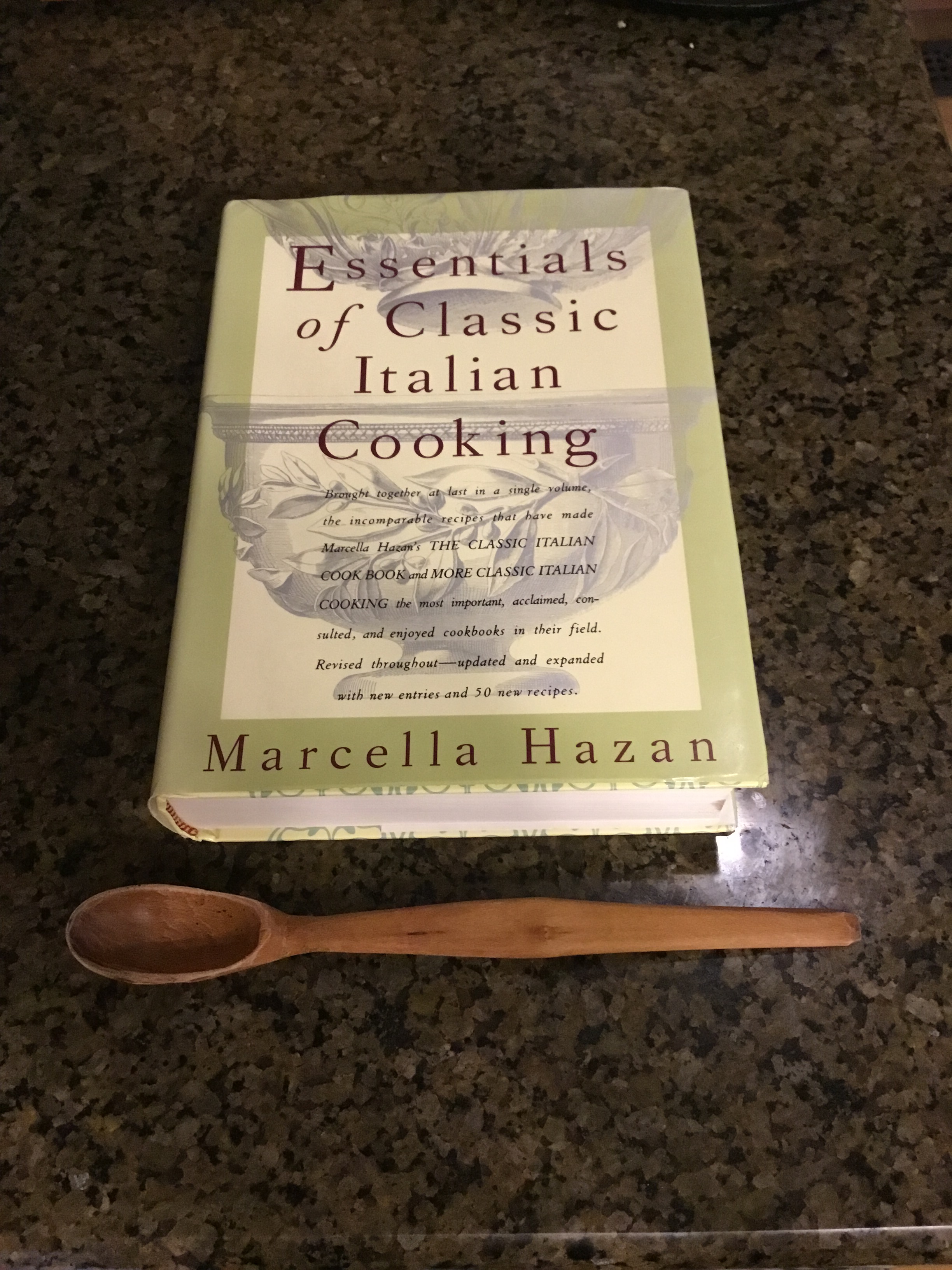
P.S. Buy that book.

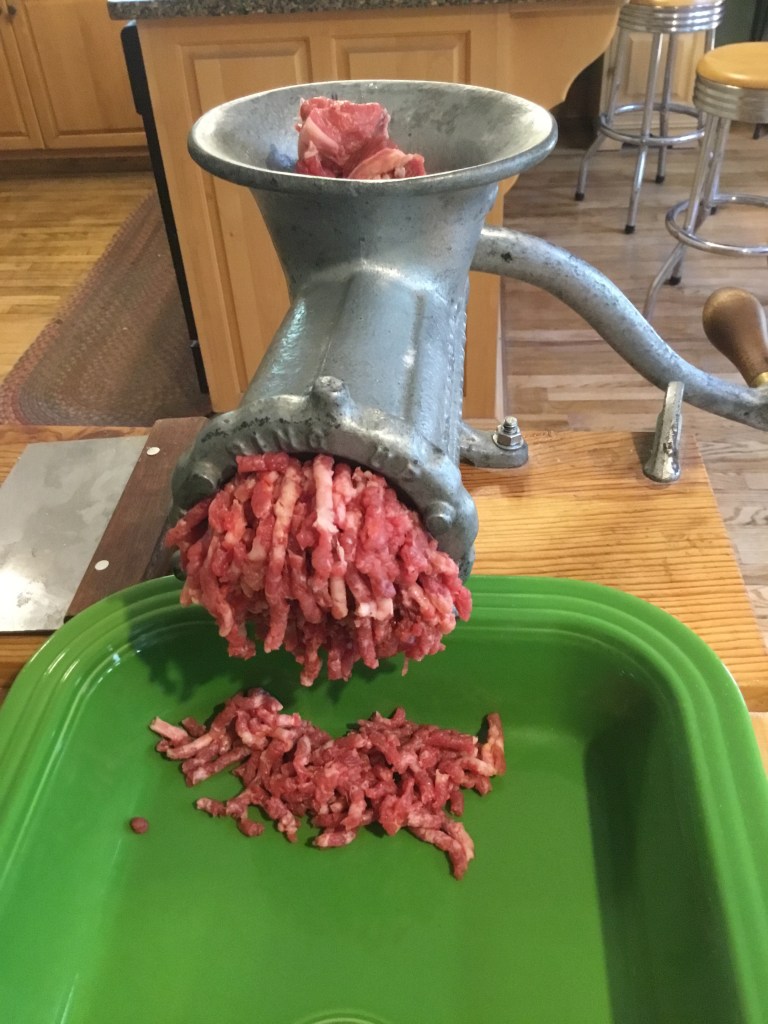
Hand Cranked Tools

Old School is the Only School

Screw electricity. Get some exercise and cook at the same time. Crank it up!

Brick Oven Tools–Scraper/Brush Combo

A Multi-Tasking Tool

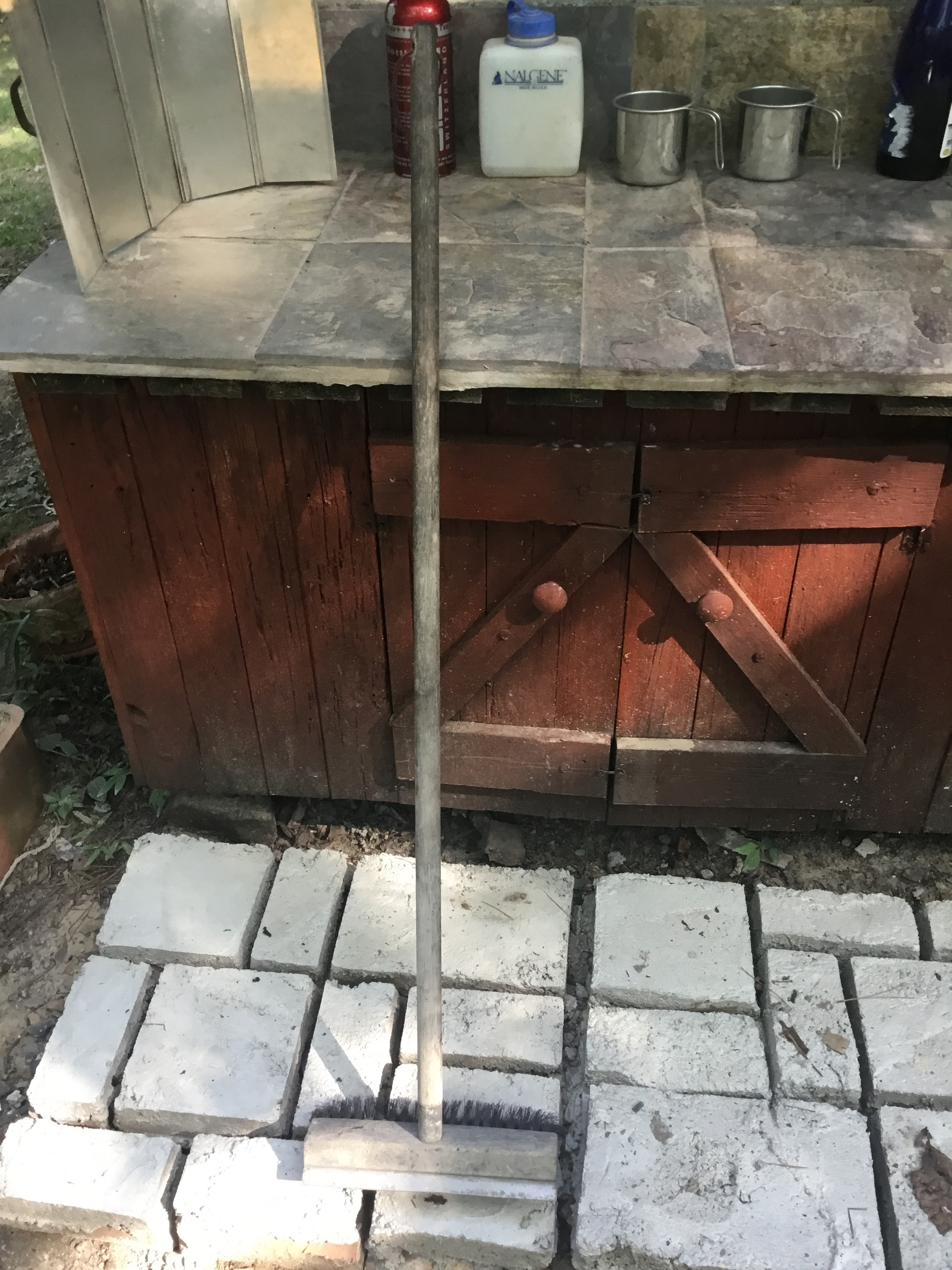
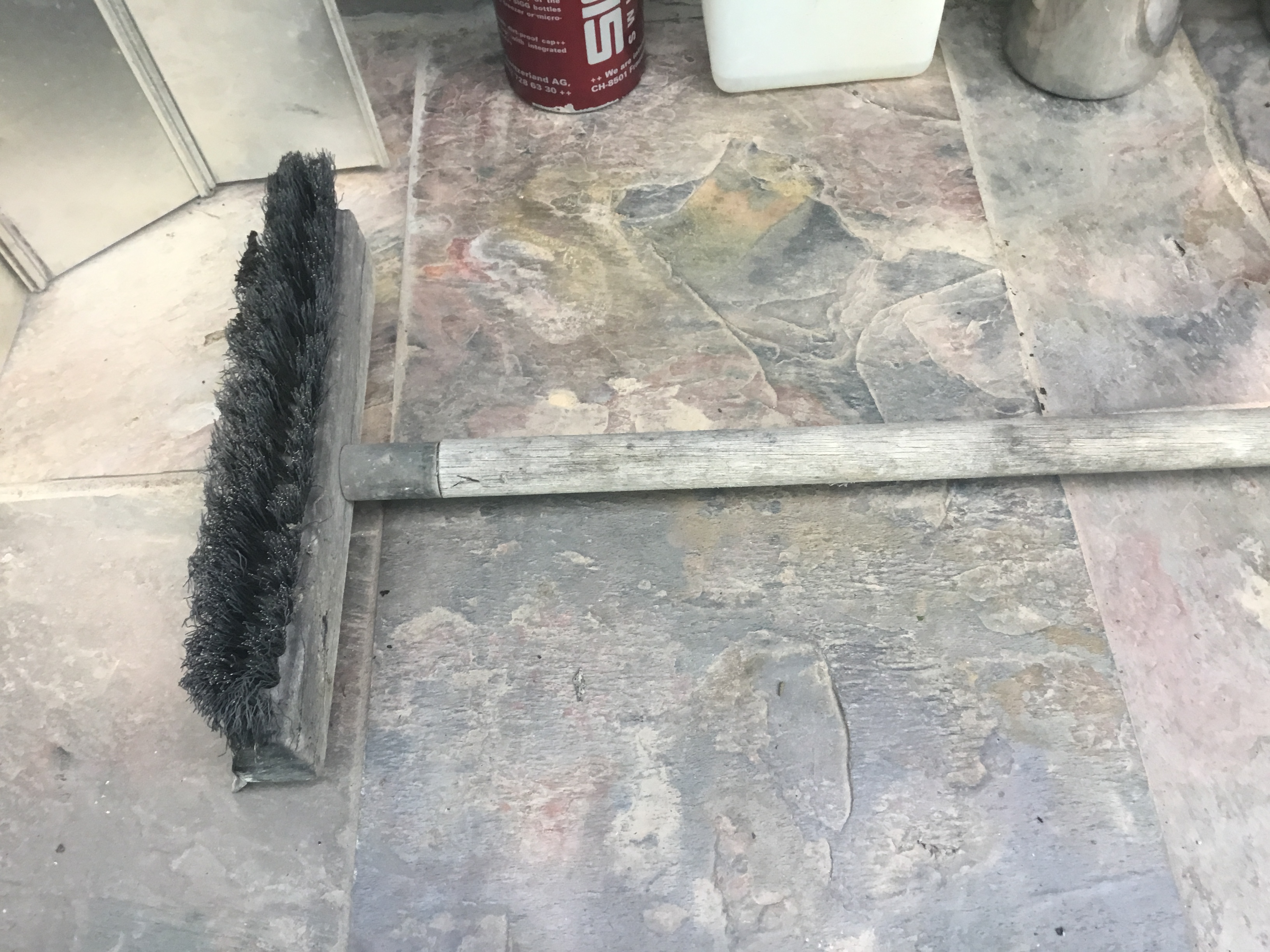
Two essential tools for the efficient use of a Brick Oven are a scraper and a brush. Many people buy them separately, but why? This old US made scraper/brush combo is over fifteen years old, and has years of use left. And I leave it outside hanging on the oven.

Just last weekend I cooked pizza for nine people on the hottest day of the year, with a blazing hot oak/pine fire, and never even broke a sweat. I could do that because of the efficiency of the scraper/brush. Let’s begin with the most useful side–the scraper.

Scraper and Bulldozer

The scraper side serves two important functions, which are scraping, and bulldozing. As a scraper it performs both maintenance and cooking functions. The long handle allows its use as an ash remover, as it reaches all the way to the back of even a large oven. Many modern ovens, like mine, have an ash slot where the remains of yesterday’s fire can be easily scraped away.

Secondly, if you’re making bread or even just baking, the scraper allows one to reposition the fire and/or coals easily, which is a skill that I will address in a later post.

If you’re into pizza or baking, this thing can bulldoze any fire into the back of the oven, which is a necessity when making pizza. Once that is done, it’s time to put the brush to work.

Don’t Brush Your Hair with it

That rather dangerous looking wire brush is really a preliminary clean up tool. It removes most of the ashes from a working fire, as well as small embers and stray pieces of wood. It prepares the surface of the brick oven for the final tool that is needed for the cooking of a pizza–a mop. That will be one of the last two tools I will discuss, but that is a whole another post.

Brick Oven Tools–Welding Gloves

Out with the Old, in with the New

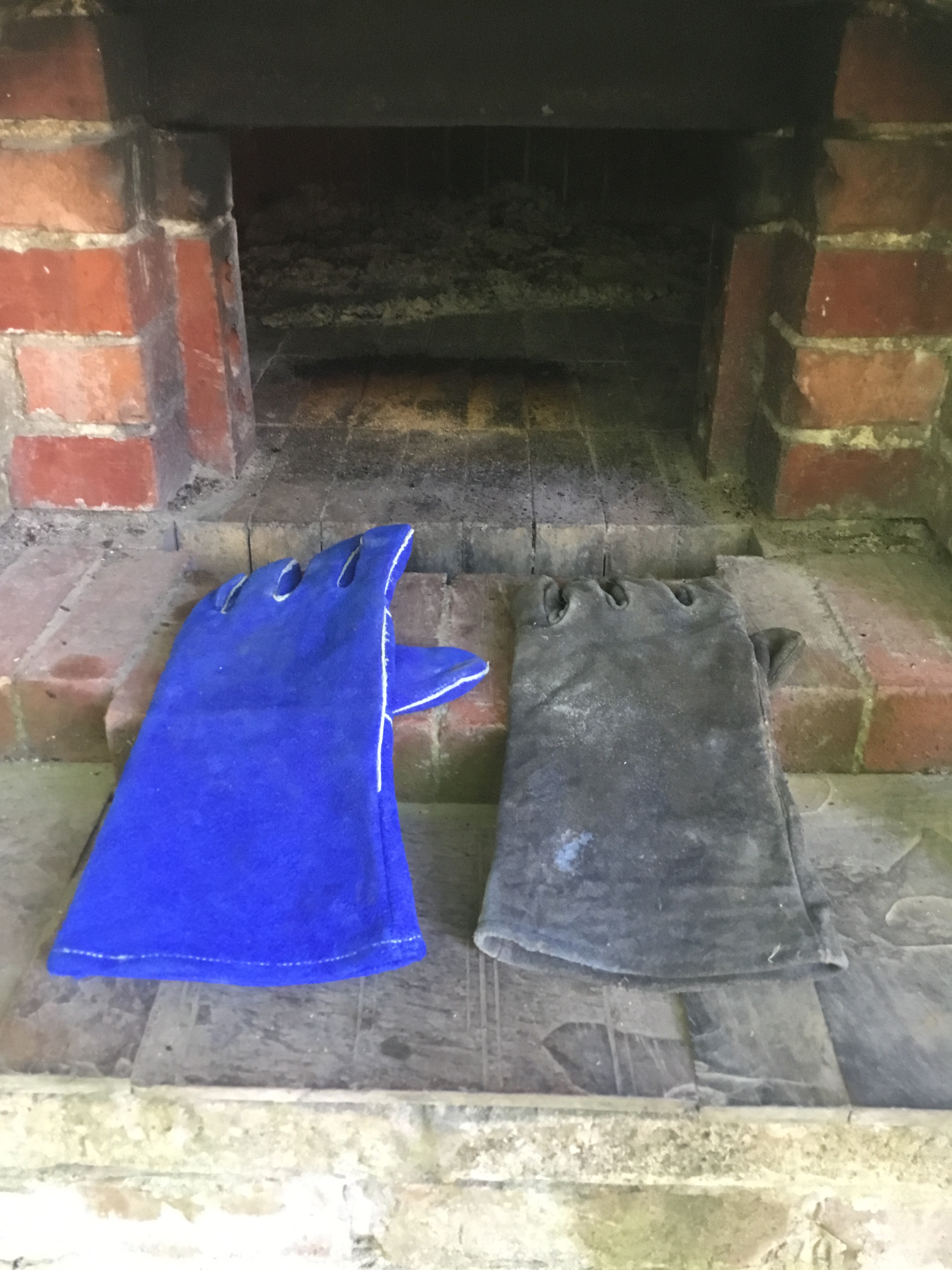
When I first bought my copy of The Bread Builders, from which I took the design for my brick oven, I loved the cover. It was a picture of a hippy looking dude with tattoos all over his arms, taking a round loaf out of a bread oven. Only most of his arms were covered up by a whacking big pair of welding gloves. Why welding gloves?

Check out the Associazione Verace Pizza Napoletana, the official group that lays out the rules for traditional pizza. First, it can only be cooked in a wood burning oven. Second, it has to be cooked in a temperature range of between 806-896 degrees F. 900 degrees F is also a common metric. That’s hot enough to burn the soot off of the interior of the bread oven. And in fact, it does. Hence the need for welding gloves.

My new pair of gloves are identical to what my original pair looked like, though they are still blue (they won’t stay that way long). I left my old pair outside on the oven one night, and a varmint, probably a raccoon, absconded with the right one. The bad news is that I am right handed.

So it was time for Amazon once again. Fifteen years later, they were still the same price. Our corporate overlord Bezos comes through again.

OffGuardian

because facts really should be sacred

Ruth Blogs Here

Or not, depending on my mood

A Haven for Book Lovers

I am just a girl who loves reading and talking about books

what sandra thinks

because I've got to tell someone.

LadiesWhoLunchReviews,etc

a little lunch, a little wine, a LOT of talking!

Margaret and Helen

Best Friends for Sixty Years and Counting...

talltalesfromchiconia

Tales of quilting, gardening and cooking from the Kingdom of Chiconia

Cyranny's Cove

Refuge of an assumed danophile...

Exiled Rebels

Serving BL since 2017

this is... The Neighborhood

the Story within the Story

Beauty lies within yourself

The only impossible journey in life is you never begin!! ~Tanvir Kaur

Southern Fusion Cooking

Country Living in the Southern Appalachians, USA--A little of this, a lot of that

Discover WordPress

A daily selection of the best content published on WordPress, collected for you by humans who love to read.

The Atavist Magazine

Country Living in the Southern Appalachians, USA--A little of this, a lot of that

Longreads

Longreads : The best longform stories on the web

WordPress.com News

The latest news on WordPress.com and the WordPress community.