We have a new winner for the earliest blooming native Rhododendron, Oconee Azalea (Rhododendron Flammeum). The usual winner, year after year, is the pink to white Piedmont Azalea (Rhododendron canescens). This year, it was a virtual tie.
Why this year? We had a cold spell in mid February which set back the Piedmont azaleas. Then we had a warm March which brought the Oconee azaleas on fast. Another factor could be the placement of this particular Oconee azalea. It’s very sheltered from the north by a large Camellia, and from the east by our brick oven. To the northwest is our tall house. There could hardly be a location better than that.
Time for a close up:
The color is not quite as red as the picture, but it is pretty close. Our other Oconees, which are about to bloom, are more orange and yellow than this one. However, as red is my favorite color, this blooming first gets Spring off with a bang.
Not even an Ivy League education can stop some people from being a fool’s fool. Florida surgeon general Joseph Ladapo and Governor Ron DeSatan, both Ivy League grads, are teaming up to make certain that as many Floridiots die as is humanly possible.
DeSatan had the following to say:
Pharma will make more money if this thing is approved and they start pushing it on everybody.
Goobernor Ron DeSatan
The fact is, that DeSatan doesn’t believe any of that. His spokesperson refuses to say if the Goobernor has been vaccinated, which is essentially the same as shouting YES. The surgeon general, on the other hand, is a true believer. From the English paper The Guardian:
Meanwhile, Dr Joseph Ladapo, the governor’s hand-picked surgeon general and a vaccine skeptic previously found to have manipulated data on vaccine safety, falsely claimed the new booster shots had not been tested on humans, and contained “red flags”.
The Guardian
A liar and a fool is definitely a fatal combination. I’m going to petition the good old University of Illinois to have my PhD changed from English to Reality. I’m first in line for the Fall Booster shot–I think it will be my sixth Covid vaccination.
This native Southern beauty has something of a reputation as being a rarity, but we have had it on both properties we have owned in Alabama, at opposite ends of the state. The fact that it blooms during the hottest part of the summer, when few people are wandering around in the woods, might explain its rep.
This Turk’s Cap like lily was discovered by eighteenth century French botanist and explorer Andre Michaux. It thrives in poor sandy soil. Unfortunately it is also a favorite food of rabbits, especially our small dog sized Swamp Rabbits. To have one bloom like this is a rarity even among our couple of acres colony of plants.
Another problem with cultivating this lily, is that it is only possible by growing it from seed. Reputedly, it is impossible to transplant, unlike other Lily species. Ben Pace, right hand man of Fred Galle at Callaway Gardens in Georgia, said they tried to transplant almost fifty of them before they gave it up. They always ended up with nothing but a handful of bulb scales. Therefore, we leave ours to grow in the wild, as they always have.
After a couple of decades, our signature plant in our outdoor kitchen is blooming. Bigleaf Magnolia (Magnolia macropphyla) has the largest leaves and largest blooms of any North American tree. This is the last of five blooms on this tree this year.
There are a couple of varieties for this species. Ashe magnolia, which is common in the higher mountains, was formerly considered a separate species, but is now lumped in as a sub-species. The most unique variety is a yellow flowered one that is found in Bankhead National Forest in Alabama. And yes that forest is named after the Bankhead family of politicians and actors.
I think this would have been the favorite tree of Talulah, as it is as extravagant as she was.
The war on independently verifiable information (history) is on a roll in Floriduh, the state that is run by head Florida Man, Goobernor Ron DeSanctis. German studies are fine, but African-American studies are verboten, especially when it involves Black farmers from Alabama. And some of those farmers happened to have been communists as well.
While you may think that I have broken into the medical marijuana stash, the book that has been banned from the African-American studies course, first by DeSanctis and then by the College Board, is titled Hammer and Hoe: Alabama Communists During the Great Depression. Worse still, the author is a distinguished history Professor at UCLA, Robin D. G. Kelley. To people who have survived the Alabama public school system, such as myself, the book was mind blowing, as it is the perfect example of history having been erased.
The history is both simple and understandable. Black workers, deprived of any other form of political representation, turned to union organizers who were affiliated with the Communist party. The great oral history by Theodore Rosengarten, All God’s Dangers, is about one branch of the party, the sharecropper’s union. Sharecropping was the system that replaced slavery, and it was designed to replace chattel slavery with debt peonage–a person perpetually in debt can be coerced into obedience. Sharecroppers saw the union and the party as their quickest way to freedom and prosperity.
The industrial workers in the steel mills of Birmingham, who were mostly Black, unionized as well, for better wages and working conditions. The result was predictable–US Steel and other corporations paid the local KKK to terrorize people, to the rate of 50 bombings in 40 years. The biggest was 54 sticks of dynamite, laid at the foundation of Temple Beth-El in 1958. It failed to detonate due to a rainstorm.
When the national media discovered that Birmingham existed in 1963, they often commented on its resemblance to Berlin in the 1930’s. Maybe that’s why the Goobernor prefers German history to American.
The Freudian idea of the unconscious mind is a problem for speakers of English, and is probably the result of yet another weak translation concerning the difference between German and English. Unbewusst, usually translated as unconscious, could be better thought of as unaware, as unconscious is more often considered a medical state in English, like a blow to the head. So if we go back to Dr. Freud, unconscious, conscious (unbewusst, bewusst), are more understandable in English as unaware, aware. Because you are unaware of something doesn’t mean that it doesn’t exist, and doesn’t involve any head banging.
This all may help to explain my realization that I have a final plan for a five part outdoor wood-fired kitchen. I realized this when I woke up from a dream this morning, and the discovery cost me nothing in psychiatric fees. At any rate, here are the five pieces/parts/cooking stations, though I am only going to discuss the first two. I’ll get to the others later.
Brick Oven
Brick Stove
Smoke House
Tuscan Grill
Fire Pit
The Cornerstone
The brick oven will get the most use of all of these, mainly because of its versatility. I should point out that a brick oven is not a pizza oven, but a pizza oven can be made of brick, and most are, but they can also be metal and a number of other materials, such as clay. Many people, myself included, will lapse into calling this a bread oven, as that may be their primary use (this was designed to be mostly a bakery oven). However, anything that can be baked or roasted can be cooked in one of these ovens, with the added advantage that the temperature can easily be raised to 1000 degrees F, or higher. When this oven gets very far above 1100 degrees, my digital thermometer just says “HI.”
Baking traditional bread (think round sourdough loaves) also requires a door for the oven. After a fire is hot enough, which can be used to roast meat, veg, etc, it is allowed to burn down into coals. Those are then spread over the entire surface of the oven, to further heat the surface of the firebricks. After those coals are burned down to ashes, the oven is cleaned out, and the loaves are placed in the oven–this size oven will hold a dozen loaves. The door is then closed, and used to maintain an even temperature of between 400 to 500 degrees, or thereabouts. Theoretically, 36 loaves could be cooked in this with one firing, which made this style of oven popular with large bakeries, or even as communal ovens. The most loaves I have cooked in mine is a grand total of two.
Potager
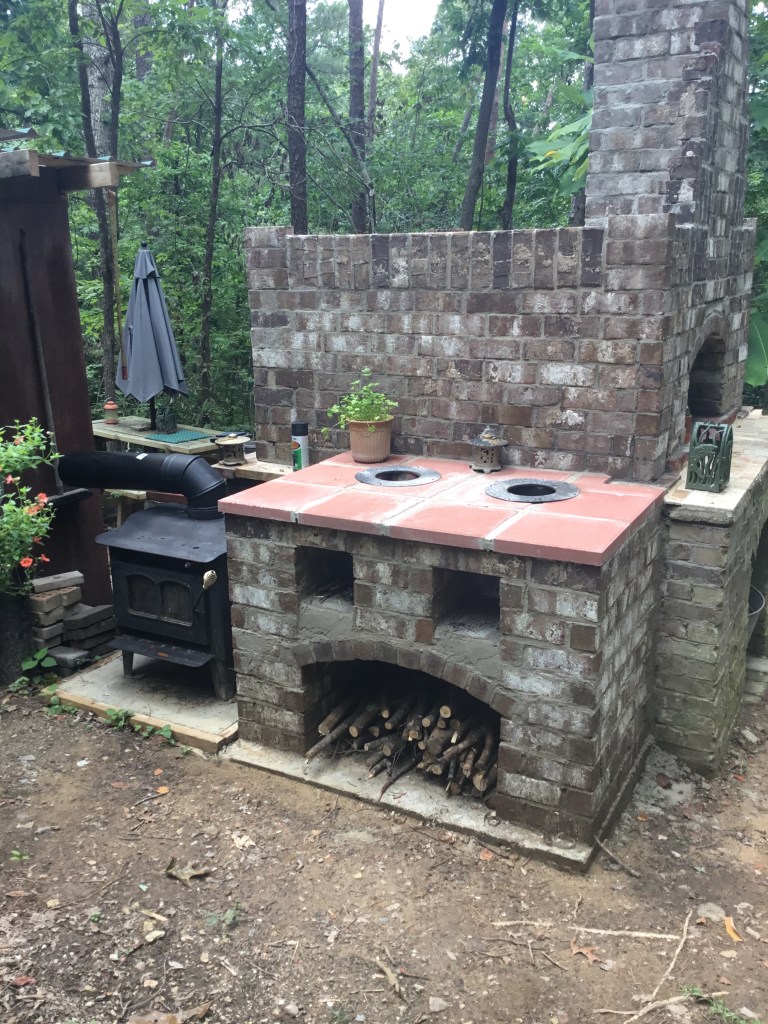
This particular masonry structure fits into the category of something you don’t see every day–a Potager, more commonly called a Stew Stove in English. These were particularly popular with the upper crust of the eighteenth century, and the most famous ones in the States are at Monticello in Virginia. My Potager is a copy of one rebuilt at Ham House, a British National Trust Elizabethan period property in Surrey. It is definitely a French influenced design.
The concept is elegantly simple. A masonry firebox leads to a chimney like opening (I used flue thimbles as openings). This concentrates all the heat and smoke down to a six inch area. In the case of this stove, just sit a cooking vessel over the opening. The temperature can be varied so that it can range from a sear, to a saute, to a long and slow stewing. In short, this is a half ton equivalence to a modern cooktop, with the exception in my case, that the fuel is free and one hundred percent renewable.
As an experiment, I first used this to roast some poblano peppers that I bought at the farmer’s market, on a grill. They smoked as well as roasted, and were jet black in no time. After I cleaned and sliced them, they went into the freezer for use this winter. For stewing, shovel coals into the firebox, and use a pair of bellows to control the temp. Extra fuel is literally at your feet.
Coals from the brick oven can be used for the Potager, and a busy cook can bake and saute at the same time. Alternately, coals from the smokehouse steel wood stove, pictured above, could be used to smoke something and stew at the same time. A cook with four arms could bake, sear, grill, stew, and smoke food simultaneously. Such a creature would end up with a powerful hunger in no time at all.
As this plant has at least three common names, I’m going with the most provocative, and yet the most historically accurate one (if you want the whole scoop, read the long discussion from 2008 on Nola.com about the issue). Creole food expert Poppy Tooker of New Orleans believes the original ones from France were actually shallots, but that only the green parts of the plants were used, and that eventually any green onion became known as a “shallot.” Here she is–
I believe in all those original old Creole recipes, people were actually using shallot tops, because they were growing them like that out in their garden, then, later, probably buying them in whole bunches with a little oniony part on the bottom and the green onion part on the top. . .I really believe this is the truth, and why we call them shallots instead of scallions or green onions or spring onions.
Poppy Tooker
Common names of plants are really only as useful as nicknames anyway, so this debate is about as important as what your dog’s name really is–is one of our Aussies named Siegfried, or is it Ziggy? Either way, he’s still a dog.
This plant does have a provenance of sorts, as the person I bought these bulbs from wrote “I obtained a start about 1972 from an elderly Creole gentleman in Golden Meadow Louisiana.” That’s good enough for me.
I think of these scrawny things when I hear multiplier onion.
Ready for Replanting
These are the common yellow multiplier, which come in various varieties. Fortunately, scientists have come to the rescue, and reclassified all onions and shallots as just Allium cepa, with different types. Now to the questions of whether or not Elephant garlic is really garlic: Hint: it isn’t. A scallion? Different species also. For now.
As per Al.com, our local news site, this roo is no beer drinking, pickup riding, good time Aussie. It is a sure enough public menace. And I remember the good old days when a PBR would get an Alabama roo into your F-150.
Says Tuscaloosa County Deputy Martha Hocutt, “These are wild animals; these are not the cute little fuzzies.” On a side note, Nick Saban is rumored to be recruiting this beast to run for the Crimson Tide.
The masonry work on the re-built brick oven is finito, and the oven has been getting a work out. We have cooked a few roasts, re-seasoned some cast iron, and churned out multiple pizzas, including six one day during the weekend of the fourth. And we still have that big stack of firewood on the west wall.
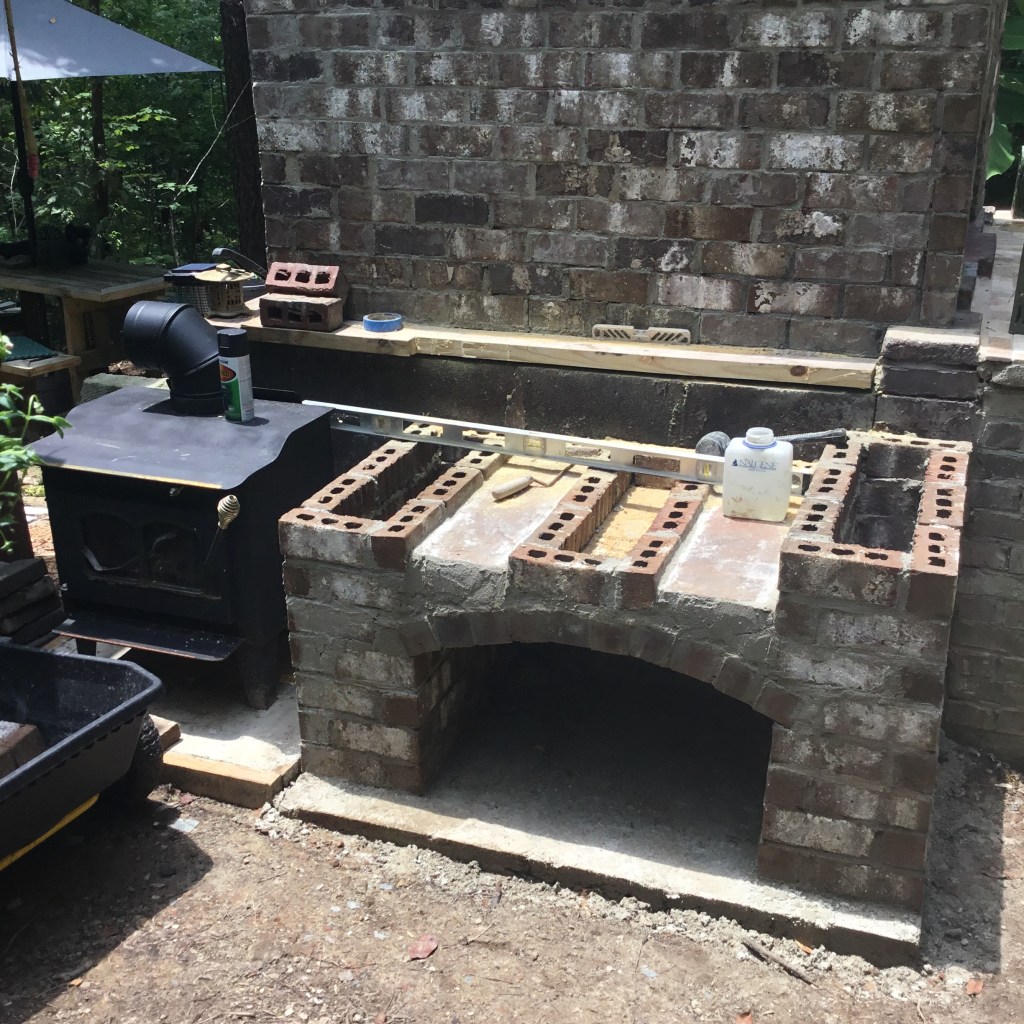
I haven’t shown all three walls, as the two side walls are identical, and the back wall is just a smaller version of the other two. The east side is an entirely different story. Here’s picture worthy of a contest.
A Brick Hutch for Giant Rabbits?
There are actually two projects going on over here. One is actually attached to the brick oven, but is not part of it. It is to serve an altogether different function. The old steel wood stove is soon to be attached to another part of the outdoor kitchen. Needless to say they all involve burning wood.
Anyone who can nail the purpose of each of these two units will be awarded an honorary certificate from the Institute for the Advanced Study of Southern Using What You Got. I’ll add a heavy hint–think of something that Monticello and Mount Vernon have in common, and I don’t mean the Presidents.
July 1 begins the “Don’t Say GAY” law for Flori-duh schools. The first victim is unfortunately light. Rainbow images (aka, the visible spectrum) are explicitly banned from public schools, in the form of stickers, clothes, jewelry, what have you. Is this a symbol of the darkness that is falling across our once free country?
I hope some film class includes the classic Hepburn-Grant movie Bringing Up Baby, where Cary Grant, while wearing a woman’s robe, jumps in the air and explains, “I just went GAY all of a sudden.” I would feel bad about Physics teachers who can’t show a picture of the visible spectrum, but it is hard to imagine a physics textbook that doesn’t have one. The optics wouldn’t look right.
Even better, teachers of Florida, resign in masse. Let the Goobernor deal with that.







 Southern Fusion Cooking