A Field Guide to Southern Hamburgers

HamburgerHamburger meat is on the way. The grinder just needs a few more cranks.

A. D. Livingston, in his great book On the Grill, tells the best hamburger story I have ever read, and it actually qualifies as one of the best stories I’ve ever read, period. It’s a tragi-comic tale of the decline of Southern food, and the Southern diet, both at the same time. It also involves high school football, cheerleaders, and grilled hamburgers. It doesn’t get much more Southern than that.

A. D. has a unique explanation for the year after year success of his local high school football team. It was the hamburgers served at each home game:

Above all else, however, I credit a few good ol’ boy chefs and the great American hamburger. Thick and juicy. Hot and tasty. Grilled to perfection.

Fans from both sides of the gridiron would mob the hamburger venue at the home field, lured in by the smell of ground beef cooking over hickory and charcoal, and the resulting revenue went to support the team.

Just as no good deed goes unpunished, however, all good things come to an end:

But slowly things changed and un-American activities began to gnaw at the spirit of the thing. By the time my son reached varsity football and I was called upon to lend my services as a chef, the situation had really become hopeless.

Locally ground quality beef had been replaced by Sam’s Club type pre-formed burgers. Not surprisingly, no one wanted to eat that garbage. When confronted with that reality, the new head of the Quarterback Club had the following answer for A. D. :

“Look, feller,” he said, fed up with me. “This is a ball game. If people want hamburgers, they’ll go to Hardee’s.”

And in that manner, the South fell again. Only the Southerners who fell this time were all so obese, they couldn’t get back up.

Let’s look at Southern burgers, traveling from East to West.

Carolina Burgers

This is something of a barbecue burger, and I have compiled a list of the most important ingredients. I think of this as being a North Carolina, instead of a South Carolina, burger.

  • Gotta have: Coleslaw, American Cheese
  • Gratuitous meat added: All meat chili
  • Burger: Ground Chuck

Anything with coleslaw is good, and I would throw in a slice of dill pickle as well. Be gratuitous.

Pimento and Cheese Burger

Originally a coastal specialty, this burger was something of a craze for awhile, and has spread around the country. Talk about a cheeseburger! Cheese, with peppers and mayo. That’s what I’m talking about.

  • Gotta have: Good Pimento and Cheese, and lots of it, and a slice of tomato
  • Gratuitous meat added: Bacon
  • Burger: Ground Chuck

Though this may be a slow motion infarction of a meal, one every so often probably won’t kill you. Probably.

Slug Burger, Penn Burger, Mystery Burger

This is the one I have been wanting to write about, a burger intended to be consumed by the Southern lumpenproletariat. You’re going to have to google that term. This low priced specialty is concentrated in the Tennessee Valley region of Tennessee, Alabama, and Mississippi, and surrounding environs. The Southern Foodways Alliance has a blog post dedicated to this curiosity. Let’s just say this one is not for everyone.

  • Gotta have: Filler, filler, filler. Usually Soybean Meal, Flour, or Oatmeal, as well as a boatload of condiments, to cover up the taste of the filler
  • Gratuitous meat added: As little as possible
  • Burger: Ground Beef, Pork, or whatever was found dead in the road

My hometown of Cullman was so special that we had TWO Mystery Burger joints, including a C. F. Penn franchise, where they deep fry the burgers. I had my first Mystery Burger when I was about ten, and even my ten year old brain said, “What the f*** is this?” Actually, it was also my last one. Foodies like to talk about “mouthfeel,” a term I find to be borderline obscene. Walk up to someone on the street, and ask, “How is your mouthfeel today?” This thing had the mouthfeel of the refuse from a lumberyard. Hence our family name for it: Sawdust Burger.

Louisiana Burger

How about from the ridiculous to the sublime? I’ve always thought that if Mississippi had not gotten in the way, Louisiana and Alabama would have been like two brothers who lived next to each other, and always tried to best each other at everything, be it good or bad. Corrupt as hell, and football and food crazy, Alabama has the James Beard award winning best restaurant in the country, Highlands Bar and Grill, (Frank Stitt, the owner and Executive Chef, just happens to be from Cullman), and the last I heard, a pretty good football team. Louisiana has chef Donald Link, among others, and LSU ain’t bad at football, either. Here is a short version of Chef John Folse’s Southern/Louisiana Burger:

  • Gotta Have: Egg,  Bread Crumbs, and Parmesan Cheese as a binder
  • Gratuitous meat added: None needed
  • Burger: Ground Chuck

Cheese IN the burger? Absolute genius. Whenever we had beef that was too lean back on the farm, we would use egg and flour as a binder. That’s when the connection struck me-it all goes back to the original hamburger from Germany. Donald Link is something of a German Cajun, having ancestors named Zaunbrecher, who helped establish rice farming in Louisiana. Talk about fusion. Talk about good.

The Basic Burger

Let’s get back to the basics, after all of these variations. Hamburger obviously originated in Hamburg, Germany, as Frankfurters originated in Frankfurt, and Wieners in Wien (Vienna). A Berliner is a kind of jelly doughnut, and people still debate if JFK stood before a huge crowd in Berlin in 1963, and said, “I am a Jelly Doughnut” (Ich bin ein Berliner). The more normal construction would have been “Ich bin Berliner.” I asked my German friend Torsten, who was an engineer at the Mercedes plant in Vance, Alabama, about that, and he said that context is everything, when it came to statements like JFK’s. So JFK was not a jelly doughnut, after all. He was a Mensch.

This basic burger recipe is similar to A. D Livingston’s, with a couple of additions:

  • Ground Chuck (I grind my own)
  • Salt
  • Black Pepper
  • Worcestershire Sauce
  • Soy Sauce
  • Garlic Powder

Proportions are a matter of taste. I cook my burgers on a Lodge cast iron sportsman’s grill, over oak and hickory charcoal. I also like really strong dijon or creole mustard on my burger, and Vidalia onion. One thing I will never cook on my grill, however, is Mystery Burgers.

Coffee and Chicory–Better Know a Southern Staple

Coffee 1A hot homemade English Muffin, and homemade Fig Preserves, and an old Cafetière of Coffee and Chicory. Breakfast!
When I left the farm in Good Hope, Alabama, for college, I knew that there were people who drank coffee without chicory in it, but I had never met one, as far as I knew. It could have been because I didn’t drink coffee, or even alcohol. Then when I started graduate school, and entered into the teaching profession at the same time, I found I needed something to wake me up in the morning, and put me to sleep at night. My girlfriend Melanie Jane and I headed out for the Kroger’s in Tuscaloosa, on a mission, after my first class. We left there with two new items in our buggy: some Luzianne Coffee and Chicory, and a bottle of BV Beau Rosé. Being an adult wasn’t all bad.

The other thing we bought at about the same time is a cookbook that is still my favorite, the 1901 edition of The Picayune Creole Cookbook, from New Orleans. For years the only two cookbooks we owned were that, and The Joy of Cooking (it should be noted that Irma Rombauer, who wrote the original Joy, was from St. Louis, which is sometimes considered to be Southern, though usually not). Truthfully, those two books, and a little curiosity, is all a cook needs. However, the very first recipe in the Picayune Creole Cookbook is Café à la Créole: Creole Coffee.

Though chicory is not mentioned in the recipe, the praises lavished on coffee are next level. Coffee “supported the old age of Voltaire,” and I challenge anyone else to find a cookbook that begins with a reference to Voltaire (a bust of Voltaire welcomes visitors to the entrance hall at Monticello). I have to throw in another quote about a French writer, this one by Henry James: Honoré de Balzac could not have written so many novels without “deep potations of coffee,” allegedly around fifty cups per day. But here is the real kicker from the recipe:

Coffee is now regarded by physicians as an auxiliary food substance, as retarding the waste of nerve tissue and acting with peculiarly strengthening effect upon the nervous and vascular systems.

Coffee. It’s what’s for breakfast. As much as I have drunk, I should live to be two thousand years old.

Now, New Orleans Creole Coffee is most famous for it’s various coffee and chicory concoctions, and just one producer has at least six varieties of coffee and chicory to choose from. Chicory is a southern European plant with blue flowers, from the Aster family, though the part used in the beverage is the roasted root. Chicory root has claims of medicinal qualities about it that would have made the writers of The Picayune Creole Cookbook blush.

chicory-root-001

This marriage of African coffee bean and European roasted herb root made it to France in 1801, and was well entrenched in N. O. by the time of the Civil War blockade. According to Smithsonian Magazine, folks from New Orleans tried everything from acorns to beets as additives and fillers for their coffee, in order to stretch out their supply. Apparently Coffee and Chicory tasted better than Coffee and Acorns.

If you are brave enough to try this incredibly smooth, addicting drink, locals throughout the South recommend just about everything available. The general consensus is that there are two favorites: Community Coffee Coffee and Chicory, and Union Coffee and Chicory. Consider all other brands as tied for third, and they all have slight variations in flavor. Prices vary widely, so do a little searching before purchasing. I personally buy the 32 oz. bags of Community Coffee Coffee and Chicory, but I probably should consider coffee rehab.

If you have a super special coffee variety already that you have sworn allegiance to, say, something grown only on three acres on a mountain in Jamaica, and picked only by left handed Ganja smokers, despair not. Chicory is sold widely, and even Community Coffee sells bags of it. Mix one part of chicory, with three parts of your Ganja smoker picked Jamaican primo, and there you have it. That’s the standard mix ratio, but experimentation is encouraged. Believe it or not, instant chicory is also available, for fans of instant coffee.

Now, naturally, to the world famous Cafe du Monde in the French Quarter of New Orleans. Starbucks it ain’t. Unless you want your coffee cold or frozen, you have two choices: black Coffee and Chicory, or Cafe au Lait, which is half strong Coffee and Chicory, and half hot milk. No lattes, no frappuccinos, and definitely no pumpkin spice. If you go there and ask for a doughnut and some pumpkin spiced coffee, please have the word “TOURIST” tatooed across your forehead first.

I was a Teenage Fast Food Worker, Part One–The Night I Cooked for the Mob

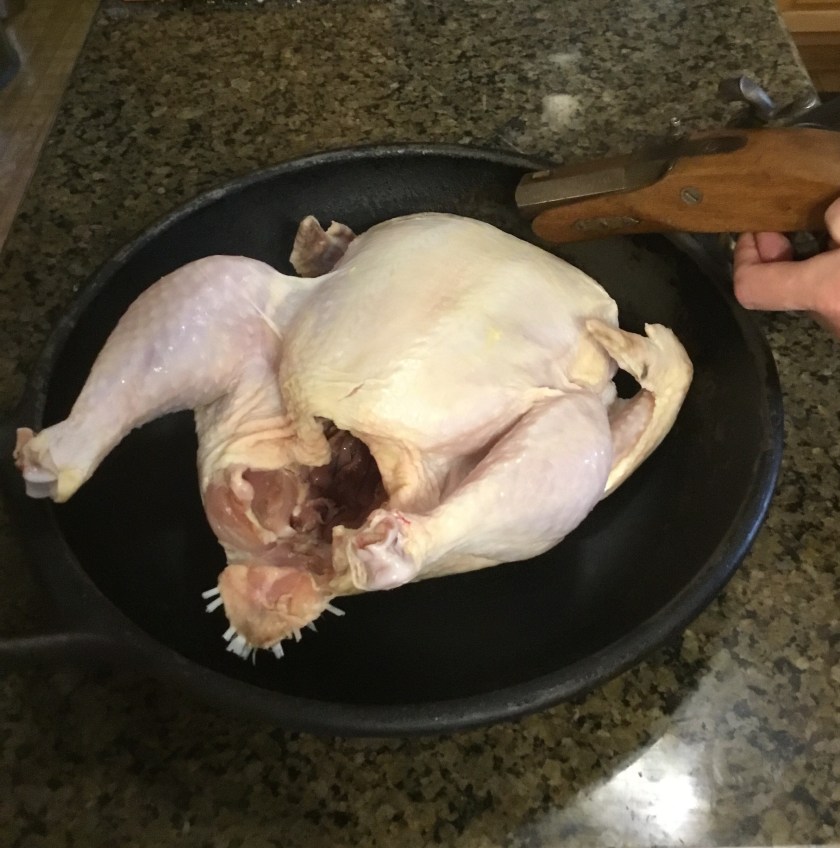
ChickenWhy is there a derringer pointed at where this organic chicken’s head used to be? Why is a whole chicken in a skillet? Why am I asking you? Read on.

Nineteen year olds rarely have a chance to cook for a couple of mobsters, and that was not my intent when I showed up for the night shift at our local fast food fried chicken franchise in my home town of Cullman, Alabama. I just wanted to get my work done, and get the hell out of there as fast as possible, because I had a hot date at ten o’clock that night. Ladies, gentlemen, and all you other guys out there, any young woman who will wait until ten to start a date is worth the time.

Speaking of extortion schemes, the University of Alabama was starting a series of tuition increases that have not stopped since then, and I needed some extra money to cover the bits and pieces. After one year there, I was actually headed into my junior year, having begun college with a year’s worth of credit. At any rate, I was one of the last people to see tuition at $98 per semester.

We had two cooks at two different stations that night, as the restaurant served two different types of fried chicken: one that was pressure fried, which gives the chicken a texture impossible to duplicate in the average home kitchen; and another that was just plain old greasy deep fried chicken, though it was marketed as being “crispy.” I manned the deep fryer, as the pressure frying machine was obviously too complex for an English/Physics double major (I later dropped the Physics part).

By 9:15 I had gone through my usual eighty pounds of chicken, and was ready to leave. We locked up at 9:30, and then we two cooks would mop and de-grease the floor with a combination of scalding hot water and Clorox. At exactly that time, a black Cadillac with Illinois plates pulled into our empty parking lot. Two rather large gentlemen with no foreheads and fancy suits stepped out of it, and headed toward our lobby door. Everyone knew it was the Chicago mob.

How did we know? We were in a small town in north Alabama, but none of us fell off the turnip truck on the way to work that day. A local millionaire, who went by the name of Bully Moon, lived a block behind our restaurant. He was rumored to be an acquaintance of many shady folks, including the Chicago mob. Everyone knew this, except for the police, apparently. Bully was eventually convicted of obstruction and tax evasion, and given six years at Club Fed. He only served three. There, he couldn’t touch Little Man Popwell, who owed $400, 000 of tax penalties in 1955, and also spent some time in Club Fed. Little Man was 5′ 6″ and weighed 300 lbs, and allegedly ran the Birmingham affiliate of the New Orleans Mafia, which is said to be the oldest mob group in the country. He ran an illegal mini-casino out of his home in Shelby County, just south of Birmingham, and was even inducted into the Poker Hall of Fame in Vegas.

Our two visitors made their way into the lobby, and found themselves face to face with our cashier, who had long fake fingernails, and a beehive hairdo that even Marge Simpson couldn’t compete with. I am able to translate her Southern and their Chicago-ese because of my five year residence in Illinois, and my many more than that years long residence here.

Cashier: “Kin I hep yu?” (Can I help you?)

Goon 1: “We wan sum chickn.” (We want some chicken.) The goon 2 never said anything. Maybe he was shy.

Cashier: “Woold you like the crees-pee, or tha oorigeenul res-a-pee?” (Would you like the crispy, or the original recipe?)

Goon 1: “Whut’s da diffunce?” (What’s the difference?)

Cashier: “Tha oorigeenul has a see-crette blee-end of erbs and spices, and the crees-pee is marry-nated and deep fri-iid.” (The original has a secret blend of herbs and spices, and the crispy is marinated and deep fried.)

Goon 1: “We’ll take uh buckit uv da kispy.” (We’ll take a bucket of the crispy.)

Damnation! If any of that chicken was bad, I was a dead man. There’s nothing worse than someone who misses a date because they’re dead. Maybe my sweetie would cry at my funeral. Then I remembered that there weren’t any tables in our lobby, and only one plastic chair. We were a take out place. They were going to have to eat at Bully’s.

The date was back on.

Or so I thought, as they took the bucket of chicken two feet down the counter, and tore into it standing up. It was awesome to watch. The only difference between those two, and an Alaskan Grizzly eating a live salmon, is that they didn’t eat the bones. Instead, they chunked them back into the bucket, and grabbed another piece. Within five minutes, there was nothing left but a bucket of bones.

They both wiped the grease off their mouths with their jacket sleeves, and Goon 1 turned to our cashier, and said, “Pudy gud.” (Pretty good.) And then they got back into their Caddy, and in my imagination, drove down a block to give Bully the business. So there it was–the mob thought my fried chicken was pudy gud, and I still had a hot date waiting for me. Life was pudy gud.

This needs an epilogue of sorts. A couple of years after my two months at that fine establishment, the kitchen caught on fire, and both chicken fryers and chicken eaters moved across town to a brand new building. They even had tables and chairs there. My date turned out to be even hotter than expected, and four years later, we were married, and still are. As it turned out, I married the best Phi Beta Kappa fryer of chicken in the South. Maybe one day Melanie Jane will have the chance to fry some chicken for a couple of wise guys from Illinois, the state University of which, strangely enough, happens to be her Alma Mater.

James Hemings, the Godfather of Southern Cooking–and of American Fine Dining

If you have never heard of James Hemings, it’s not your fault. Blame it on an educational system that has historical amnesia. Just to give a hint of what James did, he introduced the following dishes to the newly minted United States: French style ice cream (the kind everyone eats now), crème brûlèe, pommes frites (french fries), and best of all, macaroni and cheese. Essentially, all the cornerstones of a healthy diet.

To put it bluntly, James Hemings was the enslaved servant of Thomas Jefferson, despite the fact that he was actually the half-brother of Jefferson’s wife, Martha Wayles Jefferson. (If you would like a complete history of the Hemings family, read Annette Gordon-Reed’s superb The Hemingses of MonticelloAn American Family.) Jefferson “inherited” the entire Hemings family upon the death of his father in law. Despite that beginning, James would become the person who was arguably the first classically trained chef from North America.

In 1784, shortly after the death of his wife Martha, Jefferson was dispatched to Paris as Minister to France, and to help Benjamin Franklin and John Adams negotiate with the French government for support of the new nation which they had helped create. The group that left for France had to be one of the strangest family groupings in American history: Jefferson, his twelve year old daughter Martha “Patsy” Jefferson, and nineteen year old James Hemings, who Jefferson referred to in one letter as “my servant.” Jefferson’s goal was for James to train as a French chef. Regardless of the goal, when James stepped foot on French soil, he was free, slavery being illegal in France.

Upon arriving in Paris, James immediately apprenticed with a caterer named Combeaux, at Thomas Jefferson’s expense. Realizing that he could claim his freedom, James made a deal with Jefferson, that his enslavement become an “apprenticeship” instead, and that he be granted his freedom after a number of years. Jefferson agreed, and additionally, paid James a salary that was more than double that of a well placed Parisian servant. James’ second apprenticeship was at the estate of the prince de Condé, Chantilly, which included a stable that could accommodate 240 horses, and had what was considered the finest kitchen and chef de cuisine in France. The apprenticeship was remarkably expensive. Jefferson paid for it anyway.

By the end of 1788 James Hemings himself was the chef de cuisine at the Jefferson residence in the Hôtel de Langeac on the Champs-Elysées, which served as a de facto American Embassy in Paris. James hired a tutor to help make him completely fluent in French, and had the pleasure of seeing his younger sister Sally arrive in Paris, as a servant and companion to Jefferson’s youngest daughter Polly. By August of 1789 James served his first famous dinner, which included a six hour long marathon discussion between Jefferson, the Marquis de Lafayette, and seven other Frenchmen, who, according to Jefferson, invited themselves over; as Lafayette told him, they would like “to ask a dinner of me.” Their topic of discussion was the ever growing French Revolution. Although, apparently, there was more drinking than eating, Jefferson considered the evening to be a great success.

Then came June 20, 1790, back in the States, and what is sometimes called the dinner table compromise, or alternately, the greatest meal in American history. The first functioning Federal government was installed, and Secretary of State Jefferson and Secretary of Treasury Alexander Hamilton agreed on little. However, the question of war time debt overlapped their respective positions, as most of the states’ debts were to foreign institutions. Jefferson and Hamilton agreed that the debt the states carried and could not pay, could, in fact, cause the collapse of the new government.

Jefferson decided that this problem could best be solved over a meal prepared by James Hemings. Jefferson hosted the meal at his apartment in New York, the then seat of the government. The staff of Monticello, along with writer Charles Cerami, has made up a mock menu for the meal, based on what Jefferson typically ate (this information comes from the excellent book Thomas Jefferson’s Crème Brûlée, by Thomas J. Craughwell):

  • Green Salad with Wine Jelly
  • Capon stuffed with truffles, artichoke (artichokes are still grown at Monticello), chestnuts, and Virginia ham. It was served with an apple brandy sauce.
  • A Top Round Beef Roast and Veal Knuckle, served with onions, carrots, bacon, and garnished with parsley and thyme
  • Small plates of confections
  • Vanilla Ice Cream inside a puff pastry

Naturally this would need five bottles of wine to go with it, concluding with a bottle of Champagne to accompany the dessert. And there it is, fusion cooking, with mostly local ingredients prepared using mostly French techniques, though the beef and veal were cooked for hours in an old American stand-by, a cast iron dutch oven. Thankfully, James Madison was also present to help tackle this feast.

The solution to the debt dilemma was this. Jefferson agreed to Hamilton’s idea that the Feds assume the states’ war debts. Jefferson, knowing that a financially stable state like Virginia would never go along with such an idea, proposed that the national capitol be moved to the South, as compensation. Madison’s job was to get the bills through Congress. Thus modern America was born, over dessert and ice cream, and multiple bottles of wine.

James Hemings returned to Monticello, and taught his brother Peter how to cook in the French fashion. Peter also became a master brewer later, and ran the brewery at Monticello. After James had successfully taught Peter the necessary cooking skills, he was finally granted his freedom in 1796, the requirements of his “apprenticeship” having been fulfilled.

One last episode remains in this story. Soon after Jefferson was inaugurated as President in 1801, he had an intermediary contact James, who was working in nearby Baltimore, and offer him the job as the first chef de cuisine at the brand new White House. James was hesitant, and Jefferson indicated that he did not want to pressure him into the job. James did return to Monticello in the fall, and ran the kitchen there for one last time. By late October, James Hemings was dead, from an apparent suicide.

After asking for confirmation of this report, Jefferson received the following reply from his acquaintance William Evans:

Sir,

I received your favour of the 1st Instant, and am sorry to inform you that the report respecting James Hennings Having commited an act of Suicide is true. I made every enquiry at the time this melancholy circumstance took place, the result of which was, that he had been delirious for Some days previous to his having commited the act, and it was the General opinion that drinking too freely was the cause, I am Sir

Your obedient Servant

William Evans

This strangely modern tale of substance abuse claiming a chef’s life in no ways changes the influence James Hemings had on American, and particularly Southern, cooking. In 1824 Jefferson relative Mary Randolph published the South’s first great cookbook, The Virginia Housewife. Included in the book is a recipe for ice cream (the first published in the US), and a recipe for”Macaroni,” where the other main ingredients are milk and cheese.

Where could those ideas possibly have come from?

Welcome to Southern Fusion Cooking

Southern Fusion Cooking is dedicated to both all things Southern and all things cooking. We have recipes, but we also have history. This is not just an exploration of “How to Make Cornbread,” but an investigation of all the traditions that have contributed to Southern cuisine–be they African, European, Indigenous, or more recently, Asian. The train is leaving the station, so jump on board.

OffGuardian

because facts really should be sacred

Ruth Blogs Here

Or not, depending on my mood

A Haven for Book Lovers

I am just a girl who loves reading and talking about books

what sandra thinks

because I've got to tell someone.

LadiesWhoLunchReviews,etc

a little lunch, a little wine, a LOT of talking!

Margaret and Helen

Best Friends for Sixty Years and Counting...

talltalesfromchiconia

Tales of quilting, gardening and cooking from the Kingdom of Chiconia

Cyranny's Cove

Refuge of an assumed danophile...

Exiled Rebels

Serving BL since 2017

this is... The Neighborhood

the Story within the Story

Beauty lies within yourself

The only impossible journey in life is you never begin!! ~Tanvir Kaur

Southern Fusion Cooking

Country Living in the Southern Appalachians, USA--A little of this, a lot of that

Discover WordPress

A daily selection of the best content published on WordPress, collected for you by humans who love to read.

The Atavist Magazine

Country Living in the Southern Appalachians, USA--A little of this, a lot of that

Longreads

Longreads : The best longform stories on the web

WordPress.com News

The latest news on WordPress.com and the WordPress community.