New School Gumbo Paddles

Get Out the Gumbo Pot

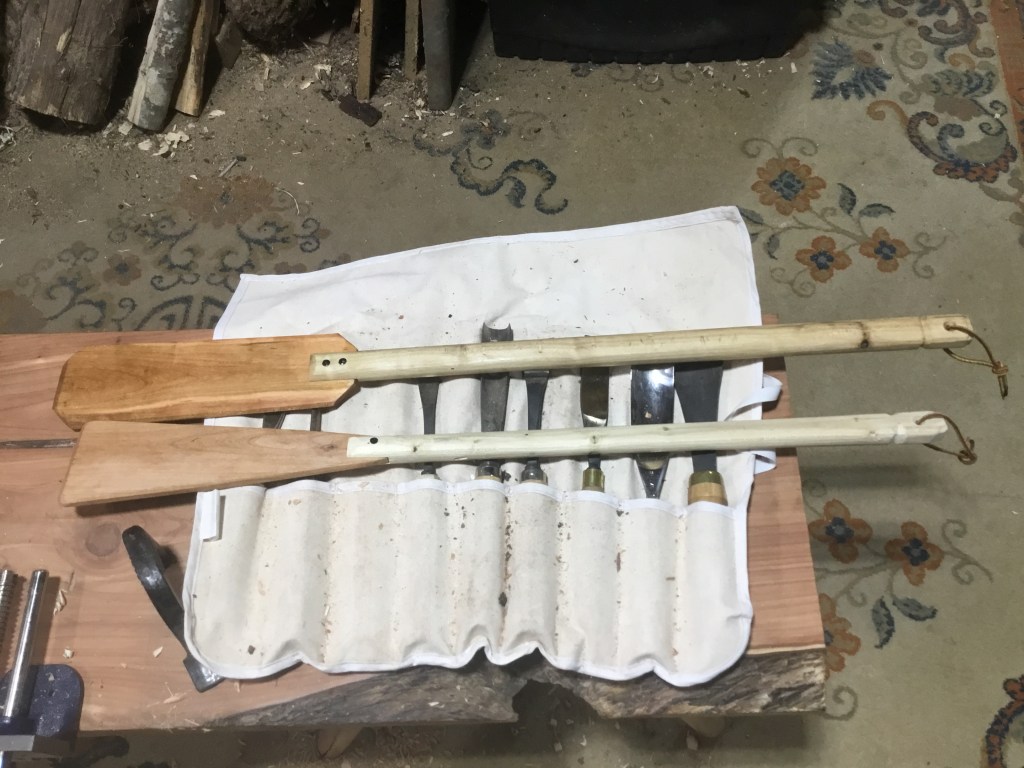
Having finally found a decent quality bandsaw (Rikon) that cost less than a car payment, I decided to break it in by making three Gumbo paddles. The handles on all three are Yaupon holly, a Gulf coast species, and the paddle blades are Black cherry. I made two of the bottom ones, for myself and one Brother in law. The large one is for another Brother in law, who cooks ten and twenty gallon batches of gumbo for St John’s Church in Cullman, which was founded by town father Johann Gottfried Cullman. Said Brother in law’s Son in law just happens to work there.

The paddles blades were cut with the bandsaw from the stump of Cherry tree in our front yard. It had been wind blown for about a year, so it didn’t need much drying. The handles as well were band sawn from wind blown Yaupon, and then turned into ovals by planing first with a Jack plane, and finishing with a Block plane. They were left smooth enough that they needed no sanding.

The mortises in the handles were likewise sawed out with the band saw, and then the waste was chiseled out. Final attachment was with a glue joint held into place with French diamond head nails, which serve a double purpose as decoration.

The larger paddle was finished with straight Walnut oil, while mine was finished with a Walnut oil wax finish. I broke mine in on Sunday cooking Beef stew in our fire pit in the Outdoor Kitchen. The paddle is long enough to have kept me away from the heat, and more importantly the smoke, which was whipped up by a ten mile an hour Southwest wind. The final addition was an accessory cord hanger, which in the case was made from some old worn out boot laces. Waste not, want not.

Favorite Woodworking Planes–Partner Planes

Stanley #3 and #5 1/4

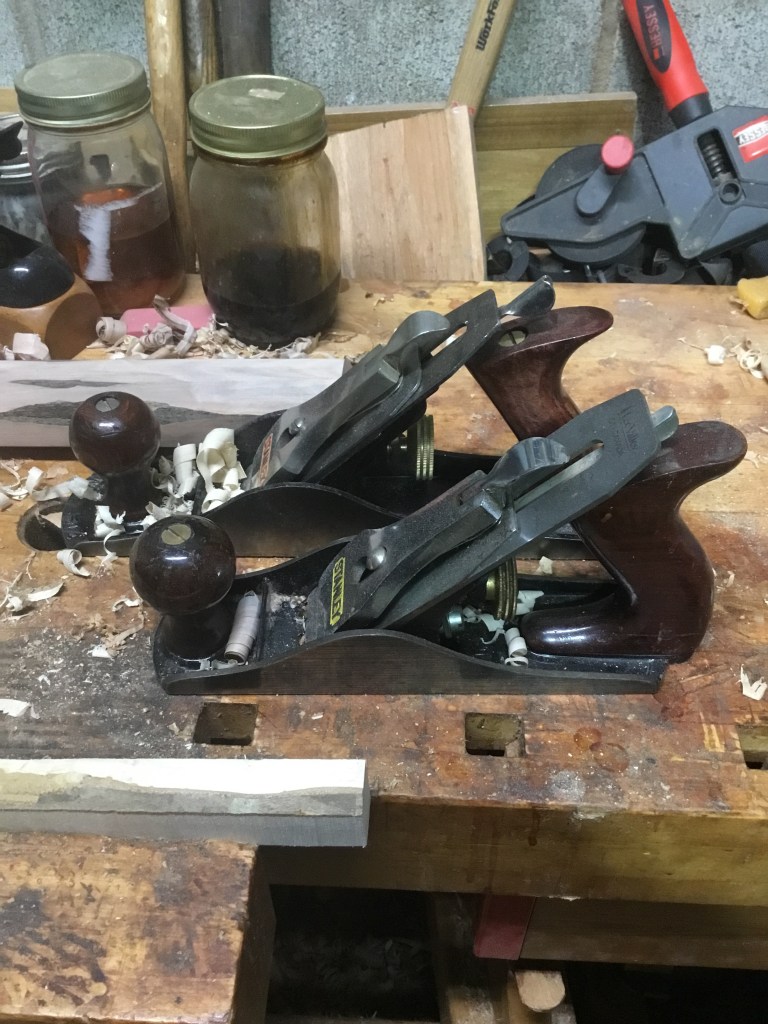
Partner planes are planes of different lengths that have interchangeable parts, from the blades on down. The most common example is the Stanley #4 and #5, both with 2″ wide cutters, which make a versatile duo at 9″ and 15.” Less common is the Stanley #3 and #5 1/4, which makes an attractive alternative to the 4-5 combination.

What we have here is a closer match in the length of the two planes, at 9″ and 11 1/2″ (the #4 and #5 are 9″ and 15″ respectively). The idea for the 11 1/2″ inch length, often referred to as the “Junior Jack,” actually came from the Ohio Tool Company. Logically it makes good sense, as the gap between the standard Smoothing and Jack planes is large at 6.”

With either combination you can do the following. I deep sixed the #3 low quality standard cutter, and replaced it with a Lee Valley 1 3/4″ one–a considerable upgrade (Lee Valley just purchased Hock Tools of California, giving them a huge market share for quality blades.) I took the also not-so-great factory cutter from the #5 1/4, and reground it to an exaggerated camber shape, turning the plane into a long scrub plane. I also have a #5 with a re-ground blade as an extra long scrub plane.

At any rate, I can just switch cutters on these partners and have a really long smoothing plane (or a short Jack plane), and a short scrub plane. The best thing about the #5 1/4, no matter how it is used, is the weight–it’s a full pound lighter than a #5. To me it’s a case of bigger is not necessarily better.

Winter Vegetable Container Garden

Most gardeners in USDA Zone 7 or higher could easily have a set up like this.

For our Winter garden this year I went with all container plantings. It was a good thing too–when the bomb cyclone hit in December, and our temps went down to 8.9 degrees F, I just wheeled three cart loads of plants into our 60 degree basement, left them there for a couple of days, and then brought them back out. We will now have fresh greens until spring planting, which actually begins this week.

Pictured is a mixed planting of lettuces, spinach, boy choy, radishes, onions, chard, collards, kale, and one container with a mesclun mix that includes arugula. The potting soil is 95% composted chicken manure, a by product of our egg layers, that produce a more than steady supply of it. The spinach quiche we made was the perfect combination of their products.

Grand total of the expenses for this garden was $20 for seeds. I’m going to splurge and spend $40 on the summer version, which will easily be double this size. You won’t hear any complaints about the price of lettuce from me.

College Board Celebrates Black History Month by Removing References to Black Alabama Farmers From AP Black History Course

The war on independently verifiable information (history) is on a roll in Floriduh, the state that is run by head Florida Man, Goobernor Ron DeSanctis. German studies are fine, but African-American studies are verboten, especially when it involves Black farmers from Alabama. And some of those farmers happened to have been communists as well.

While you may think that I have broken into the medical marijuana stash, the book that has been banned from the African-American studies course, first by DeSanctis and then by the College Board, is titled Hammer and Hoe: Alabama Communists During the Great Depression. Worse still, the author is a distinguished history Professor at UCLA, Robin D. G. Kelley. To people who have survived the Alabama public school system, such as myself, the book was mind blowing, as it is the perfect example of history having been erased.

The history is both simple and understandable. Black workers, deprived of any other form of political representation, turned to union organizers who were affiliated with the Communist party. The great oral history by Theodore Rosengarten, All God’s Dangers, is about one branch of the party, the sharecropper’s union. Sharecropping was the system that replaced slavery, and it was designed to replace chattel slavery with debt peonage–a person perpetually in debt can be coerced into obedience. Sharecroppers saw the union and the party as their quickest way to freedom and prosperity.

The industrial workers in the steel mills of Birmingham, who were mostly Black, unionized as well, for better wages and working conditions. The result was predictable–US Steel and other corporations paid the local KKK to terrorize people, to the rate of 50 bombings in 40 years. The biggest was 54 sticks of dynamite, laid at the foundation of Temple Beth-El in 1958. It failed to detonate due to a rainstorm.

When the national media discovered that Birmingham existed in 1963, they often commented on its resemblance to Berlin in the 1930’s. Maybe that’s why the Goobernor prefers German history to American.

Great Seasonal Poems, Part Two–The Schoolboy, by William Blake

William Blake was only one degree of separation removed from Thomas Jefferson. They were both friends with the great enlightenment thinker and writer Thomas Paine. This poem is very much a poem of that enlightenment, the spirit of which we could use now. This is from Songs of Experience.

The Schoolboy

by William Blake

I love to rise in a summer morn,
When the birds sing on every tree;
The distant huntsman winds his horn,
And the sky-lark sings with me.
O! what sweet company.

But to go to school in a summer morn,
O! it drives all joy away;
Under a cruel eye outworn.
The little ones spend the day,
In sighing and dismay.

Ah! then at times I drooping sit,
And spend many an anxious hour,
Nor in my book can I take delight,
Nor sit in learnings bower,
Worn thro’ with the dreary shower.

How can the bird that is born for joy,
Sit in a cage and sing.
How can a child when fears annoy.
But droop his tender wing.
And forget his youthful spring.

O! father & mother. if buds are nip’d,
And blossoms blown away,
And if the tender plants are strip’d
Of their joy in the springing day,
By sorrow and care’s dismay.

How shall the summer arise in joy.
Or the summer fruits appear.
Or how shall we gather what griefs destroy
Or bless the mellowing year.
When the blasts of winter appear.

I used to love teaching summer school at the five institutions of “higher learning” where I was employed. There were only two types of students–highly dedicated ones, or those who had no intention of attending class. I forget which one I preferred.

Great Seasonal Poems, Part One: Ode to the West Wind, by Percy Bysshe Shelley

California residents may not be a big fan of the west wind right now, but never fear, spring is not far behind.

Ode to the West Wind

BY PERCY BYSSHE SHELLEY

I 

O wild West Wind, thou breath of Autumn’s being, 

Thou, from whose unseen presence the leaves dead 

Are driven, like ghosts from an enchanter fleeing, 

Yellow, and black, and pale, and hectic red, 

Pestilence-stricken multitudes: O thou, 

Who chariotest to their dark wintry bed 

The winged seeds, where they lie cold and low, 

Each like a corpse within its grave, until 

Thine azure sister of the Spring shall blow 

Her clarion o’er the dreaming earth, and fill 

(Driving sweet buds like flocks to feed in air) 

With living hues and odours plain and hill: 

Wild Spirit, which art moving everywhere; 

Destroyer and preserver; hear, oh hear! 

II 

Thou on whose stream, mid the steep sky’s commotion, 

Loose clouds like earth’s decaying leaves are shed, 

Shook from the tangled boughs of Heaven and Ocean, 

Angels of rain and lightning: there are spread 

On the blue surface of thine aëry surge, 

Like the bright hair uplifted from the head 

Of some fierce Maenad, even from the dim verge 

Of the horizon to the zenith’s height, 

The locks of the approaching storm. Thou dirge 

Of the dying year, to which this closing night 

Will be the dome of a vast sepulchre, 

Vaulted with all thy congregated might 

Of vapours, from whose solid atmosphere 

Black rain, and fire, and hail will burst: oh hear! 

III 

Thou who didst waken from his summer dreams 

The blue Mediterranean, where he lay, 

Lull’d by the coil of his crystalline streams, 

Beside a pumice isle in Baiae’s bay, 

And saw in sleep old palaces and towers 

Quivering within the wave’s intenser day, 

All overgrown with azure moss and flowers 

So sweet, the sense faints picturing them! Thou 

For whose path the Atlantic’s level powers 

Cleave themselves into chasms, while far below 

The sea-blooms and the oozy woods which wear 

The sapless foliage of the ocean, know 

Thy voice, and suddenly grow gray with fear, 

And tremble and despoil themselves: oh hear! 

IV 

If I were a dead leaf thou mightest bear; 

If I were a swift cloud to fly with thee; 

A wave to pant beneath thy power, and share 

The impulse of thy strength, only less free 

Than thou, O uncontrollable! If even 

I were as in my boyhood, and could be 

The comrade of thy wanderings over Heaven, 

As then, when to outstrip thy skiey speed 

Scarce seem’d a vision; I would ne’er have striven 

As thus with thee in prayer in my sore need. 

Oh, lift me as a wave, a leaf, a cloud! 

I fall upon the thorns of life! I bleed! 

A heavy weight of hours has chain’d and bow’d 

One too like thee: tameless, and swift, and proud. 

V 

Make me thy lyre, even as the forest is: 

What if my leaves are falling like its own! 

The tumult of thy mighty harmonies 

Will take from both a deep, autumnal tone, 

Sweet though in sadness. Be thou, Spirit fierce, 

My spirit! Be thou me, impetuous one! 

Drive my dead thoughts over the universe 

Like wither’d leaves to quicken a new birth! 

And, by the incantation of this verse, 

Scatter, as from an unextinguish’d hearth 

Ashes and sparks, my words among mankind! 

Be through my lips to unawaken’d earth 

The trumpet of a prophecy! O Wind, 

If Winter comes, can Spring be far behind?

Thanks again to the Poetry Foundation.

I repeated the famous last line and a half of this poem on Sunday, while cooking some beef stew (with Piedmontese beef) in our fire pit. The fire pit was built by my brother-in-law from an old propane tank, and the west wind blew smoke in my face one time too many. The same BIL has a herd of these fancy Italian bovines, and gave us a freezer full of meat for Christmas. Ashes and sparks, indeed.

Bearded Hatchet–Getting a Handle on It

Straight outa Bulgaria comes this excellent Smith forged bearded hatchet. The advantage of this hatchet design is apparent as soon as it’s handled. The space between the head and the handle allows the hacheteer to carve, or cut, like an extension of the hand.

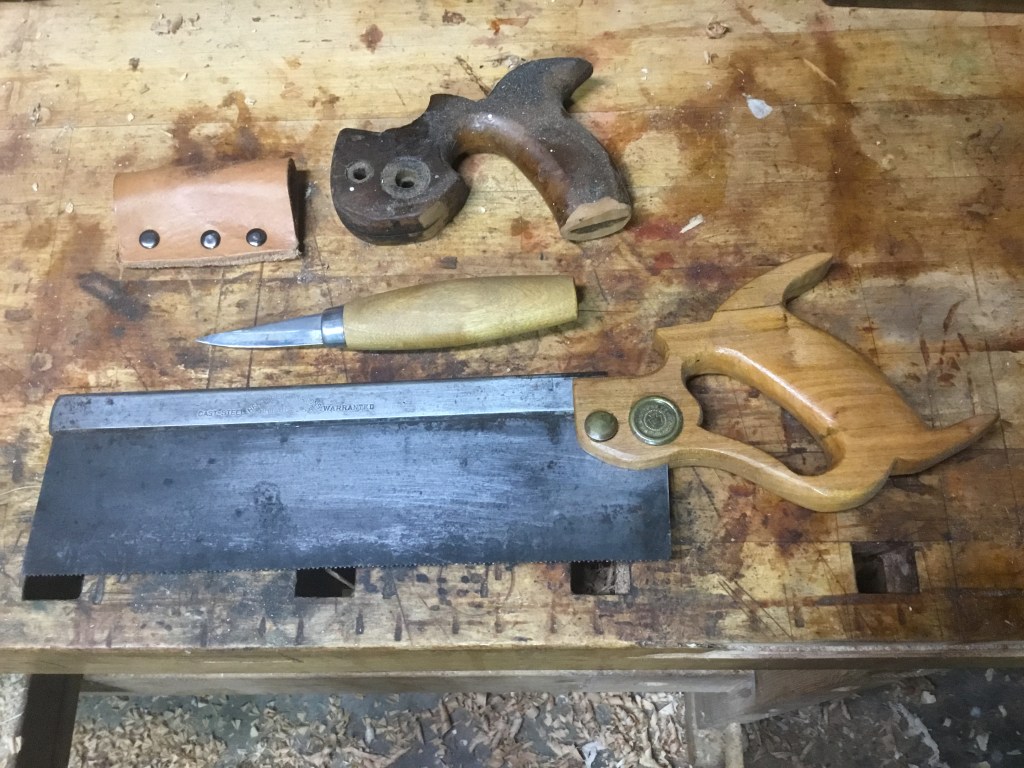
The company that sells these gems is Thracian Forge, which is a top seller on Etsy. They come un-handled, to save shipping and labor, so I had a Sourwood handle ready made waiting for it. Unfortunately, never having seen a Bulgaria/eastern European hatchet before, I made it according to Western style hatchet head dimensions. It turned out to be three inches too long and an inch too wide at the head. A back saw and a little time on the shaving horse solved that problem.

Eastern Europe has become a treasure for traditional woodworkers, as skills lost to industrialization in the West survived in the East and North. Grab a copy of Woodworking in Estonia, which is actually a Ph D dissertation, and look through the Bulgarian and Ukranian forges who sell on Etsy. I tried to identify the smith’s initials on my hatchet, and finally concluded that they are in the eighth century Bulgarian alphabet, which is still in use. For anyone who wants to know, that is the original source of the Russian alphabet. As the people in Ukraine like to point out, Kyiv was already a capital, at the time when Moscow was still a cow pasture.

A Poem for the US Supreme Court

Surprise! Members of our Holier-than-thou Supreme Court have been caught meeting, eating and praying with billionaires and their lackeys, and leaking decisions to them so they could get their PR ready. See the NYT story about the same. Here’s a poem for the priestly class wannabees.

This is from Blake’s Songs of Experience:

The Chimney Sweeper

BY WILLIAM BLAKE

A little black thing among the snow, 

Crying “weep! ‘weep!” in notes of woe! 

“Where are thy father and mother? say?” 

“They are both gone up to the church to pray. 

Because I was happy upon the heath, 

And smil’d among the winter’s snow, 

They clothed me in the clothes of death, 

And taught me to sing the notes of woe. 

And because I am happy and dance and sing, 

They think they have done me no injury, 

And are gone to praise God and his Priest and King, 

Who make up a heaven of our misery.” 

Blake, Songs of Experience

No comment.

Black Cherry Salt Grinder

As an afterthought to making the three Pepper grinders as gifts, I made a Salt grinder for ourselves. This one is also made from green wood, and turned on the foot-powered lathe. A scrap piece was made into a small Christmas ornament.

The reason for purchasing a salt grinding mechanism was simple–it was either that, or pay for shipping on the pepper mills. The price of the grinder was almost exactly the price I needed to reach the free shipping total, and this ceramic grinder looked far better than that used in my previous attempt at making one. The other was such a piece of junk, that I threw it away, and I hardly ever throw away anything.

After turning the two pieces for the body, I let both dry for a couple of weeks before doing anything further. This worked well, as well as better than the Sourwood pepper grinders that I made in less time. The finish, which is Blonde shellac, turned out to be nice and shiny.

I broke this in using it on some fried eggs for our three times a week breakfast muffins. My usual pinches of salt from our salt cellar always results in salt scattered all over the stove, and the cutting board the cellar sits on. This time, no mess to clean up, and super fine ground salt. Another great mechanism for Chef’s Specialties of Pennsylvania.

Barely Scraping By, Part Two–A Trio Of Scrapers

When Jacques Pépin began work as a chef in France at the age of thirteen, one of his first tasks was to scrape flesh off of the bones of cooked pieces of meat. Said scraps were then made into rillettes, pates, terrines, and other meat paste delicacies. Then the bones were used for stock. Waste not, want not.

The same sense of economy makes me a huge fan of scrapers. Sandpaper is expensive, and a disposable product as well. The fact that sander dust is a carcinogen doesn’t help the comparison. A scraper which is the cost of a few packs of sandpaper can do literally thousands of scrapping jobs.

Here are three models of scrapers. The big green machine on the lower left is a Kunz #12, a near exact copy of the old Stanley #12. This German made edition is ideal for larger jobs, like the Walnut table top I am currently refinishing. The list price is a hefty $169, but I found this one on flea bay for $25. Being a miser has its advantages. The design is circa 1870, which was the heyday of hand tool design.

Directly above that is the classic Stanley #80 cabinet scraper. This flea market purchase was only a couple of bucks, and these things literally never wear out. The #80 has a more sensitive adjustment mechanism the the #12, and is capable of doing very fine work.

The most versatile of scrapers is the Stanley #82 on the right, which can use any size or shape scraper blade. The current blade in use is the classic Bahco (Sandvick) Swedish card scraper. The #82 will prove very handy when I start my upcoming chair seat carving projects.

When primitive man scraped meat off of animal bones, did they make terrines out of it? Doubtful. However, they certainly used scrapers as one of the earliest tools. They were also barely scraping by.

OffGuardian

because facts really should be sacred

Ruth Blogs Here

Or not, depending on my mood

A Haven for Book Lovers

I am just a girl who loves reading and talking about books

what sandra thinks

because I've got to tell someone.

LadiesWhoLunchReviews,etc

a little lunch, a little wine, a LOT of talking!

Margaret and Helen

Best Friends for Sixty Years and Counting...

talltalesfromchiconia

Tales of quilting, gardening and cooking from the Kingdom of Chiconia

Cyranny's Cove

Refuge of an assumed danophile...

Exiled Rebels

Serving BL since 2017

this is... The Neighborhood

the Story within the Story

Beauty lies within yourself

The only impossible journey in life is you never begin!! ~Tanvir Kaur

Southern Fusion Cooking

Country Living in the Southern Appalachians, USA--A little of this, a lot of that

Discover WordPress

A daily selection of the best content published on WordPress, collected for you by humans who love to read.

The Atavist Magazine

Country Living in the Southern Appalachians, USA--A little of this, a lot of that

Longreads

Longreads : The best longform stories on the web

WordPress.com News

The latest news on WordPress.com and the WordPress community.