Tasso ham is not really ham, in the common sense of the word, as it is usually made with pork shoulder, aka Boston butt. Going back in time, this Louisiana seasoning product was made from any trimming leftover from a hog killing. The only constant is the combination of spices and smoke, that make this a red beans and rice all star.
Ingredients
Sliced Pork Shoulder Strips
Paprika
Cayenne Pepper
Cinnamon
Salt and Pepper
This constitutes the dry rub, and the amount of each spice depends on the quantity of pork strips. At this point the pork strips need to dry uncovered in the refriginator a minimum of three days. Then it’s time to crank up the smoke house.
More Smokin’
This old school smokehouse, right down to the hanging strip of fly paper, is now fully operational. The external smoke source is an old steel wood stove connected via a stove pipe. This Tasso was smoked for two and a half hours with green Maple at about 150 degrees F. The char patterns on the Tasso in the photo are from the smoke, not heat. The big piece of pork shoulder in the pic was destined to be barbecue.
After the Tasso has cooled, cut it into cubes and chunk it into a freezer bag. Like the frugal ant in the ant and grasshopper fable, we will have smokey dishes all winter, while the grasshoppers have to dine on McRib mystery meat barbecue sandwiches.
Goat Island Brewing’s Oktoberfest beer is not actually made in the community of Berlin, Alabama–locals call it “Bur-lin”–but just a few miles to the west, in the town of Cullman. Cullman is in fact named after founder Johannes Gottfried Kullman, who was a “Colonel” in one of the many German revolts against royalty in 1848-1849. After revolt after revolt in Germany failed, Kullman thought it wise to relocate to the constitutional Republic of the USA.
Goat Island is becoming another craft brewery that is growing every year. The Oktoberfest is a well behaved lager, that could easily be drunk by the pint. It doesn’t hurt that they have beers with clever names, like Peace, Love and Hippieweisen, a wheat beer made with Alabama summer weather in mind. It also doesn’t hurt that their Duck River Dunkel won a silver medal at the Great American beer Festival in Denver in 2018. Not bad for a small Southern brewery.
Goat Island is an actual place, a small island just offshore in the Smith Lake impoundment. Legend has it that a single goat was marooned there as the waters rose, and spent a solitary life as the only one of his kind on the island. Someone could at least have taken him a beer.
Having lain dormant all summer, the first late summer rains woke up the Cyclamen. Our middling sized rock garden is literally covered with them–they bloom where they were planted a couple of decades ago, and volunteers have spread as much as 50 feet away. As the seeds are believed to be spread by ants, uphill or downhill makes no difference. It’s just all as the ant walks.
A close examination of the lowest group of pink blooms reveals a glimpse of a dinner plate sized corm, which was the first Cyclamen I planted. It has offspring galore–blooming among rocks, under shrubs, and even out in our concrete path, where just a little soil has accumulated.
Here’s the plan–this fall I am going to transplant a few Cyclamen to the area around our outdoor kitchen. Then a whole new colony will have plenty of room to spread. Ants get ready, as acres of woods surround it.
I’itoi onions are the kind of vegetable that could make the owner of a Chia pet jealous.Brought to the desert Southwest by Jesuit missionaries around 1699 to 1700, the I’toi proved to be ideal for the type of agriculture practiced by the native Tohono O’odham peoples, known as Ak cin, which means watching for summertime monsoon rains. When rain was coming, crops such as these onions were planted, and the onions sprouted to edible size in a small number of days.
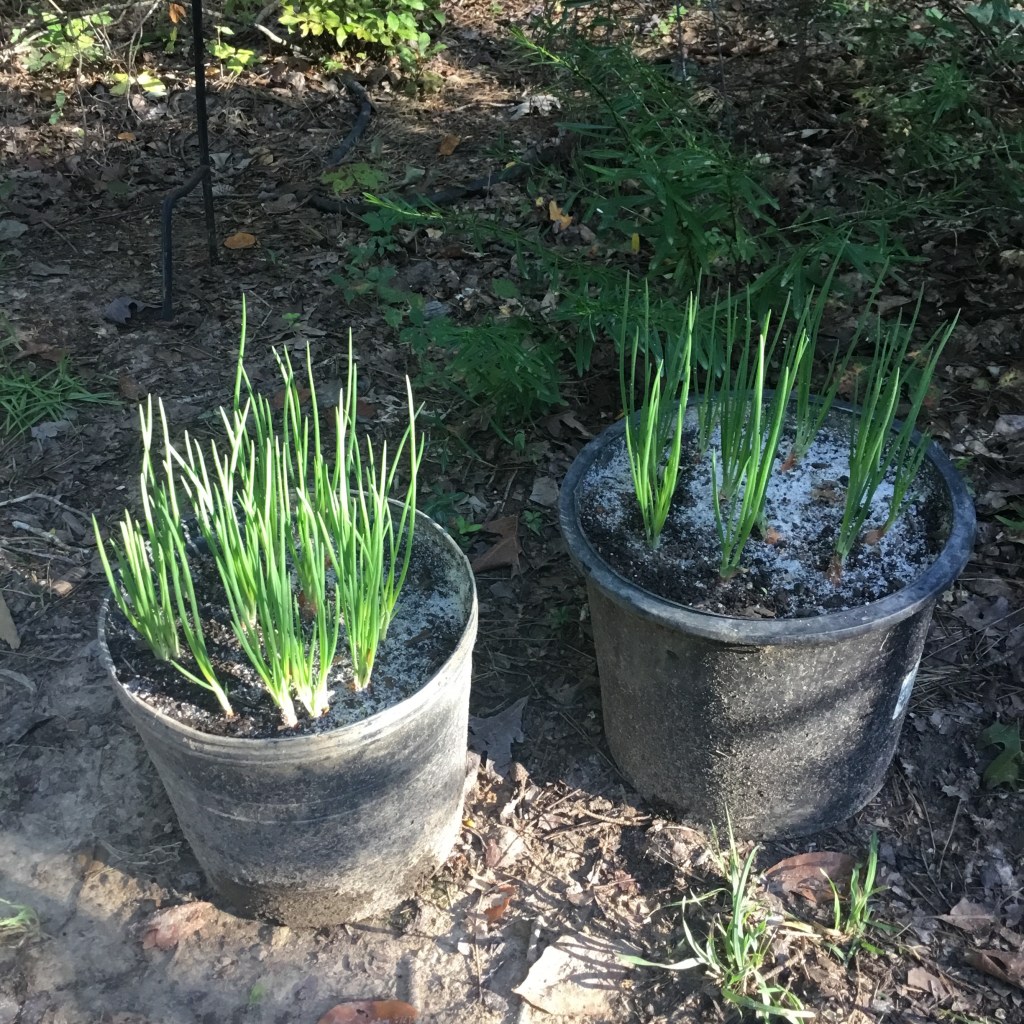
My two miniature Sonoran Deserts in a pot are a combination of well composted chicken manure with a couple of handfuls of masonry sand. Growing in containers will insure that the desert onions will have plenty of drainage when we receive one of our monsoon level rains. Having grown these before, I know it also won’t be long before these onions will be ready to be divided, and we will be in onions forever, unless we neglect them.
I’itoi onions can be used as something of a giant version of chives, by clipping just the green parts. They also can be used, Louisiana style, as a fast growing shallot. As a plant that has made it on this side of the pond for over three hundred years, it is an heirloom among heirlooms.
It takes more than a few white clouds to make these Cyclamen blooms–it takes a sho nuff deluge. 1.8″ of rain on August 11 brought these jewels back to life, and they will bloom from now until the equally spectacular leaves emerge sometime this fall.
“White Cloud” is one of the Cloud series of Cyclamen cultivars, with white blooms and silver veined leaves–we also grow the “Silver Cloud” Cyclamen, which has pink flowers and similar evergreen leaves. A single plant can sell for $7 to around $50. We paid $6.95.
The good news is these cultivars come true from seed, and re-seed prolifically–we now have these plants scattered all through our rock garden, and the plant below the rocks is a seedling. The silver Christmas tree looking leaves are equally impressive, even if they remind me of those incredibly hideous silver tinsel fake Christmas trees from the seventies. Some things you just can’t forget–ugly is just as memorable as beauty.
This bread is definitely Southern, although more Southern France than Southern US. Strangely enough, it is only a couple of ingredients away from being identical to Creole French bread, which, as I have noted, is more Italian than French.
Ingredients
1 tablespoon Olive Oil
1/2 teaspoon Salt
1 1/2 cup Flour
1 tablespoon non-fat dry Milk
3/4 cup warm Water
Mix these by hand or with a stand mixer. Also mix together in a measuring cup-
2 teaspoons dry Yeast
1 tablespoon warm Water
1 tablespoon Maple Syrup (this is a substitute for Malt Syrup)
Let the yeast mixture rise in a measuring cup, until it reaches a volume of about one cup , then mix thoroughly with the flour mixture. Knead by hand or with a stand mixer. When the dough stops sticking to your oiled fingers, transfer to a bowl to rise–a wooden dough bowl is traditional in the South. After an hour or more of rising, form the loaves into the shape of your choosing–I like baguettes. Lately I have been cooking mine at 450 degrees F.
The recipe comes from the The Breads af France by Bernard Clayton Jr, and it has replaced the Picayune Creole Cookbook on my kitchen cookbook stand. It’s that good. As Clayton notes, Monaco, all 400+ acres of it, is highly influenced by its proximity to Italy, and thus we have the addition of oil to the bread, which fortifies it. Take away that and the milk powder, and you have Creole bread. However, when it comes to this style of French/Italian/New Orleans bread, there is only one thing to say about it–it’s all good.
Our local Farmer’s market, held at the Festhalle, has been busy this summer, purely because of the excellent produce and value, compared to jacked up super market prices And people still keep arguing that transportation costs don’t result in higher prices. Check the price of gas, because Scotty did not beam that food to Publix.
Every ingredient, save for two, came from either the Festhalle or our front yard. I’ll differentiate those in the ingredients list.
Ingredients
1 tablespoon Italian Olive oil
1/2 medium Onion, Chopped (Festhalle)
1 sweet Pepper (Homegrown}
4 plum Tomatoes, Chopped (Festhalle)
2 Oyster Mushrooms (Festhalle)
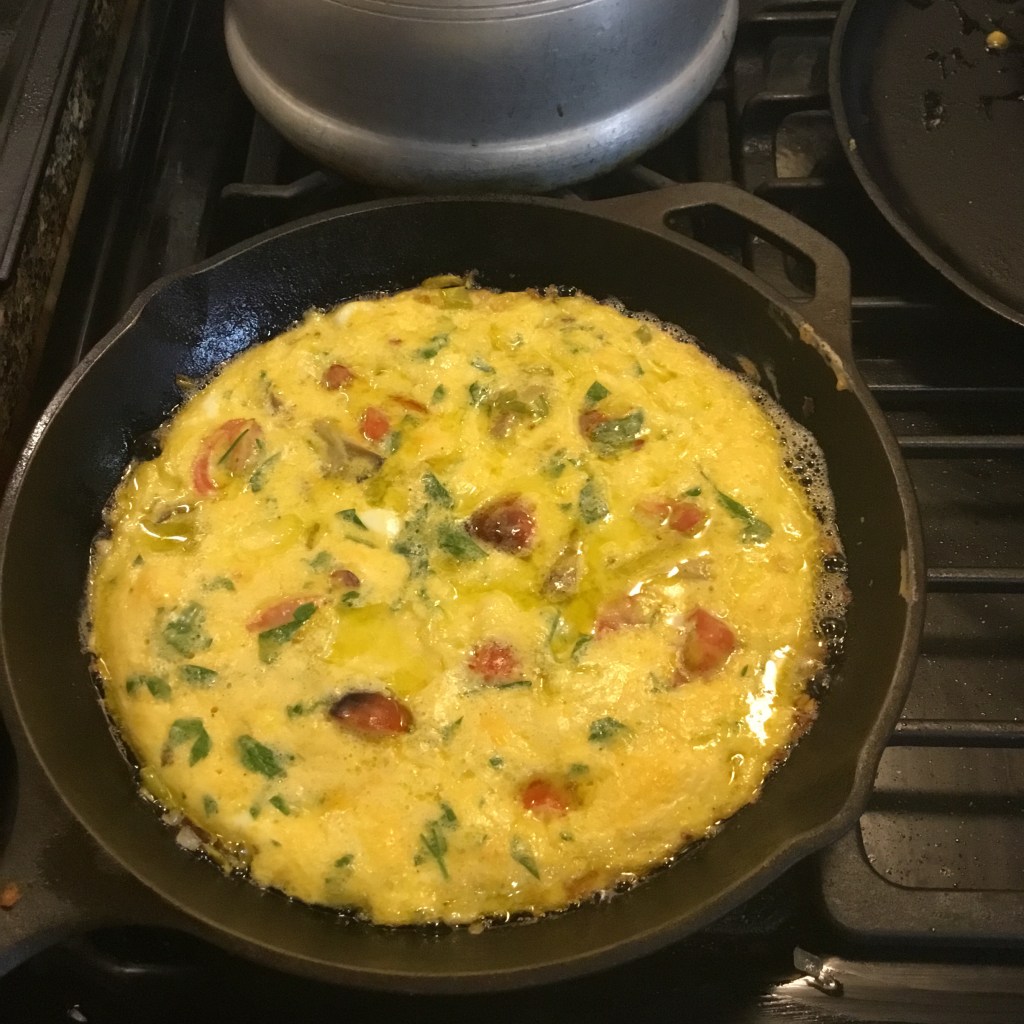
Saute the onions, peppers, and mushrooms in the olive oil, and when done add the tomatoes and cook for a further minute. Mix together—
3 extra large Eggs (Homegrown)
1/2 cup shredded Vermont Cheddar Cheese
Chopped Parsley (Homegrown)
Sea Salt and Pepper
Pour the egg mixture into the veg, and cook this frittata style–let the eggs begin to set, and then throw the skillet into a 400 degree F oven, until the omelette is done to your liking. Alas, poor supermarket. Only two imported items, from Italy and Vermont. Wait, the cast iron skillet is from Tennessee, another exotic foreign country.
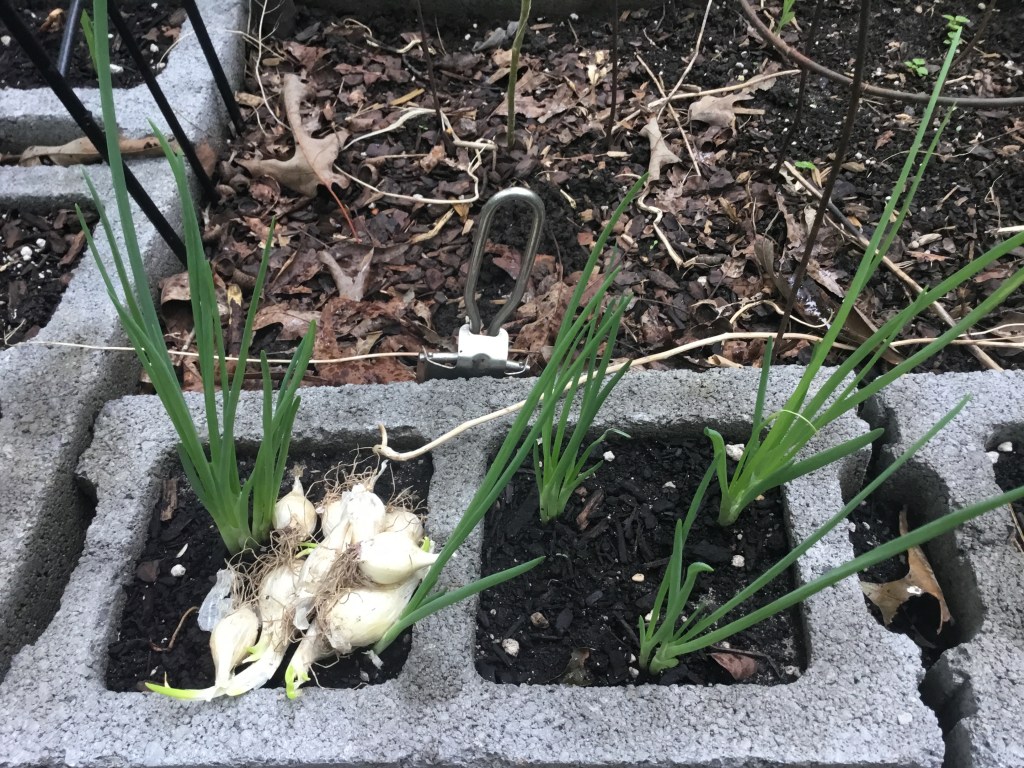
The first planting of Josette shallots worked out so well I had to order another bag. All told, I will have 22 Josettes planted in four cinder block “raised beds.” I saw this idea at some gardening site on the inter webs, and had a pile of free cinder blocks lying around, and had to try it. With a little potting soil, presto, instant raised bed.
Now that Allium cepa has been divided into two large groups, bulb onions and multipliers, I am going to refer to all multipliers as shallots, in the great Gulf Coast tradition. My next multiplier purchase will be some of the Southwestern I’itoi onion, an heirloom that was brought from Spain, circa 1699.
This exercise has led me to mentally compile a list of onions, leeks, and garlic that are suitable for permaculture. In short, I buy them once, and then propagate them myself. So far I have in mind five onions, two leeks, and two garlics. When they are all in the ground I will report back.
The Freudian idea of the unconscious mind is a problem for speakers of English, and is probably the result of yet another weak translation concerning the difference between German and English. Unbewusst, usually translated as unconscious, could be better thought of as unaware, as unconscious is more often considered a medical state in English, like a blow to the head. So if we go back to Dr. Freud, unconscious, conscious (unbewusst, bewusst), are more understandable in English as unaware, aware. Because you are unaware of something doesn’t mean that it doesn’t exist, and doesn’t involve any head banging.
This all may help to explain my realization that I have a final plan for a five part outdoor wood-fired kitchen. I realized this when I woke up from a dream this morning, and the discovery cost me nothing in psychiatric fees. At any rate, here are the five pieces/parts/cooking stations, though I am only going to discuss the first two. I’ll get to the others later.
Brick Oven
Brick Stove
Smoke House
Tuscan Grill
Fire Pit
The Cornerstone
The brick oven will get the most use of all of these, mainly because of its versatility. I should point out that a brick oven is not a pizza oven, but a pizza oven can be made of brick, and most are, but they can also be metal and a number of other materials, such as clay. Many people, myself included, will lapse into calling this a bread oven, as that may be their primary use (this was designed to be mostly a bakery oven). However, anything that can be baked or roasted can be cooked in one of these ovens, with the added advantage that the temperature can easily be raised to 1000 degrees F, or higher. When this oven gets very far above 1100 degrees, my digital thermometer just says “HI.”
Baking traditional bread (think round sourdough loaves) also requires a door for the oven. After a fire is hot enough, which can be used to roast meat, veg, etc, it is allowed to burn down into coals. Those are then spread over the entire surface of the oven, to further heat the surface of the firebricks. After those coals are burned down to ashes, the oven is cleaned out, and the loaves are placed in the oven–this size oven will hold a dozen loaves. The door is then closed, and used to maintain an even temperature of between 400 to 500 degrees, or thereabouts. Theoretically, 36 loaves could be cooked in this with one firing, which made this style of oven popular with large bakeries, or even as communal ovens. The most loaves I have cooked in mine is a grand total of two.
Potager
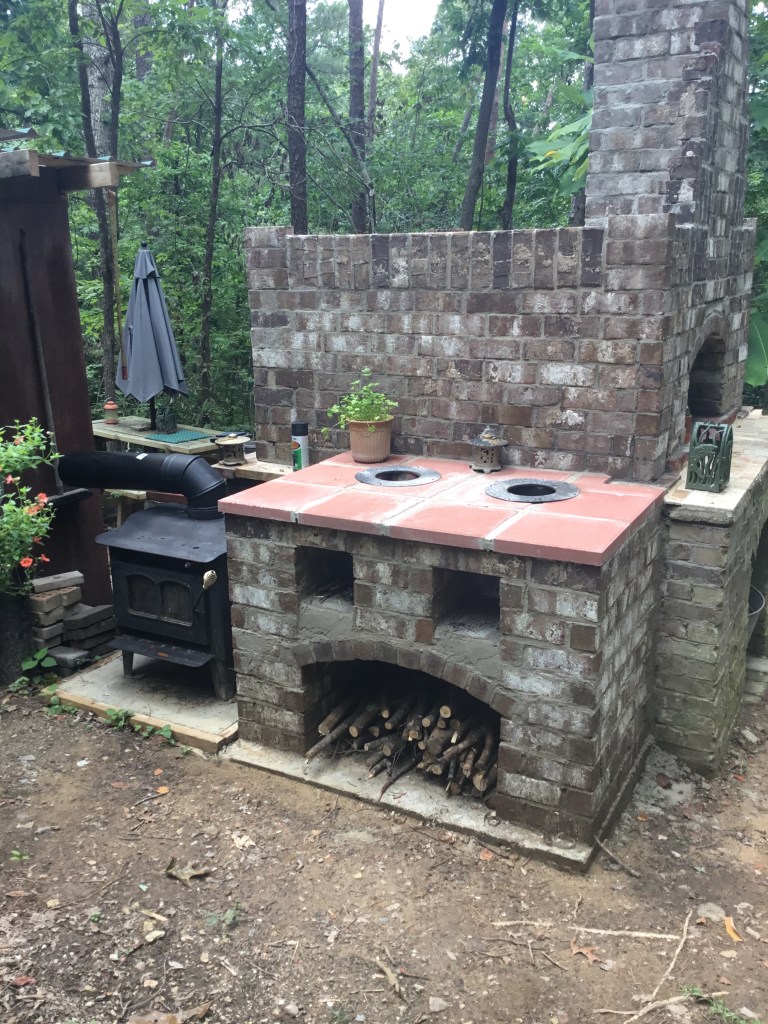
This particular masonry structure fits into the category of something you don’t see every day–a Potager, more commonly called a Stew Stove in English. These were particularly popular with the upper crust of the eighteenth century, and the most famous ones in the States are at Monticello in Virginia. My Potager is a copy of one rebuilt at Ham House, a British National Trust Elizabethan period property in Surrey. It is definitely a French influenced design.
The concept is elegantly simple. A masonry firebox leads to a chimney like opening (I used flue thimbles as openings). This concentrates all the heat and smoke down to a six inch area. In the case of this stove, just sit a cooking vessel over the opening. The temperature can be varied so that it can range from a sear, to a saute, to a long and slow stewing. In short, this is a half ton equivalence to a modern cooktop, with the exception in my case, that the fuel is free and one hundred percent renewable.
As an experiment, I first used this to roast some poblano peppers that I bought at the farmer’s market, on a grill. They smoked as well as roasted, and were jet black in no time. After I cleaned and sliced them, they went into the freezer for use this winter. For stewing, shovel coals into the firebox, and use a pair of bellows to control the temp. Extra fuel is literally at your feet.
Coals from the brick oven can be used for the Potager, and a busy cook can bake and saute at the same time. Alternately, coals from the smokehouse steel wood stove, pictured above, could be used to smoke something and stew at the same time. A cook with four arms could bake, sear, grill, stew, and smoke food simultaneously. Such a creature would end up with a powerful hunger in no time at all.
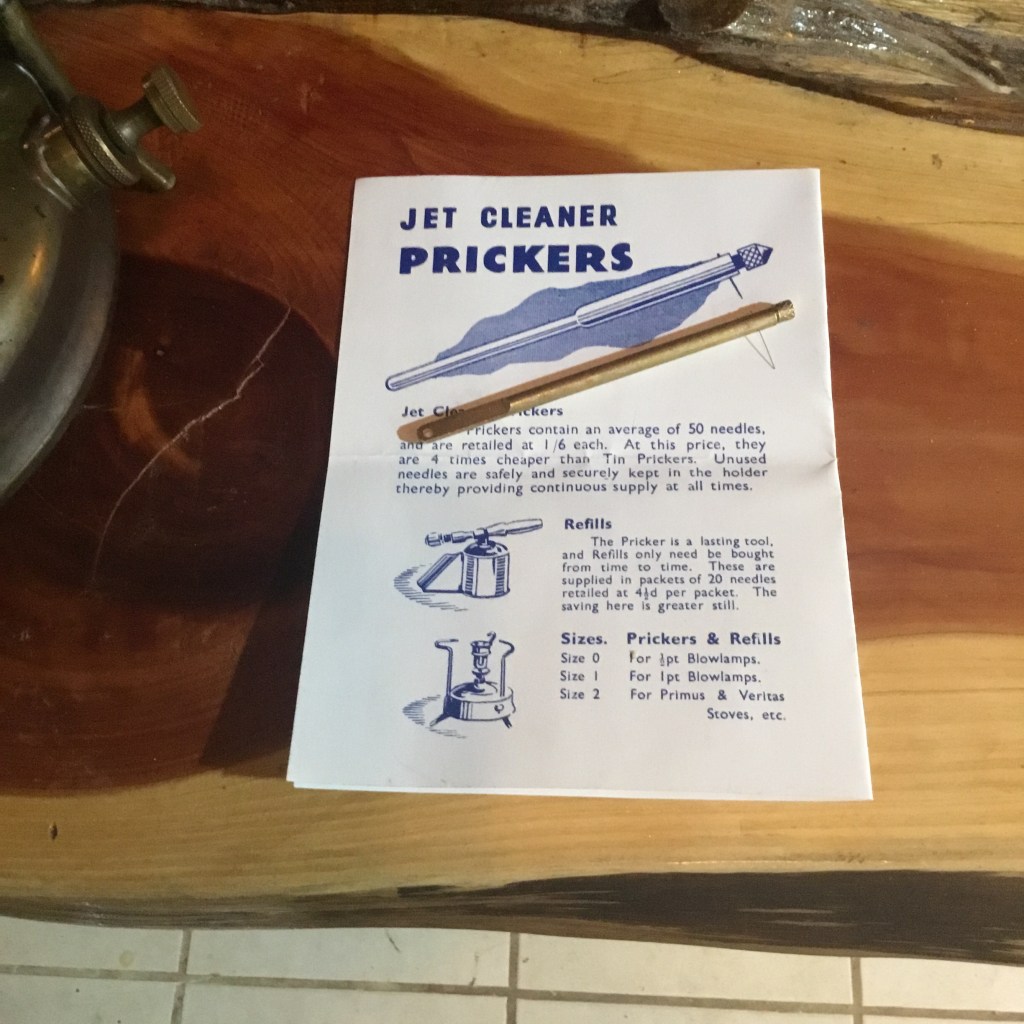
Everyone who has an old Optimus stove complains about the pitiful disposable tin prickers based on the original Optimus model. Optimus is all about being on the opposite end of disposable. A kerosene stove jet is going to clog, and will have to be cleaned in order to function. Those clever Brits have an answer to that problem.
Above is a nice sold brass pricker with replaceable needles. Even better is the fact that the end that holds the needle in place is also machined out to serve as storage for spare needles, and this device comes with twenty. That’s probably enough for a pricking lifetime.
Anyone can buy these on fleabay, or at Tilleylampsandstoves.com. Julian Shaw, the owner (not the actor) sure knows his stuff. Just don’t order things during a heat wave in England, if you need your pricker ASAP.








 Southern Fusion Cooking