Italians and Their Egg Yolk Rules

Some of These Eggs will have Orange Yolks

Italians buy their eggs according to the color of the yolks. Yellow yolked eggs are labeled giallo dell’uovo, and the prized orange yolked egg is called (actually) red yolked egg, rosso d’uovo. I’ll do chemistry first, and then the backstory.

Since Dr. Leroy Palmer first published his research in 1915, it has been known that yolk color is caused by the chicken’s diet. Different carotenoids called xanthophylls are the determinants. More recent research has narrowed down the two main chemicals to Lutein and Zeaxanthin, and one scientist has determined the first is the source of the yellow yolked egg coloring, and the latter for the orange color. That led me on the search for the second one.

Veg! Feed the birds leafy greens, corn, wheat and carrots, as all are good supplements to the diet. This supports my observation that their favorite food is Dandelion greens. I can start a chicken riot with those every time.

Now to the backstory. I was fascinated by the great food book by Bill Buford called Heat. He became so fascinated with Italian food that he goes to Italy regularly to learn from the best of the best cooks. Even though he was the fiction editor for The New Yorker magazine, he was born in Mississippi, and knows his eggs. Hence his experience with a woman who is a legendary pasta maker in Italy.

Bill describes the master of pasta, and why he went to study with her:

It was also why I’d got so interested in the egg, because on my first morning, watching Betta prepare the dough, I saw that an egg was a modern pasta’s most important ingredient, provided that it is a very good egg, which was evident (or not) the moment you cracked it open. If the white was runny, you knew the egg had come from a battery-farmed animal , cooped up in a cage, and the pasta you made from it would be sticky and difficult to work with, exactly like the unhappy batch that Betta produced one evening after Gianni fell asleep, having had too much wine at lunch, and failed to buy eggs from the good shop before it closed and had to drive to the next town to the cattivo alimentarii, the nasty store, and pick up a dozen of its mass-produced product. The yolk was also illuminating. The nasty store’s were pale yellow, like those most of us have been scrambling for our urban lives. But a proper yolk is a different color and, in Italian, is still called il rosso, the red bit …

Heat, Bill Buford

Poor urban folk, deprived of all the goodies. I have a mixture I now feed my birds. The basic bit is as follows:

16% Protein Organic Chicken Crumbles

Corn and Wheat Scratch

Black Oil Sunflower Seeds

Carrots

Various Greens in Season

Maters, Precious

Other Fruit and Veg that are left over (Squash and Pumpkin are especially good)

Ours yolks just keep getting more and more orange. I may one day even get one of the legendary red tinged yolks.

The Picayune’s Creole Cookbook, 1901 Edition Reprint

I love people who hate on Amazon and our corporate overlord Bezos, when I know that they are buying like crazy from them. Life these days would be nearly impossible without them.

I have been saving writing about this cookbook for a couple of years now, and this is only a teaser. I’ll begin with the modest assertion that this is the greatest cookbook ever written (or at least it’s my favorite). You are allowed to ask why.

First, thanks to archduke Bezos, I was able to purchase a mint quality hardback of the 1989 version of the book for $3 plus change. It is expertly edited by a great cookbook writer herself, Marcelle Bienvenu, who wrote the definitive cookbook on Cajun cooking, Who’s Your Mama…? And please don’t confuse Creole food with Cajun food, unless you want to get laughed at.

Then, the recipes are superb, especially the meat recipes for chicken, beef, and Gulf seafood, as well as every vegetable imaginable. There is even a suggestion about how to serve broiled Robins or Larks–this one is not suggested by me, but the recommendation is to serve your songbirds on buttered French toast, and garnish with parsley.

The last mystery was as to who wrote this mammoth book (this latest version is 629 pages). An intrepid young scholar at Tulane University named Rien Fertel has determined that the author was one Marie Louise Points, a writer for the Picayune, who was “from a white, French-Creole family in New Orleans; her ancestors were from Virginia and around the Gulf Coast.” This is a common enough history, as my two favorite “Louisiana” writers came from Missouri and Alabama, respectively.

Bienvenu took the interesting approach of using the recipes from the second edition, but the introduction to the first edition. Anyone who has a copy of the second edition knows why. The second edition has an introduction that contains every racist stereotype that one would expect from the city that brought us legalized segregation with the case of Plessy v Ferguson in 1896–only four years before this book was first published. Fortunately, when it comes to the kitchen, all women and men are created equal.

Sandvik/Bahco Scraper

Hand Forged or High Tech, the Swedish know their Metals

When one of top woodworking tool sellers in the country describes a single thin piece of steel as being “legendary,” it’s time to pay attention. The wood certainly does, when this well sharpened Sandvik (now Bahco) scraper gets in on the action.

It’s easy enough to sharpen a good scraper blade, as it can be done with just a file and a burnisher–a screwdriver will do as a burnisher in a pinch, but mine (re:gear head department), is carbide steel. The edge is a “hook” edge, not a chisel edge, like a plane blade.

Let’s have a trans-Atlantic coalition:

Western Europe, Meet Eastern US

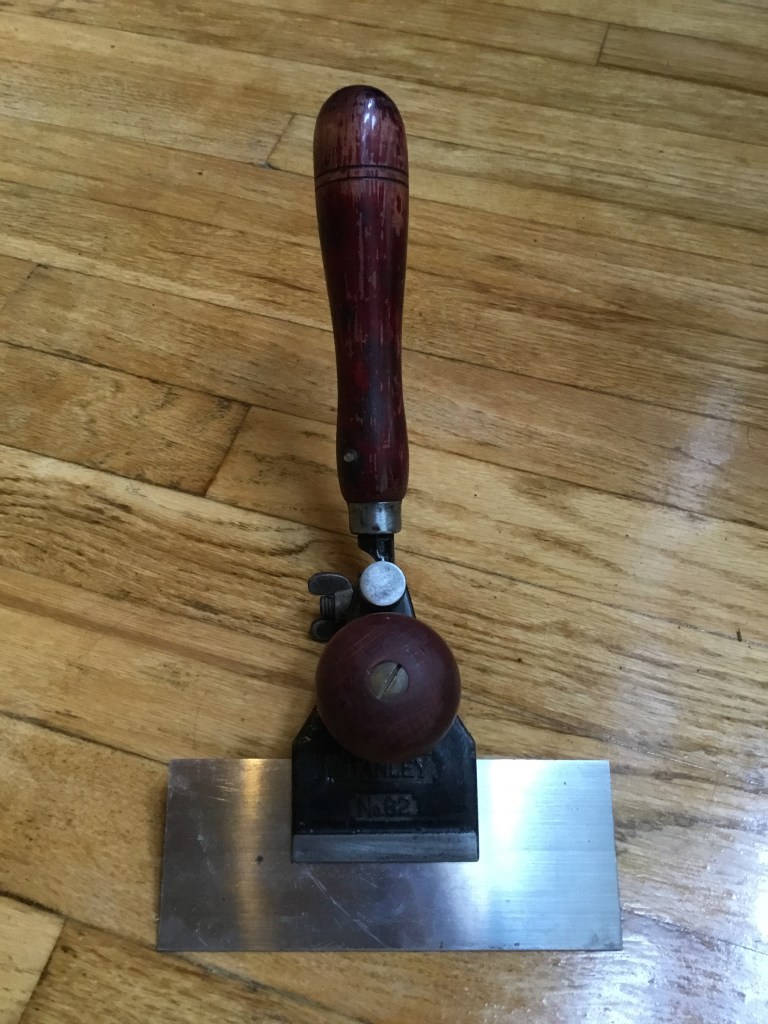
Gott in Himmel! A Swedish scraper blade in an American tool, which was designed by a German immigrant. This floor will be refinished in just days, if I can keep the stinking dogs from walking through the wet water-based polyurethane.

Kitchen Invasion, Part Four–Arthur Umanoff Stools

“And I Saw you on the Barstool, Where You held that Glass so Tight”–Neil Young

Seriously, I had never heard of this great designer of mid-century modern furniture until yesterday. Umanoff was the owner of a company called Post Modern Ltd, and his work was featured at the Museum of Modern Art in NYC. Then we end up with two of his stools for $18. Read on.

MJ and I both grew up in dire straits, or as we say in the South, dirt poor. We did have houses full of books, and the beautiful Southern outdoors around us. Even with that, a dollar is still a dollar, to this day.

Example given, our shopping habits. Our most famous shopping trip was buying a piece of layered Swedish art glass (an Orrefors candle holder, no less), and a classic Stanley woodworking tool, for $4. I didn’t even bother to get a better price, which I usually do.

Yesterday was as good. These stools were under a pile of junk at a flea market, but looked good. MJ, wanna be art major, saw them first. I thought $18 was a bit much, but we needed better bar stools. What the hey.

MJ, who should have the research degree instead of me, found these on the interwebs after we bought them. Three were going for $800. Maybe being cheap is it’s own reward. At least we have a nice place to sit now.

Kitchen Invasion, Part Three–The Storage Wars

This is how the Kitchen always Wins

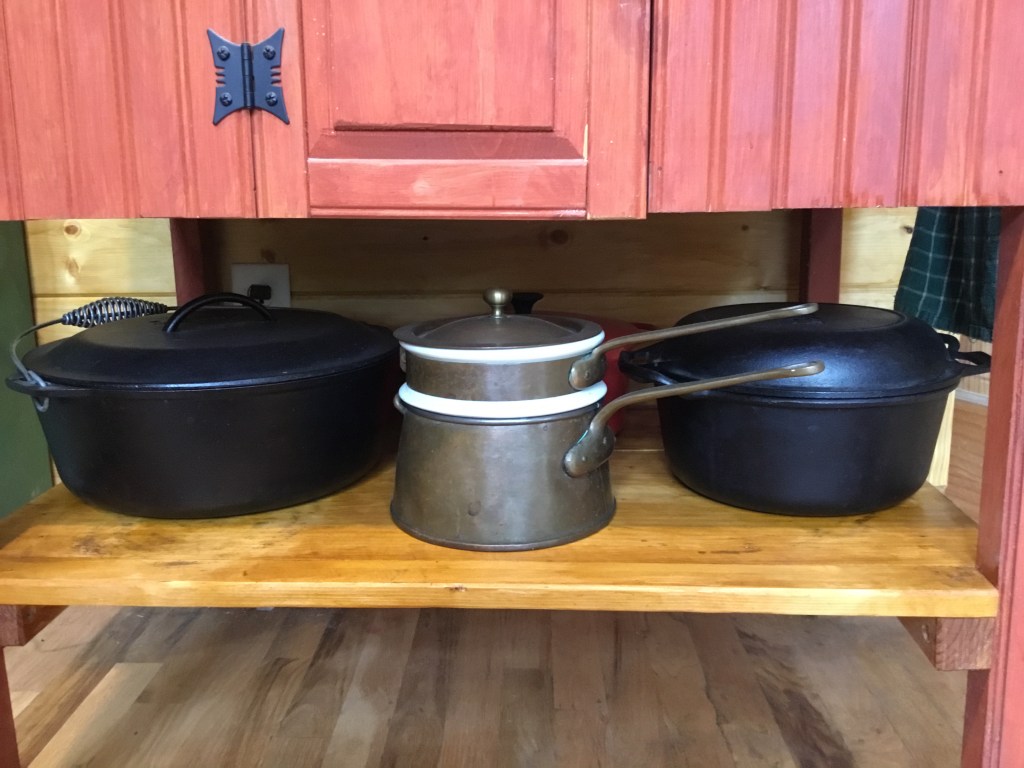
The shelf under my baking bench was meant for baking equipment, but guess again. Three cast iron pots and a brass/ceramic beauty walked in and said–out of the way, jokers.

So we now have three Dutch ovens and a French/ American double boiler ruling the shelf. One Dutch oven is an eight quart Lodge model, and as heavy as a sea anchor. The other is a Franken Oven, made of a Dutch oven bottom and a skillet lid top. An old Creuset enameled Dutch oven hides in the back. The best, however, is the double boiler.

The Bazar Francais double boiler is a gem, with a French made copper body and a lining from Hall Pottery in the USA. I had a brain infarction, and decided today this would be perfect for keeping mulled wine hot during Xmas.

Wait, there’s still wall space.

Yes!

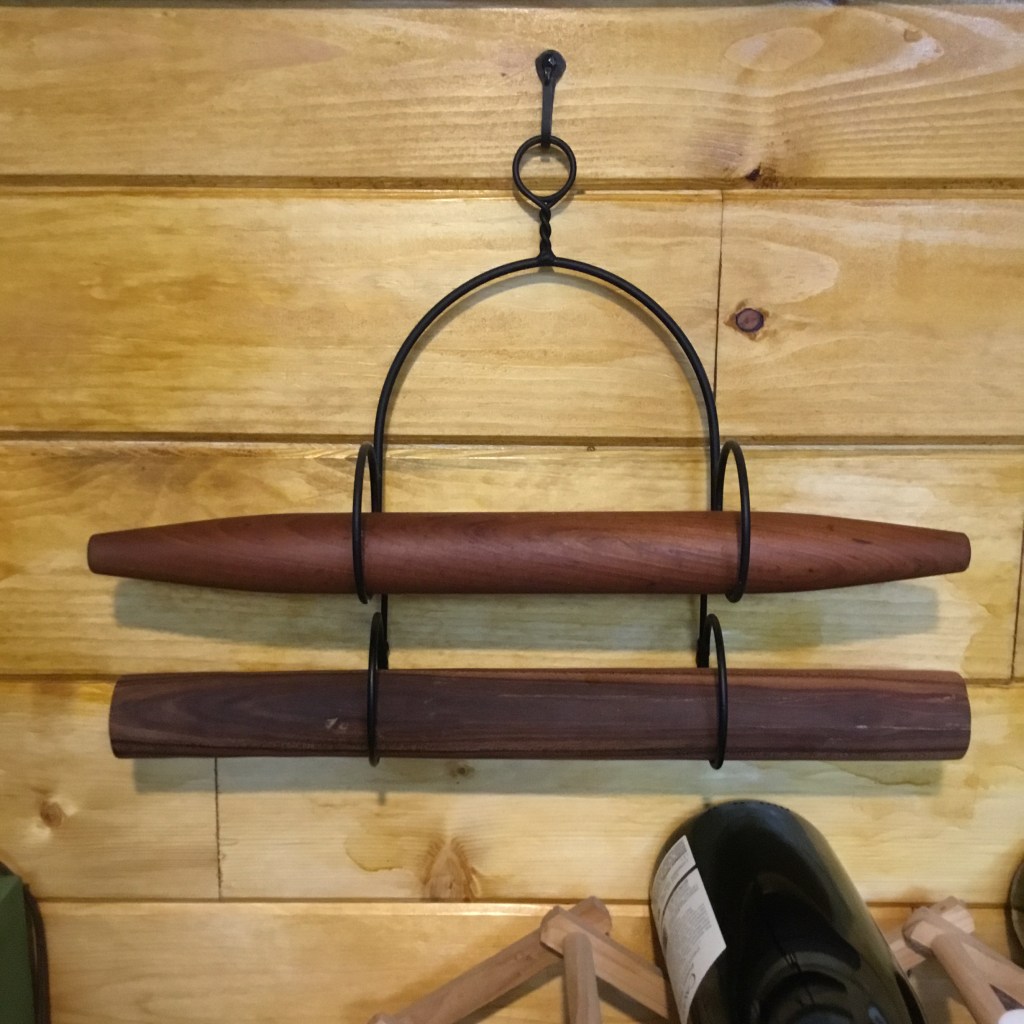
What, actual baking equipment? These dudes are serious. The cherry French style pin was made in Kentuck, and the bad mother Dogwood one made in my basement, though everyone thinks it is Walnut. I know Walnut, and this is no Walnut.

A fifty/fifty split. The pins are used more often than the interlopers. But I can’t get that mulled wine off of my mind.

Homemade Habanero Powder

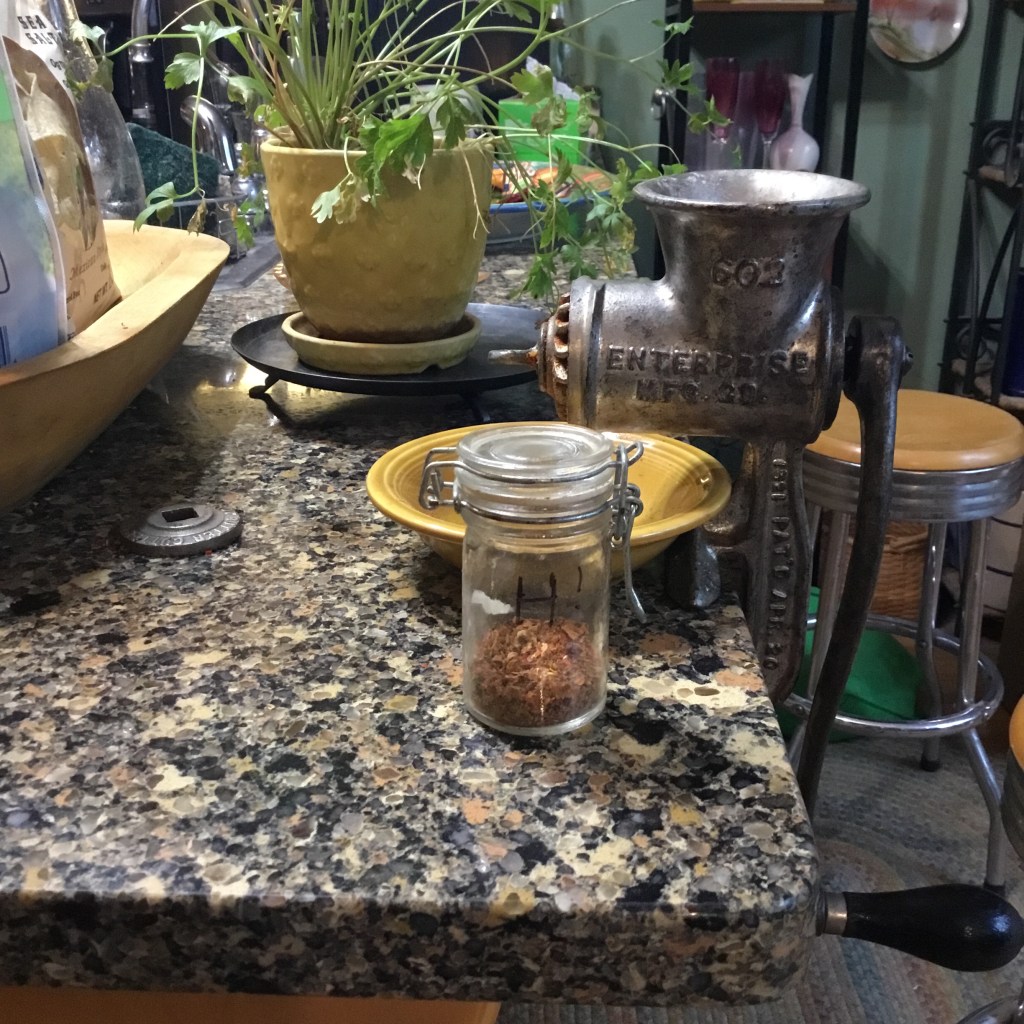
Habanero with the Offensive Instrument that Made it

Just a brief note about what to do with end of the season really hot peppers. A bunch of really squishy looking yellow peppers were hiding in the bottom of a big container of hot peppers I bought at the Festhalle. It was obvious what they were: Habaneros.

Not intending to use them fresh, I turned to my lowest tech imaginable method of drying, with the sun as the only source of heat. It does a great job of heating up the South every summer. I threw them in my drying platter, and forgot about them. Before I knew it, they were ready for the grinder.

I have a couple of electric machines, but none clean up as easily as the trusty Enterprise #602. More peppers are drying as we speak. Should I ambush my in-laws with this? Maybe.

Pepper “Poblano”

With Hardy Begonia

Unbelievably, there may be more Hoya! about Poblano peppers on the interwebs than there is about any other pepper. (For those not familiar with Hoya!, it’s the stuff you don’t want to step in while in the horse barn). First, it is sold under two names–Poblano and Ancho, though the name Ancho is usually (but not always) reserved for dried ground, red, Poblanos. Secondly, it is said to grow in zone 10 and further South, and be no more than 25″ tall. Guess again–I’m in zone 8, and this plant is 52″ tall and still growing.

Ocular Proof

The last and third pile of Hoya! is that these are a mild pepper. Actually, Jalapenos can be also, if you buy one of the varieties that has had all the heat bred out of them. The worst case of pepper burn I have had all summer was from Poblanos I cut up to freeze. I bought them from one of our best local Hispanic farmers, and she neglected to tell me they were really hot. Let the buyer beware.

In short, be skeptical. Grow some yourself, and see what result you get. I am mixing up a seed mix with upwards of ten varieties of hot peppers for next year, so I can see which ones are best. It’s called evolution in action. That is, as long as I survive the pepper burns.

Kitchen Invasion, Part Two–If the Preacher had not Fallen through the Porch, We would not have this Cupboard

This image has an empty alt attribute; its file name is porch.jpg
Seriously

I really wish I could make this stuff up, but Pastor Fiedler fell through this porch. Actually, these are just some of the surviving boards of the porch that the hefty pastor fell through. Read on.

Fiedler was one really funny pastor, and I witnessed his take down of one of MJ’s most repulsive in-laws–at a wedding, no less. With that said, he was also quite large, and he never once missed a free meal cooked by Agnes Olga, MJ’s mother. However, he almost missed one meal when he fell through the porch.

Background info. When MJ’s parents built their house, they did it right. Oak floors throughout, and even oak boards as the floor to the porch. To preserve the porch, they used green lead paint to keep it from rotting. Bad news–nothing will keep wood from rotting in this hot humid climate.

A couple of decades later, the fateful day arrived, and it could have been karma, as he was the first pastor of the church who could not speak German (the church was even founded by Col. Johannes Gottfried Cullman). Fiedler showed up as hungry as usual, but no lighter than before. He hit the one really weak board on the porch, and boom! Down he went, about three feet.

No harm was done to the man of God, but the porch received a death sentence. Here’s where I come in. I happened to be there while my in laws were tearing up the oak boards, and replacing them with cheap pressure treated pine. I asked them what they were going to do with them, and the answer was that they were going to be burned. There is nothing as healthy as burning boards painted with lead paint.

I offered to take a few boards off of their hands, and the result is above, a cabinet I made using only hand tools. I even saved some of the green paint. Hey, nostalgia, and a great story.

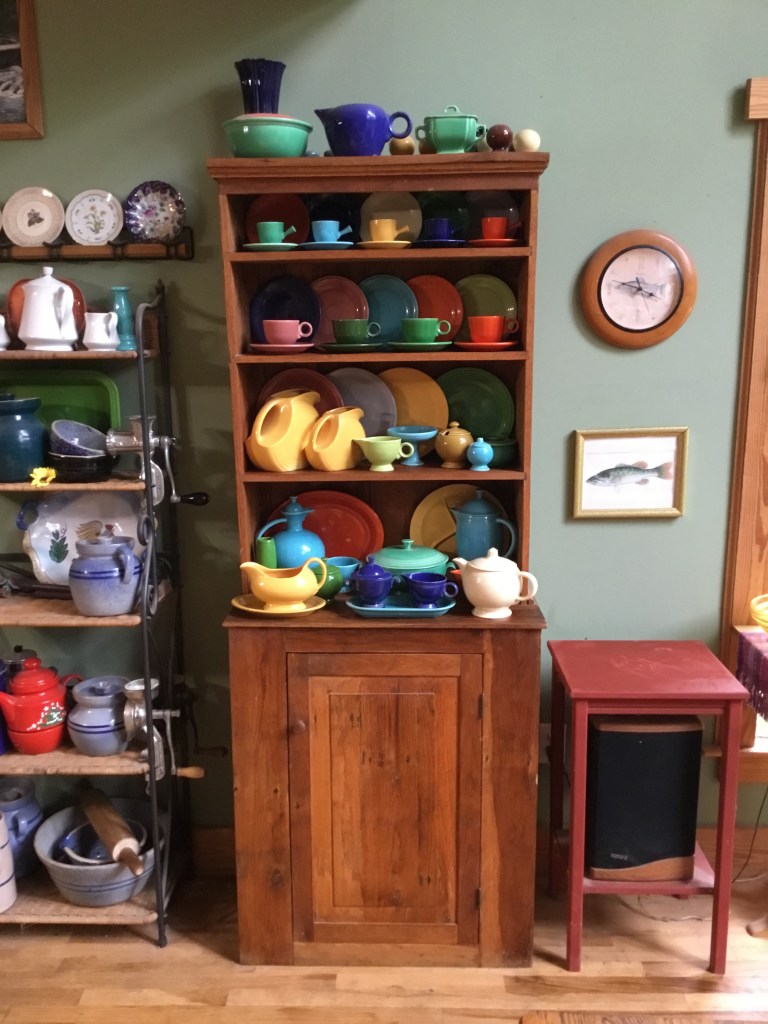
Fiesta Ware not Included

As my man Brecht wrote ( sorta plagiarizing Villon), where are the snows of yesteryear? I at least I saved a few of the oak boards.

Pepper “Royal Black”

Or is it Black Pearl?

I bought these seeds from the greatest seed seller around, J. L. Hudson from California. He has kept me in seeds for years, and this one sounded primo. It really is.

The black fruit, which ultimately will turn red, contrasts with the purple leaves. The blooms are also purple. It is a type of pequin pepper, a variety that originated in the pepper famous state of Tabasco in Mexico. Though the peppers are upright like a Tabasco pepper, this is actually listed as a different species.

The question: Should it have round or Tabasco shaped peppers? Most photos on the inerwebs show plants with Tabasco shaped peppers. However, they are all black, and quite hot, even up to the level of a Cayenne pepper on the Scoville scale. In short, they are hot to quite hot.

My father, who was a notorious seed thief (he called it “collecting”), would have walked away with at least one pocket full of these. He even stole all the lily seeds from a college that was attended by my three oldest sisters–only the college happened to be housed in a convent called Sacred Heart. I know that because I was there when it happened.

Sage “Berggarten”

If it does this in Six Months . . . ?

Due to the ever increasing vagaries of our climate, no doubt caused by Anthropogenic Climate Disruption (the technical term for Global Warming), our herb gardening is now confined to containers. We have one sage plant that is at least ten years old, and it has to be root bound like nobody’s business. Then I saw this plant, with the German name of Berggarten (Mountain Garden), at our local plant seller. That made it a done deal.

Yikes! I planted it in this giant Mexican terra cotta container with a white Martagon lily, and the sage began growing like it was trying to escape back to the mountains of Deutschland. (I probably should add that the plant is in fact named after one of the gardens of Herrenhausen Palace in Hanover, Lower Saxony, which is not on a mountain). The interwebs descriptions call the plant “compact.” Draw your own conclusion.

Fortunately, the taste of this plant equals its magnitude. No holiday around here is complete without some cornbread dressing that tastes of sage as much as it does of cornbread. I can see a serious herb drying project in my near future.

OffGuardian

because facts really should be sacred

Ruth Blogs Here

Or not, depending on my mood

A Haven for Book Lovers

I am just a girl who loves reading and talking about books

what sandra thinks

because I've got to tell someone.

LadiesWhoLunchReviews,etc

a little lunch, a little wine, a LOT of talking!

Margaret and Helen

Best Friends for Sixty Years and Counting...

talltalesfromchiconia

Tales of quilting, gardening and cooking from the Kingdom of Chiconia

Cyranny's Cove

Refuge of an assumed danophile...

Exiled Rebels

Serving BL since 2017

this is... The Neighborhood

the Story within the Story

Beauty lies within yourself

The only impossible journey in life is you never begin!! ~Tanvir Kaur

Southern Fusion Cooking

Country Living in the Southern Appalachians, USA--A little of this, a lot of that

Discover WordPress

A daily selection of the best content published on WordPress, collected for you by humans who love to read.

The Atavist Magazine

Country Living in the Southern Appalachians, USA--A little of this, a lot of that

Longreads

Longreads : The best longform stories on the web

WordPress.com News

The latest news on WordPress.com and the WordPress community.