So Much Depends on a Mailbox and a Red Wheelbarrow
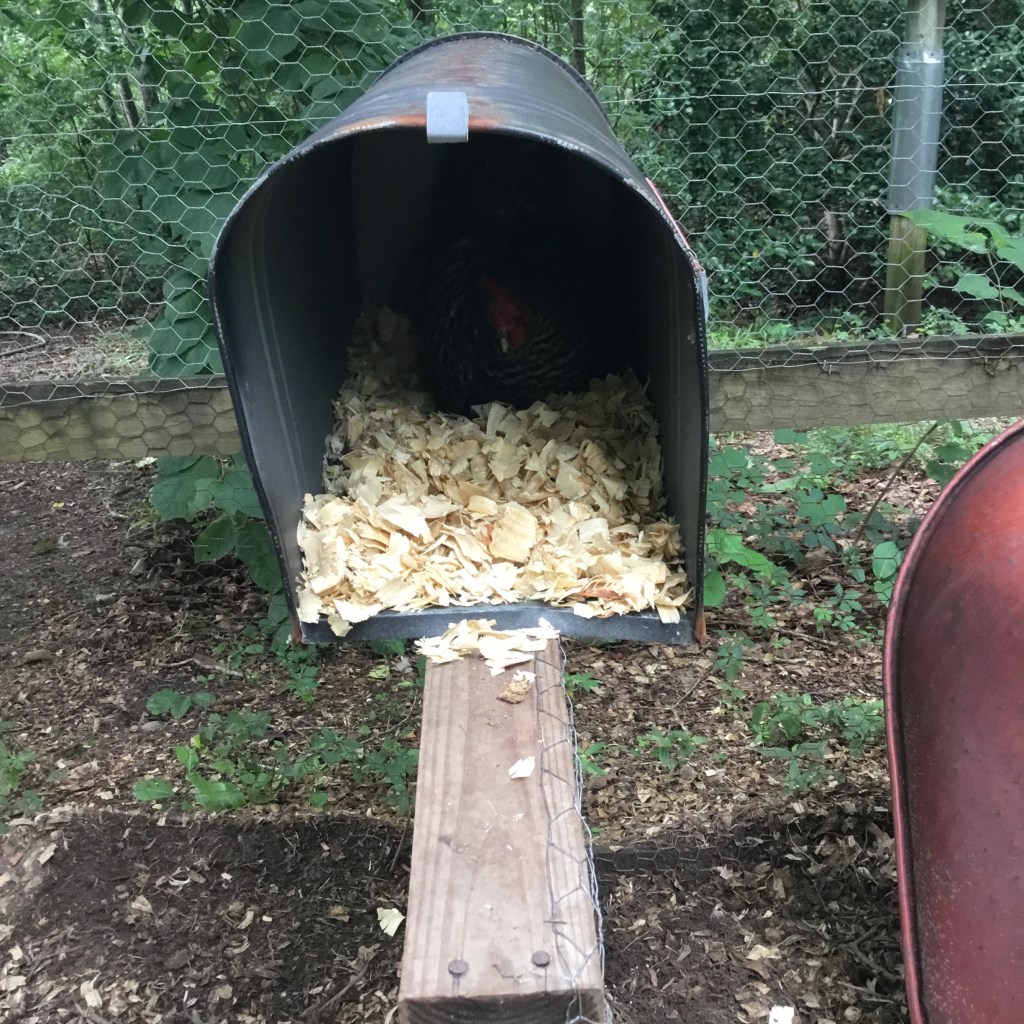
To go along with our Shaun the Sheep themed chicken pen, we have added another addition to the junkyard. MJ had the genius idea of turning our old defunct mailbox into a chicken nesting box. One Bosch drill, and three deck screws later, and it was a reality.
No Envelope for this Bird
I just added some pine shavings, and five minutes later, the Barred Rock chicken we have named Broody Bird was in there. She got comfy in a hurry.
Our flock of eight has five nest boxes now, and I suspect at least one of the young ISA Browns has begun laying. We’re not going to have an egg avalanche–it will be more like an egg tsunami. I need to get them to raise the red flag when they lay an egg.
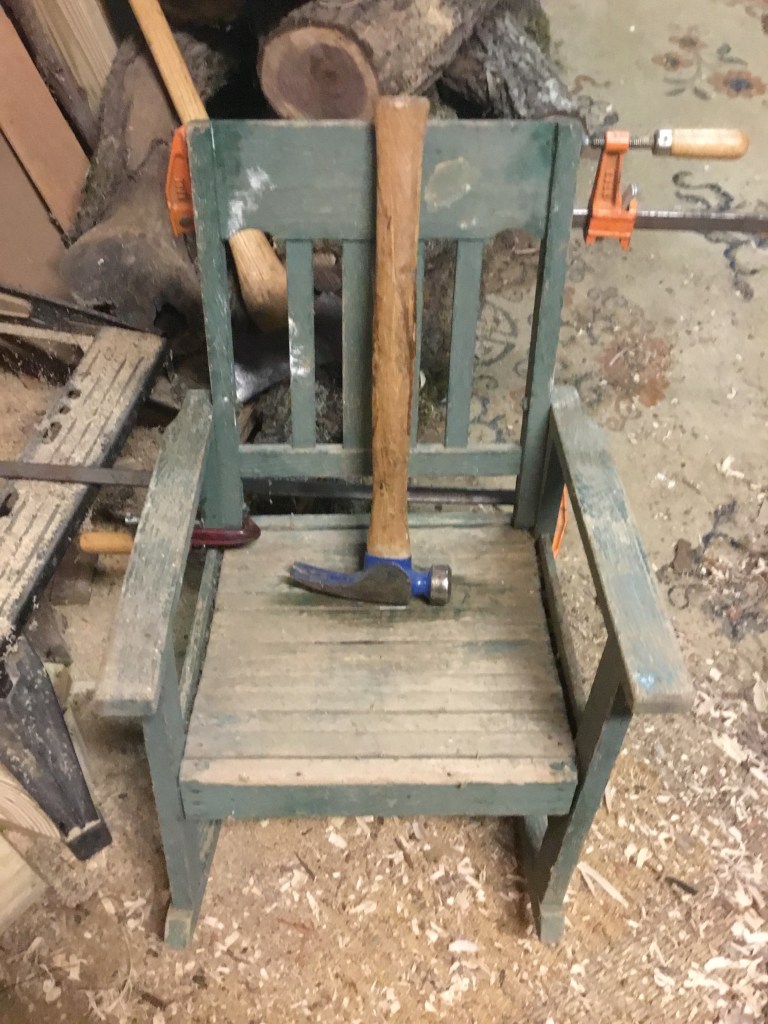
Family heirlooms, if they can be reclaimed, should never be thrown away. My in-laws commissioned me to repair this probably homemade child’s rocker, which was found in a shed, and was in seriously rough shape. One back leg was broken, two slats in the seat were broken, and every joint was coming unglued. There is a good chance that MJ’s grandfather Richter, who was born in Germany, made this, as he was a master carpenter.
There isn’t much that isn’t completely rotten that can’t be repaired with a couple of bar clamps, a c-clamp, some fasteners, and half a bottle of glue. And then there is the ingenious part of the repair.
Animals at work
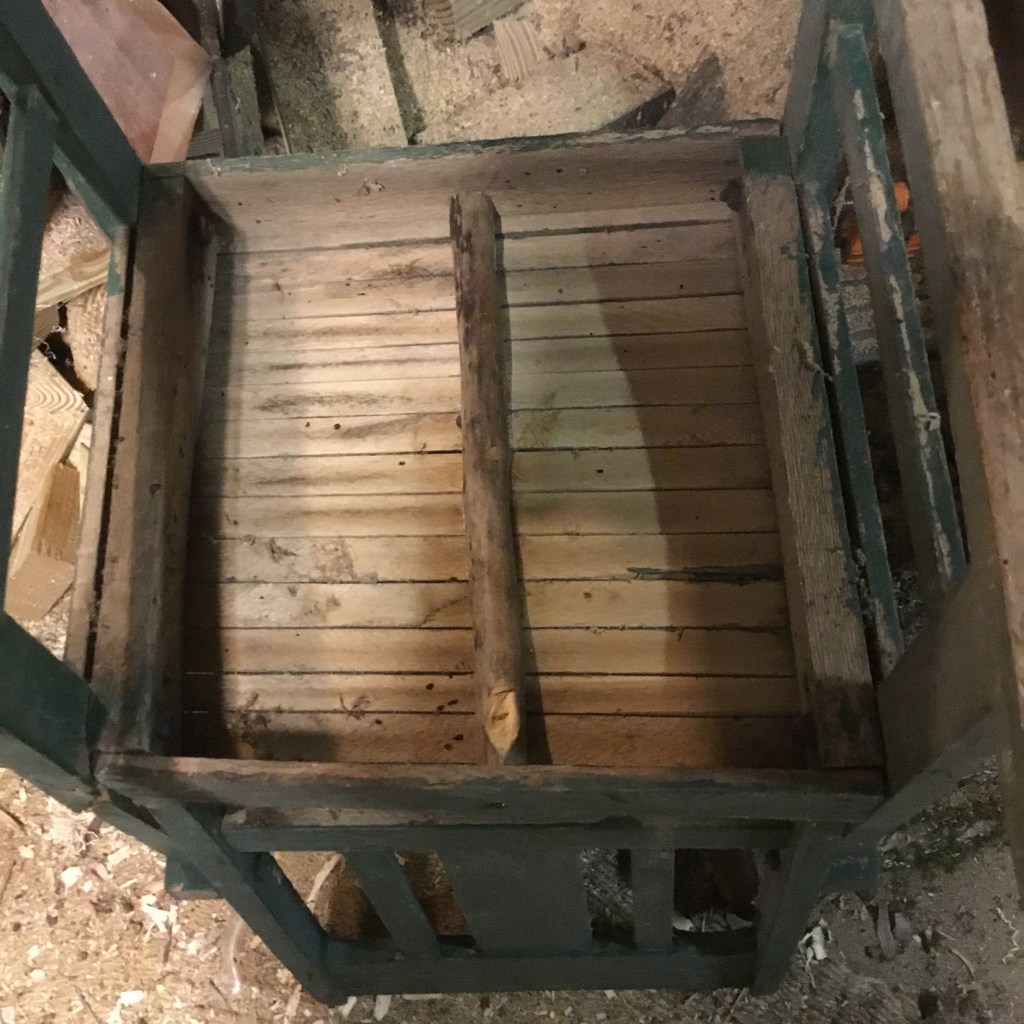
I needed something to brace up the broken slats, so I searched my scrap pile for the best item. Then there it was–a River Birch piece that had been peeled by a Beaver, that I found on the river. I thought, how can anything be more appropriate, to fix a home made rocker?
I shaped a nice curve in it with a spokeshave, coated the top with glue, and attached it with a couple of fasteners. It is a little crooked, but the slats were broken in different places, so I had to angle it ever so slightly.
If you are wondering why my 23 ounce framing hammer is sitting in the seat, it is my clamp to keep down the broken slats while the glue dried. That hammer was yet another present from MJ, who actually remembers sitting in this chair. With any luck, kids will still be rocking in this thing, a hundred years from now.
The Best of the USA and the Bundesrepublik Deutschland
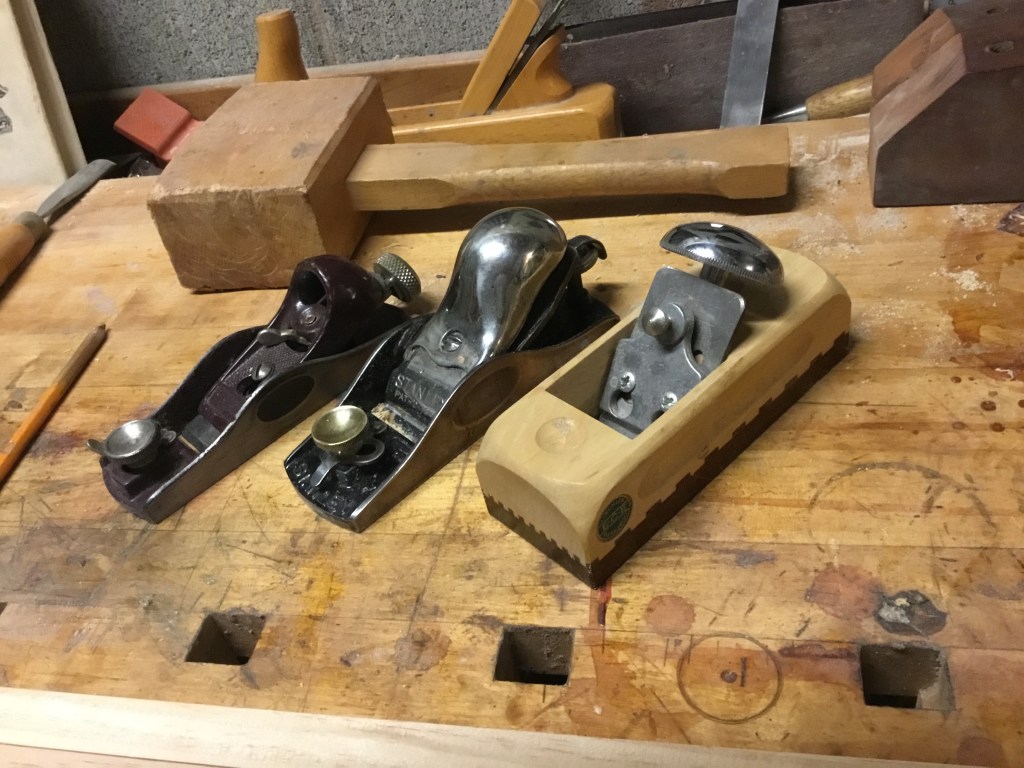
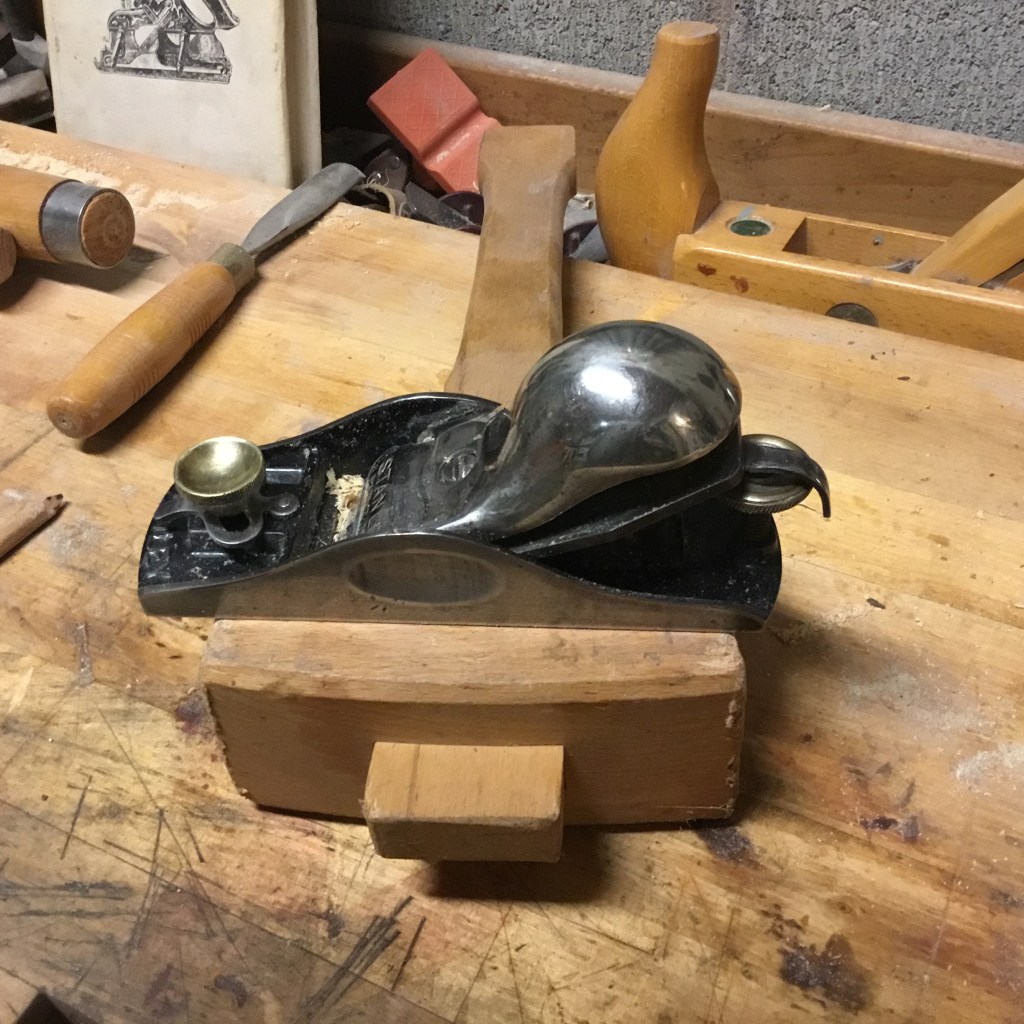
These are some of my most used planes. and two actually live in the tool tray on top of my work bench. They are that useful. To make this brief, they are a Stanley #60 1/2, a Stanley # 18, and an EC Emmerich wooden block plane with a sole of lignum vitae. Now it’s time for my closeup, Mr. DeMille. (Sunset Boulevard ref).
60 1/2
The least used is the Stanley 60 1/2 “low angle” block plane, though there is some debate over how low angle it actually is. It has an adjustable mouth, which is the key feature. The only reason it isn’t used more is the crappy blade that Stanley put on these planes. Therefore, it spends its time in my green woodworking tool bucket. I am eventually going to spring for one of those fancy Veritas plane blades, and at that point it will be look out, wood.
Germans, They are so Clever and Industrious
This beauty I would never have bought for myself, but I opened a package one Christmas from MJ, and there it was (She is of mostly German and Swedish extraction, and knows her woodworking tools). This E.C Emmerich block plane came with one bad mother of a plane blade, so no upgrade was needed. It’s built like a modern German BundeswehrPanzerdivision, and cuts like it means business. It’s partner is hiding behind it, and that’s one of only three planes I have ever had in new condition–an old Ulmia Scrub Plane, which happens to be the only bench plane that I have personally purchased new. Those definitely live in my tool tray on the bench.
The Crown Jewel
This Stanley #18 knuckle joint plane gets a workout ever time I make something. Like all things over a hundred years old (such as myself), it has a secret weapon.
That Means Oil Hardened
Yep, that’s the extra thick and hard Lee Valley blade, made in Canada. Those things are worth far more than the money they cost. It does make this dingus as heavy as a sea anchor, but as my friend Torsten Fisch used to say, in his thick German accent, “Size matters. Bigger is better.” Of course, he did work for Mercedes.
As this is Juneteenth, we should celebrate someone who was freed from slavery–Peter Hemings, head chef at Monticello. He learned to cook from his famous older brother James, and was such a master that President Thomas Jefferson would write from the White House for his recipes. Despite being enslaved, he was the half-brother of Jefferson’s wife. History is complicated.
Not satisfied with just that, Peter taught himself brewing, and became the head brewer at Monticello. He was so good at that that he was recommended to be an instructor for the brewer for President James Madison. Jefferson wrote Madison that Peter was “uncommonly intelligent and capable of teaching.” Apparently he could make great beer as well.
After he finally gained his freedom, Peter took up yet another trade–being a tailor in Richmond. It appears that the people of Virginia were both well fed and well clothed, because of people like Peter. My guess is he was the source of many of Mary Randolph’s recipes, from the famous 1824 cookbook The Virginia Housewife.
Years ago, the best deli in Birmingham was in the tiny suburb of Cahaba Heights. The classic item was a turkey sandwich with a hot honey mustard sauce. I finally got the recipe for the sauce from them, and not much could be simpler.
Here are the grand total of the three ingredients.
Ingredients
12 ounces whole grain Mustard
8 ounces Honey
Powdered hot Mustard
Put as much of the last ingredient in it as you dare. This is also known as Oriental mustard, though ours came from Canada. It varies greatly in heat level, and as a menu at a Chinese restaurant we frequented used to say, “it gives you a pleasant burning sensation up your sinuses.” Fair warning.
Alas, the deli has long since closed, but hot honey mustard lives on, as does that pleasant burning sensation. That one is forever.
The problem with being rusticated with your dear spouse is that she finds a hundred things for you to do. The truth is, I needed to do most of these things anyway.
A case in point is the Hall Tree, all but one of the pieces of which I have had for years. I finally got the last piece of pine for this, as the upright part of the tree is laminated from three pine boards (three 1″ x 3″s). The Cherry feet came out of my famous scrap pile, and the post is attached with a tenon. And then there is the hardware.
The small iron hooks are Amish handmade, and the nails were handmade in a World Heritage site nail factory in France. The big hooks came from my favorite tool seller, Lee Valley, which is based in Canada.
The big framed dingus in the background is one of the favorite magazine features that I have written. They also published one of the photos I took as a full page intro, of MJ fly fishing for brook trout. If she will model for free, I suppose the least I could do is make her a hall tree. And buy her a beer.
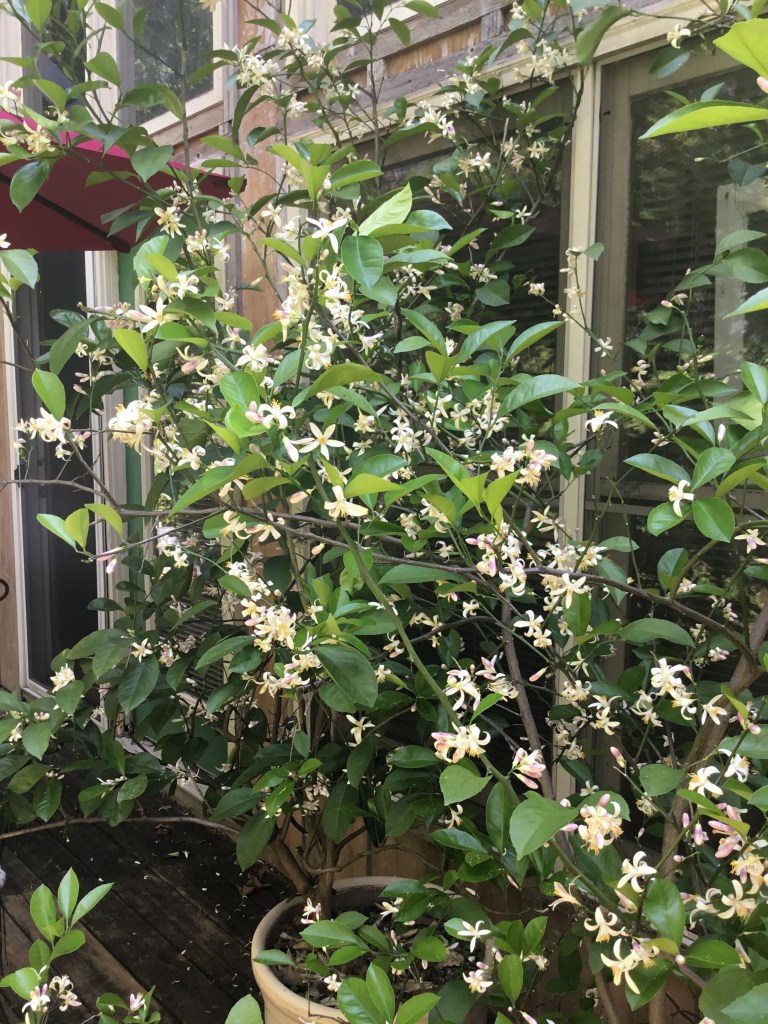
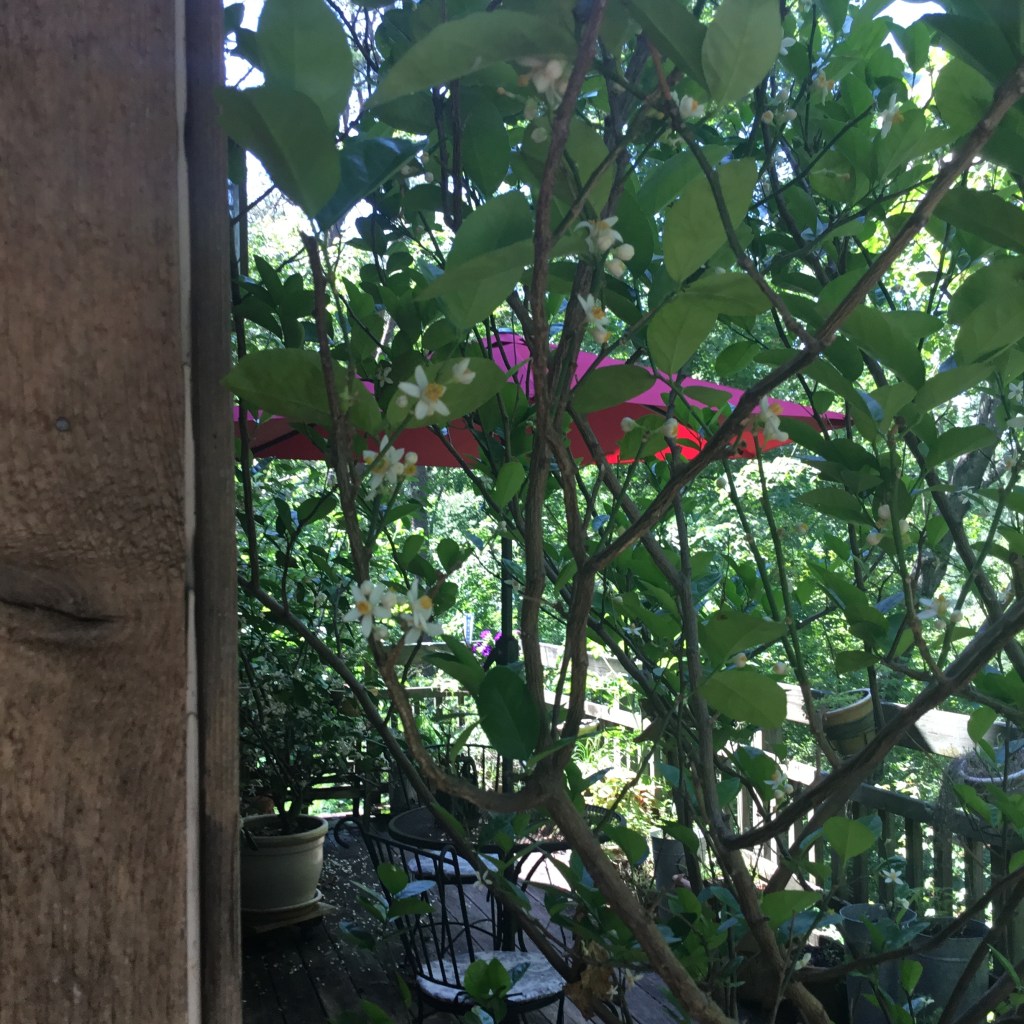
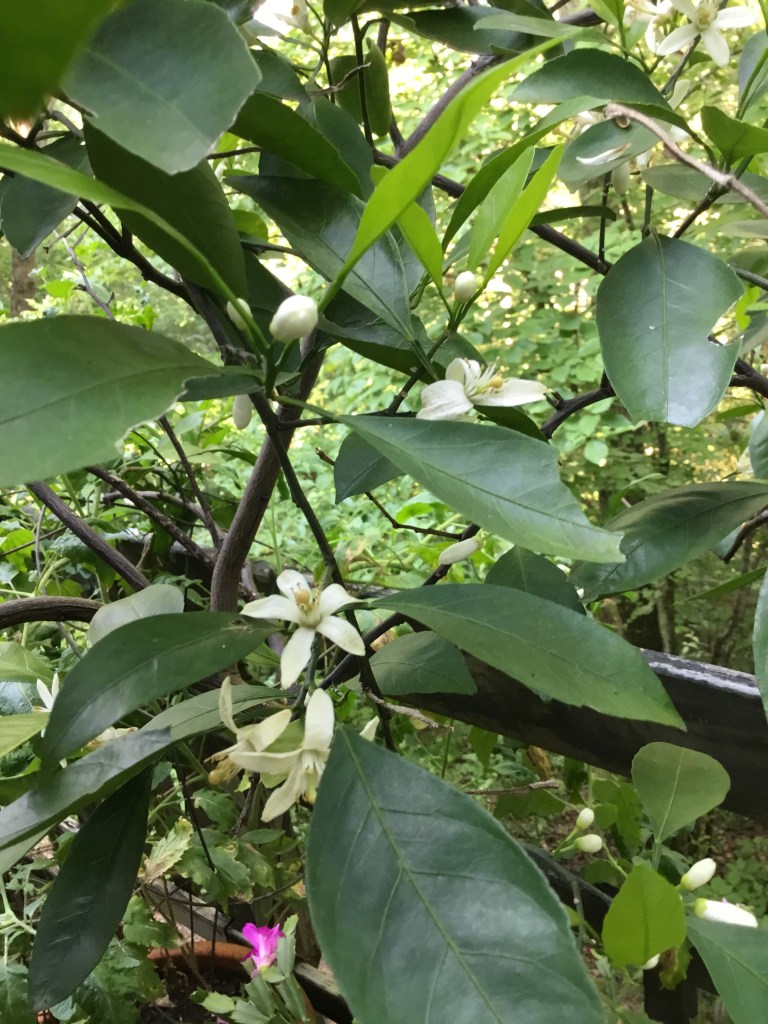
MJ’s mastery of citrus continues, as we have two Meyer lemons that are completely covered in blooms, at least three hundred to five hundred blooms or so. People don’t associate the Appalachians with citrus, but just bring them indoors in containers in the winter (Goethe wrote that they did the same thing in Germany, and that was over two hundred years ago). We’ll end up with only a few lemons, but we usually have enough to last us most of one year, until the next crop comes in. We freeze the surplus.
Key Lime Pie Waiting to Happen
The Key Lime is our most reliable producer of fruit, and we have had over 150 limes in one year, from just his one plant. We still have a bag full of these in the freezer. Beer with lime, anyone?
Orange Blossom Special
The Satsuma Mandarin Orange is the least productive of the plants, but the smell of the blooms is spectacular. This is grown widely on the Gulf Coast, as it is quite hardy for a citrus. There is even a town called Satsuma in south AL. The best Satsumas come from Plaquemines Parish in LA, which is just south of New Orleans. They even have their own Orange Festival.
Finally, MJ has some cuttings of Meyer Lemon started, and she doles those out to her family. All I can say is that growing citrus from cuttings is not for people with short attention spans. MJ has a waiting list of more than one year.
Whenever the fresh tomatoes start rolling in, I always think about the great book by Barbara Kingsolver, Animal, Vegetable, Miracle, and the chapter that she titled, “Life in a Red State: August.” The title is overdetermined, as she was referring to the circumstance that she was living in Virginia at a time when it was run by right wingers, and the fact that she had so many tomatoes that she could not even see the surface of her countertops. That’s a serious canning job.
We timed using our last quart of MJ’s home canned tomatoes perfectly, as we used them last weekend to make sauce for our brick oven pizza. Then guess what, the new fresh tomatoes start rolling in. These are all local, and some came from around ten feet from our front door. The light colored ones are Bella Rosa, that we grew on our deck.
The purple ones we bought at the Festhalle Farmer’s Market, from the same farmer who grew that crate of tomatoes that are my logo. I suspect that they are Cherokee Purple, a great tasting tomato, as his daughter, who handled the sale, had dyed her hair purple. A farm girl has to do what a farm girl has to do.
Barbara Kingsolver writes that most farmer’s vote conservative because of the risk involved in farming–one bad crop or bad season, and you’re toast. I would add a lack of decent education in rural areas is a great contributor. After spending twenty nine years in the education system which is now the worst in the US, I can say that we have worked hard to become last overall. Irony alert.
I will instead concentrate on maters, having given up on learnin’, except for my own. We have a state run by looney tunes characters, except that they have no humor, which is not a good combination.
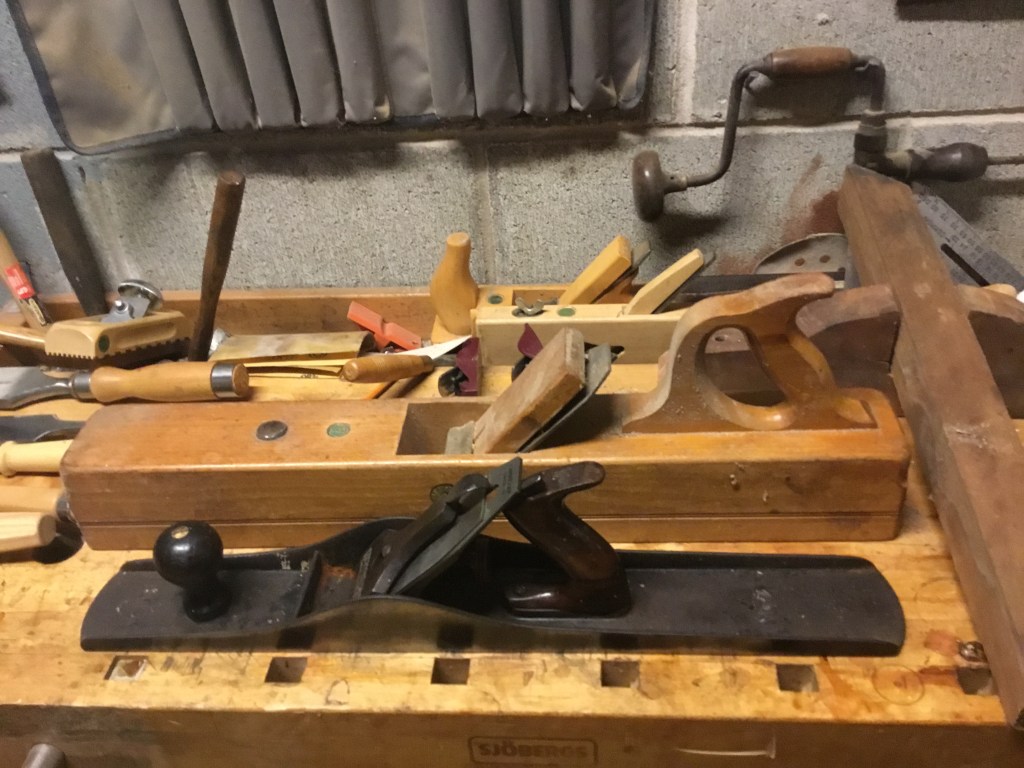
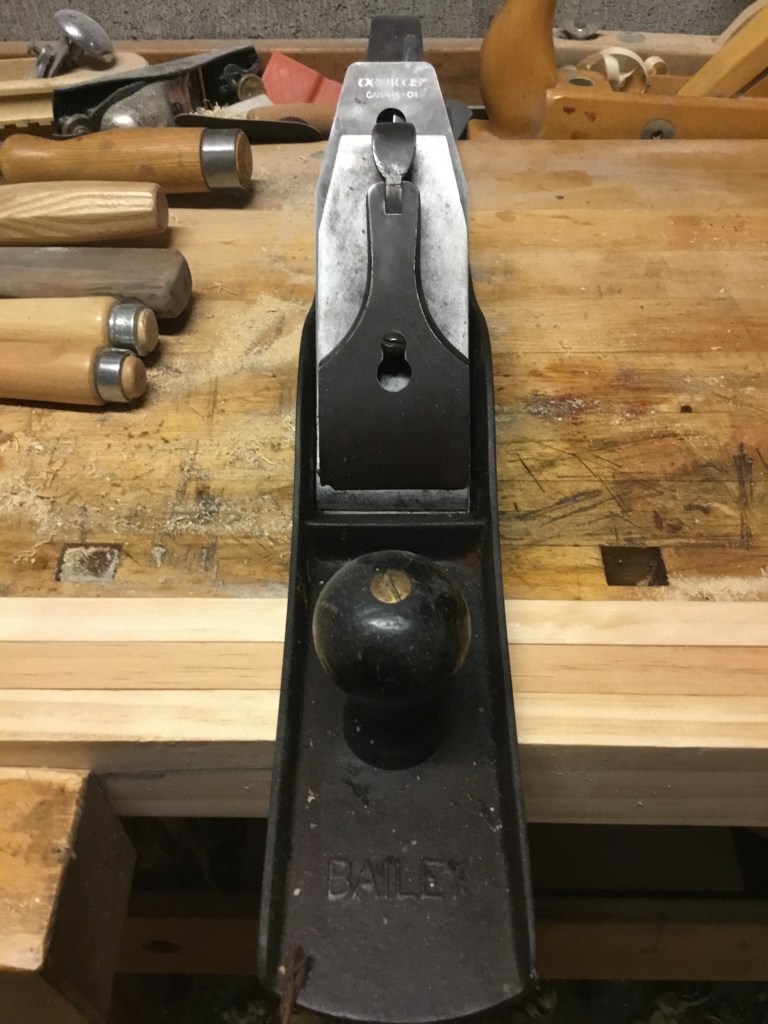
All of my Jointer planes (used to edge plane boards for gluing, such as tabletops, or for general leveling), were bought used, which saved me hundreds of dollars. That left me with enough money to buy a fancy plane blade for the 22″ long Stanley #7C (that’s the iron one, with a corrugated sole). It’s an extra thick cutter, made by Veritas/Lee Valley in Canada. It will seriously slice up some wood, even though it cost more than the plane did.
The plane is something of a mashup of parts, with a wrong sized lever cap (the thing that holds the cutter on), and handles of different kinds of wood. I did just order a new correct sized lever cap from Fleabay, as I have numerous projects which MJ has ordered me to complete.
Ebony, Cast Iron, Steel, and Rosewood–and a little Brass
However, when I really want to flatten some wood, I reach down in my tool rack under the workbench, and grab the German made old 23 1/2″ beech wood Ulmia/Ott jointer (also in the top picture). It’s light, sharper than a razor, and easy to use. It’s the only large plane that permanently lives under the workbench. It’s that useful, and I used to feel guilty about how little I paid those Canadians for it, on Fleabay. Used to.
And then there is the first jointer I bought, a Stanley/Bailey #31. It’s a full 24″ long, but they made these in two inch increments up to 30″ long, the last of which must have been a special order by Andre the Giant. These are called “transitional planes,” as they are wood bodied, but with iron adjustments. They were completely out of favor when I bought five different ones at an Indiana Flea Market, and I doubt I paid $50 for the lot. They are excellent tools.
For a good long while, hand tools like these were only sought after by country living Luddites such as myself. Now a whole boutique industry has emerged to make planes that are fantastically expensive. A jointer this size from one of those companies now costs more than the monthly payment on our Prius Eco. I’ll buy one, as soon as one comes out that I can ride to the Farmer’s Market at the Festhalle, like our Prius.
Tater digging time has arrived down here, and there will be lots of them. The first few plants yielded four different taters.
There are two yellow varieties in the bucket, and they are Gold Rush, and the standby Yukon Gold. The reds are Norland Red, which is quite attractive, so much so that I think I will eat them. The classic Russet rounds out this group.
I did very little for these roots except treat them with soil sulphur, to keep them from rotting, and a handful of organic fertilizer. With that little effort, we will be in taters for the rest of the summer. That’s taters, not tatters, though I do a really great Mick Jagger imitation, singing “Shattered.”