As an afterthought to making the three Pepper grinders as gifts, I made a Salt grinder for ourselves. This one is also made from green wood, and turned on the foot-powered lathe. A scrap piece was made into a small Christmas ornament.
The reason for purchasing a salt grinding mechanism was simple–it was either that, or pay for shipping on the pepper mills. The price of the grinder was almost exactly the price I needed to reach the free shipping total, and this ceramic grinder looked far better than that used in my previous attempt at making one. The other was such a piece of junk, that I threw it away, and I hardly ever throw away anything.
After turning the two pieces for the body, I let both dry for a couple of weeks before doing anything further. This worked well, as well as better than the Sourwood pepper grinders that I made in less time. The finish, which is Blonde shellac, turned out to be nice and shiny.
I broke this in using it on some fried eggs for our three times a week breakfast muffins. My usual pinches of salt from our salt cellar always results in salt scattered all over the stove, and the cutting board the cellar sits on. This time, no mess to clean up, and super fine ground salt. Another great mechanism for Chef’s Specialties of Pennsylvania.
When Jacques Pépin began work as a chef in France at the age of thirteen, one of his first tasks was to scrape flesh off of the bones of cooked pieces of meat. Said scraps were then made into rillettes, pates, terrines, and other meat paste delicacies. Then the bones were used for stock. Waste not, want not.
The same sense of economy makes me a huge fan of scrapers. Sandpaper is expensive, and a disposable product as well. The fact that sander dust is a carcinogen doesn’t help the comparison. A scraper which is the cost of a few packs of sandpaper can do literally thousands of scrapping jobs.
Here are three models of scrapers. The big green machine on the lower left is a Kunz #12, a near exact copy of the old Stanley #12. This German made edition is ideal for larger jobs, like the Walnut table top I am currently refinishing. The list price is a hefty $169, but I found this one on flea bay for $25. Being a miser has its advantages. The design is circa 1870, which was the heyday of hand tool design.
Directly above that is the classic Stanley #80 cabinet scraper. This flea market purchase was only a couple of bucks, and these things literally never wear out. The #80 has a more sensitive adjustment mechanism the the #12, and is capable of doing very fine work.
The most versatile of scrapers is the Stanley #82 on the right, which can use any size or shape scraper blade. The current blade in use is the classic Bahco (Sandvick) Swedish card scraper. The #82 will prove very handy when I start my upcoming chair seat carving projects.
When primitive man scraped meat off of animal bones, did they make terrines out of it? Doubtful. However, they certainly used scrapers as one of the earliest tools. They were also barely scraping by.
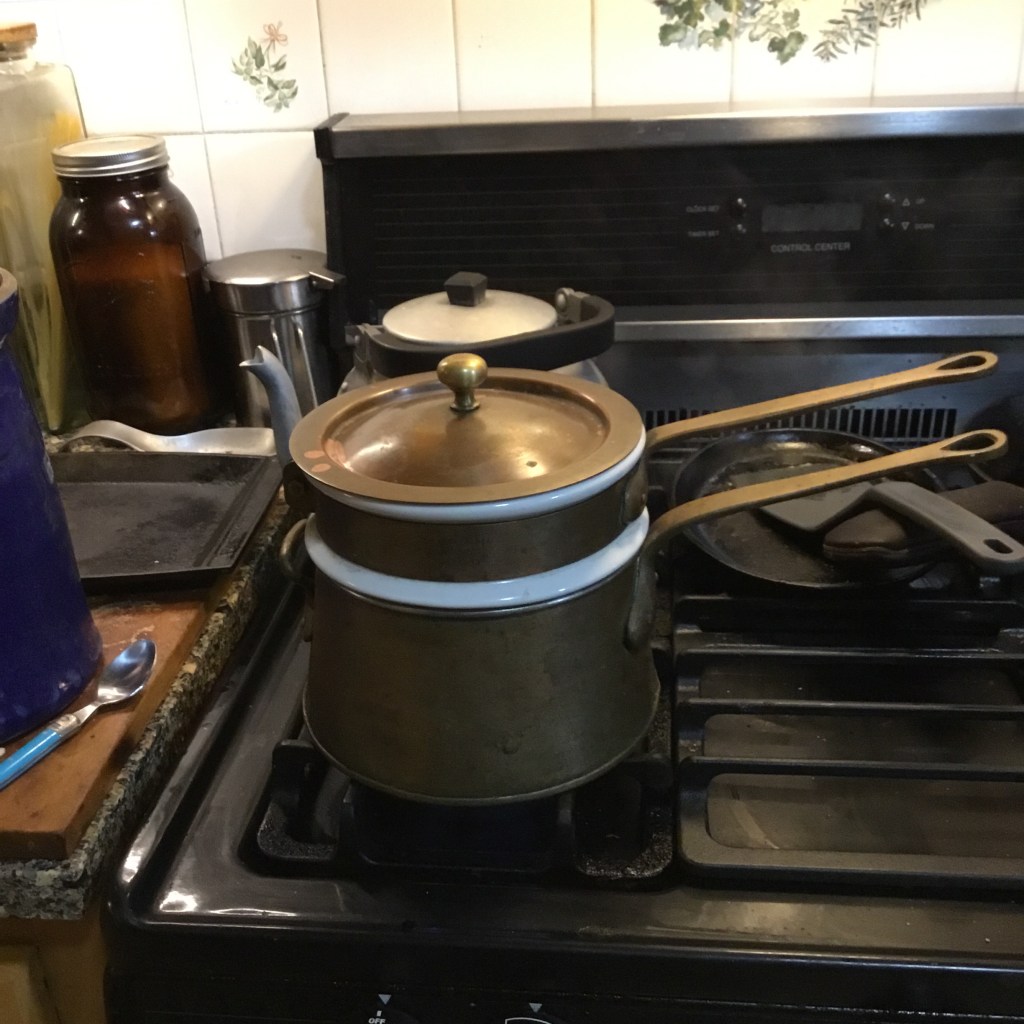
Mulled wine, aka Glühwein in German, is one of the most wicked drinks ever devised. And even though our Fall weather has been unbelievably mild, with no freezing weather before Thanksgiving a likelihood, our old French/US hybrid double boiler has been getting a workout. Here’s a classic German mulled wine recipe.
Ingredients
1/2 bottle Red Wine
1 slice Lemon with five Cloves
5 Cardamom seeds
1 stick Cinnamon
Sugar to taste
Heat this combo until it reaches the boiling point, but do not let it boil. We have been so overly enthusiastic that I even hopped on the flea bay train, and bought a couple of those little German Christmas market mulled wine mugs from the Munich Christmas market, the Münchner Christkindlmarkt. An explanation of why the markets are called “Christ Child Markets” deserves a dissertation.
Martin Luther, in his tireless pursuit of reform, put a bullseye on Christmas, the most holy of holy days. Pre-Luther, presents were exchanged on December 6, which is Saint Nicholas’ Day. Saint Nick himself was the present bearer. Luther was having none of that.
Luther said presents should be exchanged on December 24, which is still the custom in Germany. Additionally, no Catholic saints were to be allowed- the Christkind, or Christ child, would deliver the goods personally. The Christ child was an invisible spirit of Christmas, which came to be considered to be a teenaged young woman. I’ll take the Christkind over a big fat guy every time.
Nürnberg (Nuremberg), a city that knows how to do Christmas properly, has the most famous Christkind around, a young woman who is elected to serve a two year term, beginning each year at Advent. She wears a white robe with gold threads, a long blonde wig, and a gold crown. The Christkind opens the yearly Nürnberger Christkindlsmarkt with a traditional speech, which is among the finest of Christmas spectacles.
Meanwhile, back to the drink. It can be served with an additional shot of rum, but beware. Too much Christmas spirit is still too much.
Of all the abominations found on fast food menus, there’s the McRib sandwich, and then there is everything else. Technically a “restructured meat product,” it is literally nothing more than a pile of squashed pig organs.
Of the three main components, the pig heart is the least revolting. That makes the McRib an ideal Valentine’s Day present. Give your sweetie one of these as a present, and the chances are good that you’ll never have to buy that person another present again.
The tripe portion is probably the most nutritous of the group, though not normally associated with barbecue sauce. However, it will take a heap of sausage casings to make that sandwich.
The most exotic of the trio is the scalded pig stomach. The only possible use for this seems to be to make the ingredients as cheap as they can possibly be. The irony is that if you eat this, the same thing may possibly happen to your stomach.
So there you have it, the best example of you don’t even get what you pay for with fast food. A McRib is like a McJob or a McMansion–all image without real substance. This sandwich should run for office.
This trio of mills are Christmas presents for the in-laws, all of whom can put away some chow. Primitive man that I am, I made these from green (unseasoned) wood, and skipped the whole pricey and unnecessary kiln-dried process. The cost was lowered even further by using wind blown wood from last February’s tornado, a good portion of which is still lying on the ground on our property.
The first, and possibly the most critical step, is wood choice. I have more wood varieties at my disposal than I can literally shake a stick at. So I went with the easiest one–sourwood. That’s the wood I have that is least likely to split, out of everything around here, as it has the lowest T/R ratio–always check the inter webs for T/R info before using a wood for a green woodworking project. I made four blanks, two of which had absolutely no splits. The third had only a tiny hairline split on one end, which I just filled with beeswax. The fourth split along its entire length, and will be recycled into another project.
I began with a part of the tree that is rarely used, except for spoon carving, the limbs. Sourwood is so difficult to split that a small limb usually doesn’t split at all, even from the pith. Because of the roundish nature of limbs, I was able to skip the first step of roughing out with a hatchet, and went straight to peeling bark with a drawknife, and then rounding out the blanks with a concave spokeshave. After that the 3″ x 11″ blanks went straight on to the foot powered lathe.
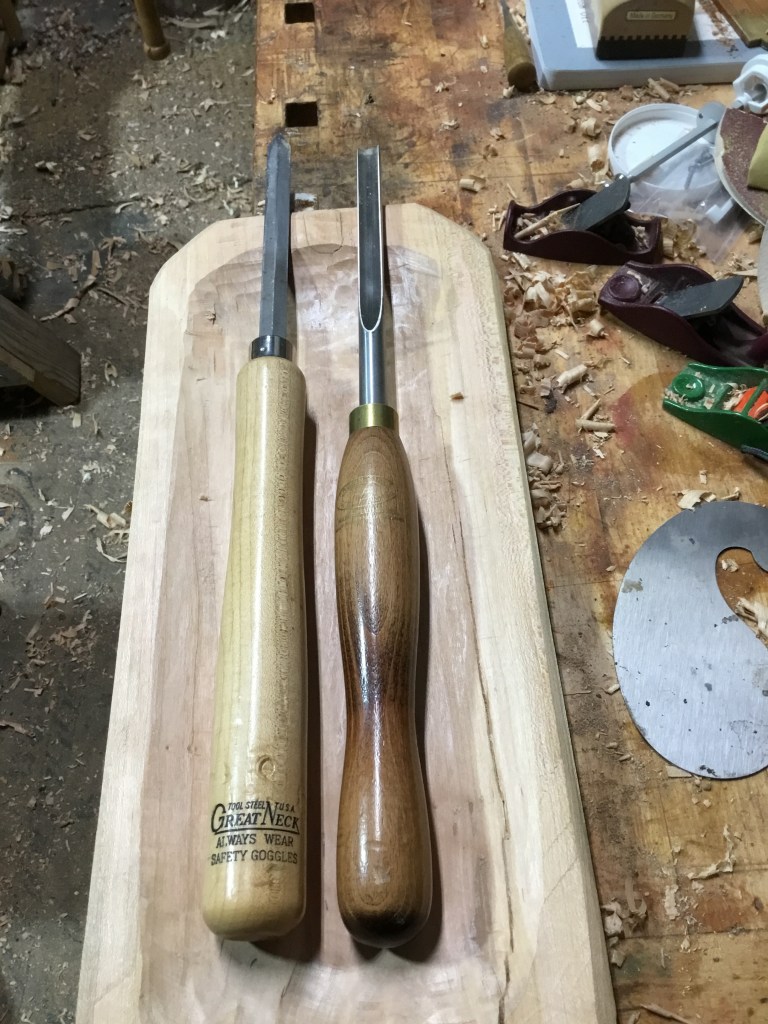
The roughing tools below are specialty tools made specifically for foot powered lathes. The 2″ chisel and the 1 1/2″ shallow gouge can be used in any combination, though I go gouge, and then chisel. These make fast work creating a perfectly round blank.
Ashley Iles Pole Lathe Tools–The Chisel on the Left has a Homemade Cherry Handle
Conventional lathe tools are perfect for detail work such as forming the beads. Below are a diamond parting tool and a 3/8″ spindle gouge. Once the details are roughed in, it’s Zen break time. The green wood needs to dry for at least a day.
Detail Tools
There are two good reasons to let green wood dry for awhile. It turns easily, but dries to a rough finish. It also dries into an oval shape, which would render it useless as a mill. The level of dryness is easily seen from how much moisture there is in the shavings coming from the turning work.
Grinder design is a matter of taste, as a perfectly round grinder would function as well as a fancy one. I just copied the design of the grinders sold by the manufacturer of the mechanism, Chef Specialties up in Pennsylvania. The width of the three different sized holes that must be drilled are included with the grinding mechanism kit. They are much easier to use than the old Peugeot mechanism that I made our grinder with, though Peugeot grinders are more durable than their cars.
Other styles of grinder kits are available, and I am making a salt grinder out of green turned black cherry. Anyone who would turn dry cherry on a foot powered lathe would end up needing orthopedic help.
Since we intend to burn copious amounts of wood this winter, I have set up two of these dual purpose chopping/splitting block combos. This one just happens to be right behind our outdoor kitchen, which has no fewer than five different wood burning cooking stations. At least one is utilized every week.
I will begin, however, with the taller chopping block. Though this is almost entirely intended for green woodworking, it is also useful for splitting kindling–I have one of the Swedish kindling splitting tools that looks like a miniature drawknife. However, for any green woodworking project, this is the perfect waist height for rough trimming a blank with a hatchet, whether it is a camp or broad hatchet. It is also great for sitting a beer on.
The lower one will be used the most, as I have cords of firewood that need splitting. This height keeps the wood off the ground, as well as keeping the splitter out of the dirt. My old splitter is an el cheapo big box store product. My main firewood producing station is to have a quality German made Ochsenkopf (Oxhead) spitting axe.
Finally, for large splitting projects, there are always steel wedges, which are best used in combinations of three. The large piece of cherry that rests on the splitting block was split with wedges, as it splits very well. When the wood tells me what to make with it, out comes the hatchet.
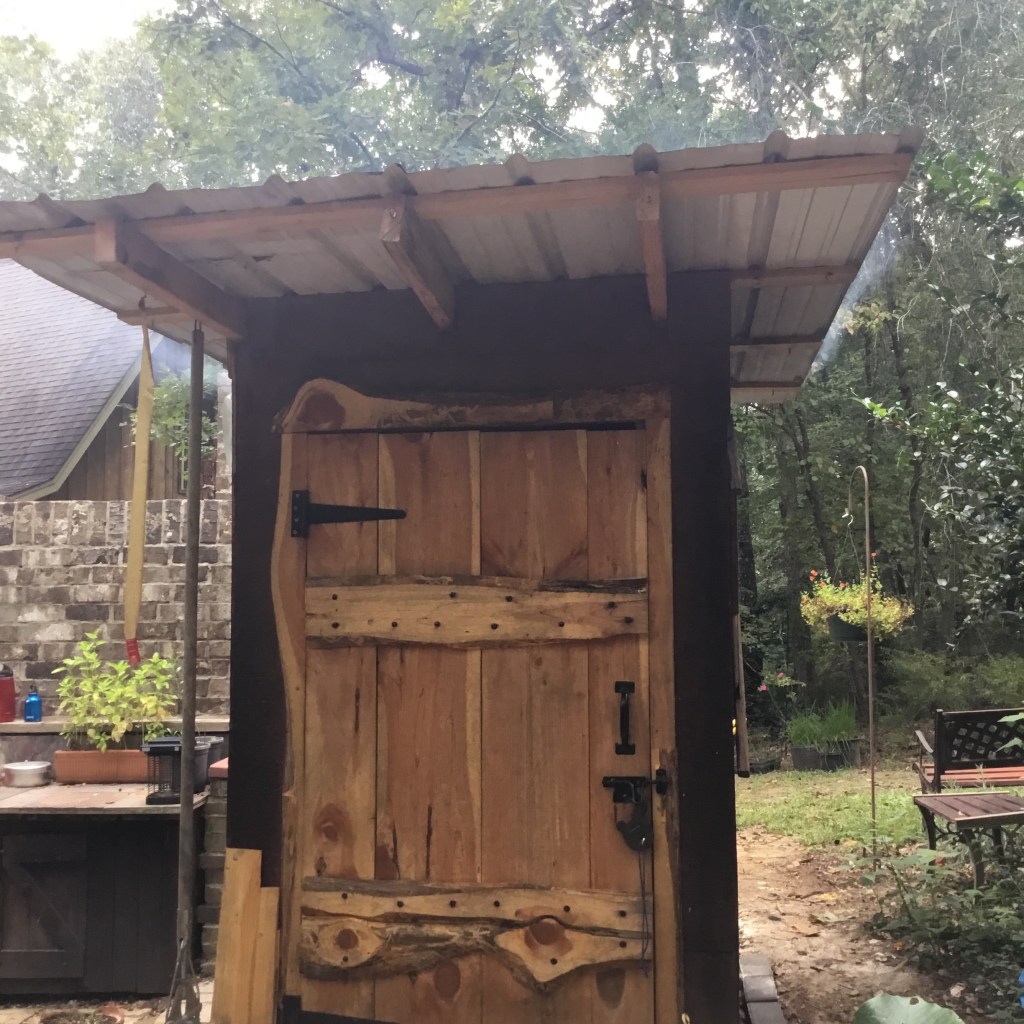
This rustic construction is a smoking fool. The few pine shingles on the left are just the beginning of what will be a fully shingled structure, eventually. When that is finished, it will be as rustic as it gets, befitting of an all wood burning old school outdoor kitchen.
Here’s another piece of wood burning equipment:
Repurposed to the Great Outdoors
This old steel wood stove had been hanging out in our basement for a good fifteen years. Now, with the connection to the smokehouse completed, it is the smoke engine supreme. It is also surrounded with an endless supply of firewood.
Now we need some meat–
Sorry, Pig
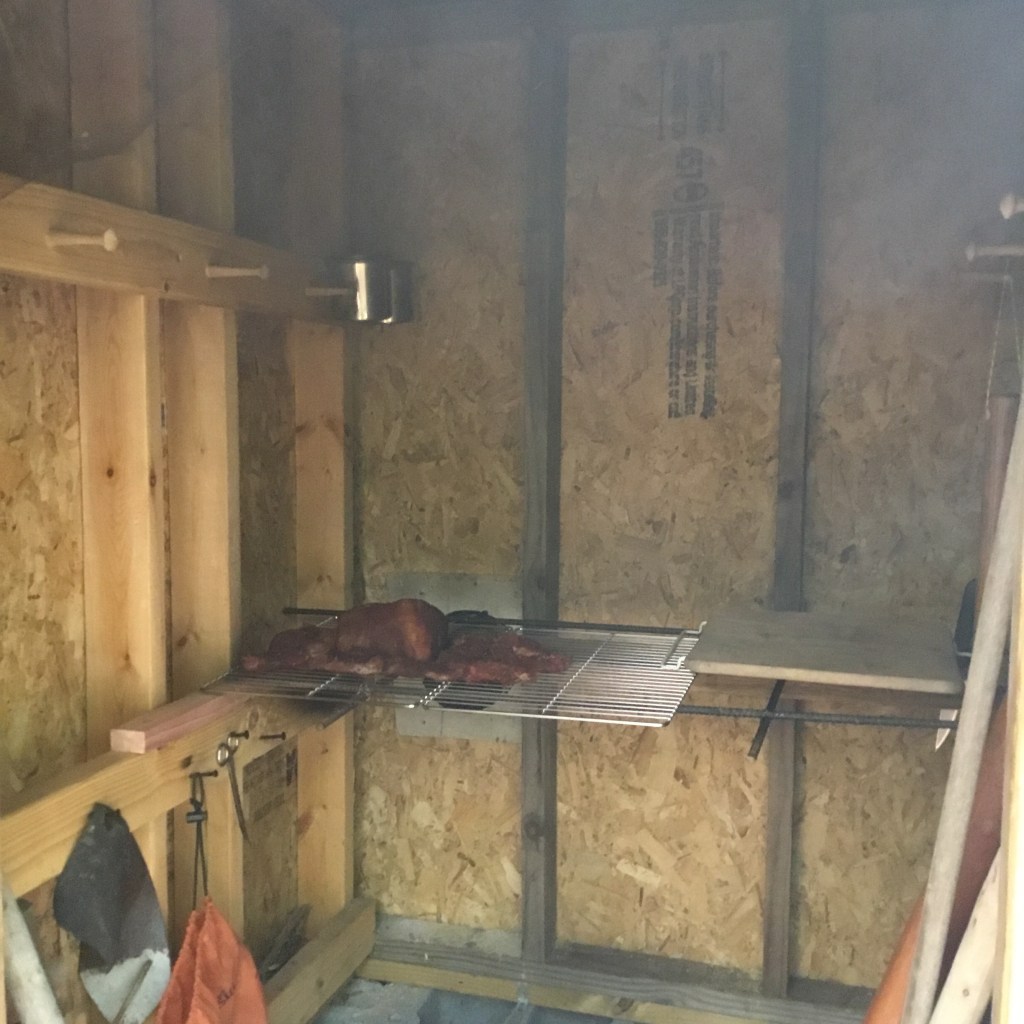
That’s all pork shoulder, some sliced into strips for Tasso ham, and the rest left for barbecue. No secret rubs for the barbecue here–we just use Galena Street mix by Penzy’s Spices, which is a great small business. Too much more smoked meat –this weekend we have pork loin ribs and a salmon fillet–and I may end up as the poster boy for the fat bear photo contest.
“Biggest EVER bird flu outbreak means 48MILLION chickens, turkeys and ducks have now been culled across UK and Europe,” screams the headline in the UK paper Daily Mail. Expect an epidemic of hysteria as well. 10.5 million domestic fowl were culled from just two domestic US farms last spring.
Yes, the cause of bird flu is a highly contagious virus, but with the two year old like attention span of the news industry, expect zero analysis of the contributing and enabling factor–industrial factory farms. The bird flu virus did not appear from nowhere, as humans had to create the conditions for its explosive spread.
Try a simple thought experiment. Cram five million humans into a very small space, say that they are all elbow to elbow. Then leave them there for a few months, with nothing but the most basic food and water. What could possibly go wrong?
I just got this email from Classic Hand Tools, a great English tool seller–the crashing pound is going to mean large price increases. In their own words:
Our new mob in control in No.10 have tried something radical to boost the UK economy. Only time will tell whether their gamble will be justified. All we know is that the pound has tanked a massive amount and big price rises are now on the very near horizon for your premium hand tools. We will do our best to be as skinny with margins as possible but that won’t stop prices increasing soon. We have been saying this for a while but we didn’t expect the pound to be hammered so hard. Luckily we have got reasonable stock levels on many lines but that won’t last too long.
Classic Hand Tools
I have an Ashley Isles turning tool on the way already, but I will scour the inter webs to see if I need anything else, although truthfully, I have almost reached the point of Maximum Tool. I suppose there is always good old fashioned hoarding.
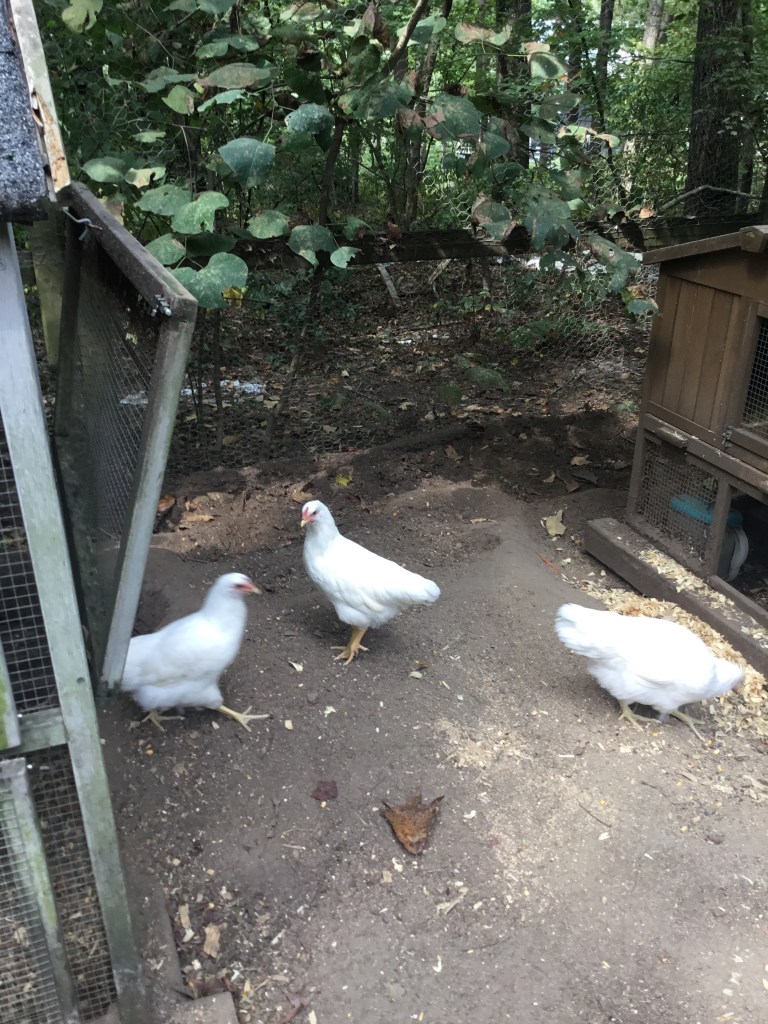
How we ended up with four Rhode Island White “Starter” chickens is the typical story of if your head is hard enough, beating it against the wall eventually works. After a few Google searches, I finally found four local sellers who hatched their own chickens. The first three I called didn’t answer, and had no voicemail. The fourth answered on the first ring, and promptly put me on a waiting list for chickens which would be ready for sale in a week. I made the cut, and drove up to the community of Battleground to pick them up.
Did he have the chickens! The first group I saw was a flock of a few hundred Rhode Island Whites, which were a special order from a hatchery. My chicks were part of an “overrun” set of hens, which were the result of an excess production of chickens, that the hatchery did not want. During my drive home, I had time to think about why chickens that look this fine are threatened as a breed. I came up with two good reasons.
The first is that correlation does not equal causation, a common mistake among our poorly educated population. Consider the following parody:
All Cats are Gray at Night
All White Chickens Look Alike
They don’t, except on a superficial level. Similarly, just because the words Rhode Island appear in Rhode Island Red chickens and Rhode Island White chickens, that the whites are only a white version of the reds. They aren’t. Whites are a well documented breed that is the result of crossing three different breeds that was introduced in 1888. Rhode Island Reds were developed by a number of breeders using a large range of different brown chicken breeds. The names are the result of geography, not merely genetics.
The larger issue is that Big Chicken, and Big Ag in general, ruins everything it touches. The myth that industrial production is more “efficient” than local food production finally took it on the nose this past summer, as even politicians are lamenting how expensive their crudité has gotten. Dudes, try shopping somewhere other than the supermarket–a farmer’s market, maybe.
At any rate, the big decline in Rhode Island White numbers in the 1960’s corresponds with the corporate takeover of food distribution that occurred at the same time. In this case, correlation can be proven to be causation as well, with independently verifiable evidence. Now that the system of Big Chicken is beginning to show its weaknesses, from Bird Flu caused by overcrowding and poor sanitation, to high prices brought on by equally greedy corporations, like Big Oil, will local production step in and fill the void? Is that flock of hundreds of Rhode Island Whites a sign or an aberration? History, in the long term, favors the sustainable, in whatever form it may take.







 Southern Fusion Cooking