“It is this,” I answered, producing a trowel from beneath the folds of my roquelaire.
–EA Poe ,”The Cask of Amontillado”
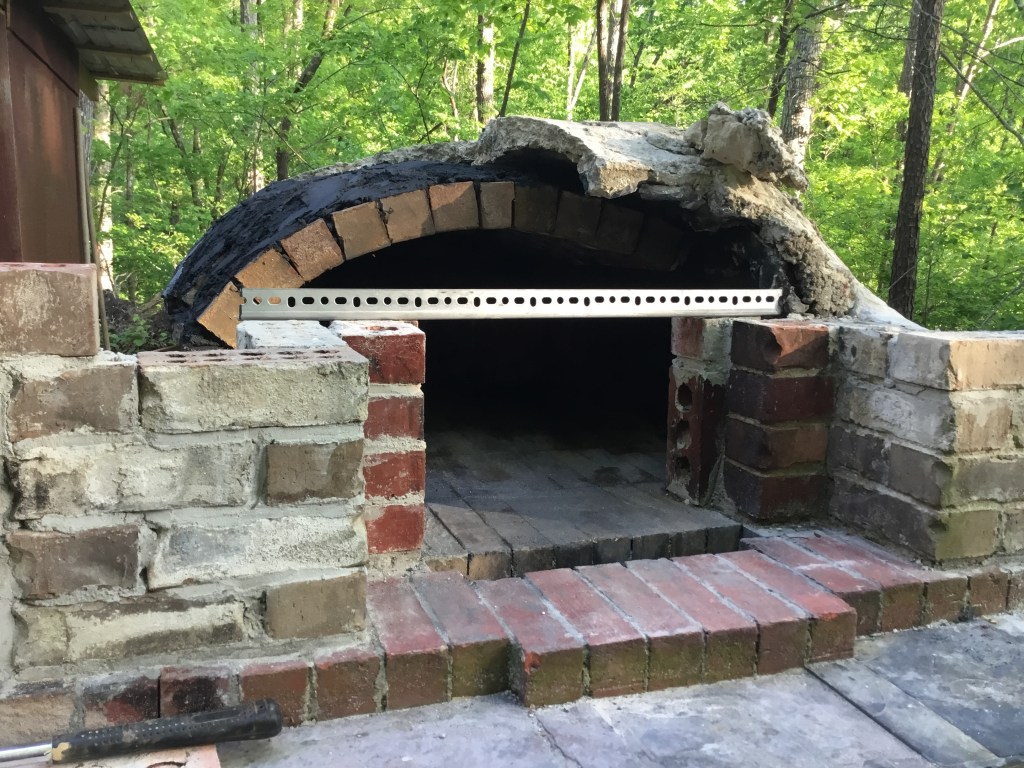
Roasted salmon this weekend, pizza next–the oven is officially back from the ashes. The soldier row of bricks on the top of the facade is to be carried around on all four sides, and I have a cunning plan for some brick buttresses on the remaining two feet of chimney, that yet have to be added. Insulation makes this thing even better.
380 Pounds of Concrete Later
I have removed the form, and the dome oven insulation still needs more concrete. The goal is a solid layer of insulation about five inches thick. According to the bread builders book, an oven this size could produce 36 loaves of bread with just one good fire. Speaking of baking, I also rescued the old oak baking door for this new cathedral of fire–
Set Loose the Hounds
I will finish this Celtic knot carving as a medallion, brittle splitty Oak notwithstanding. Carving will be a suitable pastime for our too hot summer weather. Morning work outside, afternoon work in the cool workshop. Eat when you’re hungry. I might as well end with a poem about the most famous proponent of the great replacement theory, one Herr A. Hitler.
Adolf Hitler’s facial hair,
Is a very curious affair.
Such a small toothbrush
For such a big mouth.
Bertolt Brecht
Maybe one of our juvenile little Hitlers will replace him in the hottest level of hell.
My old decrepit Stanley 25 smoothing plane might as well have been thrown into the parts bin, as worn out as it was. In particular, the body was so roached out to the point that it was essentially unusable. I even went far enough to find a nice piece of hop hornbeam to resole it. That was several years ago.
Then, a near mint body appears on flea bay for much less than the price of a decent used plane (these haven’t been made in about eighty years). I added my four parts from the old plane, and this rebuild is back in action, even with the original lacquer finish.The 8″ length makes this a great grab it and get it done plane.
Partners in Smoothing
Both the 25 and 35 (above) have the same 2″ wide blade, and these two even have the same patent applied for date of 1892 stamped on them, so I assume they are of a similar vintage. These will never do work as fine as a Gage plane, but there are thousands of them floating around, which means they offer great value for the dollar. And then there is the legendary Stanley 34 jointer, known as the big one, which is a full 30″ long. No. 34, meet No. 25, aka mini-me.
The Romans still rule when it comes to arts, crafts, and architecture, and I include cooking and rhetoric as arts-sorry, Plato and Socrates. The Greeks did bring the idea of brick ovens to the area that is now known as Naples in Italy, but the Neapolitans perfected it, as is apparent from the 33 brick ovens unearthed in Pompeii. I’m just happy to have one back in functional condition.
Speaking of Roman specialties, they were absolute masters at building arches, like the parts of the aqueducts that are still standing. They are amazing examples of engineering and strength, and the door to the domed part of the oven would have been an arch as well in a Roman oven. The angle iron holding up the flat slanted front of this dome is easier, and less expensive as well.
It’s on to building the chimney, re-insulating the dome, and one last addition-
Walls!
The entire enclosure is to be walled in with brick on all four sides, brought about by our 900+ leftover bricks. To use that many bricks on this oven would require a 34′ high chimney like the one on our house, and I am not that tall. Melanie, who has a Degree in Ancient and Medieval History, as well as a minor in Latin, wants this oven to be named Phoenix. I believe the phoenix myth could easily have come from the role of cooking in human evolution, with fire and the resulting heat being the mechanism that creates cooked, and therefore more easily digestible food (see the work of Harvard anthropologist Richard Wrangham in Catching Fire: How Cooking Made Us Human). I won’t even talk about how good the wood fired pizza is.
The positive part of book bans is often overlooked, as a significant part of the population only thinks about books when they hear that some have been banned. I even taught a World Literature survey class once where everything on the syllabus was available in the erotica section of a large bookstore in Montgomery. Every work had been banned at one time or context or another, and some are still banned by the holier than thou. Interest in the class increased greatly when I informed the students of these facts.
The list of my top five to be recommended for censorship was not easy to compile, but I started and ended with Southern writers, as the South has been around the block a few times on this issue.
5) The Thomas Jefferson Bible
If King James could have his own special version of the Bible, why couldn’t Mr. Jefferson? The Life and Morals of Jesus of Nazareth was his second attempt at distilling the Bible down to its essence. That it is only 84 pages long says all you need to know. My personal bible would include both the stories about Judith and Holofernes (see the famous painting by Artemisia Gentileschi, Judith Beheading Holofernes), and most importantly, the one where Jesus stretched too short wood to the proper length in Joseph’s workshop. No one would read that one either.
4) Gargantua and Pantagruel, by Francois Rabelais
What’s not to love about two giants wreaking havoc all over France and Europe? The Church didn’t think this first bestseller of fiction was very funny, and Rabelais needed the protection of the Queen of Navarre to avoid execution, on the basis of his assertion that giants can be born through their mother’s ears. Of course the priest named Friar John of the Funnels, who was always drunk, didn’t strike them as humorous either. Always a favorite in my World Lit class, but don’t teach this in Floriduh.
3) Narrative of the Life of Frederick Douglass, an American Slave, Written by Himself
Slavery and American history? Sounds all woke to me. That Douglass was criticized for writing that religious slave owners were the worst ones, says all you need to know about pre-civil war America. People, please go back to sleep, and don’t tell this to Florida man if you ever wake up.
2) The Sorrows of Young Werther, by Johann Wolfgang von Goethe
This masterpiece of Sturm and Drang (storm and stress) is all about love, and suicide at a young age. Banned by Italy and Denmark as a bad influence on the young, the city of Leipzig in the German part of the Holy Roman Empire also banned the style of clothes that the fictional Werther wore. Now that’s a real ban, German style.
1) To Kill a Mockingbird, by Harper Lee
Yikes! A young girl who wears boy’s clothes and goes by the name of Scout. Named by NPR as America’s favorite novel, it has racism, profanity, and gender confusion, all under an oak tree in south Alabama. Remember when Scout said to “pass the damn ham” at the family dinner table? Hardly a flattering depiction of Southern girl-hood. Also, don’t forget that scary Boo Radley. I am the proud owner of the first printing of this book, which is in the picture above.
After all that thinking, which may well be illegal soon enough, I am going to relax and read a comforting banned book.
The yearly springtime curtain of green is descending in our woodland, and it’s time to get the outdoor kitchen rebuilt and ready for action. Our new smokehouse survived the tornado of exactly two months ago, and as my favorite food writer AD Livingston noted, they usually turn into storage sheds when not in use. It’s time to get the masonry tools out of there and get to work.
The all new left side and repaired back wall (above) is made of reclaimed bricks from the old oven. The left side itself is a “soldier row” of bricks that are stood on end–19 in total–that curve on the front and back ends. We were very fortunate that none of the fire bricks on the cooking surface were damaged, and I only had to re-set two rows, and these beauties are dry laid. No black mortar stains under the fingernails. Yet.
I am not Montressor
The dome is almost complete, and the black mortar is everywhere. The front is to be a flat slope that rests on the angle iron, which also has to be joined to the arched top. I have the masonry blade on my circular saw, so the dust mask will get a workout. If I were as fast a mason as the villain Montressor in Poe’s masterpiece “The Cask of Amontillado,” who walls up his friend not so Fortunato in the cellar beneath his house, I would celebrate with some pizza in a few days. Give me a couple of more weeks, and check to see if anyone has gone missing.
I loved teaching at The University of Illinois as a Grad student, and I was often assigned to teach English in a stately building named Lincoln Hall. A giant bronze bust of Honest Abe greeted all students and staff at the entrance, in honor of the man who in 1861 famously said,
“Labor is prior to, and independent of, capital. Capital is only the fruit of labor, and could never have existed if labor had not first existed. Labor is the superior of capital, and deserves much the higher consideration.”
Lincoln, First Annual Message (to Congress)
Alas, not many people from the Land of Lincoln, which has instead become the land of tractors with A/C, stereos, and GPS guidance systems, still share such a view.
It was no surprise to see the following headline from WGN Chicago: “Illinois recommends residents halt use of bird feeders, baths,” complete with a stock photo of a hummingbird. The rules were actually nothing but some recommendations, which most literate people will ignore as just more evidence free corporate sponsored agit-prop. The only notable one is the last one, again from WGN: “Avoid feeding wild birds in close proximity to domestic flocks.” Take that, wild things.
This empty rhetoric (I also taught in the Department of Rhetoric) is a diversion away from the real problem, overcrowded factory farms where birds have died by the millions–last count was around 27 million, with 10.3 million coming from just two farms in Iowa–and so we have the classic solution in search of a problem. Even WGN seems to be saying as much with its last sentence:”So far, the [current bird flu] strain has not been detected in any songbird species.” Bird flu is ahead 27 million to 0, and the contest isn’t even over.
The news industry exists for the same reason as the entertainment industry–to sell consumer products. Instead of reporting actual facts about daily Covid deaths, or Russian fascists committing genocide, we get stories about hummingbirds–not that I have anything against Hummers, but things need some perspective.
Today’s bird flu hysteria is about the ever-present danger of hummingbird feeders. Today’s click bait headline on Al.com is “Avian flu and bird feeders: Can you still feed hummingbirds?” It should read “should” instead of “can,”but this is only click bait, and I clicked on it. Among the ads for sandals and Toyotas was some generalizing about hummingbird safety, from Dr. Victoria Hall, who lives in the hummingbird paradise of Minnesota.
Dr. Hall starts out well enough, admitting that there is actually no evidence about any dangers of giving birds sugar water–unlike humans, who contract type two diabetes if they consume too much sugar water, aka soft drinks (that’s my addition). Then out comes the generality.
Because the science is unclear on the role of songbirds in this current H5N1 outbreak, one consideration is to not encourage birds to gather together at places such as bird feeders or bird baths. These are places where things like viruses could easily be exchanged between individuals
Hall
Exactly. That’s why I am not going near any cafeterias as long as viruses exist. On top of viruses, there could not be enough plates, or food, or silverware. Someone could have a gun. Someone else could speak Russian. Some creep might have a sharp fork.
The hummer feeders stay up, and filled. I might even find a new nest this year. But on to more important things–what Coach Saban serves the losers of Alabama’s spring scrimmage–beanie weenies, and no cake for dessert. That monster! How do his teams keep winning?
“Why experts say you should immediately stop filling birdfeeders”. So blares a leading headline on our state’s top “news” site, Al.com. Never mind that there is only one expert cited, and she lives in Minnesota. At any rate, here’s what Dr. Victoria Hall has to say.
“Unfortunately, we have a lot of gaps in knowledge about the role of songbirds in HPAI outbreaks. We have some data from previous outbreaks around the world, but this outbreak is very different. The 2022 outbreak is unique because of the very high levels of transmission of the currently circulating H5N1 virus strain in wildlife.”
Hall
Let me translate:
“…we have a lot of gaps in knowledge about the role of songbirds in HPAI outbreaks.” Trans–We don’t know.
“With minimal viral surveillance being done with songbirds, it is hard to measure the risk of transmission from songbirds to other birds.” Trans–We don’t have enough data to prove anything, but I am an expert, so I don’t need any.
Let me step in to the void with what is actually known. Here’s useful information from the CDC, cited near the end of the article:
According to the Centers for Disease Control, 27 million cases of avian influenza have been reported in backyard and commercial poultry as of April 8th. Another 637 cases have been reported in wild birds in 31 states, including Alabama. The Alabama case was reported Feb. 23 in an American wigeon found in Limestone County.
AL.com
Divide 637 by 27 million, and you have it–0.0000236% of documented bird flu cases in the US have been found in wild birds. I personally am going to roll the dice and keep my bird feeders full, and my chickens fed. Though I will end with a witty fake headline:
All cases of bird flu reported in Alabama were in the wild bird population.
Of course that number is only one, which occurred almost two two months ago, and was a couple of counties away from here. I just like to live dangerously.
Zeus Protecting Emma the Aussie from Donner, the German God of Thunder
Workbenches are multi-taskers, from holding stuff off the ground, to sheltering the pooch from harm during a thunderstorm outbreak. This Roman design turned out even better than expected. Just ask Emma.
Eight Legs are Twice as Good as Four
Here are only three of the holding devices that can be used on the AD 79 bench, traditional and modernized, though all are useful if not essential. The middle metal one, a forged bent piece of cast iron, is know known as a holdfast. Strangely enough, this wall tile from the Roman city of Herculaneum, buried in ash by Mt. Vesuvius in AD 79, has a Roman version of the same holding implement, securing the board on the right.
Cherubs are Handy Helpers
Used in combination with a bench top dog (stop), as opposed to the dogs under the bench, the holding ability equals any modern set up. The Romans likely used wooden pegs, which can easily be made in any length or form. The modern version is the metal dog, and the little Veritas made dogs on my bench are called “surface dogs.” They will likely last longer even than this bench. Combine the old or modern dog with a modern version of a holdfast, a Sjobergs “hold down,” the one with the screw down mechanism, and your work isn’t going anywhere you don’t want it to.
Anyone wanting to know how to build this style of bench should buy Ingenious Mechanicks by Christopher Schwartz. It is better researched than many scholarly texts, without the mind numbing academic terminology. And it has pictures.
Speaking of academics, I once had a student who acted in Shakespeare’s Merry Wives of Windsor, while she was still in high school (she played one of the merry wives who dumped Falstaff in the river). She also enjoyed jokes about punctuation, pointing out that without the comma, “Let’s eat, Grandma,” becomes “Let’s eat Grandma.” True enough.
Something similar is true with “finito Mussolini,” in that a comma makes it “finito, Mussolini.” Little Mussolinis can be found in parts of congress, various state houses, and truck stops everywhere. They should be reminded of what happened to the real Mussolini, and the importance a comma can make.
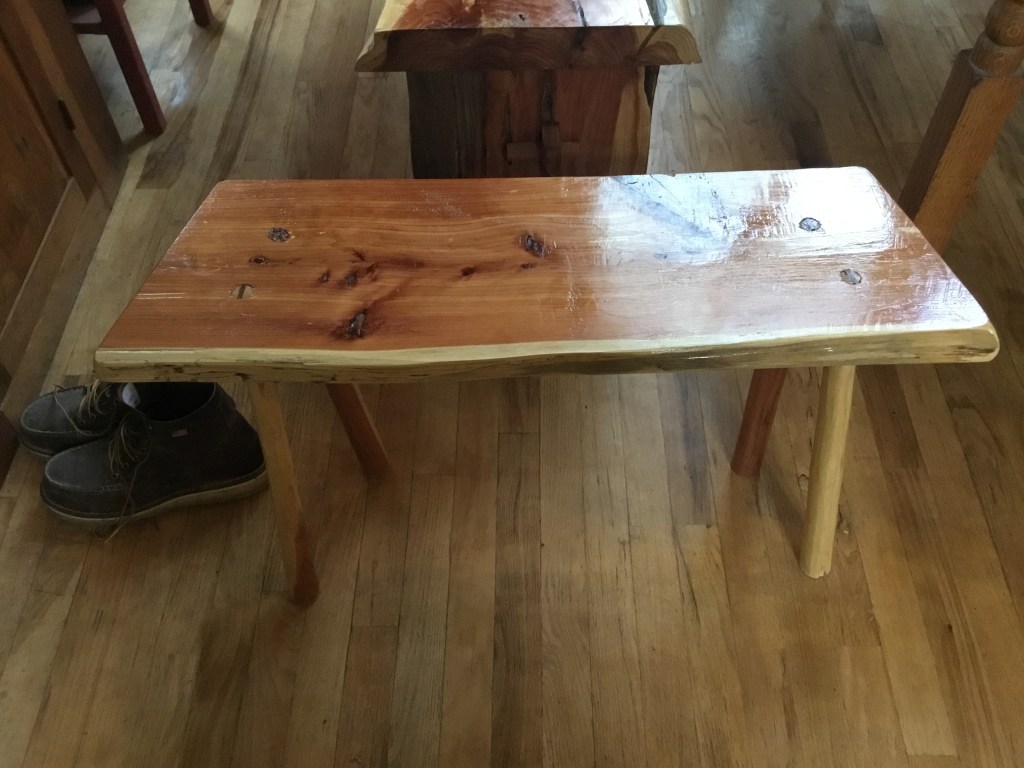
The giant stack of cedar we were given is essentially gone, with the remainder good for nothing but pegs, wedges, and fire starter, although the shavings make a superior smoked salmon flavoring, when thrown on the fire in the smokehouse–think Virginia juniper instead of red cedar, as the tree is technically a juniper instead of a cedar. This piece is a gift to the in-laws who gave us the truckload of lumber to begin with.
I actually made this to be a stool, but once possession changes hands, it is up to the discretion of the new owners, who have always been thinking end table. The legs are made in the same fashion as “stick” chairs, as in the very old style of Windsor chair known as “Welsh stick chairs.” The usual Welsh Windsor is normally made without stretchers between the legs, as opposed to an English style chair. The piece, chair or table, therefore is considerably lighter than one with stretchers.
I have also finished my Roman workbench, and a picture of it will help to explain where all that red cedar went.




 Southern Fusion Cooking