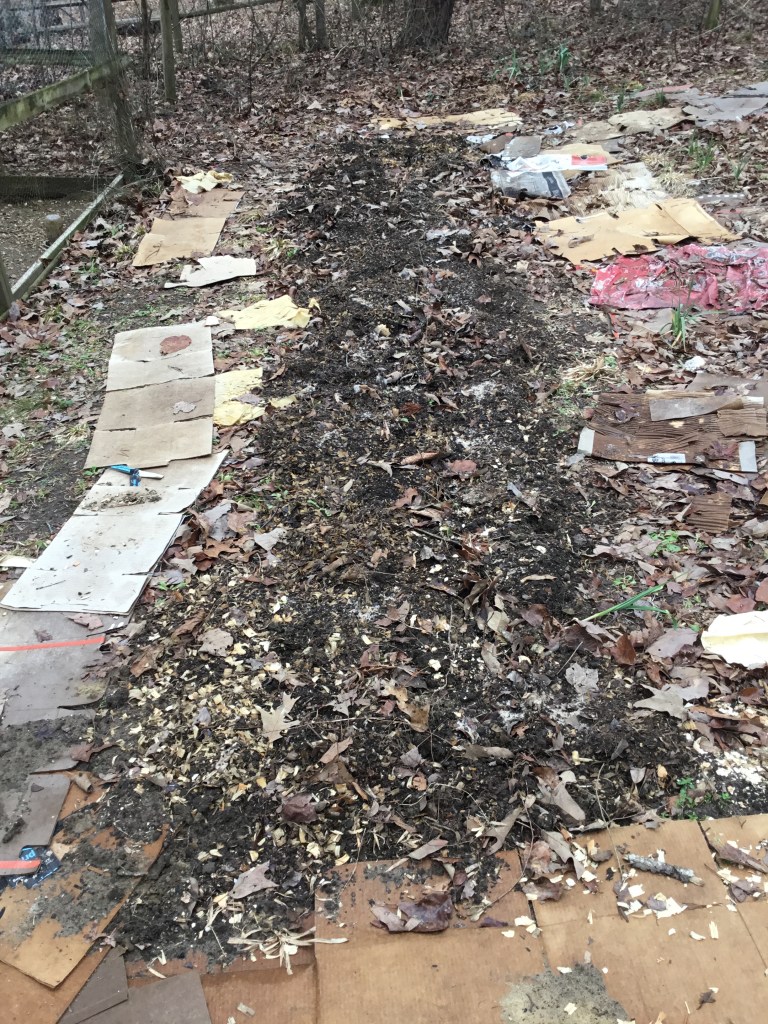
MJ thinks my cardboard mulch is tacky, but after I read a “gardening expert” on the interwebs who said that cardboard is impermeable to water, which is hilariously stupid, I had to try it. It killed all the weeds around our Asparagus bed.
So I planted my thirty new Asparagus crowns, and decided to give the whole bed a banquet of Chicken manure–composted, of course. You have to feed the veg if you want the veg to feed you.
The next layer was composted crushed egg shells–aka, calcium. The chickens just keep on giving.
Last of all was something that I actually had to purchase–pelletized lime. The good news is that it goes for about ten cents a pound.
Spargelzeit (Asparagus time) cannot get here fast enough.
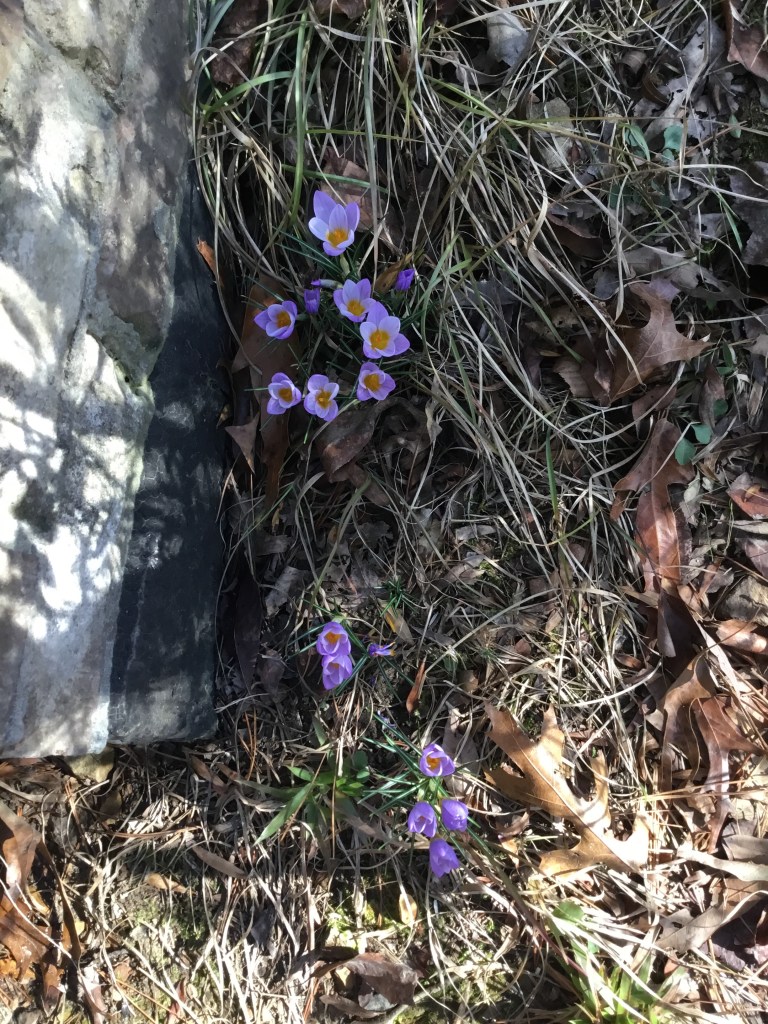
Crocus in Green Grass. Spring is practically Here.
With apologies to American master Aaron Copland for stealing his title, though I have read that dancer Martha Graham actually named it that, we will have a preview of Spring this week, with four days in the sixties F. My birthday in the middle of the week will be right at seventy degrees F. Time to really start planting.
First project–plant the thirty Asparagus crowns I just got from a seller on fleabay. Strangely enough, these one year crowns are larger than the alleged two year crowns I bought from Amazon last year. Bezos must be jealous of Elon Musk, to send such puny plants. Then the taters go into the ground, precious.
Next is seed starting, and I have plenty to do. Artichokes. which I usually kill by overwatering. and a real United Nations of peppers and tomatoes. I have seeds from several continents, and the total is this: fourteen pepper varieties and eighteen different tomatoes. Thankfully I have enough plastic pots and trays to cover an acre. Being an old farm boy has its advantages.
I’m going to have to make a list of the plants, as I have one seed package of saved seeds which just says “Funky Tomato.” I have to quote the great George Clinton from Pfunk, and my favorite song of his.
It’s 40 degrees F here, and spitting snow, but spring planting has already commenced. Seeds are slowly accumulating, and I have three new fruit trees which have me fired up, to go along with my accidental three avocado seedlings. These next few years could be fruity.
All these are new to me, two figs and an olive. That’s right, an olive. It will stay in a container for a few years, but I will probably plant it out eventually. This, and a couple of other varieties, are said to be fully hardy here in hardiness Zone 8a
Fig “Olympian” sounds like a winner. It was found by a retired botanist in Olympia, Washington–hence the name. It is said to have YUGE figs on it. Good, as fig preserves are my favorite.
Fig “Violette du Bordeaux” is tres French (very French.) This one has the claim of the best tasting fig in the world. As I have never had a bad tasting fig, this should be a good one. Also said to be very hardy, as my so-called black turkey figs regularly get frozen back to the ground.
Olive “Arbequina” is the last one. Having never grown olives before, this is an experiment. I am already contemplating buying more plants of these Spanish olives, as we love both olives and olive oil.
Taters, precious, go into the ground starting this week. Heirloom tomatoes go into the flats in the basement this week. I’m going to be busy. I may even have to make a list.
One advantage of enduring the heat of a Southern summer is that we get great vegetables in the summer, and great blooms all winter long. Blooming right now is one of our favorite crocus plants. The rare shrub Neviusia alabamensis will be next.
MJ and I have something of a sentimental attachment to crocus, as we both have birthdays next month, during peak crocus season. The two of us teamed up to make this art work:
Enjoy the Cold Weather
The cross stitched sampler is based on a Danish design, and naturally, MJ did that. I made the the oak frame, and did the ball and sausage carving. Fairly simple carving, but another classic design.
Our spring is only a few weeks away, and I have a new crop to experiment with–olives. Mr. Jefferson would be proud, as he could never get them to grow.
When you get up early on New Year’s Day to feed the chickens, and the low temp is 67 F, something is seriously wrong. That something is Anthropogenic Climate Disturbance, aka Global Warming. It’s fine now, but the summer will be when the bill comes due.
There is one constant, however–the wonders of chicken excrement. Americans in general treat chickens like a protein machine, caged, abused, and thrown away and eaten at a very early age. Our flock of eight ramble around all day, eat greens and high protein food, and we get eggs by the dozen. Better, possibly is the giant piles of excrement, which I compost. I am just beginning to use it as fertilizer. It could be the GOAT (greatest of all time.)
Chicken excrement and I go way back. When I grew up on the old farm, that was our main fertilizer, and sometimes the only one. As it turns out, industrial scale chicken production produces industrial scale chicken stuff. We had tons of this stuff at a time, which means we had tons of vegetables, and pounds and pounds of beef–we fertilized the pastures with chicken stuff, and even had to buy a giant stuff spreader to be able to do it.
So the moral for this new year is, what goes around, comes around. I have been fertilizing my mustard greens with chicken stuff, and feed the greens to the chicks, and the egg quality just gets better. I composted my garlic plants (forty in total,) and they took off like weeds. I just layered my young asparagus patch with several inches of compost. I better get the asparagus steamer ready for spring.
The mooching lifestyle is far more under appreciated in the US than it should be. A person could practically live off of discarded items, and I am certain that many people actually do. There’s no tax on throw aways, either.
I am only a part time moocher, but I have dumpster dived and mooched in numerous locales. I pulled a fancy desk chair out of a dumpster, worth several hundred dollars, and then spend my time at the computer sitting in an old post and rung oak chair, that I mooched for $5 at a flea market. My latest mooch could prove to be my best: a flat bed truck full of cinder blocks, and the wood pallets this compost bin are made of.
The story is this. We have been have been showering the in-laws with free eggs, and one couple had just had a retaining wall replaced, and needed to get rid of the left over and used cinder blocks, more commonly known in these parts as “see-mint blocks” (cement blocks.) As my mooching has become a valuable reputation enhancer, they offered us the blocks, and with free delivery. We countered with an offer of thirty eggs. It was a deal.
The sweetener was that the blocks are to used in the construction of a smokehouse, and we offered free use of that as well, once it is completed. The blocks arrived quickly after that offer. I helped unload them, and they had been sitting on two pine pallets on the truck. My brother in law asked if I wanted them. He didn’t know I been looking to mooch two wooden pallets as well.
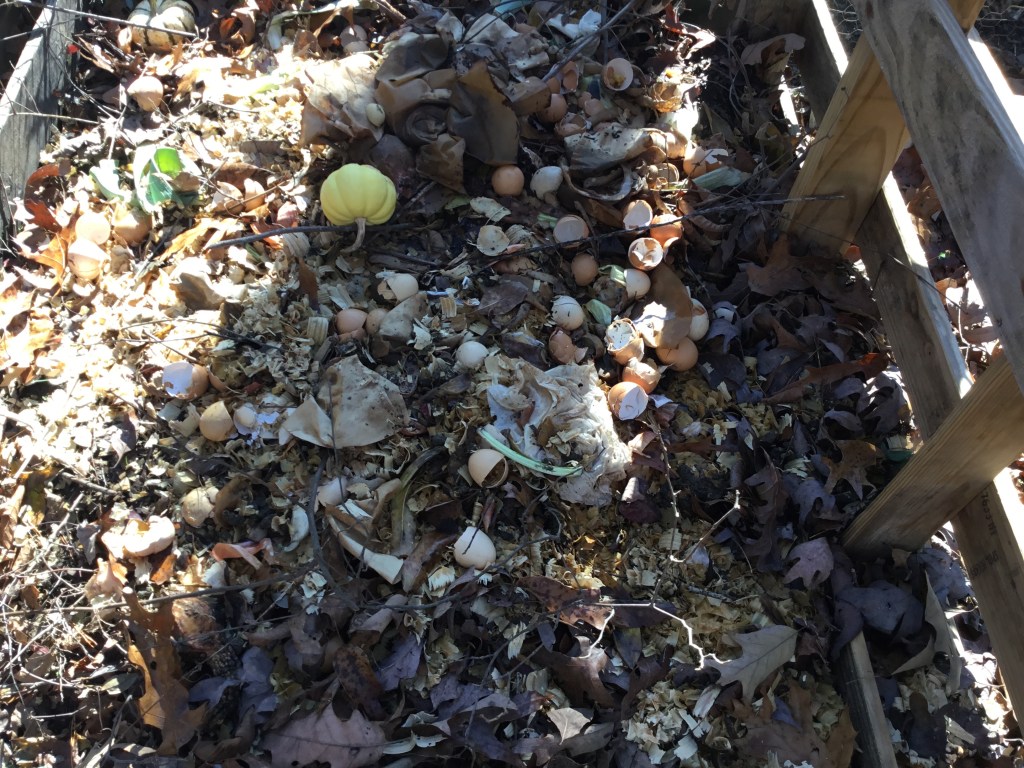
Three deck screws later, and I had a new compost bin, attached to the back of the chicken run. It is now being filled with table scraps, leaves, and chicken manure in various states of decomposition. It will be half full in no time.
Free Fertilizer
Next spring we will have mooched fertilizer as well. Which reminds me that it is almost time to grab a shovel, and get to work.
We try to never throw any food away. First there are leftovers, then dog treats, and cooked grains go to the chickens. Everything else gets composted.
We have random compost piles throughout our garden, though I did recently complete what I have been calling a “Moocher’s Compost Bin,” because my total outlay for the bin was three deck screws–everything else was mooched. Our reward for chunking all sorts of stuff into our garden was completely unexpected. We now have two nice Avocado plants.
These weren’t planted, but in the gardening lingo, were “volunteers.” We ate more than a few Hass avocados over the summer, and in true frugal fashion, composted the pits, aka seeds. Strangely enough, Mr. Hass, from just outside of Pasadena, CA, began with just three seeds that he planted. One turned out to be the parent of the now famous Hass avocado. They are tasty.
Apparently the Hass does not come true from seed, but people who get free plants can hardly complain. We will grow these in containers, where they are said to reach no more than seven feet tall.
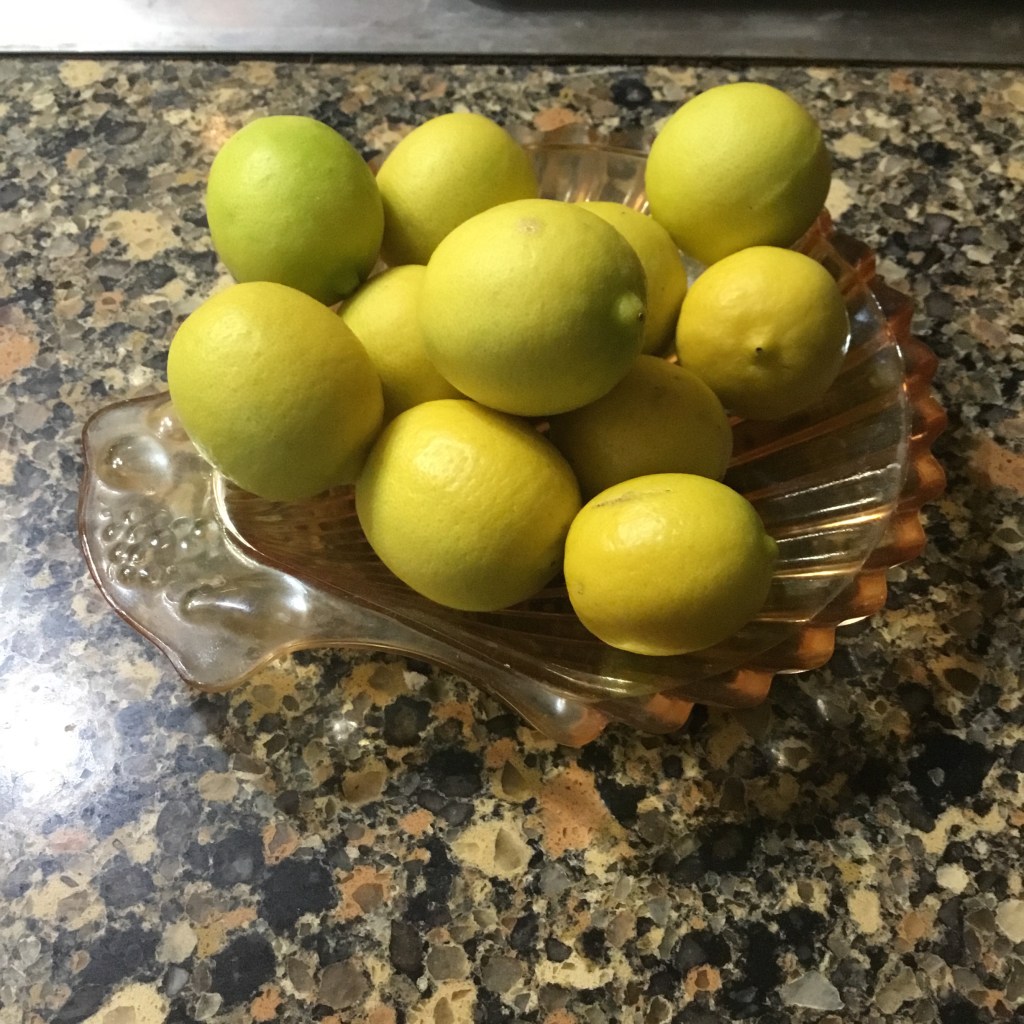
Can you grow tender fruits in containers? Here are our first free falling Key Limes. As soon as they are ripe, they fall off, and go boink boink boink across the floor, usually in the middle of the night. No dead cat bounce here.
Key Lime Daiquiri, Anyone?
My favorite are the Meyer Lemons.
Pie on the Menu
If you want the world’s longest Christmas song, finish “On the Twentieth Day of Christmas my True Love gave to Me, Twenty Meyer Lemons….” I’ll have a drink instead.
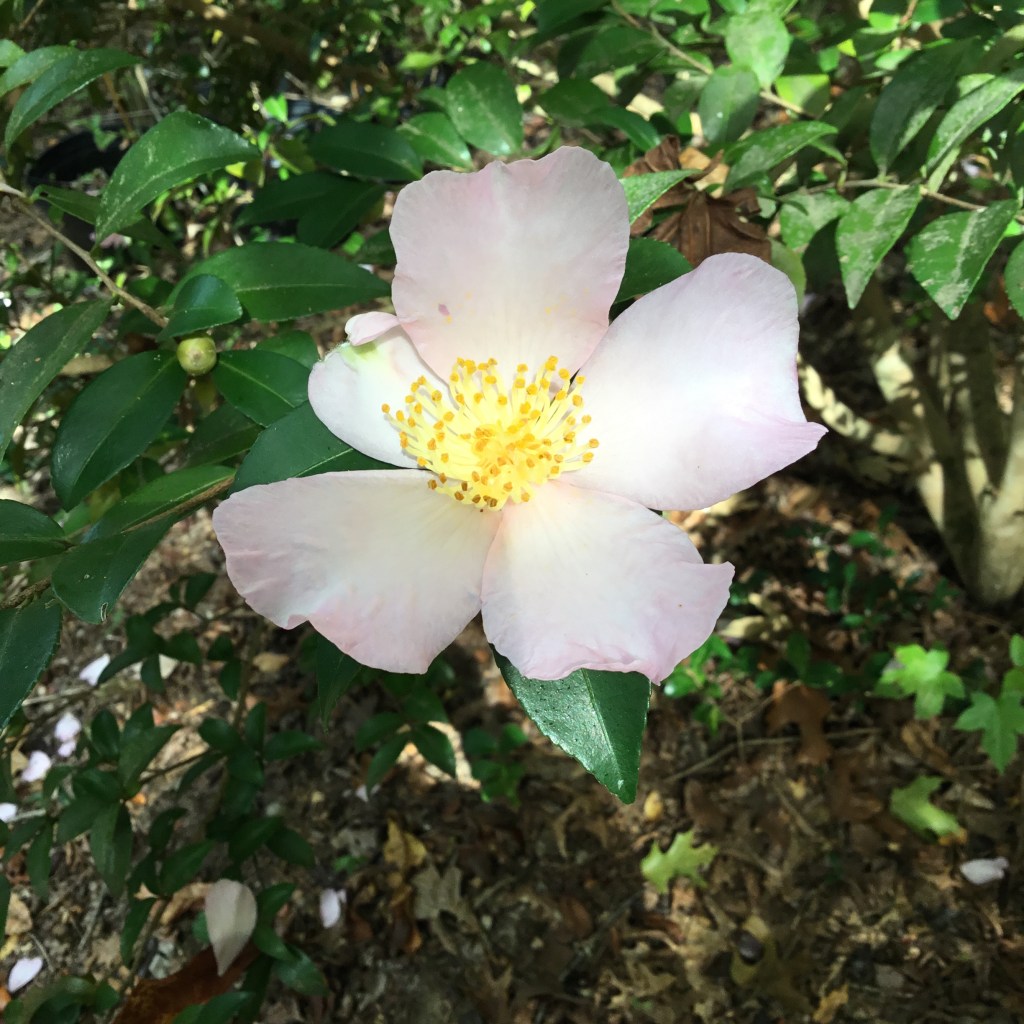
We’ve had the best Fall weather in memory, despite the fact that three hurricanes have blown through (we only get the rain). The result is that our Fall blooming camellias are spectacular.
I don’t even know how many varieties we have, so this is just a sampler. That first one is “Yuletide,” which usually blooms later. It is obviously one of the Camellia sasanqua hybrids, as are most of the rest.
Singler Flower
A pink version of Yuletide, which reseeds like crazy. We have enough volunteer seedlings to create a camellia grove. Now we get to the fancier hybrids.
Double or Triple?
I think pinky here is triple petaled, but it also reseeds. There’s going to be some serious transplanting this fall and winter. This is the really fancy.
Multi-petaled
These really fancy hybrids never make seed, and have to be grown from cuttings. We also have a double petaled white, that is twenty years old and very large.
We grow these Fall bloomers because our notorious late frosts kill the buds on the more famous Spring bloomers, which have enormous blooms. It doesn’t hurt that these require no fertilizer, and very little water.
Unbelievably, there may be more Hoya! about Poblano peppers on the interwebs than there is about any other pepper. (For those not familiar with Hoya!, it’s the stuff you don’t want to step in while in the horse barn). First, it is sold under two names–Poblano and Ancho, though the name Ancho is usually (but not always) reserved for dried ground, red, Poblanos. Secondly, it is said to grow in zone 10 and further South, and be no more than 25″ tall. Guess again–I’m in zone 8, and this plant is 52″ tall and still growing.
Ocular Proof
The last and third pile of Hoya! is that these are a mild pepper. Actually, Jalapenos can be also, if you buy one of the varieties that has had all the heat bred out of them. The worst case of pepper burn I have had all summer was from Poblanos I cut up to freeze. I bought them from one of our best local Hispanic farmers, and she neglected to tell me they were really hot. Let the buyer beware.
In short, be skeptical. Grow some yourself, and see what result you get. I am mixing up a seed mix with upwards of ten varieties of hot peppers for next year, so I can see which ones are best. It’s called evolution in action. That is, as long as I survive the pepper burns.
I bought these seeds from the greatest seed seller around, J. L. Hudson from California. He has kept me in seeds for years, and this one sounded primo. It really is.
The black fruit, which ultimately will turn red, contrasts with the purple leaves. The blooms are also purple. It is a type of pequin pepper, a variety that originated in the pepper famous state of Tabasco in Mexico. Though the peppers are upright like a Tabasco pepper, this is actually listed as a different species.
The question: Should it have round or Tabasco shaped peppers? Most photos on the inerwebs show plants with Tabasco shaped peppers. However, they are all black, and quite hot, even up to the level of a Cayenne pepper on the Scoville scale. In short, they are hot to quite hot.
My father, who was a notorious seed thief (he called it “collecting”), would have walked away with at least one pocket full of these. He even stole all the lily seeds from a college that was attended by my three oldest sisters–only the college happened to be housed in a convent called Sacred Heart. I know that because I was there when it happened.









 Southern Fusion Cooking