June was a good month for rain, if you like it all at once. All but a fraction of our rain came in two days, followed by fryingly hot weeks of no rain at all. Near the first of the month we had a day of practically non-stop rain, with four+ inches recorded here (Birmingham had an all time record of seven+ inches that same day). Then we had two weeks without rain. Then one night after a day where every storm missed us by just a few miles, the rain came all at once, with .7″ in the space of thirty minutes or so.
Some sleepers awoke after that. Here are two who had a good drink at the same time–a Rain Lily and some Cyclamen. Both are my kind of bulbs, in that you plant them and then forget about them. No fertilizer needed, no irrigation needed. Just act surprised when they finally bloom.
Rain Lilies, members of the species Zephyranthes that bloom after a drenching, are all plants from the Americas. The pink variety is a native of Cuba, and thus benefits from a hurricane or two every summer, which as well benefits from our increasingly sub-tropical climate (nine months out of the year). We also grow the Southern native Atamasco Lily, a spring blooming plant that will naturalize in most areas of the South.
The Eurasian hardy Cyclamen is a whole other story. I planted the two most common species, along with some very fancy cultivars, beginning some twenty years ago, and they have surrounded two sides of our house. Technically they grow from plate-like corms, instead of scaly bulbs, and they grow larger and larger for upwards of a hundred years. In fact, just to the left of the pictured bloom, you can see the black surface of the corm, which appears to be at least eight inches wide. Their green leaves in the winter are an added benefit to the unexpected outbursts of blooms.
Another drenching is finally headed our way today, and besides the rain and cooler air, I have to guess what, when, and where, the next blooms will be.
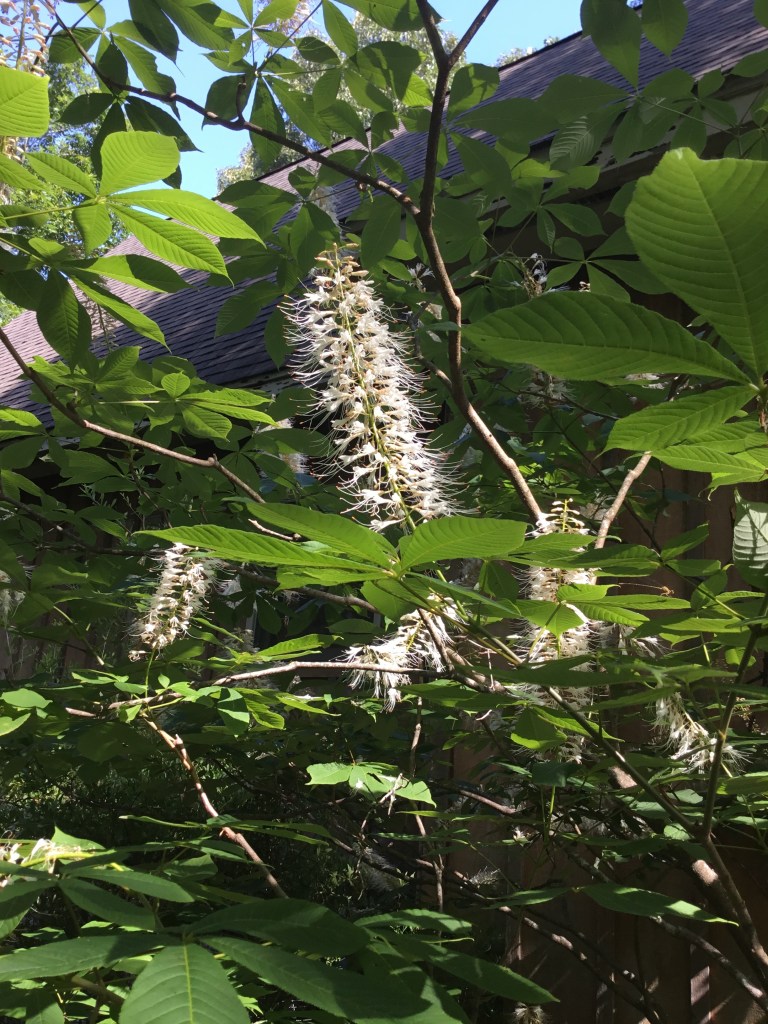
Need a late spring/summer blooming temperate forest shrub? This native could be the ticket. Two varieties of this species spread out the bloom period for a potential month and a half, and the plant doesn’t care if the highs are in the seventies, or like today, in the nineties.
In the wild, Bottlebrush Buckeye is found primarily in Alabama and Georgia, but it is now grown in Zones 4-8. The plant pictured is the earlier blooming “species” variety that was at peak bloom last week, when it was pummeled by 4+inches of rain in one day, and it still looks as pictured. Soon the second variety, often sold as var. Serotina, will begin to bloom, and will continue blooming into July. We have one of those as well, and it will bloom into July. Northern gardeners have reported later periods of bloom stretching into August.
A huge population of wild var. Serotina plants are growing just about three miles from here, south of Garden City, right along the edges of US Highway 31. Every few years Alabama Power will cut them down to the ground under the power line that runs to Blount Springs, which somehow or other rejuvenates the plants. Within in a few years the blooms will be spectacular, with limestone boulders interspersed with hundred foot long colonies of plants, and blooms hanging out over the road from steep hillsides. Unfortunately this section of highway is known for some spectacular wrecks, though they have never been attributed to drivers rubbernecking the plants.
My friend Torsten Fisch, who has been back in Deutschland for a good decade now, had a way with words, in multiple languages. A typically stiff Mercedes engineer who worked at their manufacturing facility in Vance, Alabama, after shots of Jägermeister he would cut loose with some epic rants, such as the following–
I don’t know what is wrong with you people in Alabama. As of the year 2000, the prostitutes in Germany have more rights than you do. They have social security, free healthcare, and a union.
Herr Fisch
Well said, with a German accent.
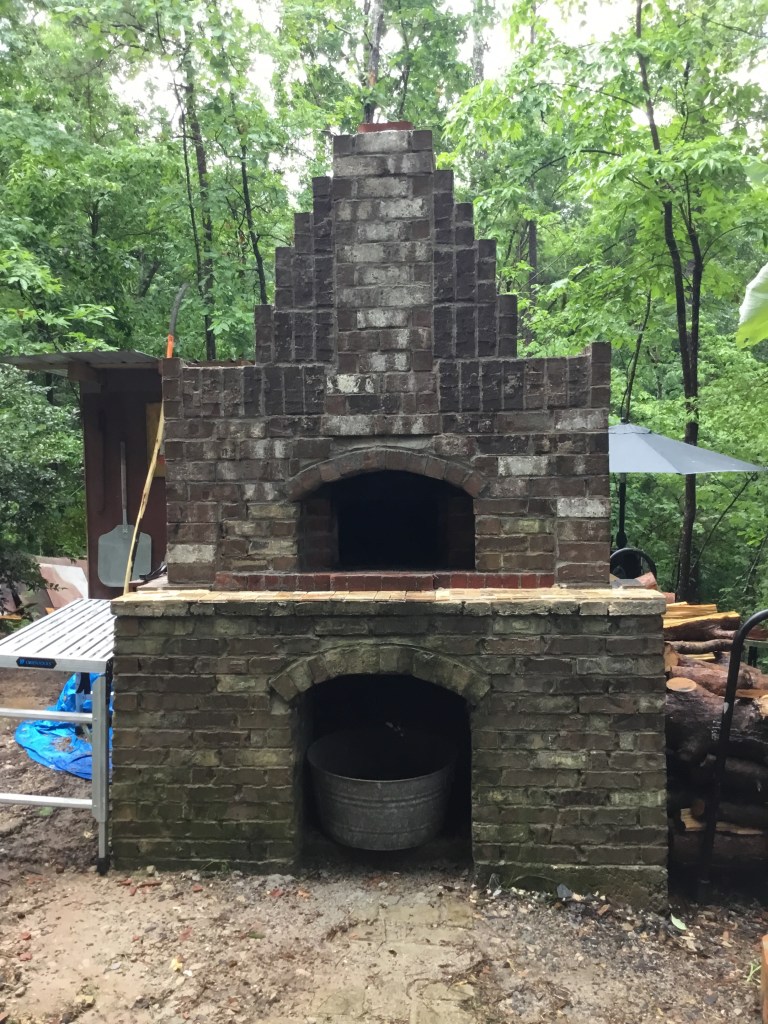
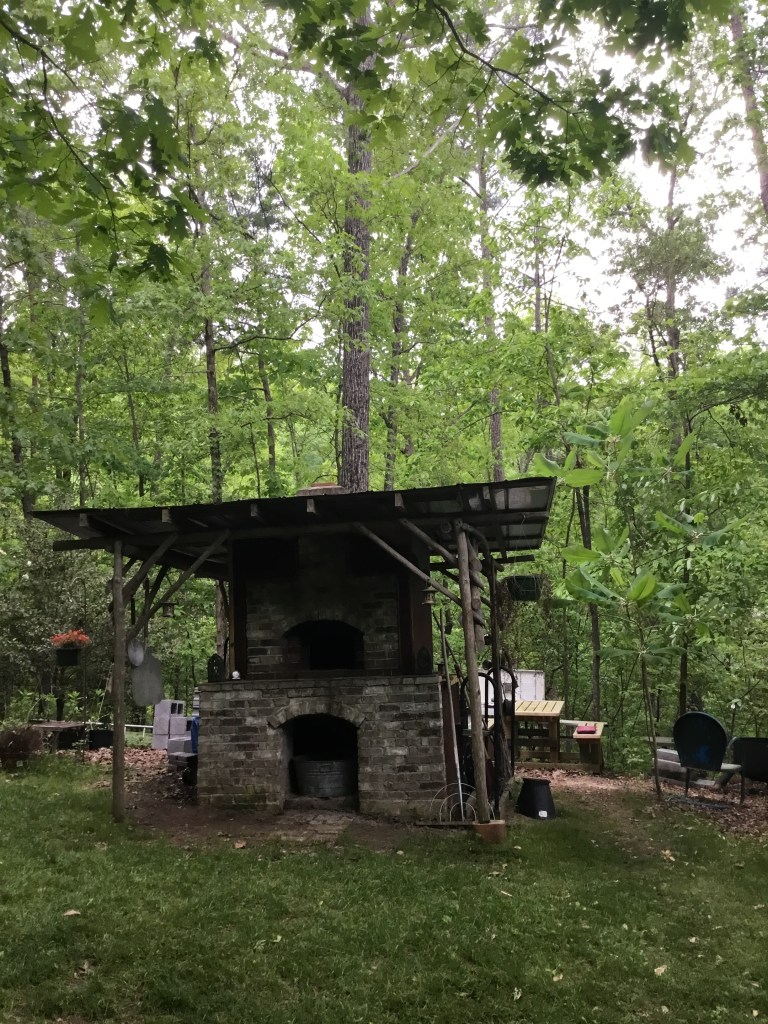
He also liked “Size matters. Bigger is better,” which perfectly sums up the Mercedes philosophy. If that is true, oven #2 is far better than oven #1. Here’s the pre-tornado version of the old oven–
The new oven is ornamented with Soldier (upright) and Sailor (ends facing forward) bricks, and a wider facade. The chimney is also taller, which should give me sufficient pitch to install a wood shingle shed roof. The walls of the yet to be constructed new enclosure will be wood shingles as well, which will require partial covering of some of the eye candy ornamentation of the chimney. At least it will then look less like a Mayan temple or a Ziggurat.
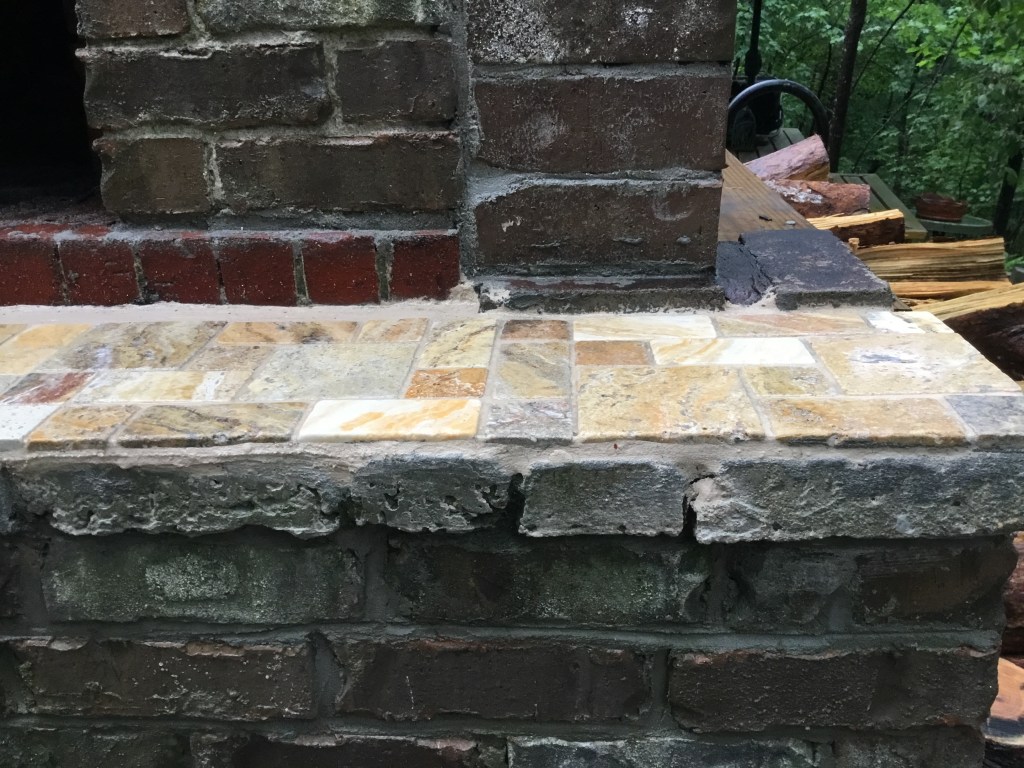
Plan for today was to grout the last section of Travertine tile that covers the front apron, but after two and a half inches of rain this morning, it’s off to plan B. Another new addition will be kitchen herbs for the outdoor kitchen, with some choice cultivars.
Roman Reference==see Coliseum
Today, besides transplants, I am sowing pots of Genovese basil and Italian parsley. Maybe I will be done with all the masonry work by the time they germinate.
Wild birds don’t get taken in by scares about bird flu or other corporate derived scams, such as inflated gasoline prices (see under the heading “Windfall Profits”). They just go about the business of being birds, and will take advantage of every structure we build, freeloaders that they are. I really can’t blame them, since we invaded their spaces.
First example has the be the earliest nesters, the Bluebirds. They regularly take advantage of the old Bluebird nesting box I made, at least when it is not inhabited by flying Squirrels, which actually prefer the Wren nesting box. Our new family fledged in April, which I know to be the month because one of the fledglings almost flew into the back of my head, while on one of its training flights. Never fear–father Bluebird was right behind him, teaching by example. Junior has now discovered our bird bath, and slings water out of it like an outboard motor.
A perennial spring inhabitant of our house are the Flycatchers, who prefer nesting in the structure under our deck. This year they changed from nesting under our porch, to nesting just outside and left of our door from our walkout basement, onto our patio. The nest was masterpiece of bird architecture, and before we knew it there were four bird sized fledglings staring down at us every time we walked out of our door. The last few days they would sit up on the edge of the nest, and examine us with a sour expression, while the mother chirped at them from understory bushes nearby. My translation was from Flycatcher to English: You fat kids get out of there, and come and learn how to catch your own food.
One day, the biggest kid was gone, and there were only three. The mother kept chirping at the others. By noon the next day, there were two. By sunset, there were none. Happy fly catching to all of them.
Hummingbirds are a whole different story. They nest here, but only a storm blown nest will give away the location. Their favorite appears to be a white Oak right outside of our house, which we saved from our dipstick fill dirt people who piled dirt up three feet around it. We excavated it from that, so we claim it as part of our structure. Multiple Hummers are now chasing each other all around our house, probably charges from a nest around there.
And then there is the king of the birds, the Wren. To my knowledge they have never nested in our wren box, preferring to go their own way. They normally nest in our hanging Boston Ferns on our porch, but a wren is going to wren. This year they nested in the regional flower of the rural South, a satellite dish. This deserves a great Irish song by The Chieftains, “The Wren in the Furze.”
The wren oh the wren he’s the king of all birds,
On St. Stevens day he got caught in the furze,
So its up with the kettle and its down with the pan
Won’t you give me a penny for to bury the wren.
The Chieftains
A Furze is a prickly gorse bush, akin to the native Hawthorne I grew from seed, which is 6′ and climbing. The Wrens are having better luck with the satellite deesh.
Which brings me to the problem with people. Like birds, we normally raise the alarm when danger is near–just think of Crows when a Hawk is around. According to our corporate media, I should instead be one of three things–exhausted, reeling, or broken, or a combination of all of them. The cliche department left off the ringer, which is pissed off, which I am regularly. Therefore I propose a new trans controversy, which is trans-species.
I am planning on identifying myself as a bird, since I don’t fit in to the current news industry narrative of what people should be feeling. With a few exceptions, such as cowbirds, birds are noble, useful, and incredibly resourceful creatures. They don’t contribute to anthropomorphic climate disturbance, or purchase weapons of mass destruction. They rarely utilize weapons of mass distraction, also.
I’ll be proud to be a bird. Like in the old Woody Allen joke, we need the eggs.
Having a supply of windblown wood that could last at least one lifetime, is not all bad. A case in point is the first dish out of the rebuilt brick oven, some glazed Salmon with herbs. I also took the advice of the authors of a new British book on brick oven cooking, and bought a battery powered infrared digital thermometer. The one I found records temps up to well over 1100 degrees F, which is very helpful, as I will later explain.
Ingredients
1 Fillet of Wild Salmon
Salt and Pepper
Lemon Juice (We have two Gallon freezer bags full of last year’s Myer Lemons)
Maple Syrup to taste
Olive oil
Fresh Fennel, Dill, and Parsley
A good ridged cast iron skillet is the perfect cooking device for this dish. I didn’t even bother mixing the glaze together in a bowl, and just put them on the fish in the order listed above. The cooking is just as simple.
Needs a Clean
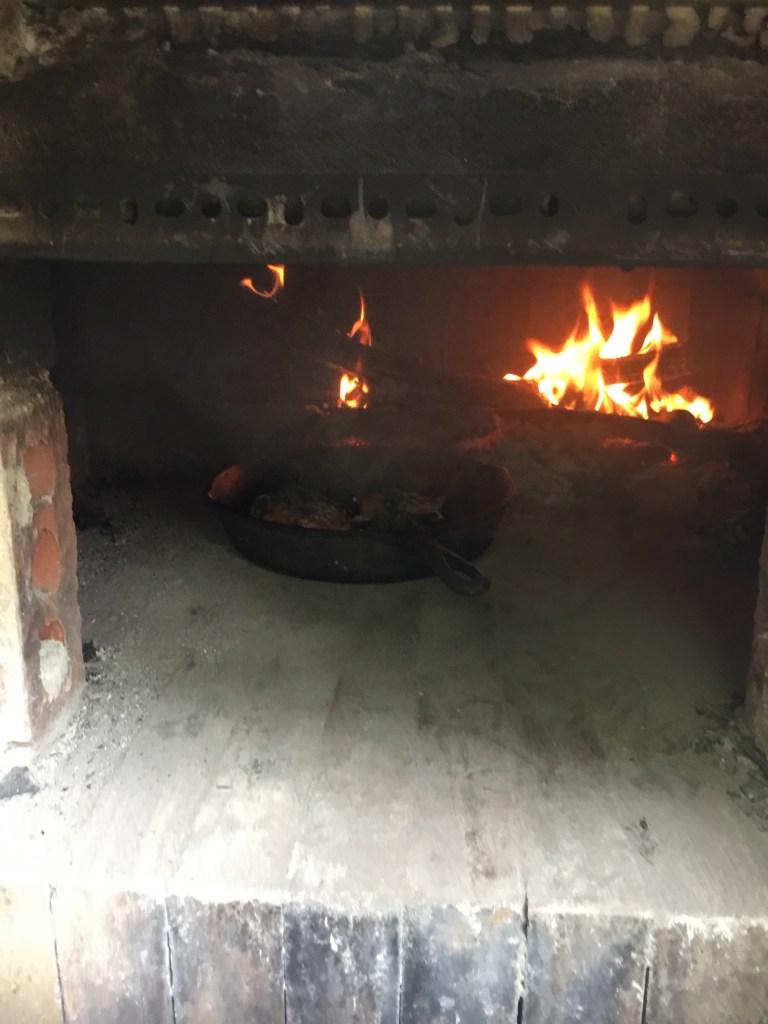
I built a stick fire out of long deceased yellow pine limbs, and in no time it registered at 1000 degrees F. The plan was to let the back wall heat up to 250, and then put in the Salmon. I pushed the fire to the back when the temp was reached. Then I roasted the Salmon until the pan hit 200 degrees–the thermometer has a laser pointer, so you know what object you’re measuring. Time for a check (see top picture). The left hand piece flaked well–done!
Should you burn pine in a brick oven? The Brits say definitely no, the Americanos who published the design for the oven I built say burn nothing but pine. Going by the results, in an oven, nothing matters but heat, as opposed to a smoker or smokehouse, where the smoke is a flavoring agent. As long as it is not treated–and I had a relative who built a fire once out of treated wood, and was rewarded with a no expenses paid trip to the hospital–it doesn’t matter. I happen to have a few tons of pine blown down and lying on the ground, so pine it is for the near future. If that hurts anyone’s feelings, I offer my sincere tots and pears.
The news industry exists for the same reason as the entertainment industry–to sell consumer products. Instead of reporting actual facts about daily Covid deaths, or Russian fascists committing genocide, we get stories about hummingbirds–not that I have anything against Hummers, but things need some perspective.
Today’s bird flu hysteria is about the ever-present danger of hummingbird feeders. Today’s click bait headline on Al.com is “Avian flu and bird feeders: Can you still feed hummingbirds?” It should read “should” instead of “can,”but this is only click bait, and I clicked on it. Among the ads for sandals and Toyotas was some generalizing about hummingbird safety, from Dr. Victoria Hall, who lives in the hummingbird paradise of Minnesota.
Dr. Hall starts out well enough, admitting that there is actually no evidence about any dangers of giving birds sugar water–unlike humans, who contract type two diabetes if they consume too much sugar water, aka soft drinks (that’s my addition). Then out comes the generality.
Because the science is unclear on the role of songbirds in this current H5N1 outbreak, one consideration is to not encourage birds to gather together at places such as bird feeders or bird baths. These are places where things like viruses could easily be exchanged between individuals
Hall
Exactly. That’s why I am not going near any cafeterias as long as viruses exist. On top of viruses, there could not be enough plates, or food, or silverware. Someone could have a gun. Someone else could speak Russian. Some creep might have a sharp fork.
The hummer feeders stay up, and filled. I might even find a new nest this year. But on to more important things–what Coach Saban serves the losers of Alabama’s spring scrimmage–beanie weenies, and no cake for dessert. That monster! How do his teams keep winning?
“Why experts say you should immediately stop filling birdfeeders”. So blares a leading headline on our state’s top “news” site, Al.com. Never mind that there is only one expert cited, and she lives in Minnesota. At any rate, here’s what Dr. Victoria Hall has to say.
“Unfortunately, we have a lot of gaps in knowledge about the role of songbirds in HPAI outbreaks. We have some data from previous outbreaks around the world, but this outbreak is very different. The 2022 outbreak is unique because of the very high levels of transmission of the currently circulating H5N1 virus strain in wildlife.”
Hall
Let me translate:
“…we have a lot of gaps in knowledge about the role of songbirds in HPAI outbreaks.” Trans–We don’t know.
“With minimal viral surveillance being done with songbirds, it is hard to measure the risk of transmission from songbirds to other birds.” Trans–We don’t have enough data to prove anything, but I am an expert, so I don’t need any.
Let me step in to the void with what is actually known. Here’s useful information from the CDC, cited near the end of the article:
According to the Centers for Disease Control, 27 million cases of avian influenza have been reported in backyard and commercial poultry as of April 8th. Another 637 cases have been reported in wild birds in 31 states, including Alabama. The Alabama case was reported Feb. 23 in an American wigeon found in Limestone County.
AL.com
Divide 637 by 27 million, and you have it–0.0000236% of documented bird flu cases in the US have been found in wild birds. I personally am going to roll the dice and keep my bird feeders full, and my chickens fed. Though I will end with a witty fake headline:
All cases of bird flu reported in Alabama were in the wild bird population.
Of course that number is only one, which occurred almost two two months ago, and was a couple of counties away from here. I just like to live dangerously.
Yes, winter in the age of climate disruption. Technically this was late late last fall, but with temps in the mid 70’s, it might as well have been late late spring. In this situation, the only thing to do is light up the brick oven, and eat some pizza outside.
Our pizza sauce has evolved over the years, and I will simply list the secret ingredients, soon to be secret no more. Here it goes:
Balsamic Vinegar
Garlic Paste
Italian Tomato Paste in a Tube (like the Garlic Paste)
Homemade Pesto, frozen in an ice cube tray
Home canned local Tomatoes
It is possible to screw up the sauce even with these ingredients, but it can only be accomplished with some difficulty. Go easy on the vinegar and the paste, and all’s well that eats well.
I will resist the temptation to make another bad joke about Al Fresco. I could hurt his feelings.
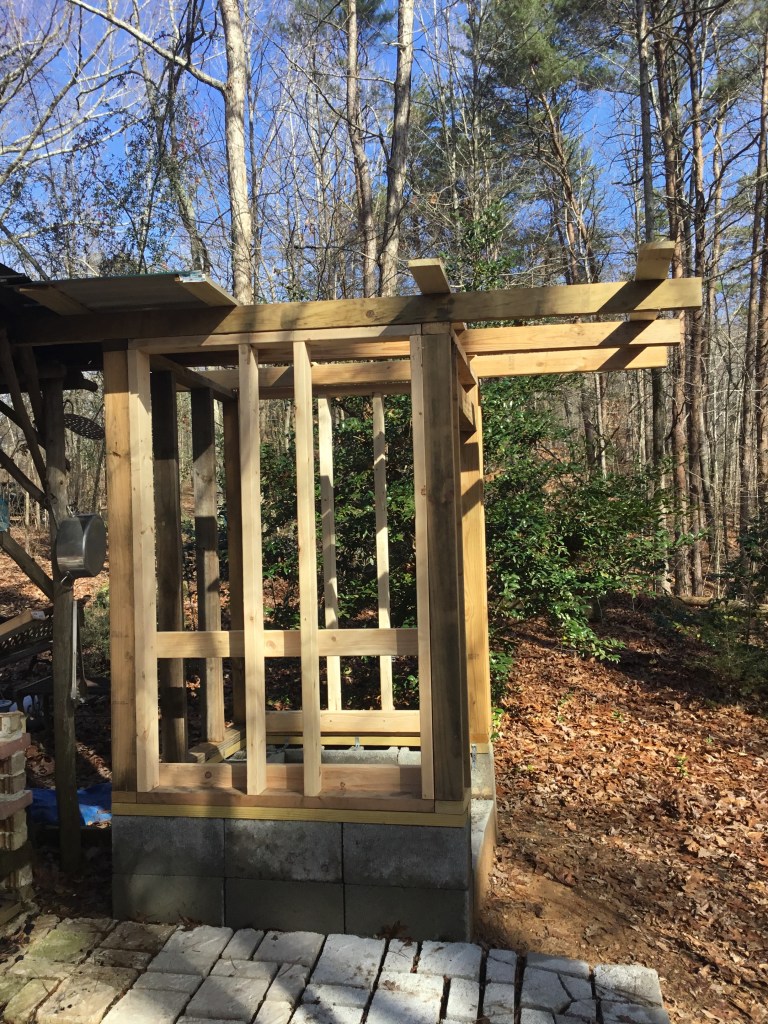
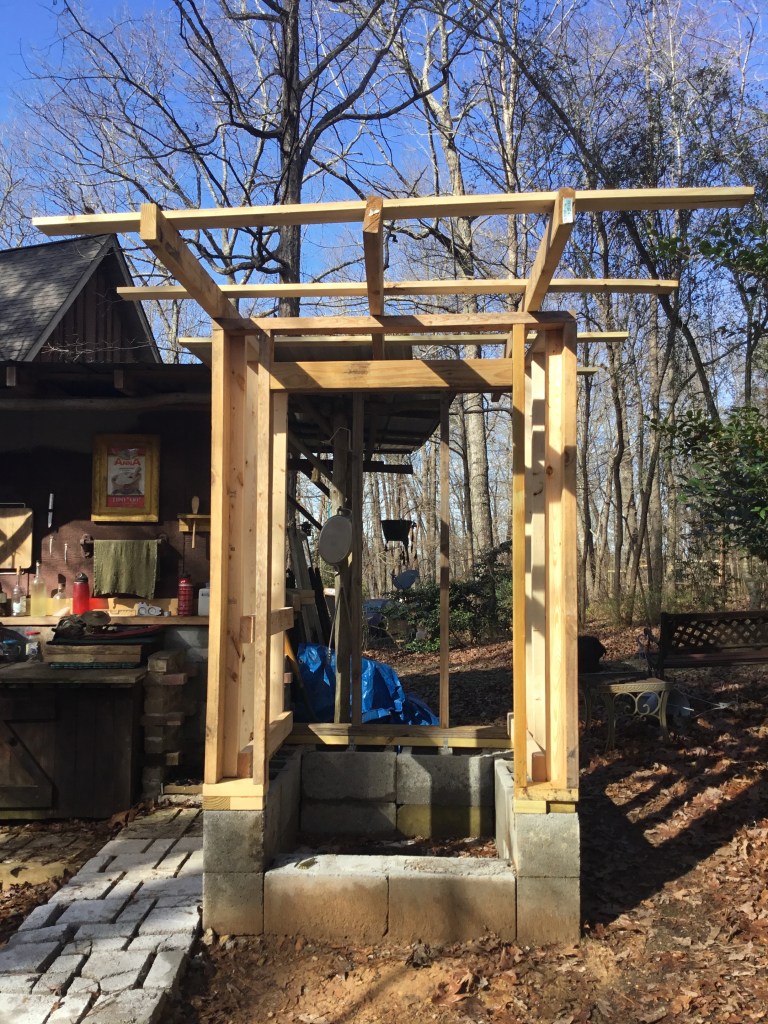
This project began with the gift of a bunch of cinder blocks, and a couple of wooden pallets–all unsolicited, naturally (I should add that cinder blocks are known as “see-mint” blocks locally). These came from BIL (brother in law) #1, who then added a few pressure treated 2x4s as well, which you can see as the sill boards on the smokehouse.
Not long thereafter BIL #2 got in on the action, giving us the lumber for the front and back walls, as well as the rafters, and some tin roofing. He really really wants this thing to be finished, as he has a whole list of meat smoking projects. We (gasp) actually bought the lumber for the two side walls. I have plans for a fancy door as well.
No Door Yet
I did all the work myself, with the exception of Melanie Jane helping me hoist up the first rafter. But, as my labor is free, as always, I did all the rest of it by my lonesome. That is, if you don’t count my actual supervisor on this project.
Get Back to Work
That’s Siegfried, more commonly known as Ziggy D. Dog. A finer nor a lazier Aussie has ever been birthed. The combination of the two traits makes him perfect for a middle management position.
MJ says that 16 square feet, the size of this structure, is big enough to sit in and smoke a couple of packs. My counter was that I would rather puff on a Bob Marley sized fattie (that’s a joint of Mary Jane, in case you just fell off the turnip truck). Truthfully, neither of us has ever smoked vegetable matter of any kind. I suppose we will have to stick with smoking meat instead.
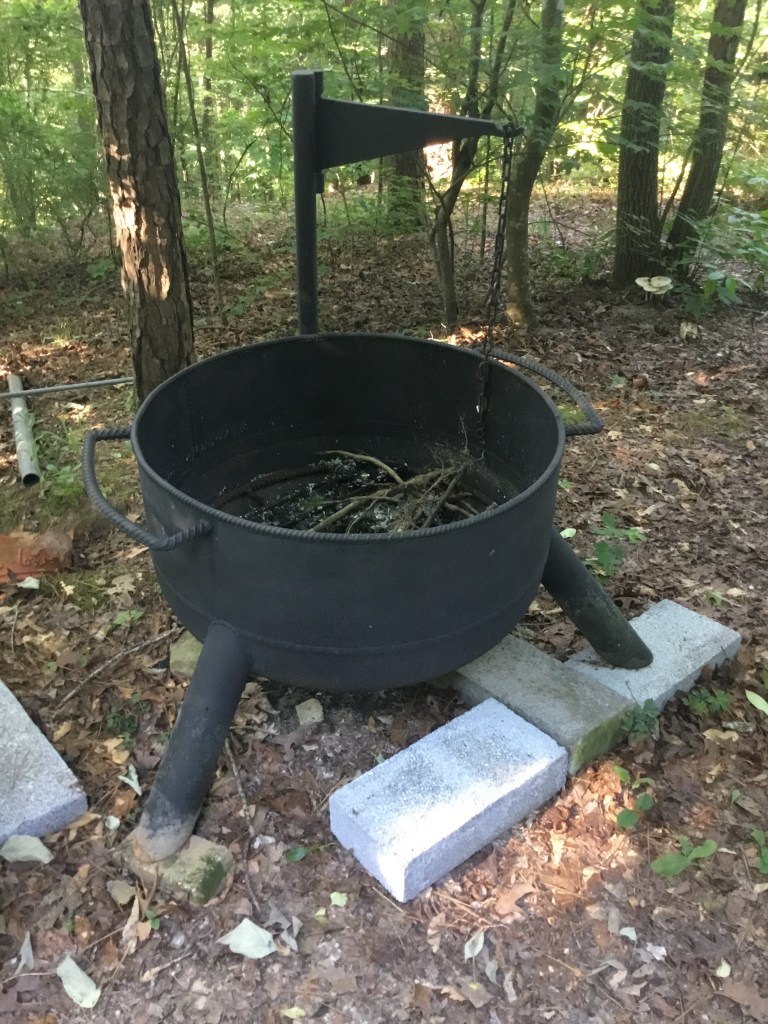
The words Fire Pit and Outdoor Kitchen have become such a cliche when put together that CNN had one of their homepage top ten lists, just on Fire Pits, last week. Strangely, they left off my heavy steel pit in favor of a bunch that were made from sheet metal. It could be that because you have to be related to the guy who makes these in order to get one–I am.
My best estimate is that this was made from the end of a 150 gallon propane tank, as they are usually 30″ in diameter, as this is. The handles and rim are made of rebar, and the legs and cooking crane are heavy steel bar and pipe. The crane works like a crane found in Colonial kitchens, so this is made to cook.
How tough is this thingie? A dead and quite large oak tree blew over in a storm, and made a direct hit on this pit. The impact was so hard that the tree mashed the pit into the ground to the top of the legs. After I cut the tree off, the only damage was that it bent the crane slightly, which had no impact on the performance of the pit.
Further evidence that it was designed to be a fire pit and a cooking machine:
Great Grate
The rebar grate can be used to stack logs on, or sit a pot on, or taken out so the things can be cleaned or used only as a fire pit. Likewise, the crane has a swivel hinge which means it can be moved completely out of the way. or even taken off altogether.
I did drill four holes in the bottom for drainage and to add a little air circulation. I will drill more eventually, but drilling through this steel just about destroys a drill bit. At least the thing isn’t full of water and mosquito larvae. This state was originally nicknamed “The Yellow State” because of the prevalence of malaria. A case of that will definitely ruin your meal.








 Southern Fusion Cooking