Some actors get a facelift or Botox or embalming fluid to give them that paralyzed face-look that Hollywood likes, but my Smokehouse has been given a shingle lift. It was something of a fiddly operation, but it turned out to be a success. It was actually completely unplanned.
The story is this: Melanie Jane wanted some tongue and grove put on one of the walls in our bedroom, so I went by our new local wood only lumberyard/sawmill to see what they had. It turned out their office was clad with exactly the kind of tongue and groove that I was looking for, and it was only 3/8″ thick. I left with two bundles of 12′ boards, all a little over 6″ wide.
That was a lot of board feet, as it turned out. I had about one fourth of it left over, and my work shop is not big enough to have a bunch of lumber lying around. I finally thought, what is 3/8″ lumber good for? Then it hit me–shingles. There was just enough wood to shingle the front of my smokehouse.
I cut it up in to 16″ long shingles. The part that is left visible is called the “reveal,” and all the rest is overlap. The 4″ long reveal means that there is actually three layers of shingle on each run, which if installed properly, will make a waterproof covering. I planed off the tongues, and cut off the groove edge with a bandsaw.
Many many shingle nails later the wall was ready for some paint. I wanted to do it right, so I bought some pigment called Blue Ridge Hematite, which is a dark red Iron oxide from Virginia (the door is made from Virginia Juniper, aka Red Cedar). I made egg tempera paint with it using the following recipe. This is for a pint:
1 tablespoon Iron Oxide pigment
2/3 pint boiled (cheap) Linseed oil
Mix these thoroughly and leave overnight. The next day add:
1 Egg
1/3 pint Water
Stir, but don’t shake, the paint. Think of it as one of James Bond’s martinis. Theoretically, the building will rot down before this paint fades. Now there’s only three more walls to shingle. I think those can wait.
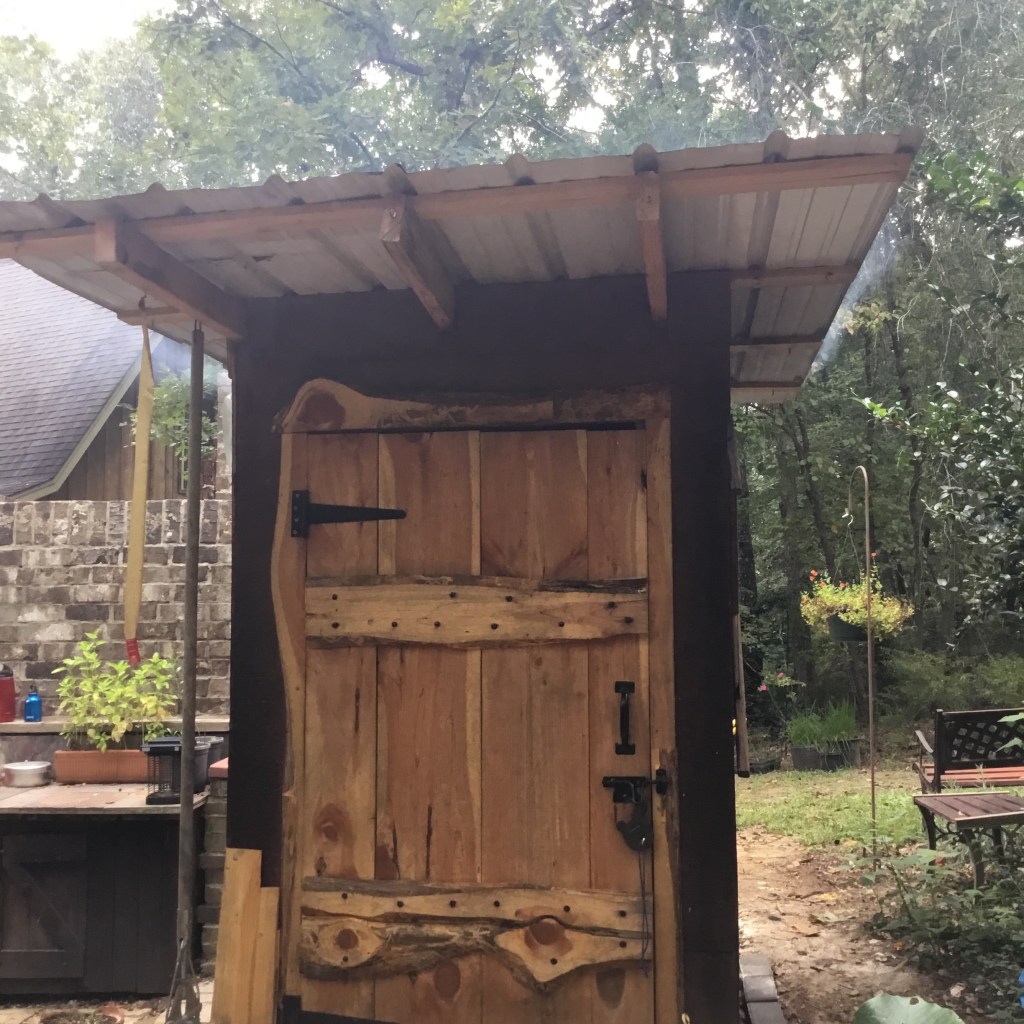
This rustic construction is a smoking fool. The few pine shingles on the left are just the beginning of what will be a fully shingled structure, eventually. When that is finished, it will be as rustic as it gets, befitting of an all wood burning old school outdoor kitchen.
Here’s another piece of wood burning equipment:
Repurposed to the Great Outdoors
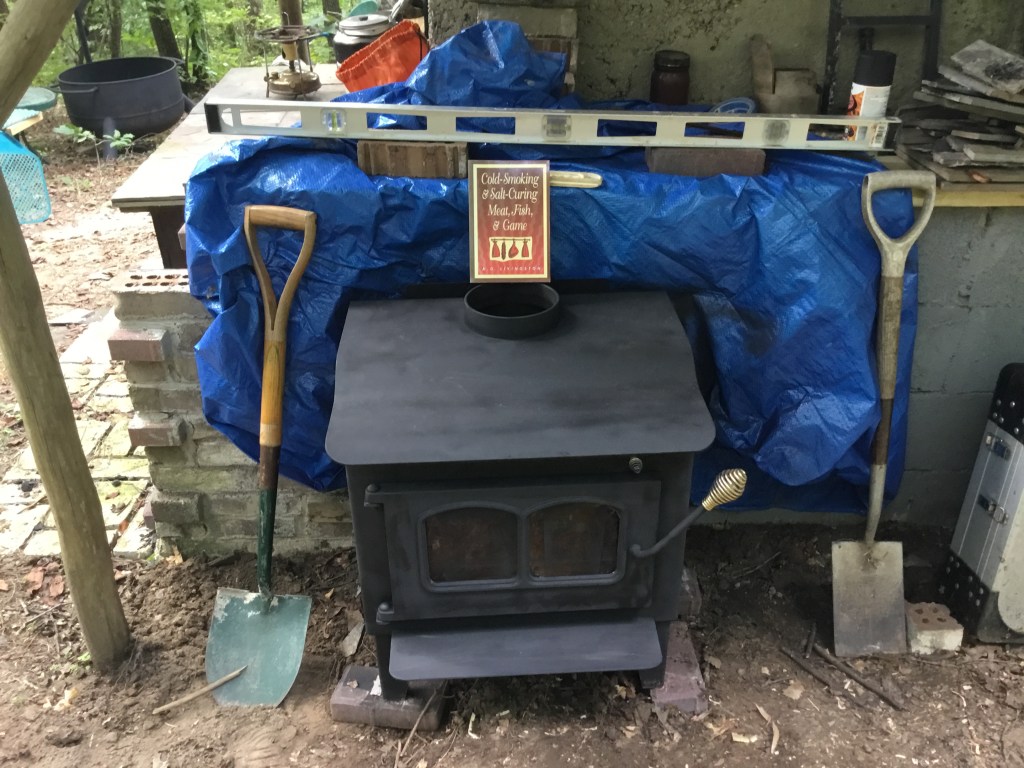
This old steel wood stove had been hanging out in our basement for a good fifteen years. Now, with the connection to the smokehouse completed, it is the smoke engine supreme. It is also surrounded with an endless supply of firewood.
Now we need some meat–
Sorry, Pig
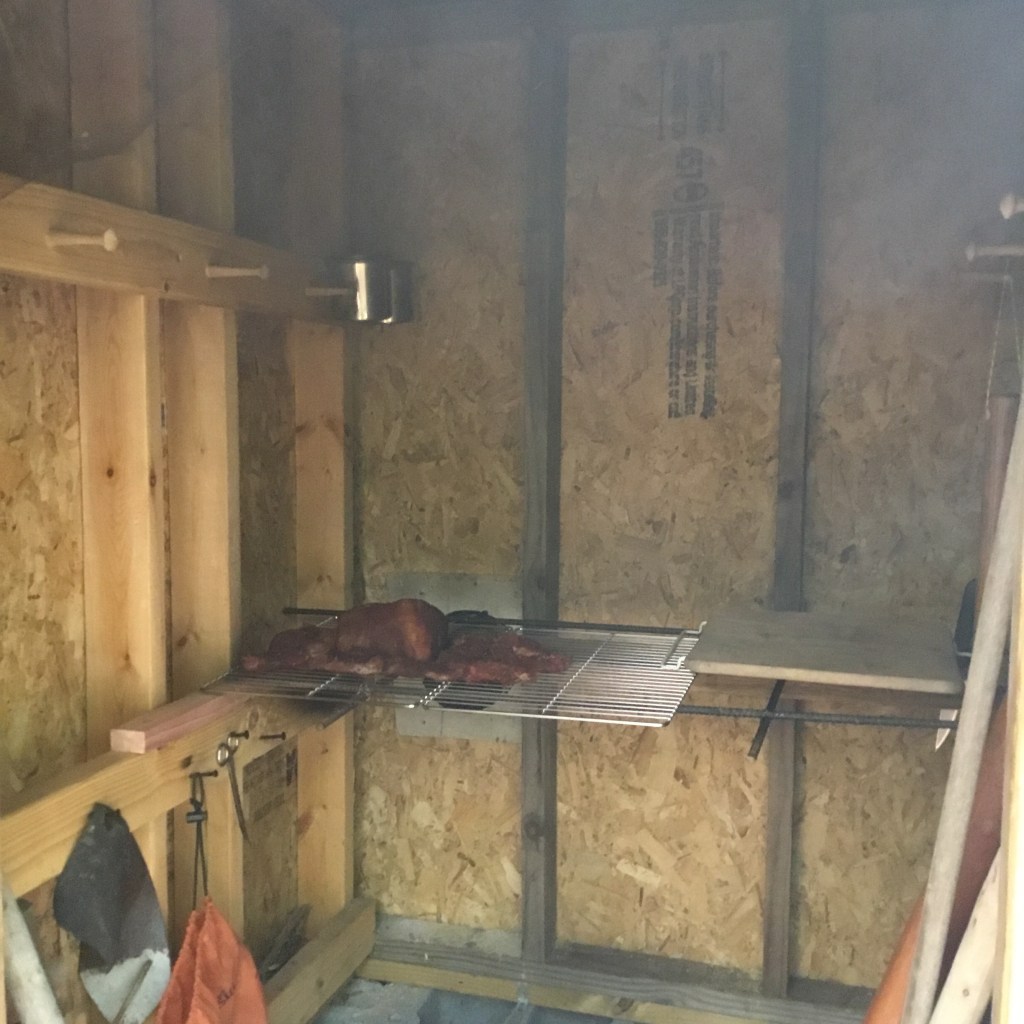
That’s all pork shoulder, some sliced into strips for Tasso ham, and the rest left for barbecue. No secret rubs for the barbecue here–we just use Galena Street mix by Penzy’s Spices, which is a great small business. Too much more smoked meat –this weekend we have pork loin ribs and a salmon fillet–and I may end up as the poster boy for the fat bear photo contest.
Tasso ham is not really ham, in the common sense of the word, as it is usually made with pork shoulder, aka Boston butt. Going back in time, this Louisiana seasoning product was made from any trimming leftover from a hog killing. The only constant is the combination of spices and smoke, that make this a red beans and rice all star.
Ingredients
Sliced Pork Shoulder Strips
Paprika
Cayenne Pepper
Cinnamon
Salt and Pepper
This constitutes the dry rub, and the amount of each spice depends on the quantity of pork strips. At this point the pork strips need to dry uncovered in the refriginator a minimum of three days. Then it’s time to crank up the smoke house.
More Smokin’
This old school smokehouse, right down to the hanging strip of fly paper, is now fully operational. The external smoke source is an old steel wood stove connected via a stove pipe. This Tasso was smoked for two and a half hours with green Maple at about 150 degrees F. The char patterns on the Tasso in the photo are from the smoke, not heat. The big piece of pork shoulder in the pic was destined to be barbecue.
After the Tasso has cooled, cut it into cubes and chunk it into a freezer bag. Like the frugal ant in the ant and grasshopper fable, we will have smokey dishes all winter, while the grasshoppers have to dine on McRib mystery meat barbecue sandwiches.
The Freudian idea of the unconscious mind is a problem for speakers of English, and is probably the result of yet another weak translation concerning the difference between German and English. Unbewusst, usually translated as unconscious, could be better thought of as unaware, as unconscious is more often considered a medical state in English, like a blow to the head. So if we go back to Dr. Freud, unconscious, conscious (unbewusst, bewusst), are more understandable in English as unaware, aware. Because you are unaware of something doesn’t mean that it doesn’t exist, and doesn’t involve any head banging.
This all may help to explain my realization that I have a final plan for a five part outdoor wood-fired kitchen. I realized this when I woke up from a dream this morning, and the discovery cost me nothing in psychiatric fees. At any rate, here are the five pieces/parts/cooking stations, though I am only going to discuss the first two. I’ll get to the others later.
Brick Oven
Brick Stove
Smoke House
Tuscan Grill
Fire Pit
The Cornerstone
The brick oven will get the most use of all of these, mainly because of its versatility. I should point out that a brick oven is not a pizza oven, but a pizza oven can be made of brick, and most are, but they can also be metal and a number of other materials, such as clay. Many people, myself included, will lapse into calling this a bread oven, as that may be their primary use (this was designed to be mostly a bakery oven). However, anything that can be baked or roasted can be cooked in one of these ovens, with the added advantage that the temperature can easily be raised to 1000 degrees F, or higher. When this oven gets very far above 1100 degrees, my digital thermometer just says “HI.”
Baking traditional bread (think round sourdough loaves) also requires a door for the oven. After a fire is hot enough, which can be used to roast meat, veg, etc, it is allowed to burn down into coals. Those are then spread over the entire surface of the oven, to further heat the surface of the firebricks. After those coals are burned down to ashes, the oven is cleaned out, and the loaves are placed in the oven–this size oven will hold a dozen loaves. The door is then closed, and used to maintain an even temperature of between 400 to 500 degrees, or thereabouts. Theoretically, 36 loaves could be cooked in this with one firing, which made this style of oven popular with large bakeries, or even as communal ovens. The most loaves I have cooked in mine is a grand total of two.
Potager
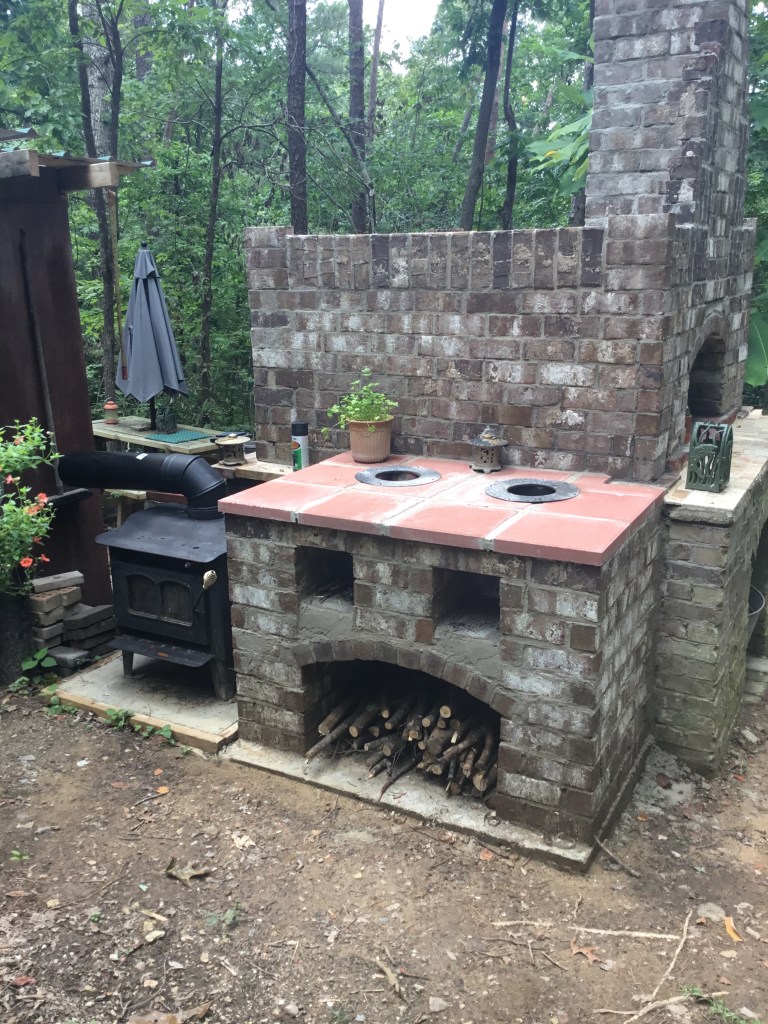
This particular masonry structure fits into the category of something you don’t see every day–a Potager, more commonly called a Stew Stove in English. These were particularly popular with the upper crust of the eighteenth century, and the most famous ones in the States are at Monticello in Virginia. My Potager is a copy of one rebuilt at Ham House, a British National Trust Elizabethan period property in Surrey. It is definitely a French influenced design.
The concept is elegantly simple. A masonry firebox leads to a chimney like opening (I used flue thimbles as openings). This concentrates all the heat and smoke down to a six inch area. In the case of this stove, just sit a cooking vessel over the opening. The temperature can be varied so that it can range from a sear, to a saute, to a long and slow stewing. In short, this is a half ton equivalence to a modern cooktop, with the exception in my case, that the fuel is free and one hundred percent renewable.
As an experiment, I first used this to roast some poblano peppers that I bought at the farmer’s market, on a grill. They smoked as well as roasted, and were jet black in no time. After I cleaned and sliced them, they went into the freezer for use this winter. For stewing, shovel coals into the firebox, and use a pair of bellows to control the temp. Extra fuel is literally at your feet.
Coals from the brick oven can be used for the Potager, and a busy cook can bake and saute at the same time. Alternately, coals from the smokehouse steel wood stove, pictured above, could be used to smoke something and stew at the same time. A cook with four arms could bake, sear, grill, stew, and smoke food simultaneously. Such a creature would end up with a powerful hunger in no time at all.
The masonry work on the re-built brick oven is finito, and the oven has been getting a work out. We have cooked a few roasts, re-seasoned some cast iron, and churned out multiple pizzas, including six one day during the weekend of the fourth. And we still have that big stack of firewood on the west wall.
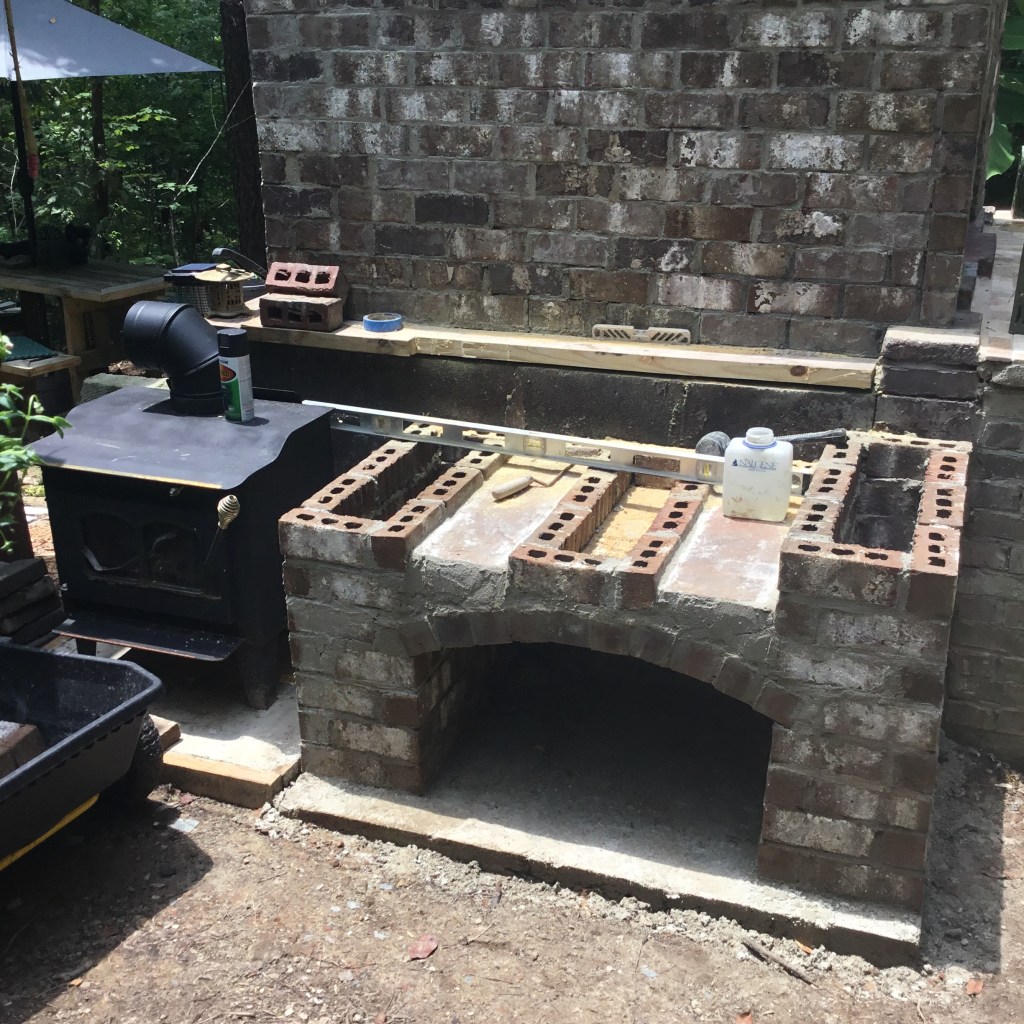
I haven’t shown all three walls, as the two side walls are identical, and the back wall is just a smaller version of the other two. The east side is an entirely different story. Here’s picture worthy of a contest.
A Brick Hutch for Giant Rabbits?
There are actually two projects going on over here. One is actually attached to the brick oven, but is not part of it. It is to serve an altogether different function. The old steel wood stove is soon to be attached to another part of the outdoor kitchen. Needless to say they all involve burning wood.
Anyone who can nail the purpose of each of these two units will be awarded an honorary certificate from the Institute for the Advanced Study of Southern Using What You Got. I’ll add a heavy hint–think of something that Monticello and Mount Vernon have in common, and I don’t mean the Presidents.
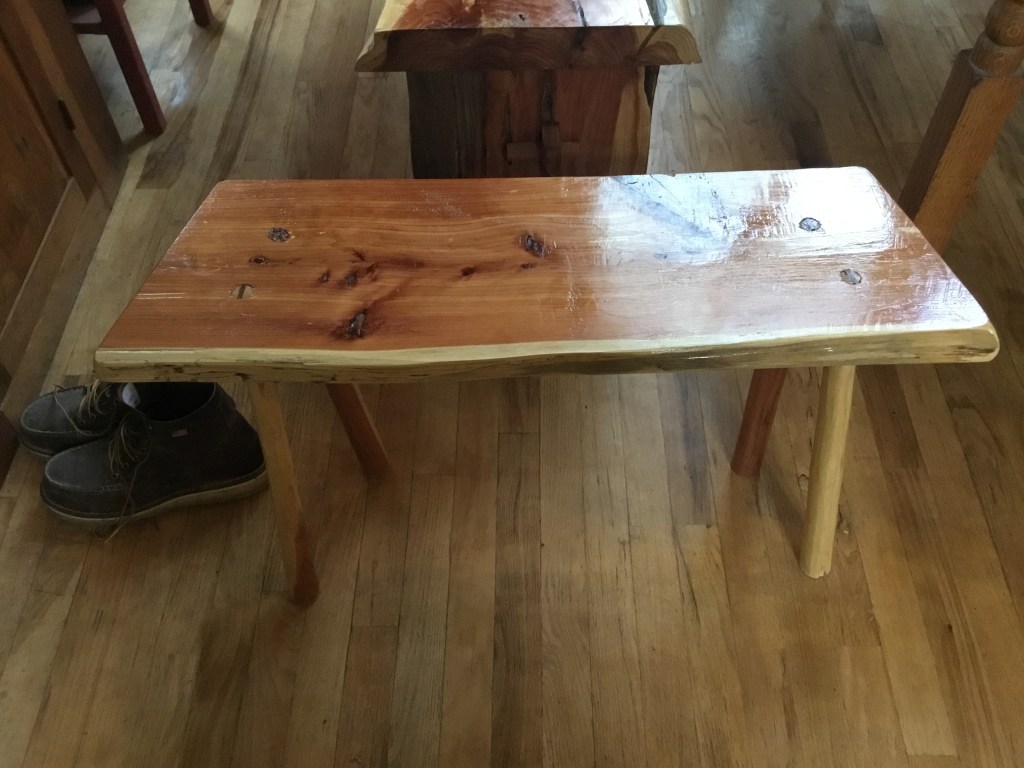
The giant stack of cedar we were given is essentially gone, with the remainder good for nothing but pegs, wedges, and fire starter, although the shavings make a superior smoked salmon flavoring, when thrown on the fire in the smokehouse–think Virginia juniper instead of red cedar, as the tree is technically a juniper instead of a cedar. This piece is a gift to the in-laws who gave us the truckload of lumber to begin with.
I actually made this to be a stool, but once possession changes hands, it is up to the discretion of the new owners, who have always been thinking end table. The legs are made in the same fashion as “stick” chairs, as in the very old style of Windsor chair known as “Welsh stick chairs.” The usual Welsh Windsor is normally made without stretchers between the legs, as opposed to an English style chair. The piece, chair or table, therefore is considerably lighter than one with stretchers.
I have also finished my Roman workbench, and a picture of it will help to explain where all that red cedar went.
Friday, 2/11, was a warm 68 degrees F, so we smoked some wild Salmon in the new smokehouse. Life is hard.
I snaked the recipe from Hank Shaw, who has the great website Hunter Angler Gardener Cook. It’s simple and delicious.
Smoked Salmon
1 medium wild Salmon Fillet
Marinade of Sea Salt, brown Sugar, and Water
Start about six hours before smoking, and marry-nate the salmon in this mixture. Then let it dry, skin side down, for another two hours.
This is a warm smoke cook, so here are the rough guidelines. Cold smoke is from about 70-100F, warm smoke is 100-130F, and hot smoke is 130-190F. These rough guidelines are for people who happen to own cooking thermometers.
Not us. Old timers around here would laugh at the idea of wasting money on a thermometer, when you can just open the damn door and stick your hand inside to see how warm the smokehouse is. Besides, they had those free advertising thermometers nailed up on the front porch (usually Coca-Cola). They would have pulled that down and used it. A lack of money leads to a surplus of creativity.
At any rate, the Salmon smokes for around two hours. After an hour, brush on some sweetener. Shaw uses birch syrup; we went with honey, as we have a beekeeper who lives a mile from here, as the bee flies. We have already seen one of his bees on some blooming crocus we have.
Naturally, after an hour and a half we got impatient and hungry, and finished the Salmon in the oven. It was a bit dry and overcooked, but still nice and smoky. It made superb Salmon cakes as well.
The last bit is fitting this thing for real winter cold smoking, which is going to take some serious labor, hooking up an old steel wood stove to this smoke mansion, in a way that will result in the whole thing not burning to the ground. Good thing my labor is free.
The game is afoot, as Sherlock liked to say to Watson. I am finally finishing off my brick oven, AND building a smokehouse to go along with it. There’s some history to go along with this plan.
Back in the day, every farmer in our area had a smokehouse. MJ’s grandfather’s was a beauty. He built a fire right in the middle of it, but only smoked meat during “hog killing weather,” which began in November when it formerly became very cold.. In short, cold smoking was the only smoking he did, which meant that the temps inside the smokehouse never topped ninety degrees.
I’m going for one that will cold smoke and hot smoke. I will be able to build a fire in the smoke house, and one outside of the smoke house, thanks to the steel wood stove that was buried under my scrap pile. Moving it also helped clean out my workroom.
Be that as it may, the foundation is also completed now, and I am ready to frame this thing. Check back in another week or two, as we are about to have some very good weather for working outdoors.






 Southern Fusion Cooking