Making Pepper Mills Out of Green Wood

Bright and Shiny

This trio of mills are Christmas presents for the in-laws, all of whom can put away some chow. Primitive man that I am, I made these from green (unseasoned) wood, and skipped the whole pricey and unnecessary kiln-dried process. The cost was lowered even further by using wind blown wood from last February’s tornado, a good portion of which is still lying on the ground on our property.

The first, and possibly the most critical step, is wood choice. I have more wood varieties at my disposal than I can literally shake a stick at. So I went with the easiest one–sourwood. That’s the wood I have that is least likely to split, out of everything around here, as it has the lowest T/R ratio–always check the inter webs for T/R info before using a wood for a green woodworking project. I made four blanks, two of which had absolutely no splits. The third had only a tiny hairline split on one end, which I just filled with beeswax. The fourth split along its entire length, and will be recycled into another project.

I began with a part of the tree that is rarely used, except for spoon carving, the limbs. Sourwood is so difficult to split that a small limb usually doesn’t split at all, even from the pith. Because of the roundish nature of limbs, I was able to skip the first step of roughing out with a hatchet, and went straight to peeling bark with a drawknife, and then rounding out the blanks with a concave spokeshave. After that the 3″ x 11″ blanks went straight on to the foot powered lathe.

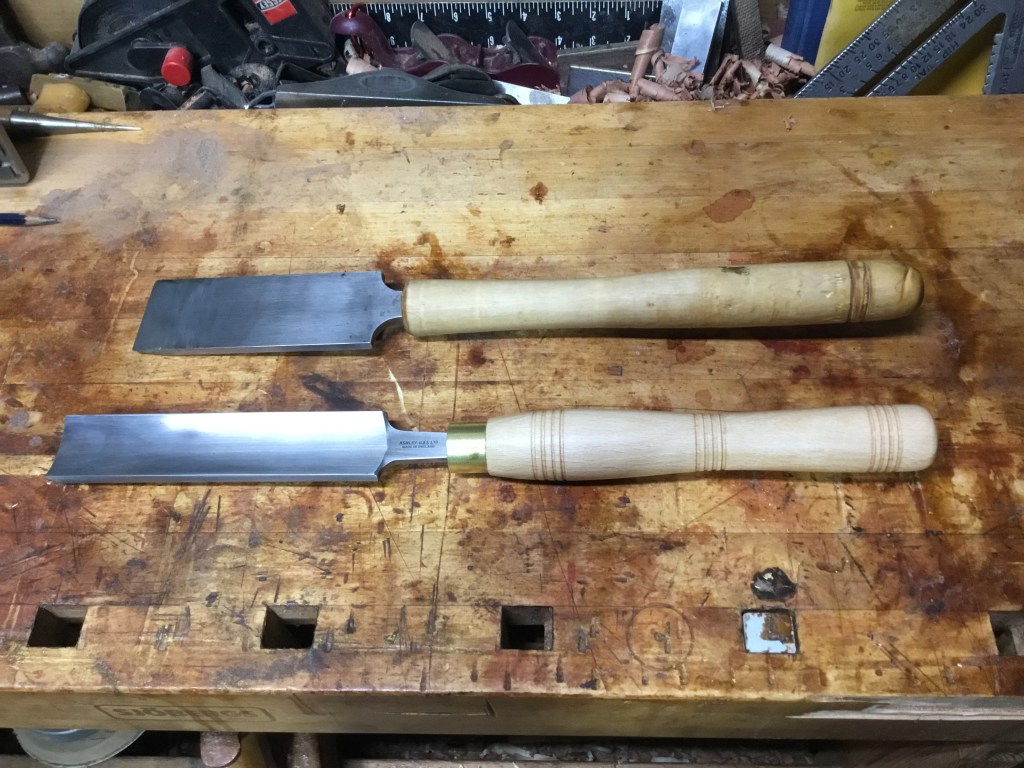
The roughing tools below are specialty tools made specifically for foot powered lathes. The 2″ chisel and the 1 1/2″ shallow gouge can be used in any combination, though I go gouge, and then chisel. These make fast work creating a perfectly round blank.

Ashley Iles Pole Lathe Tools–The Chisel on the Left has a Homemade Cherry Handle

Conventional lathe tools are perfect for detail work such as forming the beads. Below are a diamond parting tool and a 3/8″ spindle gouge. Once the details are roughed in, it’s Zen break time. The green wood needs to dry for at least a day.
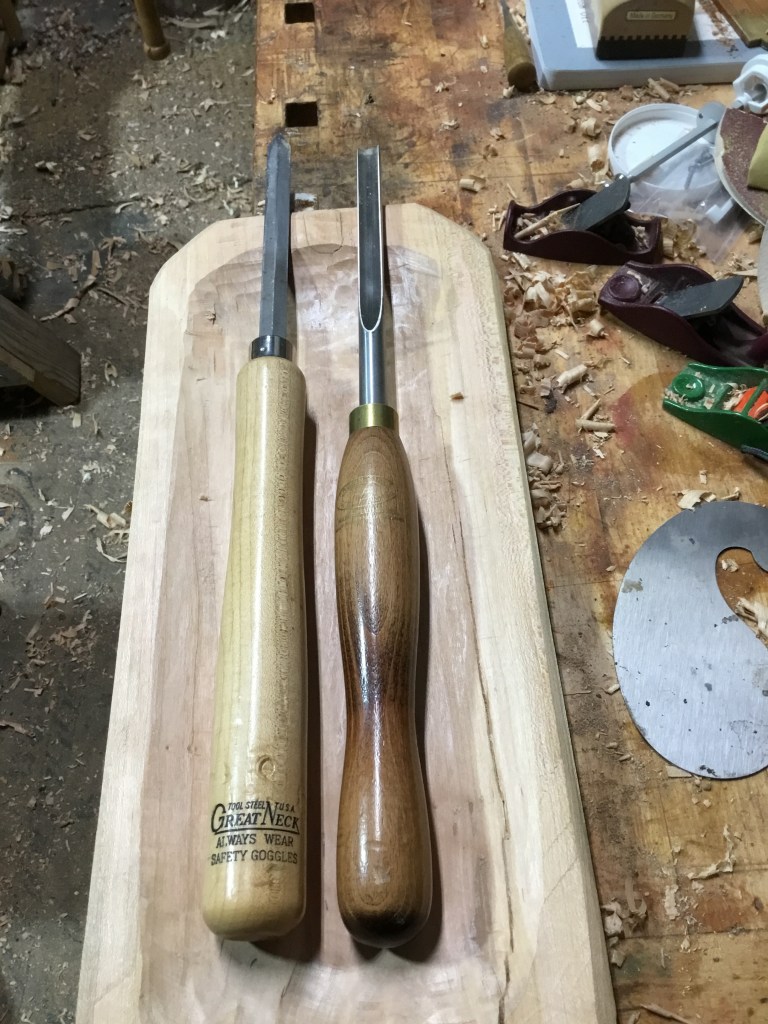
Detail Tools

There are two good reasons to let green wood dry for awhile. It turns easily, but dries to a rough finish. It also dries into an oval shape, which would render it useless as a mill. The level of dryness is easily seen from how much moisture there is in the shavings coming from the turning work.

Grinder design is a matter of taste, as a perfectly round grinder would function as well as a fancy one. I just copied the design of the grinders sold by the manufacturer of the mechanism, Chef Specialties up in Pennsylvania. The width of the three different sized holes that must be drilled are included with the grinding mechanism kit. They are much easier to use than the old Peugeot mechanism that I made our grinder with, though Peugeot grinders are more durable than their cars.

Other styles of grinder kits are available, and I am making a salt grinder out of green turned black cherry. Anyone who would turn dry cherry on a foot powered lathe would end up needing orthopedic help.

Chopping Block/Splitting Block Combo

Ready for Cold Weather

Since we intend to burn copious amounts of wood this winter, I have set up two of these dual purpose chopping/splitting block combos. This one just happens to be right behind our outdoor kitchen, which has no fewer than five different wood burning cooking stations. At least one is utilized every week.

I will begin, however, with the taller chopping block. Though this is almost entirely intended for green woodworking, it is also useful for splitting kindling–I have one of the Swedish kindling splitting tools that looks like a miniature drawknife. However, for any green woodworking project, this is the perfect waist height for rough trimming a blank with a hatchet, whether it is a camp or broad hatchet. It is also great for sitting a beer on.

The lower one will be used the most, as I have cords of firewood that need splitting. This height keeps the wood off the ground, as well as keeping the splitter out of the dirt. My old splitter is an el cheapo big box store product. My main firewood producing station is to have a quality German made Ochsenkopf (Oxhead) spitting axe.

Finally, for large splitting projects, there are always steel wedges, which are best used in combinations of three. The large piece of cherry that rests on the splitting block was split with wedges, as it splits very well. When the wood tells me what to make with it, out comes the hatchet.

Fans of English Hand Tools–Buy Now!

I just got this email from Classic Hand Tools, a great English tool seller–the crashing pound is going to mean large price increases. In their own words:

Our new mob in control in No.10 have tried something radical to boost the UK economy. Only time will tell whether their gamble will be justified. All we know is that the pound has tanked a massive amount and big price rises are now on the very near horizon for your premium hand tools. We will do our best to be as skinny with margins as possible but that won’t stop prices increasing soon. We have been saying this for a while but we didn’t expect the pound to be hammered so hard. Luckily we have got reasonable stock levels on many lines but that won’t last too long. 

Classic Hand Tools

I have an Ashley Isles turning tool on the way already, but I will scour the inter webs to see if I need anything else, although truthfully, I have almost reached the point of Maximum Tool. I suppose there is always good old fashioned hoarding.

Making Sourwood Tool Handles

Unfinished and Shellaced

Sourwood is a fairly common tree in the South, known primarily for its Lily of the Valley like blooms, and the famous Sourwood Honey, the result of the partnership between said flowers and honeybees. One particularly large (for a Sourwood) tree was uprooted when it was whacked by a broken off White Oak during our latest tornado. That led me to search for uses of Sourwood lumber.

The most common answer for traditional uses of this wood was for tool handles. More deep diving came up with spokes and arrow shafts. These things all had something in common, which is the best quality for all of these dinguses is resistance to splitting, even when made from green wood. This is the result of the fact that Sourwood has a very low T/R ration, which means it is unlikely to split while drying from green wood to seasoned.

The T/R ratio is the ratio of tangential to radial shrinkage, which for wood working purposes, should be as close to one as possible. This info is easily obtained for most species via a simple Google search. Species with very low T/R ratios are usually little used or non-commercial woods, such as Southern (evergreen) magnolia, and sourwood. Evergreen Magnolia has a T/R ratio of 1.2, and sourwood is 1.4.

Making the traditional octagonal carving tool handles was simple enough, and only needs two or three tools–a drawknife (optional), a smoothing plane, and a drill. Take a round limb of unseasoned Sourwood slightly larger than the final handle, and rough it with a drawknife or plane into an octagon. Continue spinning it around, and taper it down to an inch or so at the tang end. When satisfied with the results, drill a tang sized hole and whack in the tool blank. The green Sourwood will slowly shrink around the tang of the tool, and will never, ever, come off.

I bought these Italian made carving tools from Mountain Woodcarvers for $6 each, although they are mistakenly selling them as USA made. I didn’t have the heart to tell them about the mistake. They might raise the price.

Spud or Peeler?

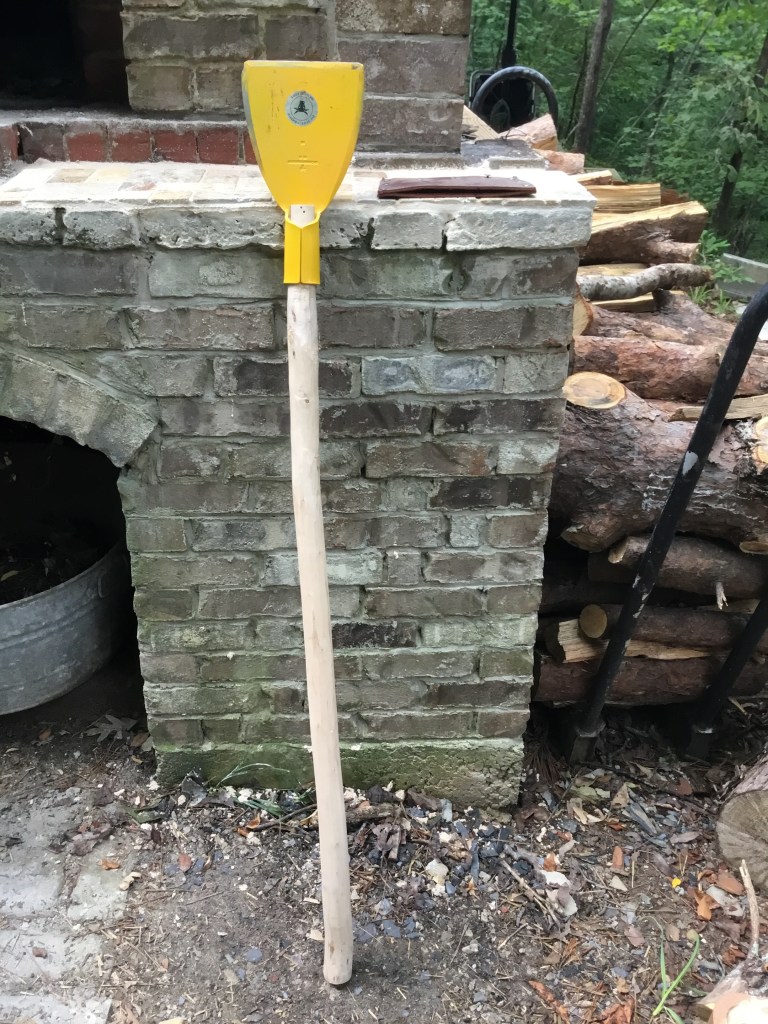
Because I have more sourwood on the ground that I can say grace over, I also decided to turn another limb into a handle for a log processing tool, a bark peeler, aka bark spud. This one a a beastly tool that doubles as an axe/brush cutter by having both sides beveled and sharpened. It is made by Ochsenkopf (Oxhead) in Deutschland. After five months of drying, the handle has no sign of a crack or split. Big tool handle is in a permanent world of hurt in this household.

Sourwood Mattarello (Rolling Pin) and Hanger

Honking Big Rolling Pin

A Matterello is a specialty Italian variety of rolling pin, used primarily to turn out wide sheets of pasta. Generally, the sizes run from two to four feet long, the longest widths used by professional pasta makers (Sfoglino). The one I made is a more overall useful length of about two and a half feet long.

The reason I chose to make one out of sourwood is two fold. The first is that it turns easily while green, like many hardwoods; the much more important one is that it has a very low T/R ratio, which means it is unlikely to split while drying–even at the pith, or center of the tree or limb.

The T/R ratio is the ratio of tangential to radial shrinkage, which for wood working purposes, should be as close to one as possible. This info is easily obtained for most species via a simple Google search. Species with very low T/R ratios are usually little used or non-commercial woods, such as Southern (evergreen) magnolia, and sourwood. Evergreen Magnolia has a T/R ratio of 1.2, and sourwood is 1.4.

My original intention was to make just a straight cylinder, until I realized that such a tool would be difficult to store. I finally realized that the more traditional design with a knob on each end is to hang the mattarello vertically. So I made a hanger as well.

Nice Fit

The hanger is Virginia juniper/red cedar, with juniper being a more accurate name. I drilled a one inch hole, sawed out the sides, trimmed the business parts with a paring chisel, and finished off with a carving knife. The finish of the mattarello is walnut oil wax, which makes it both exceptionally long and exceptionally fragrant.

Favorite Woodworking Planes, Part Renewed Stanley 25

Everything Old is New Again

My old decrepit Stanley 25 smoothing plane might as well have been thrown into the parts bin, as worn out as it was. In particular, the body was so roached out to the point that it was essentially unusable. I even went far enough to find a nice piece of hop hornbeam to resole it. That was several years ago.

Then, a near mint body appears on flea bay for much less than the price of a decent used plane (these haven’t been made in about eighty years). I added my four parts from the old plane, and this rebuild is back in action, even with the original lacquer finish.The 8″ length makes this a great grab it and get it done plane.

Partners in Smoothing

Both the 25 and 35 (above) have the same 2″ wide blade, and these two even have the same patent applied for date of 1892 stamped on them, so I assume they are of a similar vintage. These will never do work as fine as a Gage plane, but there are thousands of them floating around, which means they offer great value for the dollar. And then there is the legendary Stanley 34 jointer, known as the big one, which is a full 30″ long. No. 34, meet No. 25, aka mini-me.

The Roman Workbench is Finito Mussolini

Zeus Protecting Emma the Aussie from Donner, the German God of Thunder

Workbenches are multi-taskers, from holding stuff off the ground, to sheltering the pooch from harm during a thunderstorm outbreak. This Roman design turned out even better than expected. Just ask Emma.

Eight Legs are Twice as Good as Four

Here are only three of the holding devices that can be used on the AD 79 bench, traditional and modernized, though all are useful if not essential. The middle metal one, a forged bent piece of cast iron, is know known as a holdfast. Strangely enough, this wall tile from the Roman city of Herculaneum, buried in ash by Mt. Vesuvius in AD 79, has a Roman version of the same holding implement, securing the board on the right.

Cherubs are Handy Helpers

Used in combination with a bench top dog (stop), as opposed to the dogs under the bench, the holding ability equals any modern set up. The Romans likely used wooden pegs, which can easily be made in any length or form. The modern version is the metal dog, and the little Veritas made dogs on my bench are called “surface dogs.” They will likely last longer even than this bench. Combine the old or modern dog with a modern version of a holdfast, a Sjobergs “hold down,” the one with the screw down mechanism, and your work isn’t going anywhere you don’t want it to.

Anyone wanting to know how to build this style of bench should buy Ingenious Mechanicks by Christopher Schwartz. It is better researched than many scholarly texts, without the mind numbing academic terminology. And it has pictures.

Speaking of academics, I once had a student who acted in Shakespeare’s Merry Wives of Windsor, while she was still in high school (she played one of the merry wives who dumped Falstaff in the river). She also enjoyed jokes about punctuation, pointing out that without the comma, “Let’s eat, Grandma,” becomes “Let’s eat Grandma.” True enough.

Something similar is true with “finito Mussolini,” in that a comma makes it “finito, Mussolini.” Little Mussolinis can be found in parts of congress, various state houses, and truck stops everywhere. They should be reminded of what happened to the real Mussolini, and the importance a comma can make.

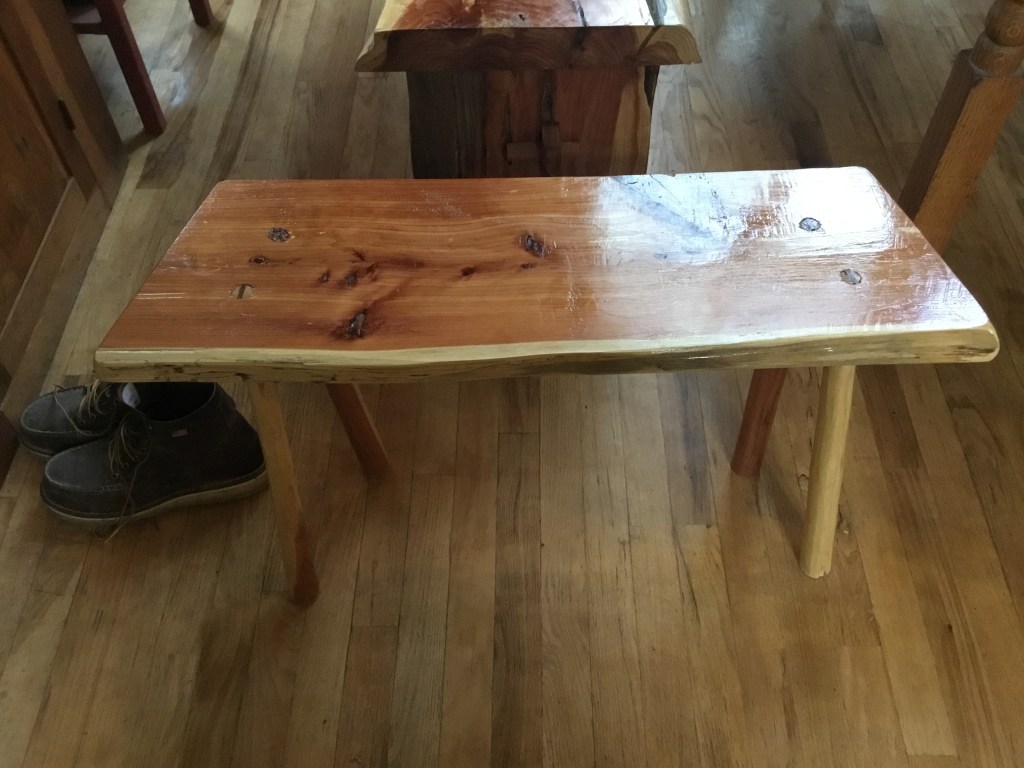
Leftover Cedar End Table

Table or Stool?

The giant stack of cedar we were given is essentially gone, with the remainder good for nothing but pegs, wedges, and fire starter, although the shavings make a superior smoked salmon flavoring, when thrown on the fire in the smokehouse–think Virginia juniper instead of red cedar, as the tree is technically a juniper instead of a cedar. This piece is a gift to the in-laws who gave us the truckload of lumber to begin with.

I actually made this to be a stool, but once possession changes hands, it is up to the discretion of the new owners, who have always been thinking end table. The legs are made in the same fashion as “stick” chairs, as in the very old style of Windsor chair known as “Welsh stick chairs.” The usual Welsh Windsor is normally made without stretchers between the legs, as opposed to an English style chair. The piece, chair or table, therefore is considerably lighter than one with stretchers.

I have also finished my Roman workbench, and a picture of it will help to explain where all that red cedar went.

Favorite Turning Tools, English Edition–Ashley Iles Tools for Foot Powered Lathes

Word for Today–Heaviosity

These may just look like two overgrown turning tools, and in fact, they are. The roughing gouge in the foreground–#6 sweep–is 1 1/2″–and the straight chisel is 2″. Their size is suited for their purpose, which is turning green wood on a treadle lathe, be it reciprocating, or continually spinning in one direction (“Treadle”-think foot powered version of the conventional electric lathe).

To my knowledge, Ashley Iles is the only major tool manufacturer to offer a complete set of turning tools for foot (human) powered lathes. I already had a set of four carbon steel turning tools, and these two, a couple of small spindle gouges, and some adapted straight chisels, rounded out the set. I bought both of these from across the pond, and the service offered by English tools sellers ranges from excellent to magnificent.

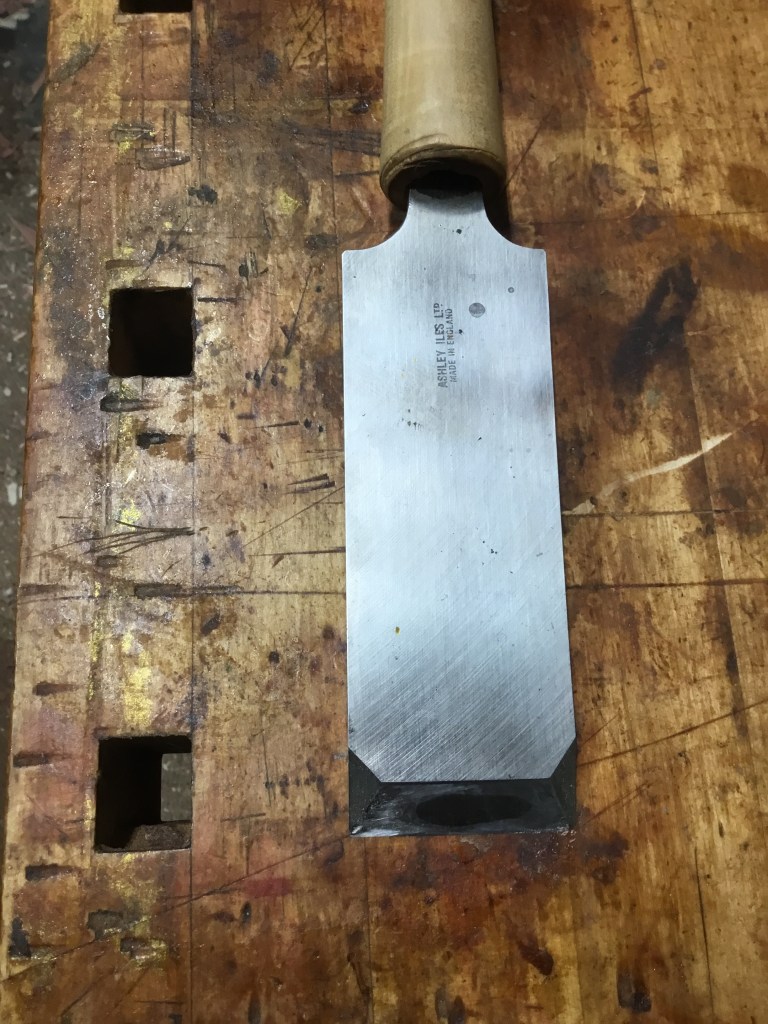
A Well Made Bevel

What distinguishes these tools from conventional turning tools? The bevels for one. The roughing chisel’s primary bevel is around 25 degrees, similar to a bench chisel. The edges of the bevel are ground into a triangle to keep the tool from snagging on the work as it turns. This is a cutting tool, not the typical turning scraper.

As is the shallow sweep roughing gouge. It has a similar bevel angle, and the size and sweep distinguish it from other similar gouges–my 1″ roughing gouge has a #11 sweep. I just purchased the shallow sweep one, and though the tools originally were available unhandled (my chisel has a rough and ready home made maple handle, which I scarfed out when the only turning chisel I had was a skew), this one arrived with a fine beech handle.

Finally, these tools are made from easily sharpened carbon tool steel. One reason is, that they need to be good and sharp, to avoid creating mostly sawdust. A extra bonus is that carbon steel is much less expensive than the usual high speed steel of high end turning tools.

The entire line of these tools are available from Classic Hand Tools in England. They can be purchased a la carte, or the entire set of six can be had for about $205. Several of these tools, including the shallow gouge, are unavailable in the States . Shipping is fast, and airmail is reasonable. In fact, my total for the gouge was less than it would have been for an equivalent tool here, if such a thing existed (the Iles deep roughing gouge, which is sold here, would be 5-10 dollars more if bought in the US). On top of that, no one knows how to package a tool like the Brits.

Maple Fry Fork

Maple and Walnut

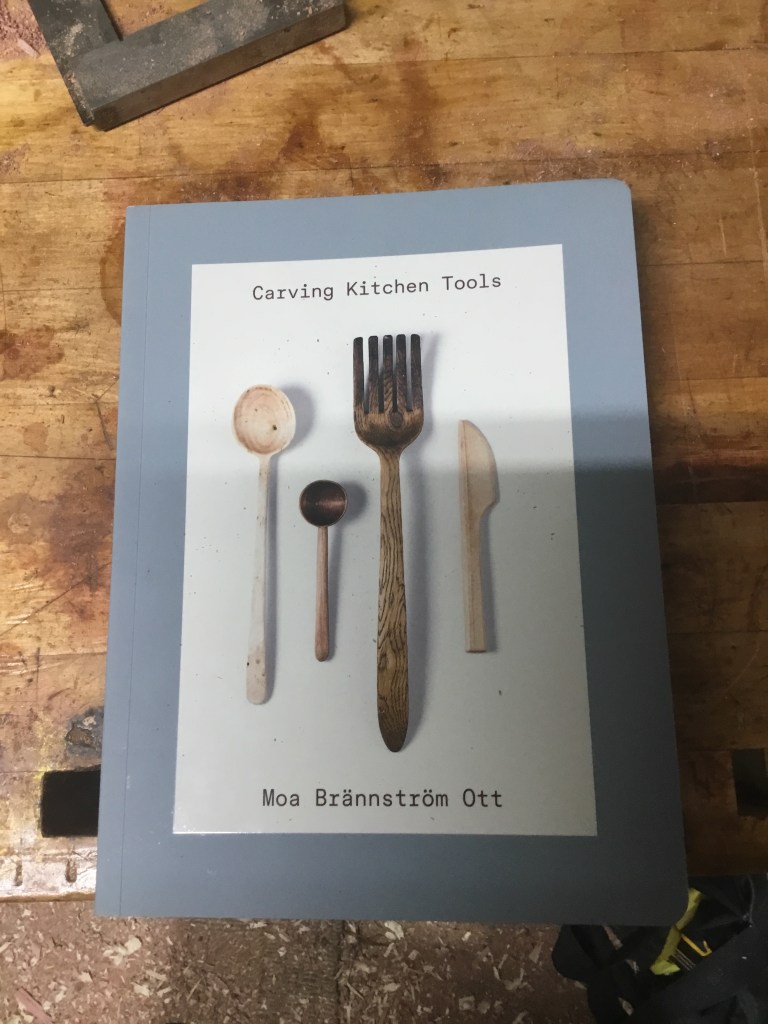
I wasn’t familiar with the Swedish term “fry fork” until this year (Google translate says that the Swedish is “stek gaffel,” for what that’s worth). I ran across it in the new English edition of Carving Kitchen Tools, by Moa Brännström Ott. I was so intrigued by this book that I made sure that it arrived on the first day of publication, 2/1/2022.

Spoons, Fry Fork, Butter Knife

I made my fry fork before I knew there was such a thing. It excels at flipping bacon, and most of all, making soft scrambled eggs. Here’s how to make them, from a French farmhouse, to the great writer Elizabeth David, who learned the technique there, to her student Jane Grigson. That’s how cooking works.

Soft Scrambled Eggs

Eggs (One per person)

Sea Salt

Olive oil

That’s it. The trick is in the cooking. I like carbon steel pans for this, as they heat up fast, and cool off quickly.

Give the eggs a thorough beating, and heat up the olive oil in the pan at high heat. As soon as the oil begins to spread out, starts moving around and forming thin layers at the point of the heated surface, and thicker layers elsewhere, turn the heat to the lowest possible setting, and take a break. When the oil has returned to an even surface, pour in the beaten eggs. Then do nothing.

What, no running around like in a cooking competition? This is more Zen than that. When the eggs begin to set, slowly separate and turn the curds to the desired size. Serve the eggs while they are still moist–no rubber eggs here.

The fry fork is just the tool for this dish. Carved from green Maple, I call mine the trident style for obvious reasons. If Neptune wants to banish me to ten years of roaming the eastern Mediterranean in an Odyssey, eating great seafood, kicking butt and taking names, and generally playing ancient Greek James Bond, I’m down with that-especially if I get to slaughter all the local scumbags, who are eating my food and drinking my wine, when I finally get back to my home city. No wonder that poem is still so popular.

OffGuardian

because facts really should be sacred

Ruth Blogs Here

Or not, depending on my mood

A Haven for Book Lovers

I am just a girl who loves reading and talking about books

what sandra thinks

because I've got to tell someone.

LadiesWhoLunchReviews,etc

a little lunch, a little wine, a LOT of talking!

Margaret and Helen

Best Friends for Sixty Years and Counting...

talltalesfromchiconia

Tales of quilting, gardening and cooking from the Kingdom of Chiconia

Cyranny's Cove

Refuge of an assumed danophile...

Exiled Rebels

Serving BL since 2017

this is... The Neighborhood

the Story within the Story

Beauty lies within yourself

The only impossible journey in life is you never begin!! ~Tanvir Kaur

Southern Fusion Cooking

Country Living in the Southern Appalachians, USA--A little of this, a lot of that

Discover WordPress

A daily selection of the best content published on WordPress, collected for you by humans who love to read.

The Atavist Magazine

Country Living in the Southern Appalachians, USA--A little of this, a lot of that

Longreads

Longreads : The best longform stories on the web

WordPress.com News

The latest news on WordPress.com and the WordPress community.