Favorite Woodworking Planes, Part 8 5/16–German Planes

Wood or metal? The debate about what to make planes out of has been around for over a couple of centuries. Like the Romans, my response is–both. I admit, however, that my favorites are these German wooden planes.

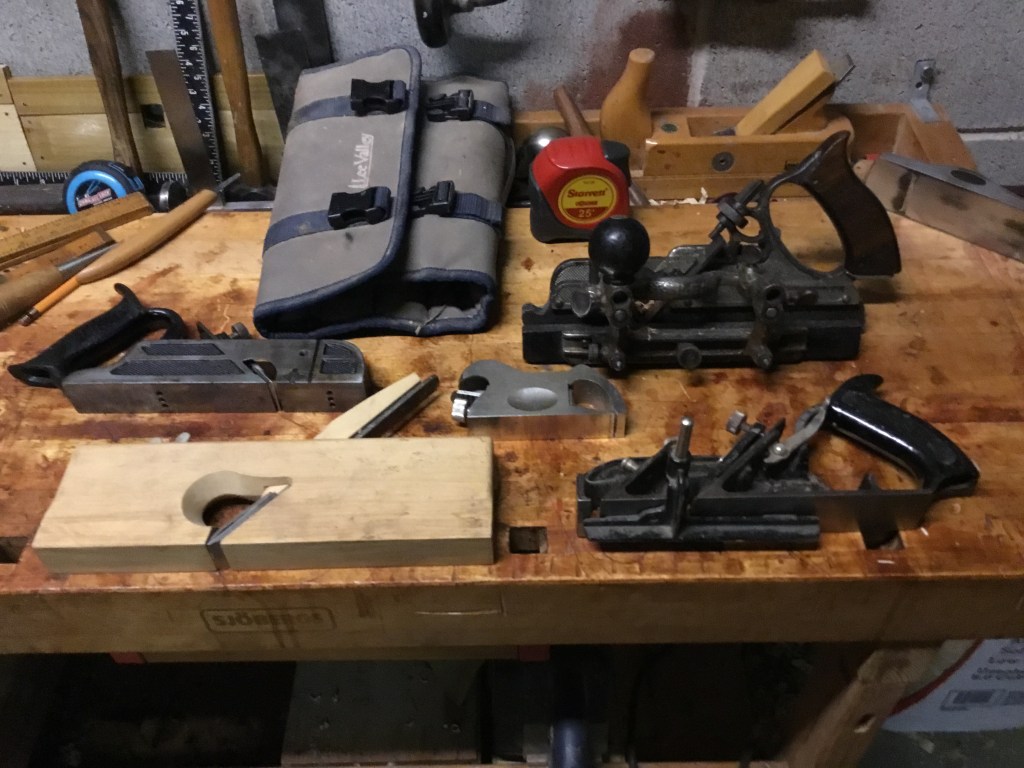
The first and the last are the best, so I will start at the bottom and work my way north. The block plane is an ECE plane, which has a fantastically good adjustment mechanism. The Lignum Vitae sole is not too shabby, either.

To the left and up may look like a smoothing plane, but it is actually a scrub plane. As I use mostly split or rough sawn wood, this plane is a necessity. I have used it more than all the rest combined. Ulmia brand.

The well used, well loved plane next to it is an Ulmia smoothing plane. It is the same length as the scrub plane, but is considerably wider. The order of use would be scrub-joiner-smoother.

The next to last row has specialty planes. The first is a very fine Ulmia rabbet plane. It doesn’t have a depth gauge, but the quality of the joints it cuts more than makes up for that. It also has an adjustable throat for finer work. Purchased at an antiques store for $10.

The match planes are ECE, and the grooving plane works fine. Something is wrong with the bevel angle on the tonguing plane, as it jams easily. I would fix that, but I have three other planes that will cut a tongue and groove joint.

The last plane on the top is the daddy of the bunch. That jointer is 24″ of solid beech, and built like an entire Panzer division. It will flatten anything, without also flattening you with its weight. Not something you want to meet in a dark alley.

I had ancestors in two different states in southern Germany. They should be thanked for bringing this kind of craftsmanship across the pond.

Favorite Woodworking Planes, Part 7 1/2–Reed Fillister Plane

I have been thinking about buying a Moving Fillister Plane for years., and had decided on buying a fancy new German one. Christopher Schwartz once wrote that old ones can by quite difficult to tune and could be difficult to get to work properly. This one was in good condition, and cost 20% of a new one. It was worth the risk.

The plane was cutting perfectly after about five minutes of sharpening. I’ve spent far more time than that getting new planes to work properly. And after I did a little research, I found that I had purchased a piece of American woodworking history.

The Reed Plane Company of Utica, New York was founded by four brothers from Wales, who came to the US in 1801. A fifth brother was a builder who constructed most of the warehouses along the Erie Canal. All this info comes from the EARLY AMERICAN INDUSTRIES ASSOCIATION.

Depending on the source, the brothers began making planes in their kitchen in 1820 or 1826. They are believed to be the first commercial plane makers in New York, and one of the first in the US. Note: Apple, Google, and Microsoft were either started, or worked out of, garages. At least Amazon was started in a rented house.

The Reed brothers eventually built a twenty square foot workshop, which contained a big one horsepower grindstone for sharpening plane blades. The horsepower was supplied by one horse.

They eventually built a much larger shop, staffed by the brothers, and various journeymen and apprentices. Apprentices at this time often had to pay to learn such a skilled trade, which amounted to a tuition of a sort–the early version of a technical college.

Back to this plane. The business edge is boxed, which means it is reinforced with Boxwood. There is a slight chip in the Boxwood right at the throat, but that has had no effect on its cutting ability. As the company ceased production in 1894, this plane is solidly nineteenth century. This is only a guess, but I say it’s 130 to 160 years old.

Now for a little outrageous behavior. How do you clean a plane that old? My go to cleaner, which many hate, is WD-40. It cleans the wood, and provides it with temporary water resistance. WD in the name means water displacement, and this is formula number 40.

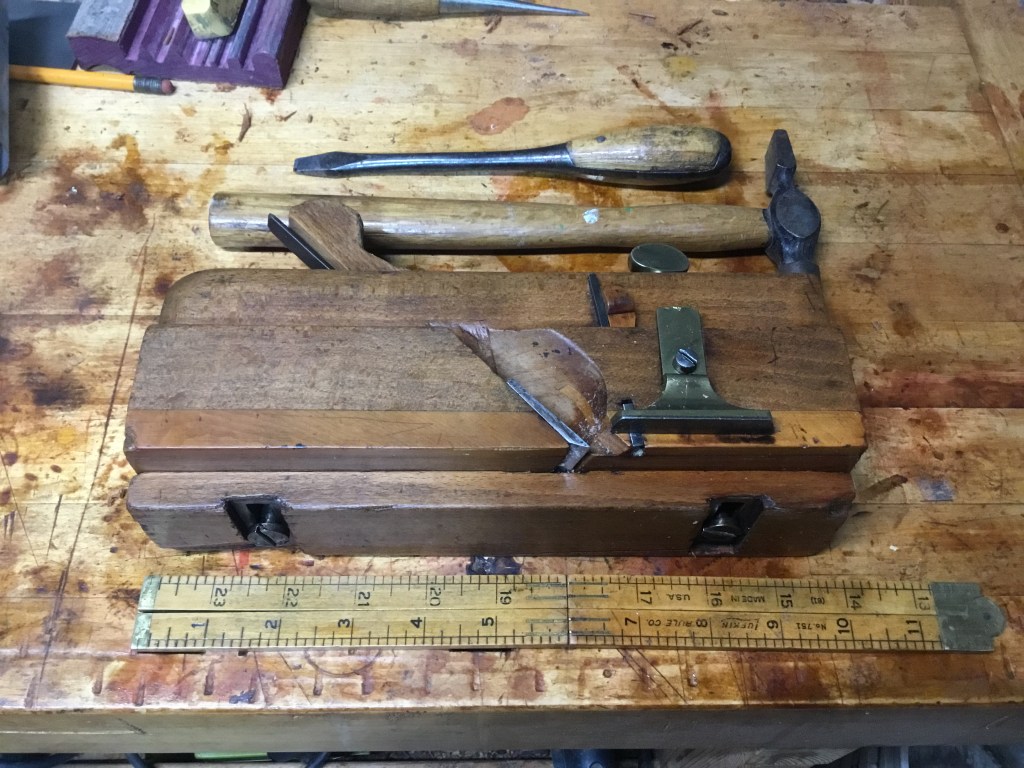
Some necessary tools to use a plane like this.

The cross peen hammer is an all around useful carpenter’s hammer, and just the right size for adjusting the depth of the cut. The screwdriver is beefy enough to deal with the giant screws that hold the fence in location. It could also be used as a defensive weapon, if things come to that. They never do.

Refurb of Cherry JK Adams Cutting Board

Chop Away

Melanie had a very bad case of cutting board envy, as I tend to hog up our huge Adams maple cutting board. Thus I was dispatched to find her a board of her own. The one we wanted from Thailand turned out to be from the “not available” category. Thus I was instructed to look on fleabay.

This Adams end grain cherry cutting board was available for less the twenty dollars. It did have a small crack on one side, but I have plenty of heavy duty clamps. It also needed to be refinished, as it appeared that it had never been oiled even once.

Some glue and a big Jorgensen bar clamp solved the crack problem, and the hairline crack that remained was filled up with sander dust, which is an old repair person’s trick. Now a positive word about sanders.

I rarely use sanders, but having fallen ill with the dreaded Gearhead Syndrome, I bought three anyway. The two random orbit sanders are a small Ryobi one, and a massive Bosch one. The beast of a belt sander I have is a now legendary Swiss made Bosch one. After two decades of work, it still runs perfectly.

This was a perfect job for the little Ryobi. I started with fine discs, then finished with a 320 grit disc. A few coats of food grade Danish oil, which is polymerized linseed oil, and it’s ready for decades of cutting .

Outdoor Kitchen, Old School, Part One–A Brick Oven, and a Curtain of Green

Ms. Eudora Welty came up with the Curtain Line

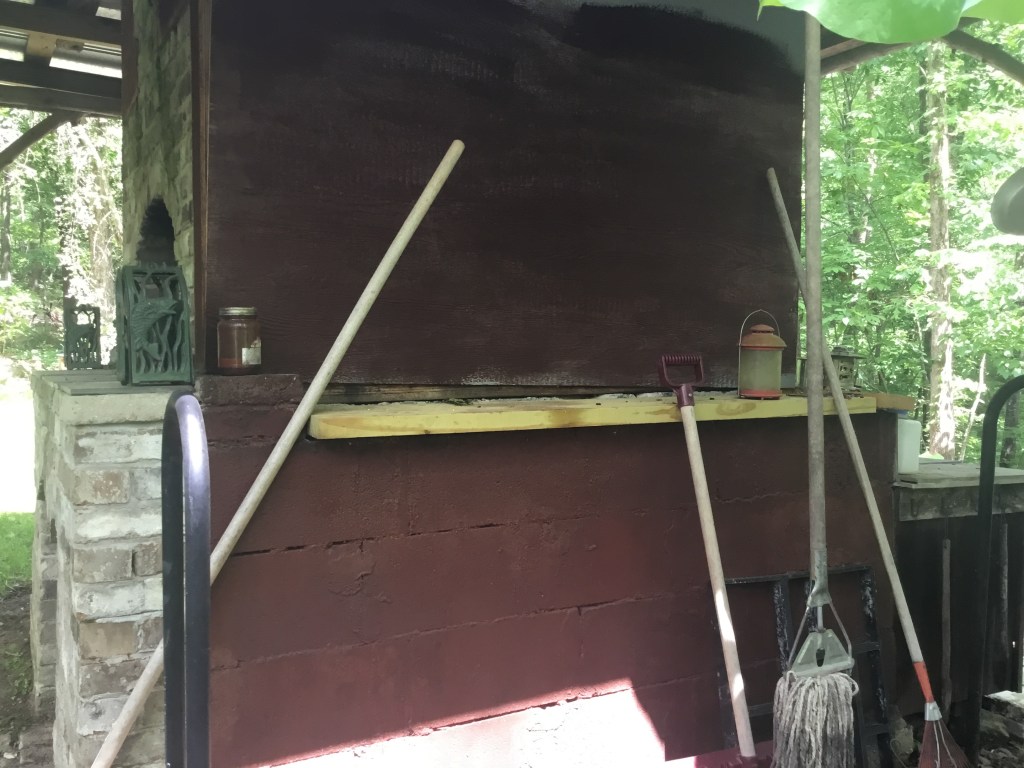
No stainless steel grills here, just bricks, camp stoves, and the end of an old propane tank, made into a fire pit. Welcome to old school, part one.

Our primary fuel is wood, mostly dead fall from our 5.5 acres of forest. The brick oven can take a couple of logs at once. It makes one mean pizza, or two. I need to get back into baking big loaves of sourdough bread.

Twenty two years and a few more days later, I am ready to do the trim work on this multi ton beast. Here’s the side view.

Egg Tempera Paint

That’s homemade paint, that came out very well. The siding was made a few miles from here. I have to buy some wood for the trim. Now for the back, which will be the center, or workplace, for the rustic kitchen.

Hobo Kitchen

Four more fuels available here, which I will get into later. The camp stoves burn alcohol, kerosene, and white gas. The blackish paint is flour paint. The wood grill on the right is my riff on a Tuscan style outdoor grill. The whole thing is as rustic as can be. I might even finish it one day.

A Curtain of Green is a great book by Ms. Welty, and the title of an equally great short story. It’s what happens here in this part of the South in the spring–the forest becomes so thick that a person cannot see through it. A great metaphor is forever.

Wood Scrapers, Part Two–Barely Scraping By

Boo on Sandpaper

An entire set of curved scrapers costs the same or less than a box of sandpaper. The difference is that the scraper can last for years, or even decades, and doesn’t fill up your lungs with carcinogenic sander dust. Though the above curved scrapers are identical in appearance, they are of two thicknesses. The .04mm ones are for fine scraping, and the .06 are for more heavy duty work.

At the top right is the famous Bahco/Sandvick scraper. Comes ready to work, and can be used without burnishing. It’s thick for a scraper, at .08mm.

The scraper bring grabbed by the old Stanley #82 is a mystery, as the calipers say it is more than 0.1mm thick. It’s as stiff as a plane bade, and has prepared, aka beveled edges, on two ends, German style. it will make some serious shavings.

A typical burnishing setup includes a vise, and a metal working one is best. An absolute must is a good file, and sharpening stone. A carbide burnisher makes things much easier, and I have a great one that was made by Lee Valley Tools in Canada.

Scrape away. Your lungs will thank you.

Edgy Bulgarians Strike Again

Bowl Time, and not of the Football Variety

I never knew much about Bulgaria until I bought these two Bulgarian made curved adzes. The country has a fascinating history, as they were ruled by the Romans, the Byzantines, the Ottomans, and the Russians, in that order. The architecture in the capitol Sofia is mind blowing–think Unesco World Heritage Site quality. I know this because I am a card carrying member of Nerdlandia–I have two plastic coated UA degrees in my wallet.

The Bulgarians are especially known for smithing work, as far back as the thirteenth century. They haven’t slowed down any, as those two adzes prove. The big adze is a triple threat, as it works as an adze, a hammer, and a nail puller. It must be a common tool, as it was factory made. It is a wood butcher’s delight.

Mini-me on the right is blacksmith made. This needed a special handle, so I made one out of walnut. The smith who made this is a Mensch.

By contrast, there is also a spoon knife made by Hans Karlsson in Sweden. It cost more than the two adzes combined. Worth the money, as probably the finest spoon carving tool in the world. I just wish he had been born in Bulgaria.

Favorite Woodworking Tools, Part Who Knows?–Spokeshaves

All Metal

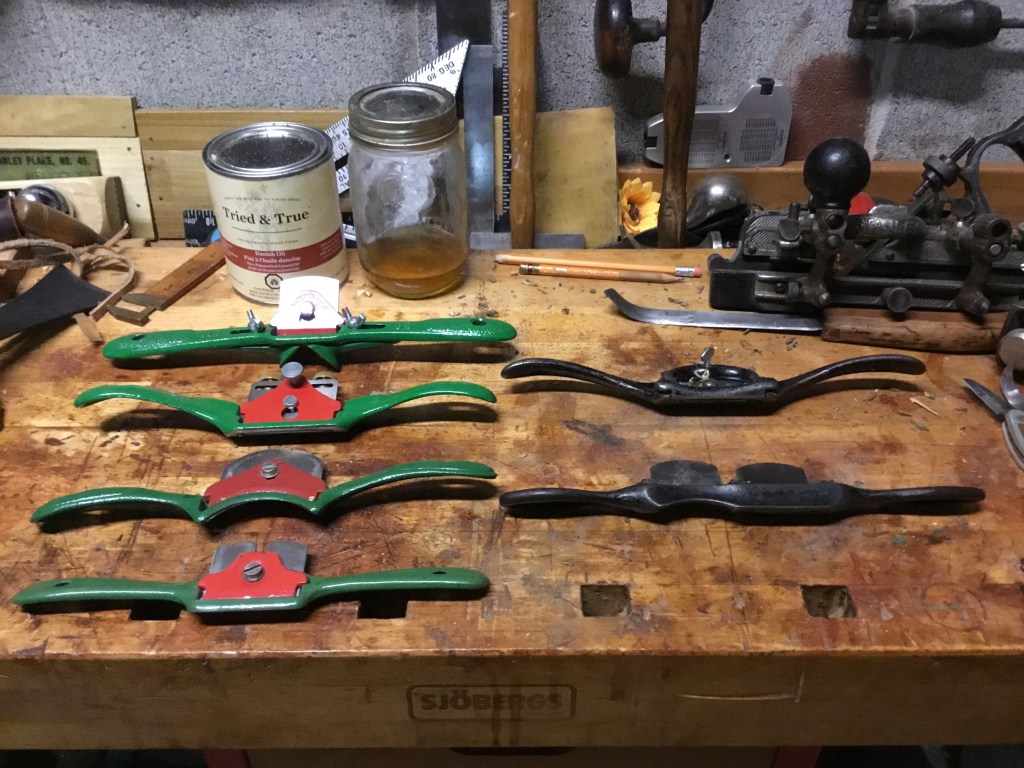
US vs Germany again, but in this case it is all good. The two old guys on the right are Stanley, while “die grünen” or the greens, on the left are Kunz. They all required a little tune up to work properly, but they are cutting machines now.

The double cutter spokeshave is the old Stanley Number 60, which has a concave and flat sole. It can be fiddly to adjust, but cuts fine. The top one is my favorite, the flat sole Number 54 Adjustable Mouth Spokeshave. It will cut shavings that are from thick to see through, and I paid a whopping two bucks for it.

The bottom two on the left are all-arounders. The small is the Kunz Light Flat Spokeshave, which means it has a flat sole. It’s great for spoon work. The obviously concave shave makes anything from spoon and spatula handles, to chair rungs and legs.

The top two are more specialized. The second from the top is the round spokeshave number 151R, a near exact copy of the same models made by Stanley and Record. The most specialized, the Number 65, also has a round sole, but is designed to make chamfers–hence the two adjustable fences. I’ve only had it for a couple of months, but it looks very promising.

The tune up is simple, get the blades as sharp as possible, and file flat the beds that they sit on. After that, learning to use them is the same way you get to Carnegie Hall–practice, practice.

A Stropping Lad

No Pun Left Behind

Here we have two strops, one retail and one home made. The older I get, the more of a stropping lad I become.

The strop for carving tools on the left is still available from the excellent Flexcut tool company. It also comes with some super fancy stropping compound, and will eliminate the need for sharpening with a micro-abrasive, if used regularly. The back side has a flat surface covered in cork, and a wide curved groove to sharpen the backs of gouges. All around groovy!

The old school large strop is home made from scrap leather and scrap wood, and yes, have a scrap leather pile to go along with my scrap lumber pile. I just glued the leather on with Gorilla glue, and clamped it down with two large wooden Jorgenson clamps. The stropping compound is not as fine as the Flexcut compound, but it gets the job done. Great for everything from plane blades to kitchen knives. It results in a scary sharp edge.

Contrary to myth, a sharp edge is much safer than a dull one. And if you do cut yourself, it leaves a neater wound. The two walking staffs in the background were made by our local friendly beavers, who thoughtfully cut them exactly to the right length. The top one appears to be River Birch, and the bottom one with bright green bark is something I have never seen before. It must taste like yuck, because the beaver stopped gnawing on it about one-fourth of the way down. Which makes me wonder–do beavers strop their teeth?

First Low Workbench

Old Sawing Bench gets New Life

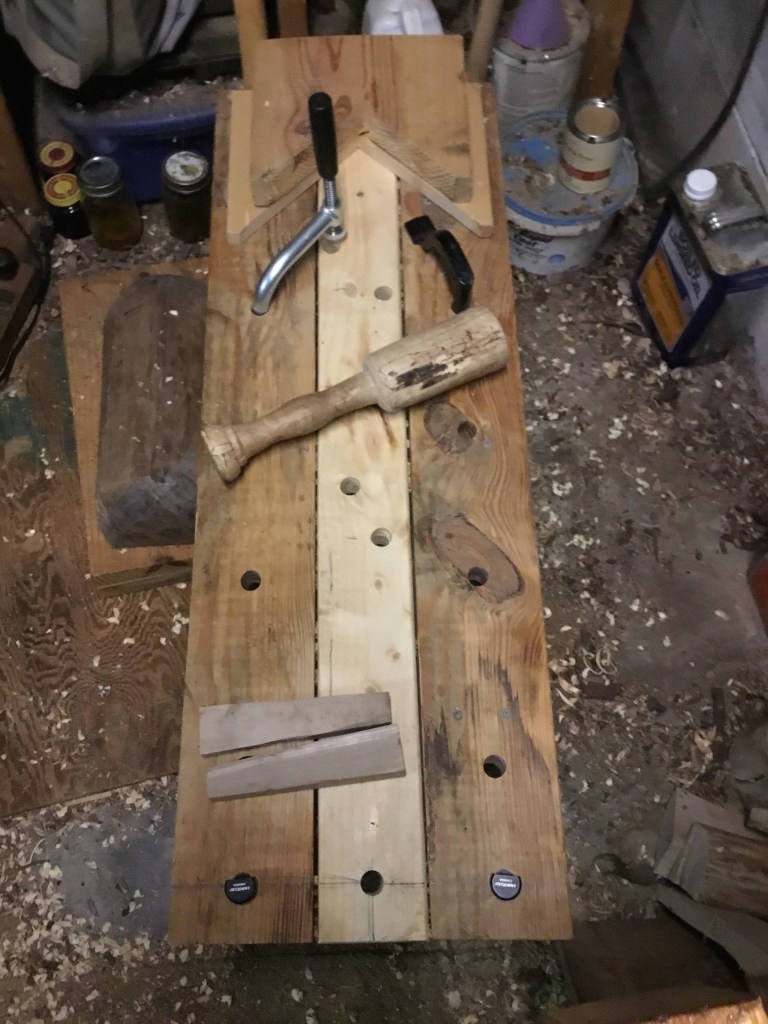
This is my first effort at making a Roman style low bench, and it turned out great. It is a bit short in both height and length, but it will do until I get two more made. More on those plans later.

This was an old sawing bench made from scrap. All I did was add a 2×4, and drill some extra holes in the bench. The bench will still function as a sawing bench, but it is now a real multi tasker.

The V joint boards on the end are called “Doe’s Foots,” and are used as a planing stop. They allow you to plane a board in any direction, all while sitting down. They can be used with bench dogs, the little metal things on the bottom of the picture, or either of the two mechanical holders, which are a holdfast and a hold down.

The holdfast, which is the iron one, is an old Jorgensen. The mallet is used to whack it into place. The hold down, which is the one with the screw down end, is a Sjobergs, designed by the Swedish workbench company. I have one of their Swedish made benches, but this clever item was made in Taiwan, the source for many great bicycle parts (Along with Japan, Italy, and Switzerland. And don’t leave out Wald in Kentucky, which makes the best bike baskets.)

The spacing of the holes in the center is based on the Roman bench that was recreated by Christopher Schwarz. That allows this to be used as an edge planing bench as well, with some dowels, and those hornbeam wedges as holding devices.

I’ll make a proper bench eventually, but I have plans to make a PT wood outdoor bench first, which will live outside, and double as a garden bench. This is a real multi tasking idea.

Woodworking Planes Part ??–Rabbet Planes

“Them Lallys, You Want Them Rabbeted, or No?”–Mr. Blandings Builds His Dream House

This motley crew of planes are from three countries on two continents, and made by three companies. I’ll start with the bottom column and proceed from there.

Bottom left is the finest of the crew, an Ulmia Ott plane made in Germany. It also has an adjustable throat, so it will take as fine a shaving as you need. Typical German quality.

Speaking of US quality, the one to the right is a fine Millers Falls #85 plane. It is missing a depth gauge, but I have another plane that has one. This thing could last for many more decades.

The shiny silver guy in the middle is technically a shoulder plane, a Stanley #90 that was made in England. Another quality piece of work, designed to do fine woodworking. Too bad I don’t do any.

Top left is a really old Stanley 191 plane. It also has lost the depth gauge, but things like that happens. These came in various sizes, and are all over fleabay, though seriously overpriced.

The mack daddy at the top right is a Stanley #45, that can cut just about any sized rabbet. The catch is, you have to have the right sized cutter. However, it has TWO depth gauges. Doesn’t do the finest work, but gets the job done.

A rabbet is not a thing with floppy ears, but a groove cut to make furniture/woodwork fit better. It’s a groovy thing.

OffGuardian

because facts really should be sacred

Ruth Blogs Here

Or not, depending on my mood

A Haven for Book Lovers

I am just a girl who loves reading and talking about books

what sandra thinks

because I've got to tell someone.

LadiesWhoLunchReviews,etc

a little lunch, a little wine, a LOT of talking!

Margaret and Helen

Best Friends for Sixty Years and Counting...

talltalesfromchiconia

Tales of quilting, gardening and cooking from the Kingdom of Chiconia

Cyranny's Cove

Refuge of an assumed danophile...

Exiled Rebels

Serving BL since 2017

this is... The Neighborhood

the Story within the Story

Beauty lies within yourself

The only impossible journey in life is you never begin!! ~Tanvir Kaur

Southern Fusion Cooking

Country Living in the Southern Appalachians, USA--A little of this, a lot of that

Discover WordPress

A daily selection of the best content published on WordPress, collected for you by humans who love to read.

The Atavist Magazine

Country Living in the Southern Appalachians, USA--A little of this, a lot of that

Longreads

Longreads : The best longform stories on the web

WordPress.com News

The latest news on WordPress.com and the WordPress community.