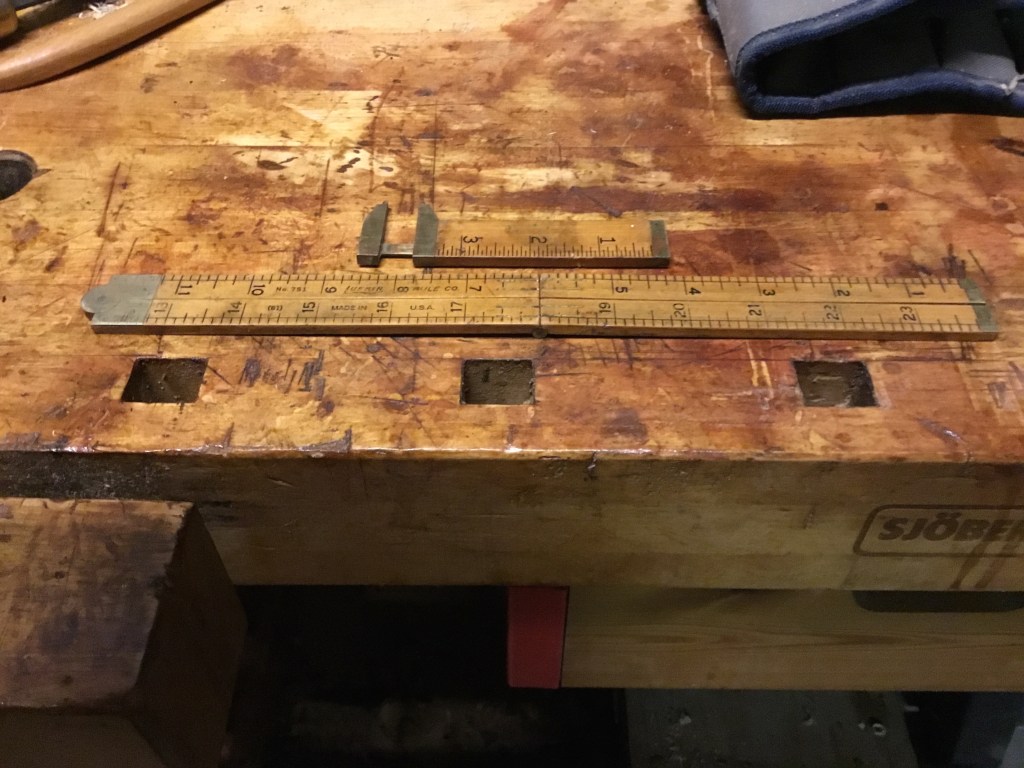
Alas, these are no longer made in this country, but fleabay is full of them. These are some seriously classy measuring tools, made of boxwood and brass.
The folding rule is Lufkin, and extends to two feet. That is my go to measurer.
The smaller caliper is four inches, made by Stanley. It’s perfect for my foot powered lathe. Too bad Stanley dumped products like this for cheap screwdrivers.
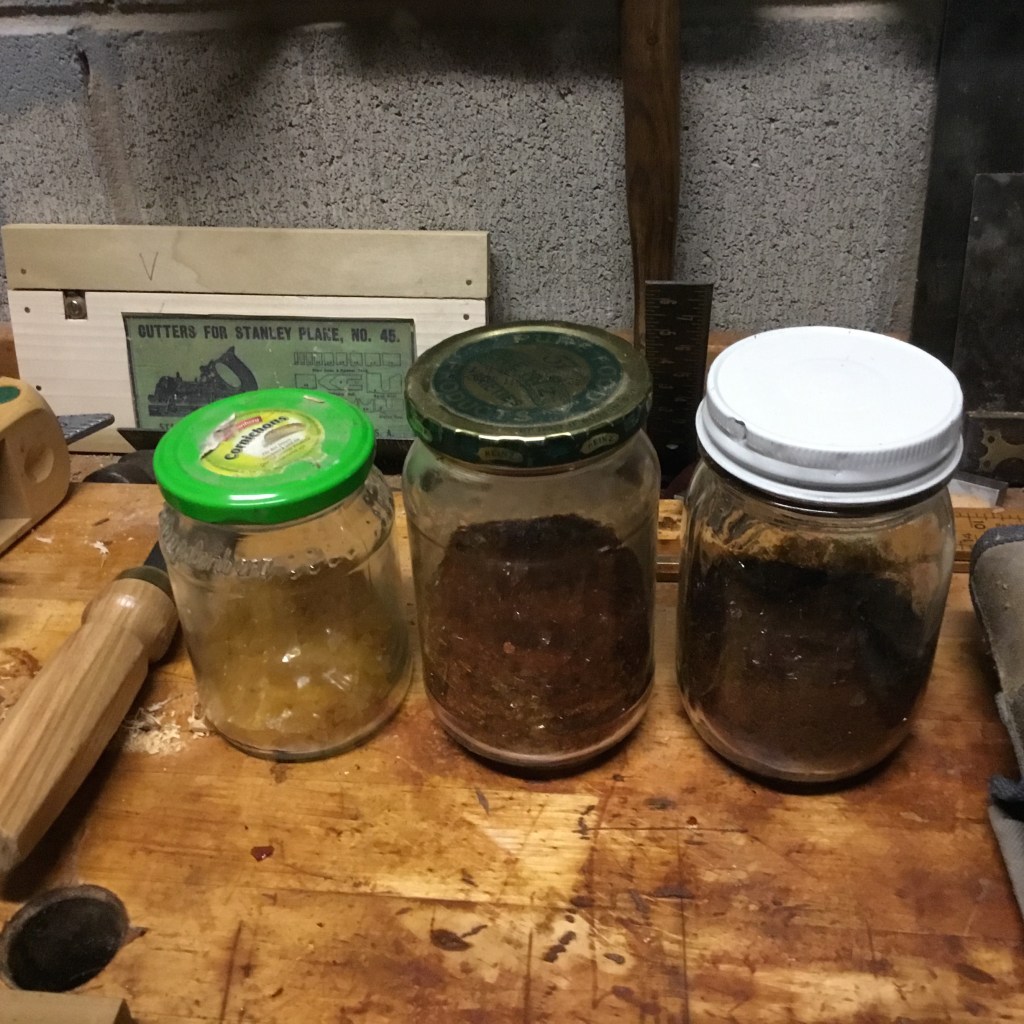
Shellac Flakes. Don’t say Beetle Juice Three Times in a Row.
Most people don’t know that they eat one of the main ingredients in one of the best wood finishes regularly, and that it comes from a bug, but that doesn’t bother me that much. Like my man HD Thoreau, “Yet, for my part, I was never usually squeamish; I could sometimes eat a fried rat with a good relish, if it were necessary.” It all depends on how good the relish is.
The wood finish I am referring to is shellac, which is essentially the secretions of the Asian Lac beetle, dissolved in denatured alcohol. There are a thousand recipes for proportions to be used, and I would refer you to Shellac.com. They also list eight main colors of shellac flakes, though most of those shades can be made with just these three.
People who eat sweets are the main ones who are likely to be eating beetle juice. US manufacturers of sweets use all manner of euphemisms for bug juice, such as confectioner’s glaze or candy glaze. It’s really bug juice, but people like to eat things that are bright and shiny. Why, I don’t know.
Also check for Natural Red #4 on the ingredient list. That’s squashed Cochineal bugs, which get the red color from cactus. The Aztecs used them for red dye.
Bugs. It’s what’s for dinner. And the dinner table.
I attended the New College at the University of Alabama before I became decidedly Old School. In our Humanities seminar, we did things like break boards with our bare hands, and rappelled down a bluff on the Warrior River. As the only former High School ath-a-leete in the class (three sports), I was put on “belay,” so I had to hold the rope at the bottom of the bluff, and was responsible for everyones’ safety. One young sorority woman showed up to the rappelling exercise wearing a very short skirt. She slipped, flipped upside down at the top of the bluff, and showed everyone a nice pair of legs. Despite the distraction, I got her down with no visible harm.
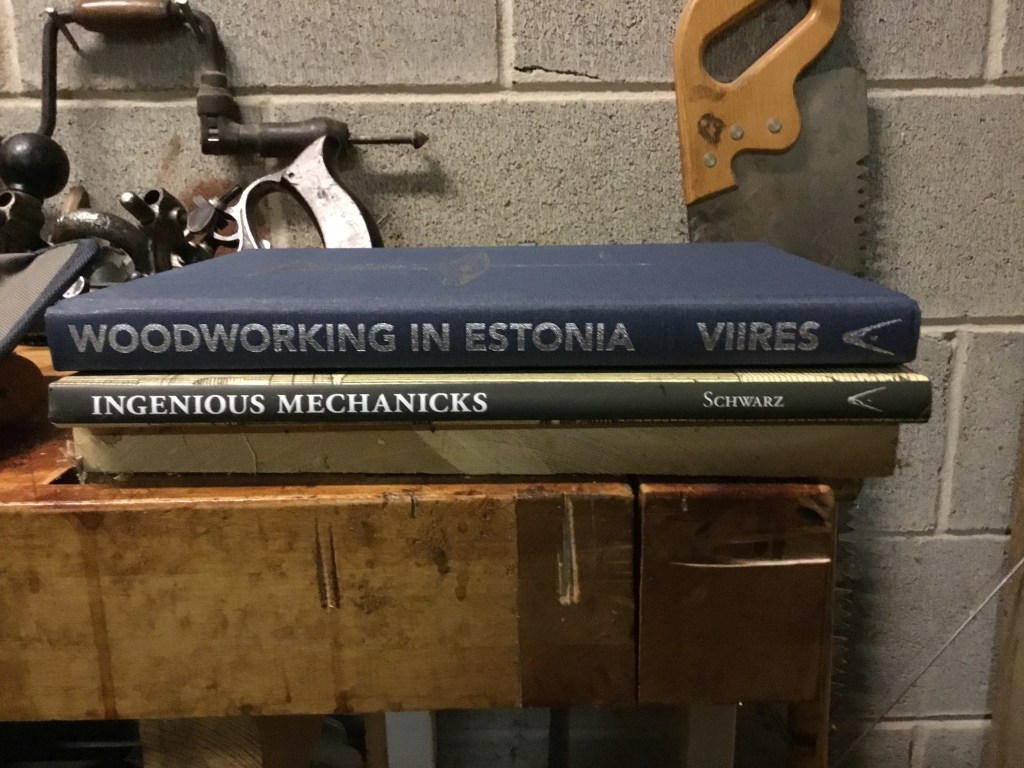
To ahh, elevate the conversation, I declare that Lost Art Press, which published these two tomes, is a national treasure. Based in the South (Kentucky), they edit, typeset, and publish everything in the US. And these are some quality hardback books.
Their first famous book was actually written by an Estonian scholar named Ants Viires, and the full title is Woodworking in Estonia: Historical Survey. The strange and literally bizarre story of it’s translation and dissemination alone are worth the price of the book. The key players were the USSR, Israel, the USA, and the Soviet Socialist Republic of Estonia. Just another day when I wished I could make stuff like this up.
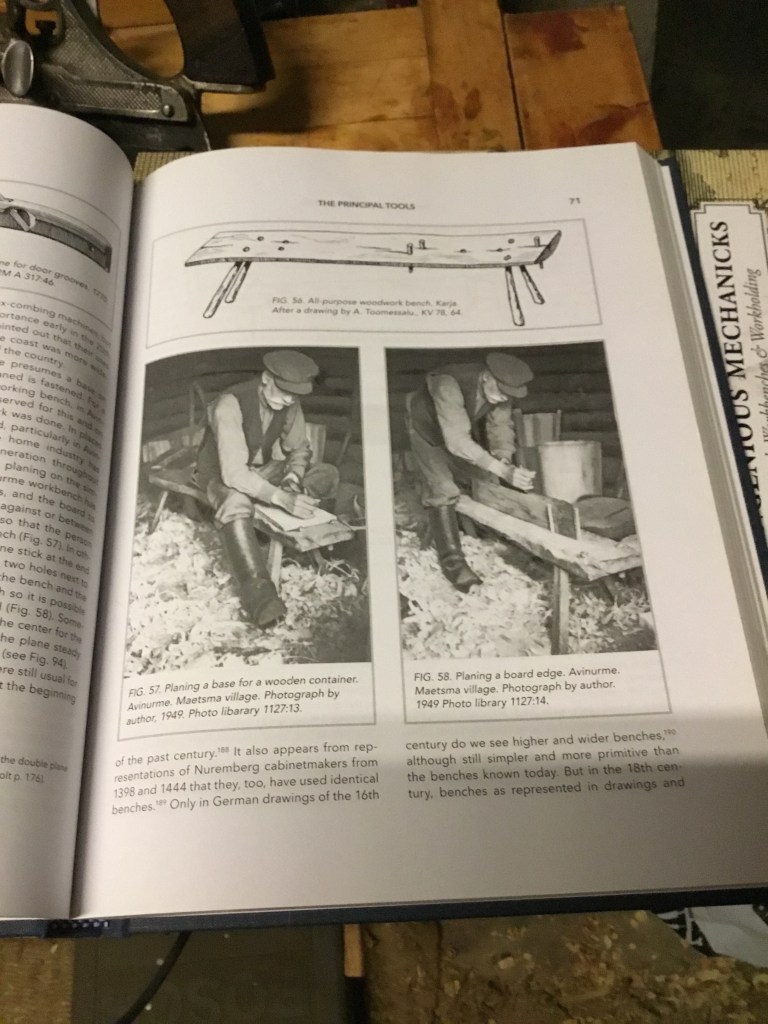
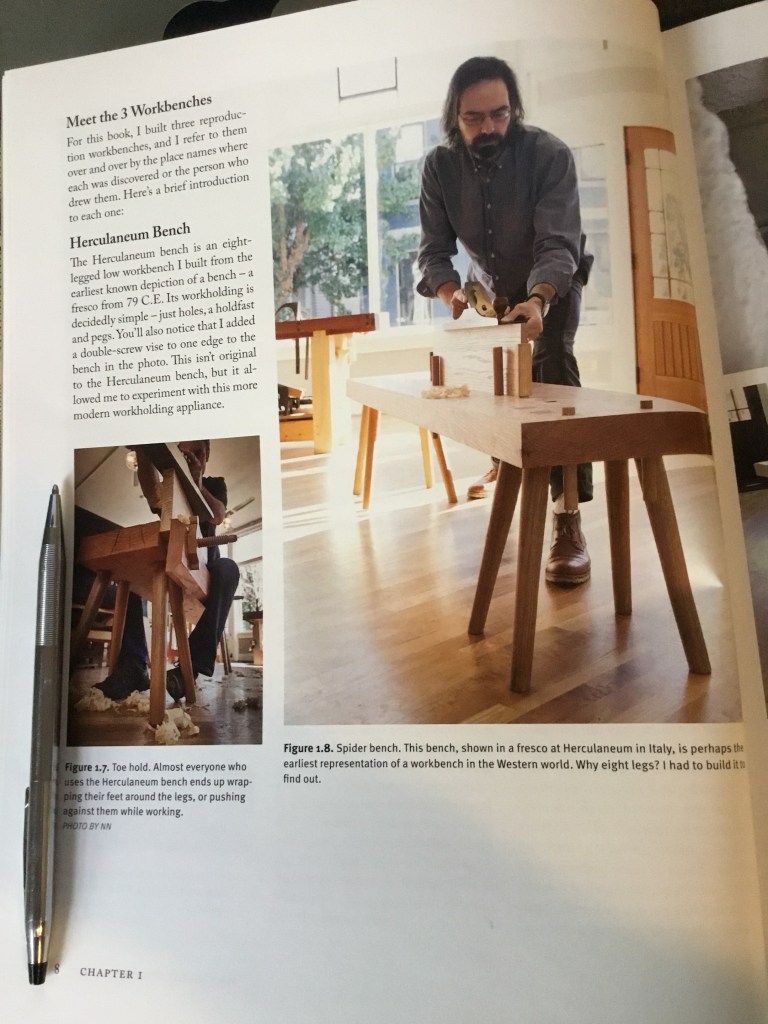
The book itself is thorough, readable, and best of all, it has pictures. Therefore I don’t have to do things like visualize how you can hand plane a board on a bench without a vise.
I Swear that’s not Me in the Picture. He’s planing Left Handed!
The publisher of this book, and co-founder of Lost Art, Christopher Schwartz, was obviously inspired by this classic. Here’s the cover of an equally fine book that Schwartz wrote.
Now We’re Talking really Old School
I’m making projects out of this book I got for Christmas like crazy. I’ll write about those later, but I see three more workbenches in my future. Schwartz, and his researcher Suzanne Ellison, go all the way back to Imperial Rome, and the oldest known workbench illustrations. Strangely enough, those benches work as well, or better, than modern ones. This design comes from a fresco from Herculaneum, buried in AD 79 by the explosion of Mt. Vesuvius.
Legs Again. Get your Mind off of Legs.
I will be forced to make one of these eight legged benches. Hopefully our local sawmill hasn’t closed yet. I’ll need a good sized slab of wood.
After the Stanley company turned into a seller of screwdrivers and hinges, I soured on US made woodworking tools. There were fantastic tools being made here, but they cost as much as a car payment. As I always had a car payment already, I turned to German and Swedish tools, as well as the occasional English one (Oops, I forgot about the spectacular quality of Canadian tools, and the value of Eastern European ones).
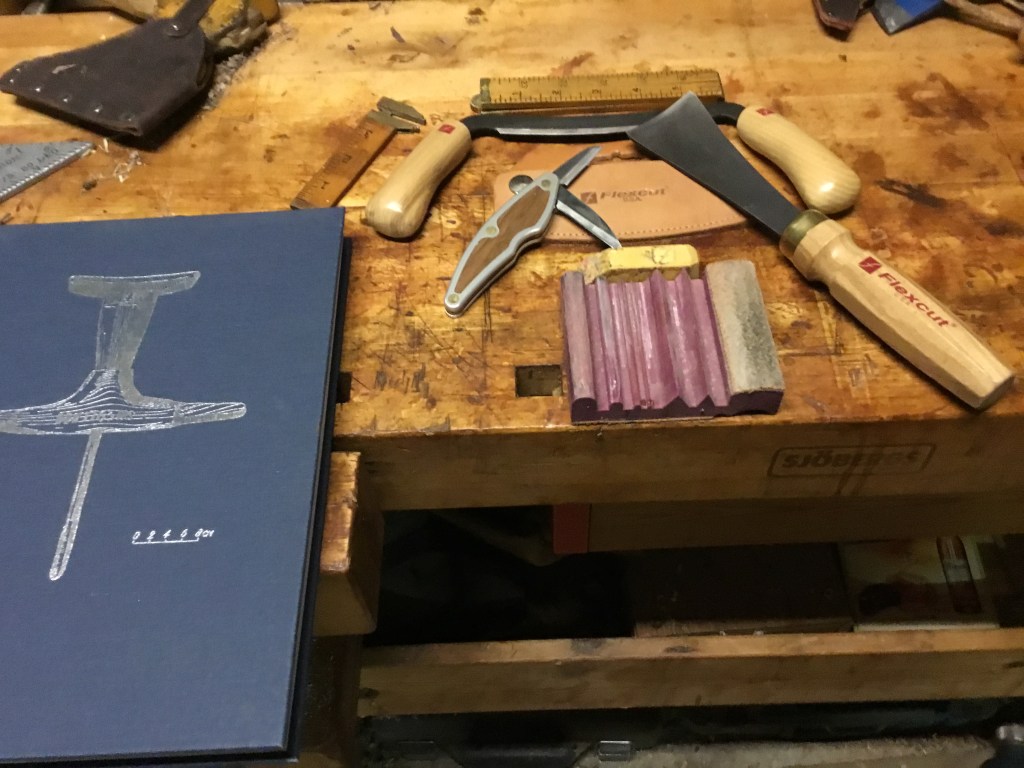
Then I ran across the smaller manufacturers like Gramercy and Flexcut. Flexcut blew me away with quality and value combined. I already had the carving tools sharpener (superb), when MJ surprised me with the gift of the folding carving knife, after I was commissioned to carve a spoon for the book A Gathering of Spoons. Wow. It was love at first cut.
Then last summer rolls around, and I have a large walnut bowl to carve (it still isn’t finished.) If I had not found the 2″ Flexcut gouge on the Highland Woodworking website, it probably never would have made it to the stage where it is now. And I had intended to mortgage the house and buy a Swedish gouge made by Hans Karlsson. Now I have a gouge and a house.
At any rate, I also have a re-vamped carving bench. More on that later.
The mooching lifestyle is far more under appreciated in the US than it should be. A person could practically live off of discarded items, and I am certain that many people actually do. There’s no tax on throw aways, either.
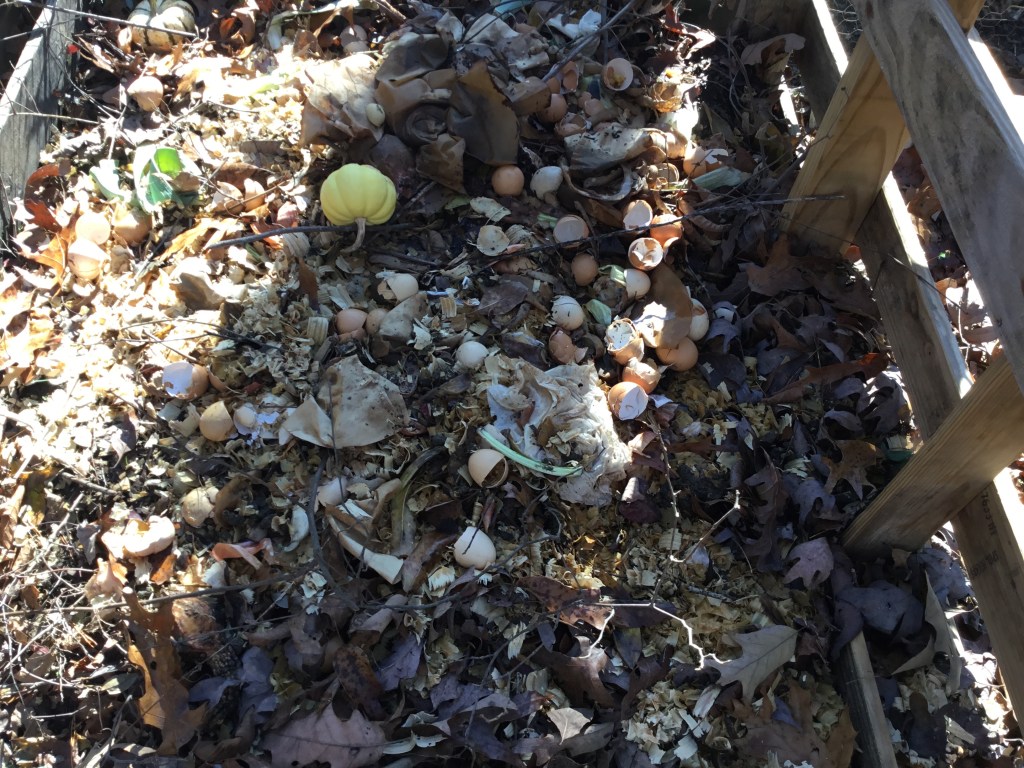
I am only a part time moocher, but I have dumpster dived and mooched in numerous locales. I pulled a fancy desk chair out of a dumpster, worth several hundred dollars, and then spend my time at the computer sitting in an old post and rung oak chair, that I mooched for $5 at a flea market. My latest mooch could prove to be my best: a flat bed truck full of cinder blocks, and the wood pallets this compost bin are made of.
The story is this. We have been have been showering the in-laws with free eggs, and one couple had just had a retaining wall replaced, and needed to get rid of the left over and used cinder blocks, more commonly known in these parts as “see-mint blocks” (cement blocks.) As my mooching has become a valuable reputation enhancer, they offered us the blocks, and with free delivery. We countered with an offer of thirty eggs. It was a deal.
The sweetener was that the blocks are to used in the construction of a smokehouse, and we offered free use of that as well, once it is completed. The blocks arrived quickly after that offer. I helped unload them, and they had been sitting on two pine pallets on the truck. My brother in law asked if I wanted them. He didn’t know I been looking to mooch two wooden pallets as well.
Three deck screws later, and I had a new compost bin, attached to the back of the chicken run. It is now being filled with table scraps, leaves, and chicken manure in various states of decomposition. It will be half full in no time.
Free Fertilizer
Next spring we will have mooched fertilizer as well. Which reminds me that it is almost time to grab a shovel, and get to work.
We have here four restored Disston saws, which are book-ended by a Keen Kutter and a no-name dovetail saw. I bought these back in the days when almost literally no one wanted a hand saw. There really is no end to dipsticks.
Let’s go right to left, Chinese style, as usual.
Dovetail Saw
The little guy at the top has no name on it, but it has incredibly small TPI (tooth per inch). They are so small, in fact, that I had to buy an equally vintage saw set just to sharpen the thing, and set the teeth. It’s a fine saw.
Disston D4 Backsaw
Now we get to the bosses. This is a fine tool, made to work for decades. It has to be my go to backsaw.
Disston Miter Saw
No number on this one, and the miter box disappeared decades ago. I need to make a new miter box, and put this back to work. Miter box project number would be 1,498
Disston D8 Rip Saw
Bad news, 1x lumber. I have forsaken my circular saw for this relic. There is no refuge. I may have to go for even bigger game.
Disston D28 Lightweight Cross Cut Saw
A fairly recent, somewhat lower quality saw. With that said, the steel blade is just as good as the older saws. I may swap out the steel nuts on the handle with some older brass ones.
Keen Kutter Cross Cut Saw
When you see a saw priced at $1, buy it. This one was in miserable condition, but it was something of a size I had never seen before. Kid’s Saw? Who knows, except for some Keen Kutter collector. Actually cleaned up far better than I expected.
People who don’t know me think I am well organized (MJ’s boss even asked me how I stay so organized.) BwahHaHaHaHa. Here’s what my workbench usually looks like.
There’s a Bench there Somewhere
Four projects at once, and the turned piece is a Salt Grinder (seriously).
However, what is a workbench without a champagne cork on it?
I have lost track of how many posts I have written about planes, so I am just going by category now. What we have here are five very nice smoothers. Right to left again, Chinese style.
The best is the little Bailey type Stanley #3, BECAUSE it has been upgraded with one of those Lee Valley O1 steel blades. It will leave things seriously smooth. I actually bartered for this with a tool seller at a flea market in Atlanta. Price: one Rosewood knob from a Stanley #45.
The Millers Falls plane is the size of a Stanley #4, but in their numbering system it is a #9c (corrugated sole). Great workmanship, and actually came with a high quality blade, which I also use on my Stanley #5.
The two wood/metal “transitional” planes are a Stanley #35 and a #24. The #35 was my go to plane for years, before I bought the two Bailey types. I love the size of the #24, but I have to resole it. Someday.
Last is a classic German Ulmia Ott plane. Someone in the distant past had the genius idea of resoling this with some really hard linoleum. It will last until the cows come home.
Millers Falls planes are a bargain on the interwebs, and their quality is arguably superior to the Stanley planes. But if you want the best, take my usual advice–buy German.
Being buried under an avalanche of around forty eggs from our chickens requires some improvisation. That’s when I remembered that one of the old Italian masters, Botticelli, used an egg based paint. Botticelli was actually a nickname meaning “Little Barrel,” which indicates that he was quite rotund.
There are a thousand recipes for tempera paint, but I adapted this one from The Natural Paint Book, which is a great work. Here’s my version:
Three Eggs
One Cup Boiled Linseed Oil (for exterior paint. Use better oil for an interior finish.)
One Cup Water
Three Tablespoons Natural Pigment
For some unknown reason I bought five (!) pounds of red iron oxide pigment from Amazon. It is actually more brownish red than red, but I have enough to paint my entire brick oven, and probably part of my house.
Mix the oil and eggs first–I just used a whisk. Add the water a few drops at a time, and dissolve the pigment in the mixture. And just like that, you are an old master, making your own paint.
This has to be stirred regularly, and used fairly quickly. It is applied in thin coats. It does look great.
My wife MJ barely knew me at all, when I spent every summer in high school framing houses. That experience made me want to go to graduate school, and stay as far away from construction as possible.
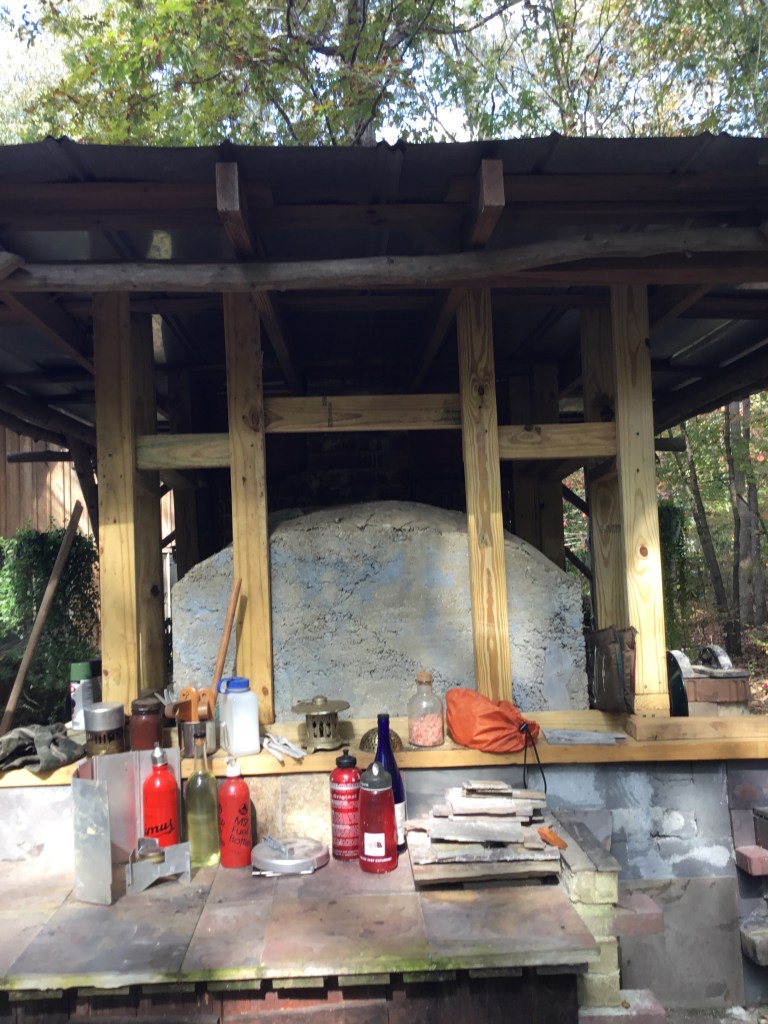
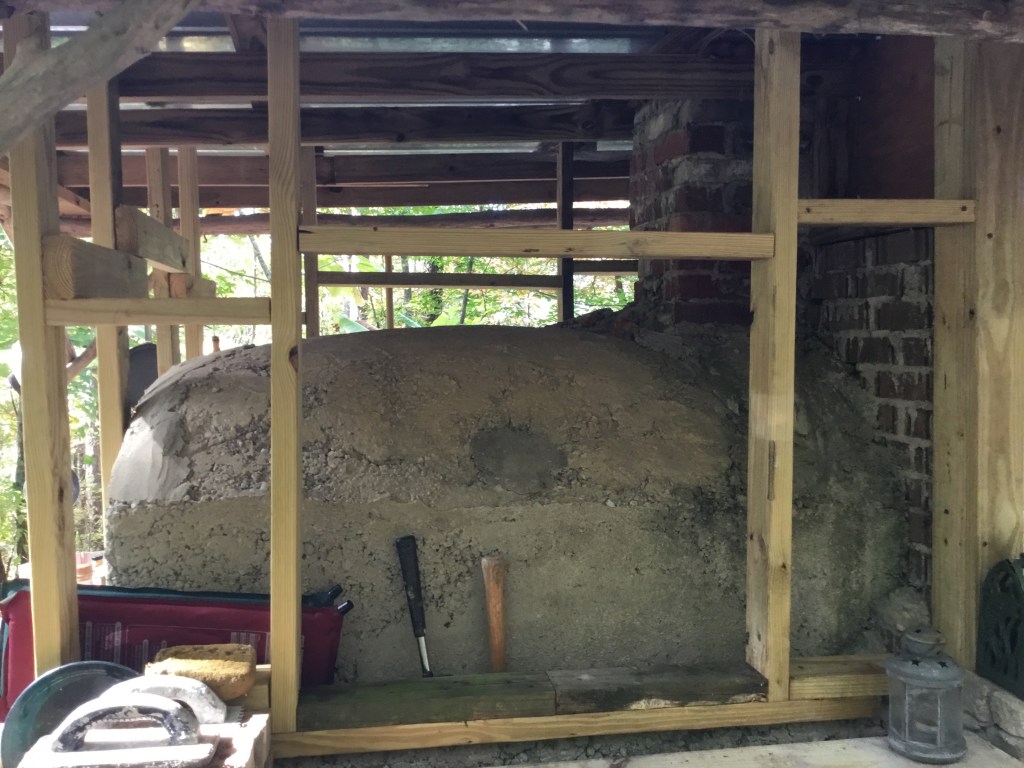
Now I spend my time cooking and building things–and writing. After a dozen years or so, I am framing in my brick oven. It was stupidly simple.
Here’s the rear view.
Needs a Cleanup
Easy work, that. I do need to de-clutter all that stuff, but it will be easier once the siding is put on.
Sideways! Kreuzweise!
Goodbye, Concrete
Admittedly, the old framer here used as many deck screws as nails in this project. It will take a kiloton nuke to bring it down.
Though my recollection grows dim, I believe that all three of these beastly tools came from the same flea market in Indiana, where they also had fantastic funnel cakes. I put new handles in all three, and the handles cost at least twice as much as the axes. I did inherit the German thriftiness gene.
The broad axe is right handed, beveled on the right side only, and also has an offset right handed handle, important if you want to keep any skin on your knuckles.
The adze was rusted and pitted on the body, so I sprayed it with a couple of coats of Rustoleum. The cutting edge was fine. To quote Neil Young again, rust never sleeps.
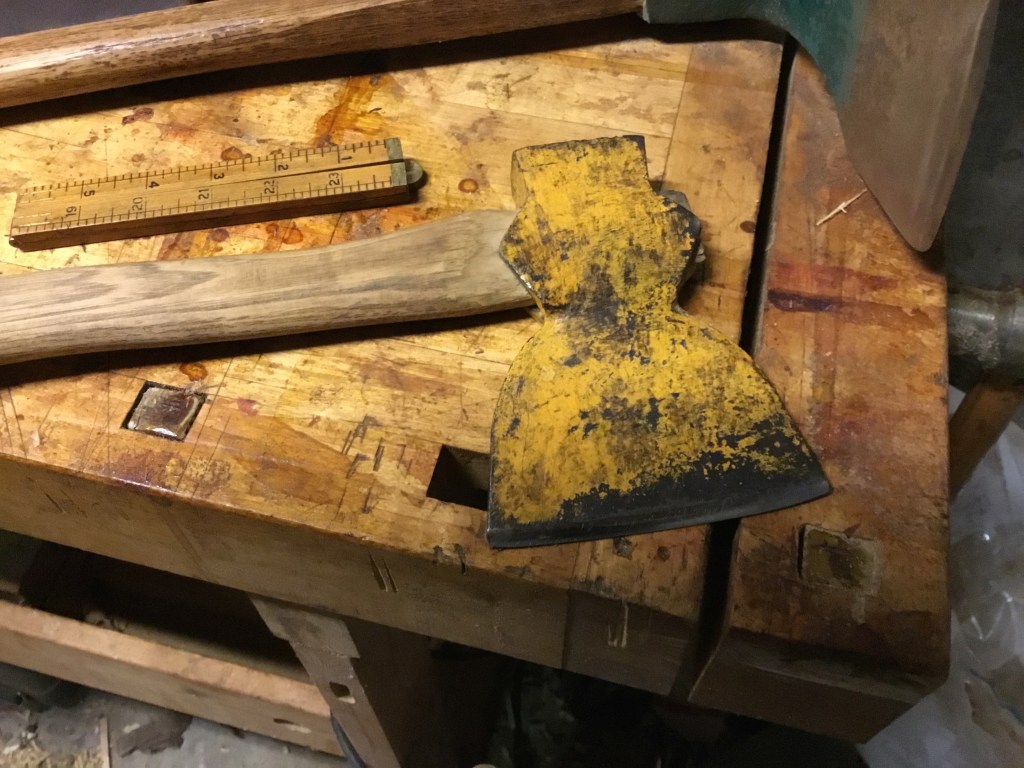
My favorite is the yellow broad hatchet, another right hander. I made the leather sheath to protect the edge. It’s been used for every green woodworking job.
They Call Me Mellow Yellow
About the yellow paint. An old timer at the flea market saw my hatchet, and said that everyone in his high school Ag class had been told to paint all their tools yellow, so they could be found easily, if, say, they were dropped in the cornfield. There certainly are plenty of cornfields in Indiana.






 Southern Fusion Cooking