Ok, it isn’t meteorological Spring yet, but don’t tell that to the native plants, because they don’t care. Here we have a Trout Lily (Erythroniumamericanum), the first of the native perennials to bloom in the Southern Appalachians. This is a signal to go trout fishing, traditionally, as the Dogwood blooms are a sign to go bass fishing. I’m down with both of those.
The temp this morning is exactly 32 degrees F, and whether it gets below that again this Spring is unknown. Our last frost date varies from February to March normally, and I already have cold hardy vegetables growing. And I also have a few potatoes in the ground. Even without a groundhog to help, I’m thinking this is going to be an early Spring.
When people involved in Sloyd (crafts) work hear the name of the central Swedish town of Mora, they immediately think of knives. Though Mora knives are made for just about every purpose knives can be used for, from Culinary to Military, they are best known for their woodcarving knives. The use of laminated steel blades in wood carving knives has been at the top of the Mora innovations.
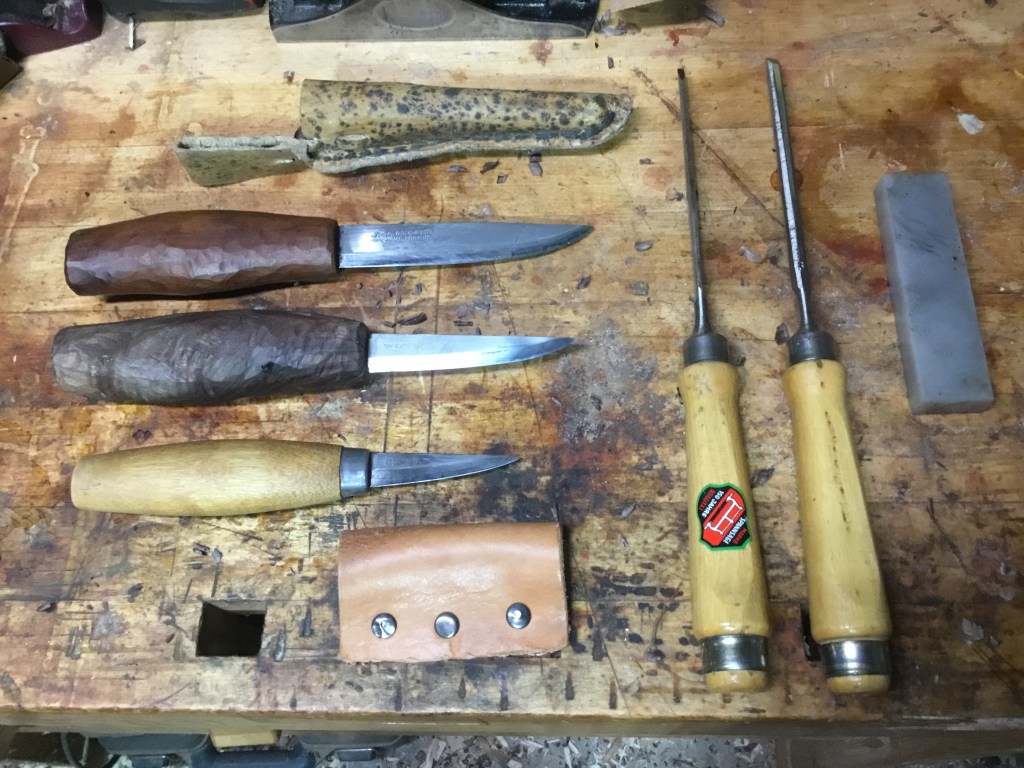
Pictured above are three different generations of Mora knives, and from two different categories. From top to bottom they are as follows: the top knife is an older Mora utility knife, roughly of the length of the current No. 2 knife; the middle knife is the No. 106 carving knife; and the bottom one is the No. 120 carving knife. The differences are as follows.
The #2 knife is a dual purpose craft/utility knife that has a 4 1/4″ long blade. This older model, which I am guessing is 15+ years old, has a laminated blade with a very hard (harder than stainless) carbon steel middle layer. Such a hardened metal by itself would be exceedingly brittle and prone to breaking, hence the two softer and more flexible outside layers. I made the Black Cherry handle–more about that later. Newer versions of the #2 do not have the laminated blade.
The #106 carving knife is brand new, and a perfect length 3 1/4″ carving specialist. The homemade handle is a piece of Black Walnut crotch, with contrary grain that should be just about indestructible. The new brand name the blank is sold under is Morakniv, following the merger of the two leading knife making companies of the town.
The small #120 detail knife has a blade 2 1/4″ long. This version has the standard factory made Birch handle, a signature of Mora knives. This knife is somewhere between the vintage of the other two, and has the name Erik Frost-Mora, on the blade. The birch handled knives are sold around the globe.
Other items pictured are some bevel edged chisels and an Arkansas stone. The Arkansas stone is of the translucent grade, with a grit rating of 1200+. This or some similar sharpening device is absolutely vital to keeping a carving quality edge sharp. A good strop also helps.
If you would like to undertake handle making for your carving knives, these two chisels are the ticket. The narrow one is 2mm, and the wider one is 6mm. The 2mm chisel is the primary mortising tool, and the 6mm is a supplement. These are old German made Spannsäge chisels, though said company has been bought out, but the two sizes are still manufactured by Kirschen (“Two Cherries” in English), and are readily available.
Lastly, there are the homemade sheaths. The top one is a traditional design, sewn around a plastic insert, and the last is a rough and ready cover made to keep my fingers safe when the knife is in its tool roll. I should have included my cut resistant gloves as well, but all carvers know about those.
Way back in the 1970’s Neil Young had it right with his song “Homegrown.” Here are the first few lines:
Homegrown’s alright with me Homegrown is the way it should be Homegrown is a good thing Plant that bell and let it ring
“Homegrown”
We didn’t start out with the idea that we were going to ring in the New Year with an all local feast, but it just turned out that way. I’ll start at the top, and go left to right around the plate, and then right to left.
Top: Baked Sweet Potato. That’s half of a big one, purchased from the Festhalle Farmer’s Market. These were grown by long time family friends, and are probably the variety “Porto Rican.” These are very sweet, and are served with lots of butter–a dessert substitute.
Left Center: Corn Bread. This is an all corn meal recipe, using McEwan and Sons Fine Ground Cornmeal. I doubt that the Certified Organic Corn was grown in Alabama, but their business, Coosa Valley Milling, just south of Birmingham, has some national fame. Their meal and grits are used at multiple James Beard award winning restaurants, and you can buy their products online–all around good stuff.
Bottom: Collard Greens. These are local as well, purchased at the Festhalle, and then frozen by yours truly. I like mine with lots of home made pepper sauce. The inheritance of bottles of such has been the subject of legal battles.
Right Top: Locally grown fresh Ham. Until this year, this was practically impossible to find. The ham pictured was home brined as well, and I will give the process of home brining, “curing,” in an upcoming post.
Center: Black-eyed Peas. More than likely these were grown by my in-laws, Melanie Jane’s sister and her husband, who brought us bags of them. That’s the way to pay a visit to some one. Southern folklore has it that every pea consumed is worth a dollar. I should be a millionaire.
The wine to wash this down with is local, if you live on the Rhône river in France. It’s a Côtes du Rhône, which has just enough pink tinge to call it a rosé.
This is as classic a Southern New Year’s meal as can be put together. People in NYC would probably label it “Soul Food.” Down here, we just call it food.
Some actors get a facelift or Botox or embalming fluid to give them that paralyzed face-look that Hollywood likes, but my Smokehouse has been given a shingle lift. It was something of a fiddly operation, but it turned out to be a success. It was actually completely unplanned.
The story is this: Melanie Jane wanted some tongue and grove put on one of the walls in our bedroom, so I went by our new local wood only lumberyard/sawmill to see what they had. It turned out their office was clad with exactly the kind of tongue and groove that I was looking for, and it was only 3/8″ thick. I left with two bundles of 12′ boards, all a little over 6″ wide.
That was a lot of board feet, as it turned out. I had about one fourth of it left over, and my work shop is not big enough to have a bunch of lumber lying around. I finally thought, what is 3/8″ lumber good for? Then it hit me–shingles. There was just enough wood to shingle the front of my smokehouse.
I cut it up in to 16″ long shingles. The part that is left visible is called the “reveal,” and all the rest is overlap. The 4″ long reveal means that there is actually three layers of shingle on each run, which if installed properly, will make a waterproof covering. I planed off the tongues, and cut off the groove edge with a bandsaw.
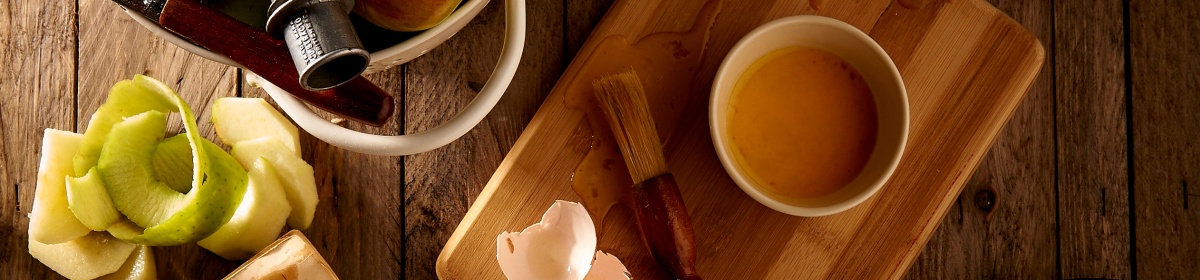
Many many shingle nails later the wall was ready for some paint. I wanted to do it right, so I bought some pigment called Blue Ridge Hematite, which is a dark red Iron oxide from Virginia (the door is made from Virginia Juniper, aka Red Cedar). I made egg tempera paint with it using the following recipe. This is for a pint:
1 tablespoon Iron Oxide pigment
2/3 pint boiled (cheap) Linseed oil
Mix these thoroughly and leave overnight. The next day add:
1 Egg
1/3 pint Water
Stir, but don’t shake, the paint. Think of it as one of James Bond’s martinis. Theoretically, the building will rot down before this paint fades. Now there’s only three more walls to shingle. I think those can wait.
Not even an Ivy League education can stop some people from being a fool’s fool. Florida surgeon general Joseph Ladapo and Governor Ron DeSatan, both Ivy League grads, are teaming up to make certain that as many Floridiots die as is humanly possible.
DeSatan had the following to say:
Pharma will make more money if this thing is approved and they start pushing it on everybody.
Goobernor Ron DeSatan
The fact is, that DeSatan doesn’t believe any of that. His spokesperson refuses to say if the Goobernor has been vaccinated, which is essentially the same as shouting YES. The surgeon general, on the other hand, is a true believer. From the English paper The Guardian:
Meanwhile, Dr Joseph Ladapo, the governor’s hand-picked surgeon general and a vaccine skeptic previously found to have manipulated data on vaccine safety, falsely claimed the new booster shots had not been tested on humans, and contained “red flags”.
The Guardian
A liar and a fool is definitely a fatal combination. I’m going to petition the good old University of Illinois to have my PhD changed from English to Reality. I’m first in line for the Fall Booster shot–I think it will be my sixth Covid vaccination.
This native Southern beauty has something of a reputation as being a rarity, but we have had it on both properties we have owned in Alabama, at opposite ends of the state. The fact that it blooms during the hottest part of the summer, when few people are wandering around in the woods, might explain its rep.
This Turk’s Cap like lily was discovered by eighteenth century French botanist and explorer Andre Michaux. It thrives in poor sandy soil. Unfortunately it is also a favorite food of rabbits, especially our small dog sized Swamp Rabbits. To have one bloom like this is a rarity even among our couple of acres colony of plants.
Another problem with cultivating this lily, is that it is only possible by growing it from seed. Reputedly, it is impossible to transplant, unlike other Lily species. Ben Pace, right hand man of Fred Galle at Callaway Gardens in Georgia, said they tried to transplant almost fifty of them before they gave it up. They always ended up with nothing but a handful of bulb scales. Therefore, we leave ours to grow in the wild, as they always have.
June is one of the best times of the year to buy fresh locally grown produce. The omelette pictured above is all local save one ingredient, some bacon. Because we grew two of the main ingredients ourselves, this cost pennies compared to supermarket bought ingredients. I won’t mention that it is also about a thousand times better. This recipe serves two.
Ingredients
1 or 2 slices Bacon
Sliced Fingerling Potatoes
1/4 diced Onion
I diced Tomato
Salt and Pepper
Cook the bacon until most of the fat is rendered from it. Remove from the skillet, and add the sliced fingerlings. We grew these in 10 gallon grow bags, and once you go grow bags, you never grow back. We have enough taters now to take us on into the fall. Salt here well and fry until brown.
Add the onions and tomato, and turn on the oven to 400 degrees F. When the onions appear to be almost done, add two eggs. These are our homegrown ones.
When the white begin to harden, throw the whole thing into the oven. Now is paranoia time-Am I going to overcook them? There’s nothing worse than turning a good fresh egg into a golf ball. Shake the skillet occasionally until you get the desired score on the jiggle test. Then halve this beauty and thanks nature’s God for her/his bounty.
I like my eggs with some hot sauce, and I am currently on the fence between two Tabasco sauces–the Chipotle and the mild Jalapeño (Green) Sauce. Maybe I should try both at the same time.
After a couple of decades, our signature plant in our outdoor kitchen is blooming. Bigleaf Magnolia (Magnolia macropphyla) has the largest leaves and largest blooms of any North American tree. This is the last of five blooms on this tree this year.
There are a couple of varieties for this species. Ashe magnolia, which is common in the higher mountains, was formerly considered a separate species, but is now lumped in as a sub-species. The most unique variety is a yellow flowered one that is found in Bankhead National Forest in Alabama. And yes that forest is named after the Bankhead family of politicians and actors.
I think this would have been the favorite tree of Talulah, as it is as extravagant as she was.
In yet another case of “Did they really say that?”, Cal-Maine, which has 20% of the US egg market, outlines the real cause of egg-flation–bird flu. Said CEO Sherman Miller: the profits were caused by “the ongoing epidemic of highly pathogenic avian influenza which has significantly reduced the nation’s egg-laying capacity.” By 718%? Not likely.
If not, then the real cause? Good old fashioned corporate America ripping off customers. After that comes the BS PR campaign that no one believes. This one is so stupid it’s amazing that the news industry even bothered to report it.
The answer is, as usual, to take the means of production into your own hands. Buy some chickens, get a coop, and whip inflation now. As well as some pigs of the capitalist variety.



 Southern Fusion Cooking