Favorite Woodworking Planes, Part Four–Miniature Planes

She is small, but she is fierce–Shakespeare

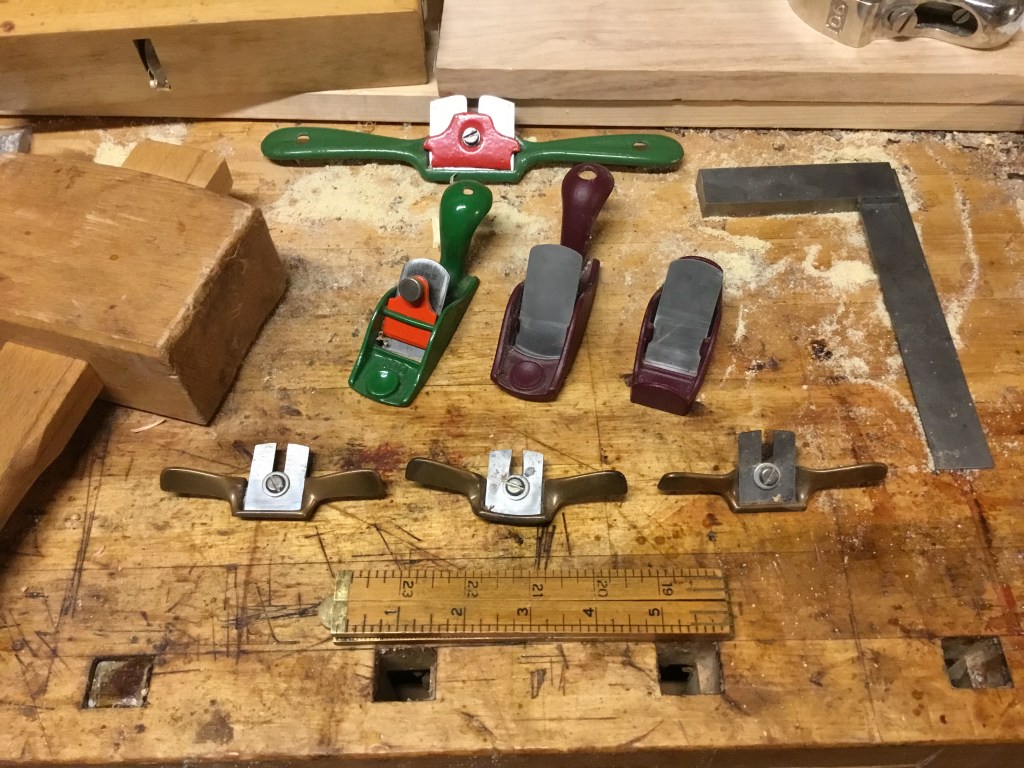
For your perusal is an assortment of small planes and spokeshaves, the latter of which are actually small specialty planes themselves (or at least function as one). The green plane is a Kunz #100 made in Germany; the middle plane is a Lee Valley copy of the Stanley #100 1/2, with a curved sole, made in Canada; and the last plane is a Lee Valley copy of the Bailey/Stanley #50 Little Victor plane, which caused quite a stir when first introduced a little over a decade ago. The small brass spokeshaves are no longer produced, but occasionally turn up on fleabay. If I remember correctly they was sold by Garret Wade, and were made by a small manufacturer in Detroit.

Kunz #100

This “Squirrel Tail” plane is just about an exact copy of the old Stanley #100. It has a flat sole, and is excellent for trimming and general work with small or green stock. It lives in my green woodworking tool bucket, as the red paint makes it easy to find should I lose it in the woods. The price is also right for a German made plane.

Lee Valley Squirrel-Tail Palm Plane

This is only one of the superb palm planes manufactured by Lee Valley in Canada. A take off on the Stanley #100 1/2 plane, this has three major improvements. The materials are far superior, the design is more useful, and the machining is about the best there is. To be specific, the handle is larger to accommodate the overgrown beasts that we have become. The blade adjustment is based on the old Victor plane adjustment–more on that in a second. The machining matches that of the innovations introduced with the LV Little Victor plane.

The curved sole makes this ideal for chair makers, though it works just as well on large carved bowls. The Stanley #100 1/2 was marketed as a “modelmaker’s convex plane.” The ease of adjustment on this new model is mind blowing, circa 1877.

Lee Valley Little Victor Plane

This is not an exact copy of the 1877 Bailey #50 Little Victor plane, but it is pretty close. Leonard Bailey introduced a newly designed set of planes that year, under the Victor name. A series of lawsuits with Stanley, Bailey’s former employer, resulted in Stanley gaining the rights to the designs. They promptly canceled the entire line of planes.

When introduced, this little plane was considered a marvel. Both the sole and the blade are machined practically literally flat, to the point that the plane could be used right out of the box. One woodworking magazine editor had the entire staff convinced they should order one the day he received it. They all did.

So it is small, but it is fierce. I used this extensively while I built the “great wall” in the previous post, and it qualifies as the leader in the race for the perfect pocket plane. Nothing is better at trimming pieces of millwork.

Brass Spokeshaves

Project too small or curvy for a mini-plane? Look for some of these little brass planes, in used condition, on the interwebs. The set has one with a flat sole, and two with varying degrees of concave-convex-osity.

I use mine constantly when carving spoons, and even when making bowls. They hang in a leather pouch I made just for these three, right next to my shaving horse, which is spoon carving central.

Here is a definite case where bigger is not better. These take up almost no space in the workshop, and if needed the whole set could fit in a tool belt. For someone who has a shop as buried in shavings as mine always is, they also create small shavings that are easy to clean up, for those of you who actually clean up your shop occasionally.
Kitchen Invasion

What a Great Wall–Richard Nixon

It happens. This is not a kitchen intervention or a kitchen rescue, this is about when your kitchen begins to invade the rest of your house. We have at least three living spaces where the kitchen is slowly creeping in. I will mention two, but describe one in detail.

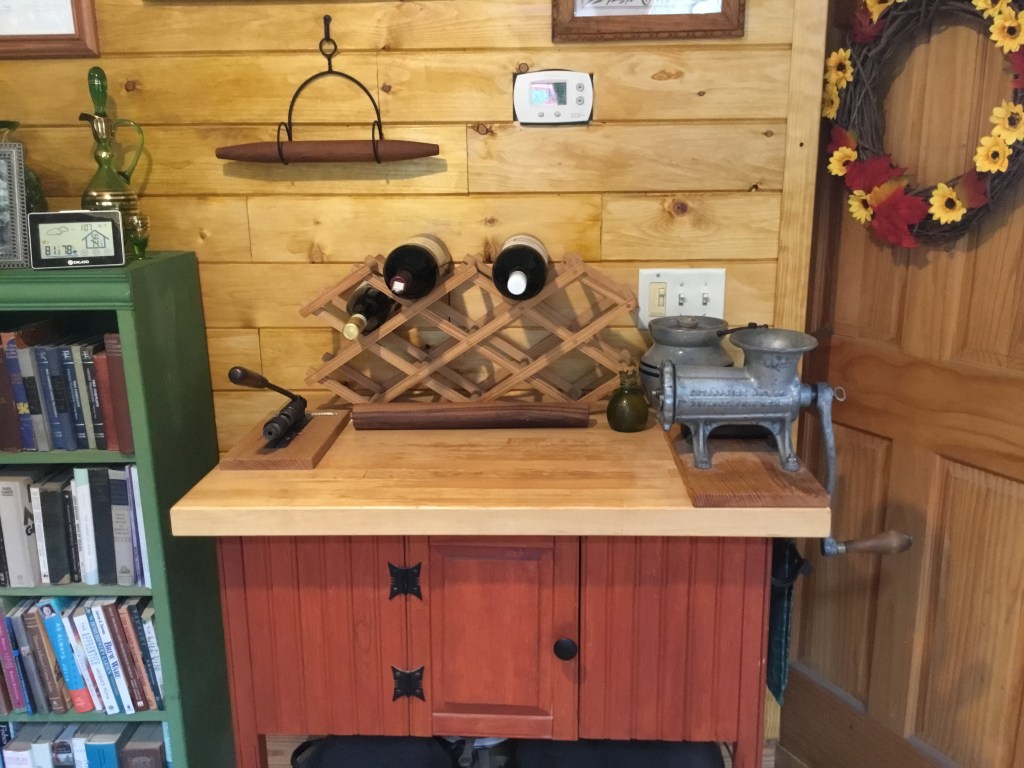
In detail–I made this dough bench intending that it be used strictly for bread making. The USA made maple butcher block top is oversized to accommodate clamped on tools–too bad it’s too thick for any of them that we have. Instead, I have a clamped down meat grinder, an Enterprise #22. Which leads to the four tasks this unit now performs.

Meat Grinding/Sausage Making

The #22 grinder is such a beast that it requires a bolted down installation. The clamp on version is much less common, and less useful. This will grind pounds of meat in a matter of minutes, and in a variety of grinding thicknesses/textures. It’s clamped on with a giant c-clamp.

The sausage making tools are stowed beneath the butcher block. Essentially, these consist of a sausage plate and three sausage stuffing tubes of different diameters to accommodate different sized casings. The world of sausage is infinite, and worth the trouble, for as Bismarck reportedly said “The less you know about how laws and sausages are made, the happier you are.” He was reffering to bought sausages and purchased politicians.

Wine Storage

It’s far better to have good drinkable wine than fancy wine storage. Jacques Pepin once showed off his homemade wine storage, and it was essentially plywood boxes in his basement.

Our little portable rack is all we need, what with our regular trips to the good wine selection at our local Publix supermarket. Most of our wine is Italian, French, or German, as all three countries have strict wine regulations.

Pecan Cracker

An antique but portable item, this old pecan cracker that belonged to MJ’s grandparents has a definite 1900 industrial look. The only thing it won’t crack are hickory nuts, but I have a 23 ounce framing hammer for those. Not too many people have a Pecan cracker in their living room, but sometimes nuts need to be cracked.

Dough Station

And it sometimes is even used for what it was intended! Everything ensconced on the top can be removed quickly. If I am making my usual Creole French bread, there is not even the need to do that. Even the French baguette pan is housed directly under the butcher block top.

The last two invasions: our dining room literally has an entire wall covered with dishes and glassware. Even the bookcase next to the dough bench is being invaded, as it is now 1/8 food books. In amongst my two first edition works by Henry James are food autobiographies by Jacques Pepin, Julia Child, and Barbara Kingsolver, and sausage making books, which are handy for task #1. I should also add that MJ’s corporate home office is overseen by two shelves of cookbooks, stacked in various configurations, one of which is a strong 19″ high.

And then there is the rolling pin hanging on the wall, which is soon to be joined by another. Every living room needs a couple of those.

Stanley #82 Scraper

Scraper, Meet Kitchen Floor. Another Justus Traut Masterwork

As it is time to refinish our kitchen floor once again, I needed a tool upgrade. Our dogs take a few years to do the damage, but there is practically no finish they can’t ruin–one of them even ate the grout out of a tile floor. Therefore, it was time to hit the dreaded fleabay for a classic tool, and as usual, this hog found an acorn.

I found that the old Stanley #82 scraper has something of a cult following. A chief writer for one of the best woodworking magazines stumbled across these on fleabay, and liked them so much he ended up buying something like nine of them, giving most away as gifts. The kicker was when one person pointed out that this scraper could reach into practically any corner. Try and do that with a random orbit sander.

I bought one that was listed as a “planer,” whatever that is. Some WD, sandpaper, and a micro abrasive and the thing was bright and shiny. I also renewed the wood handles with some wax polish.

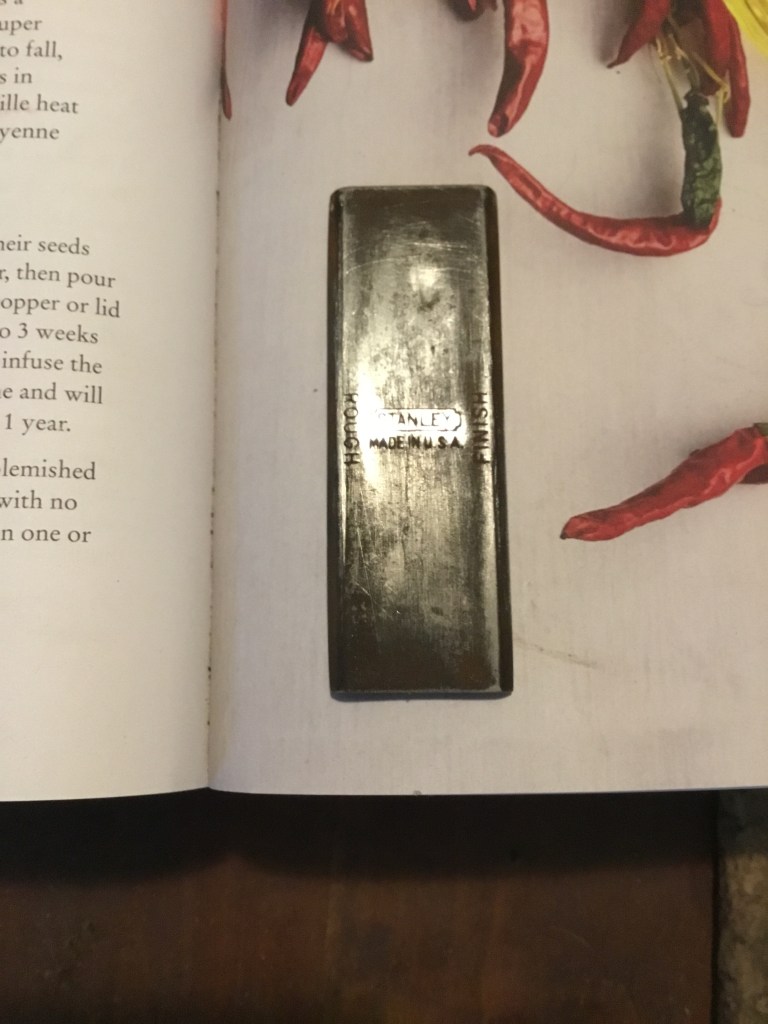
As there isn’t much detailed info about these available, I was intrigued by the original scraper blade, which has two edges bent at ninety degree angles. A couple of swipes with sandpaper revealed the Stanley logo. No big surprise there.

Double Threat

Then the extra words began to appear: “Rough” and “Finish.” After a little inspection, the two edges were finished differently. The Rough edge is curved, while the Finish edge is flat. Traut must have been a genius at multi-tasking.

The final feature is that many many scraper blades can be used besides the original one. I have already tried a high quality Swedish made Sandvik blade in it, and it scrapes like nobody’s business. The dogs will be banished from the kitchen for a good long while.

OffGuardian

because facts really should be sacred

Ruth Blogs Here

Or not, depending on my mood

A Haven for Book Lovers

I am just a girl who loves reading and talking about books

what sandra thinks

because I've got to tell someone.

LadiesWhoLunchReviews,etc

a little lunch, a little wine, a LOT of talking!

Margaret and Helen

Best Friends for Sixty Years and Counting...

talltalesfromchiconia

Tales of quilting, gardening and cooking from the Kingdom of Chiconia

Cyranny's Cove

Refuge of an assumed danophile...

Exiled Rebels

Serving BL since 2017

this is... The Neighborhood

the Story within the Story

Beauty lies within yourself

The only impossible journey in life is you never begin!! ~Tanvir Kaur

Southern Fusion Cooking

Country Living in the Southern Appalachians, USA--A little of this, a lot of that

Discover WordPress

A daily selection of the best content published on WordPress, collected for you by humans who love to read.

The Atavist Magazine

Country Living in the Southern Appalachians, USA--A little of this, a lot of that

Longreads

Longreads : The best longform stories on the web

WordPress.com News

The latest news on WordPress.com and the WordPress community.