Tater digging time has arrived down here, and there will be lots of them. The first few plants yielded four different taters.
There are two yellow varieties in the bucket, and they are Gold Rush, and the standby Yukon Gold. The reds are Norland Red, which is quite attractive, so much so that I think I will eat them. The classic Russet rounds out this group.
I did very little for these roots except treat them with soil sulphur, to keep them from rotting, and a handful of organic fertilizer. With that little effort, we will be in taters for the rest of the summer. That’s taters, not tatters, though I do a really great Mick Jagger imitation, singing “Shattered.”
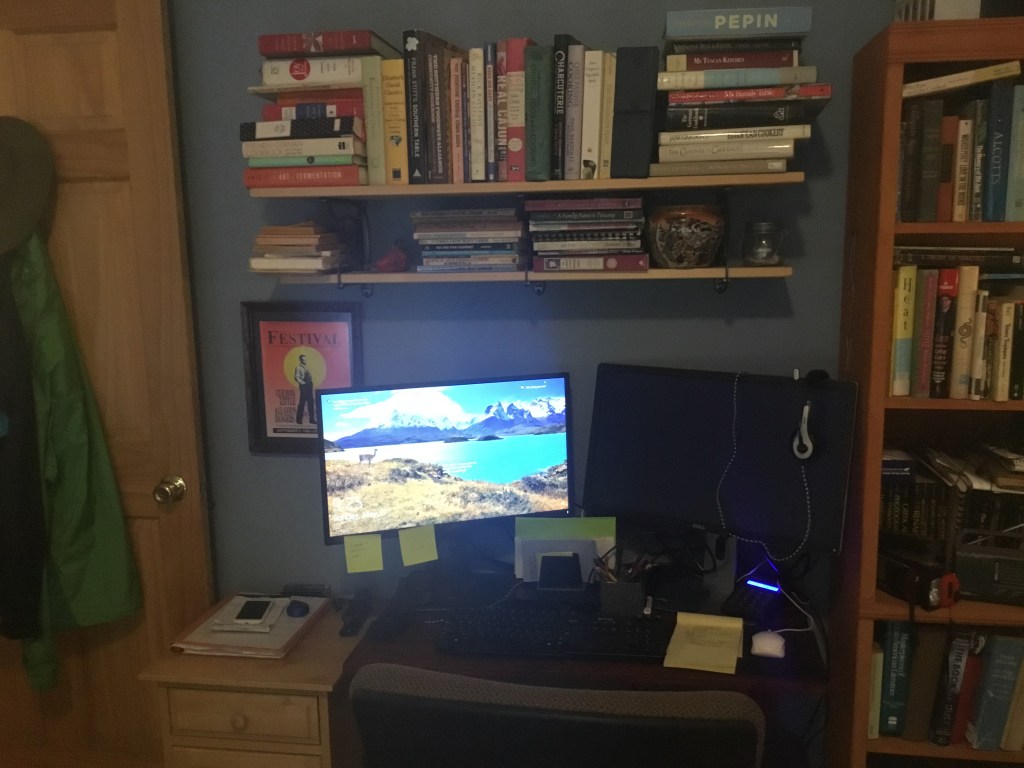
The giant Alabama based corporation Melanie Jane works for has rusticated her indefinitely, and possibly permanently. Then they tell her last week they have ordered her yet more computer equipment. Time for a new desk and some extra space. It’s not exactly Virginia Woolf’s a room of her own, but it is pretty nice.
I have one of the finest scrap wood piles in history, this having been salvaged from it. The Black Cherry wood is over fifty years old. How do I know that? Because the tree this wood came from fell on me. Hereby hangs a tale, as the Bard of Avon might have said.
Home Office, with Two Shelves of Cookbooks
The new corporate office above is overseen by a framed program featuring none other than actor Cleavon Little, who played the sharecropper Nate Shaw at the Alabama Shakespeare Festival, in the play All God’s Dangers. Unlike Bob Marley’s song, Nate shot the Deputy, but he did not shoot the Sheriff. But it was in self defense.
At any rate, back to the story. My grandfather was one of the finest loggers for the brand new Tennessee Vally Authority, as they were building the giant chain of lakes on the Tennessee River in Alabama, which would be Wilson, Wheeler, and Guntersville. He would tell tales about trees so large that they had to weld two two man crosscut saws together, just to cut them down. So old growth forests were replaced by water, and the valley could have cheap electricity, and the world’s finest fishing for smallmouth bass. Everything is a trade off.
We had this beautiful tall Black Cherry tree by our house, when I was a small child. It produced massive quantities of black cherries, which were inedible for anything other than birds. The birds would eat them in mass quantities, and then crap black cherry colored crap all over the clothes on our clothesline. Note: no one we knew owned a clothes dryer back then.
My mother pronounced a death sentence for the tree. My father was dispatched as the executioner, and he grabbed his double bitted axe, and drove his old Plymouth down for me to sit, on, and witness his skill as a lumberjack. I was instructed to sit on the hood, and watch the remarkable display of skill.
Remarkable, it was. He managed to make the tree fall in exactly the opposite direction than he intended, and I was transfixed as the tree headed straight for my head. Only the limbs hit me, but the Plymouth took a strong blow to the roof.
I forgot about the entire incident, and soon enough went off to college for ten years. My father went on to join the choir invisible during that time, and so his sheds full of goodies remained untouched. I returned home for the summer before I started my first professorial job, and there they were–a double bitted axe, and a giant pile of cherry lumber, that had been drying for over twenty years. As a victim, I claimed all of it.
I was looking in my outdoor tool closet the other day, and found the axe. I had put a new handle in it, and I am about to grind it sharp, so I can also cut down trees in the wrong direction.
This reminded me of the great poem by Gary Snyder, “Axe Handles.” Here it is (copyrighted by Gary, btw).
One afternoon the last week in April Showing Kai how to throw a hatchet One-half turn and it sticks in a stump. He recalls the hatchet-head Without a handle, in the shop And go gets it, and wants it for his own. A broken-off axe handle behind the door Is long enough for a hatchet, We cut it to length and take it With the hatchet head And working hatchet, to the wood block. There I begin to shape the old handle With the hatchet, and the phrase First learned from Ezra Pound Rings in my ears! “When making an axe handle the pattern is not far off.” And I say this to Kai “Look: We’ll shape the handle By checking the handle Of the axe we cut with—” And he sees. And I hear it again: It’s in Lu Ji’s Wên Fu, fourth century A.D. “Essay on Literature”-—in the Preface: “In making the handle Of an axe By cutting wood with an axe The model is indeed near at hand.” My teacher Shih-hsiang Chen Translated that and taught it years ago And I see: Pound was an axe, Chen was an axe, I am an axe And my son a handle, soon To be shaping again, model And tool, craft of culture, How we go on.
If you have a chop saw or a mitre saw, this is a thirty second project. I have what is probably a lifetime supply of 4″ pvc pipe, left over from the idiots who did our plumbing (they had our main drain running uphill). All I bought was this 4″ wye joint, and some test caps, instead of the more expensive plug ends. It’s only going to hold some chicken feed.
Total cost for this project was less than $15. It cost $250 to get my uphill drain fixed. This can be made in any size, but this one is small, to be fitted into our small coop. Next years project–a pen extension, another coop, and some Bresse chickens. Also an incubator, which I intend to build myself.
I had to include a gratuitous set of my old German tools in the picture, and my new 2″ bowl gouge, from PA. That thing can do some serious damage.
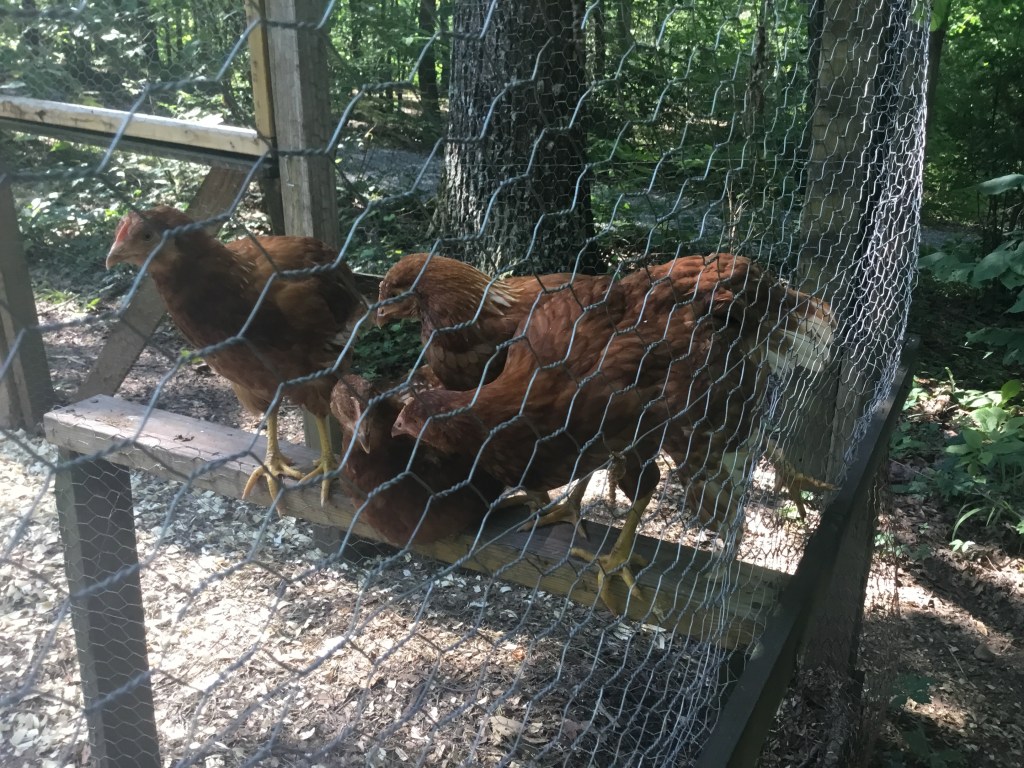
I knew that ISA Brown chickens grew fast, but these have gotten so big in such a short time that it’s almost scary. As stated before, this variety was the brain child of the French Minister of Agriculture in 1975. It is now apparent that he was bent on world chicken domination by the French (think of Volaille de Bresse, the famous blue legged meat chicken from Bresse, which a few years ago sold for forty dollars a bird in London).
So the French wanted the best eggs, to go along with the finest chicken meat, and they wanted mass quantities. Though the heritage of these birds is considered a corporate secret, it is apparent that a large part of the genetic line is the Rhode Island Red chicken. Apparently the Rhode Island White is also involved, as the roosters of these birds are always white.
And talk about hyper! The big fat Barred Rocks we have don’t even try to chase them anymore, as they can lap those big birds in one circuit around the big coop. They are also great at thieving the food out of the Rock’s giant feeder. Today’s project is making them a feeder of comparable size, out of PVC pipe. Film at eleven.
Here on the river, we have seen otters, a dog sized raccoon staring in our window, a red tailed hawk that opened up a gallon of fish fertilizer, and then wallowed in it, and a king snake that crawled between my feet to catch a toad, and swallow it whole. Wait, I left out the flying squirrels who like to nest in our bird houses. However, this is the first hummingbird nest we have ever seen.
It was lying in our front yard when we found it, under a white oak tree. The little hummers were obviously gone from it, and according to research, these birds will nest up to three more times this year. That’s a lot of ruby-throated hummingbirds.
This is a marvel of architecture. According to the interwebs, it’s woven together using spider’s web, and the outside is covered in lichen, as camouflage. Pretty clever for a bird that size. That, and they get free food from our two hummer feeders. Lucky them–this is too small for the flying squirrels to nest in.
Uncle Samuel decided to remit us some of the tens of thousands of dollars that we have unwillingly sent him over the years. It truly is a paltry sum, but I have decided to invest some of it in pepper futures. It’s a better use than sending money to defense contractors, or bailing out giant banks.
The amount I chose to invest was a total of $8.05. That gets me seventy five pepper seeds, more or less. My rate of return is likely to be enormous, as a small bag of fresh peppers at the Festhalle usually goes for around three bucks. At any rate, these are the three heirlooms I bought.
Piment d’Espelette
Another of the official peppers of the Basque region of Spain. Mildly hot, it has only been around since 1523. Strangely enough, that was the year when I was born.
Sigaretta De Bergamo
Let’s go to the Lombardi region of Italia, virus or no virus. A long sweet pepper, which surprisingly is the diameter of a cigarette. Try and find these at your local market.
Fushimi
Time to go to Nippon! That would be Japan. Another slim sweet pepper, and I can’t wait to try this one.
Moral of this story: grow your own, grow your own.
I am now at sixteen different peppers. Life is good. Thank you to the Federales for floating me eight bucks for pepper seeds. I threw in the nickel.
This is from so far south, it’s from across the border. It is, however also a staple of most Tex-Mex style Mexican restaraunts. Fortunately, it is also dead simple to make.
Ingredients
Peanut Oil
Flour
Can of Tomato Sauce
Salt
2 or more Chipotle Peppers, and Adobo Sauce
If you have cast iron intestines, you can go the Rick Bayless route, and make this with nothing but Chipotle peppers. As I prefer living, I go the tomato sauce way.
Start by making a little blond roux with the oil and flour. I used a regular size can of sauce, or you can mill some canned tomatoes, as it results in the same texture. After it begins to boil, throw in Chipotles that have been seeded. How many is strictly a matter of preference. The same goes with the amount of Adobo sauce you add. It only cooks until it is warmed through.
We made roast pork enchiladas with Vidalia onions rolled up in a tortilla, covered with this sauce, and grated Cheddar cheese. It’s a quick and easy meal, which only needs to be baked until the sauce bubbles. After that it’s time to swine away.
This plant really is sweet. Like the parent that finally has to confess to having a favorite child, this is my favorite native azalea. It blooms late, has spectacular blooms and foliage, and smells like honeysuckle. We also rescued this specimen from our own waterfront.
Happy Shrub
The entire riverbank this was growing on washed away in two floods, though we still have one plant down there, up the hillside. We managed to salvage two in total.
They do need a good bit of water, but they will get as tall as twenty feet. Hence the translation of the Latin name: “tree azalea.” The one in the picture is probably more than twenty years old. We water it in dry weather, but have never fertilized it.
These bloom about a week later than my other favorite native shrub, Mountain Laurel, which is one tough cookie. Ours almost died out three years ago during a two month drought, the longest in recorded state history, and then all re-sprouted from the ground, or miraculously grew leaves from what appeared to be dead limbs.
Almost Done
Our many, many, wild plants are at the end of the blooming cycle, and will make thousands of tiny seeds. I’m looking for a forest full of laurel. It’s also a fine carving wood, if it weren’t too pretty to cut down.
My Nicaraguan pepper seeds turned out to be sold out, so I compensated by ordering two more heirlooms on Fleabay. These are both from Europa. Now I will have a lucky thirteen pepper varieties.
Szegedi 179 Hungarian Paprika–From the city where Paprika originated. Said to be moderately hot, I got this from the same great grower in Georgia that I have been dealing with.
Antohi Romanian Sweet Peppers–a palm sized pepper, that looks phenomenal. It’s like a giant pimento. I had to order some mini pumpkin seeds from this seller in Arizona as well. MJ loves her some mini pumpkins.
We are finally having pepper weather, with temps in the eighties. We should have more than a hundred plants, if I can keep my stupid Aussie Shepherds out of my pots. Fortunately, the hot weather slows the furry jackals down.
Though people have been pickling garlic scapes (blooms and stems) for centuries, I may be the first to try the traditional Italian method of doing so with so-called Elephant Garlic. It’s really a type of leek, but it was renamed Elephant Garlic by the person who rediscovered it, the owner of the Nichol’s Nursery, out in Oregon. They also reintroduced it to the commercial market.
It has naturalized itself in my semi-abandoned veg garden, which was left dormant after two record breaking droughts. Now three alliums are taking over, including softneck garlic and Rakkyo, the famous Japanese delicacy. We are gradually bringing back other crops, and have a nice patch of potatoes coming on. But to keep the place from being overrun with Elephant Garlic, I have begun harvesting some of the scapes. The recipe is very simple.
Ingredients
Elephant Garlic (or Garlic) Scapes
Vinegar
Salt
Olive Oil
Cook the scapes for five minutes or so, in the salted vinegar. Then bottle them in olive oil and let age a day on the counter, and a week in the fridge. Be aware that they have a short shelf life, so eat them in a week or so.
The taste of Elephant Garlic is intermediate between Garlic and a Leek. It is a plant that requires eternal vigilance, to keep it from overtaking your property.






 Southern Fusion Cooking