Patagonia Tool Sak

The Sak is Out of the Closet

If you are a truly sick Gear Head, every day can seem like Christmas. Closets full of gear means that you can treasure hunt at any time you want. Stove parts and bags are every where in our house. We could probably move to a vacation home for a month or two without buying a box to pack in.

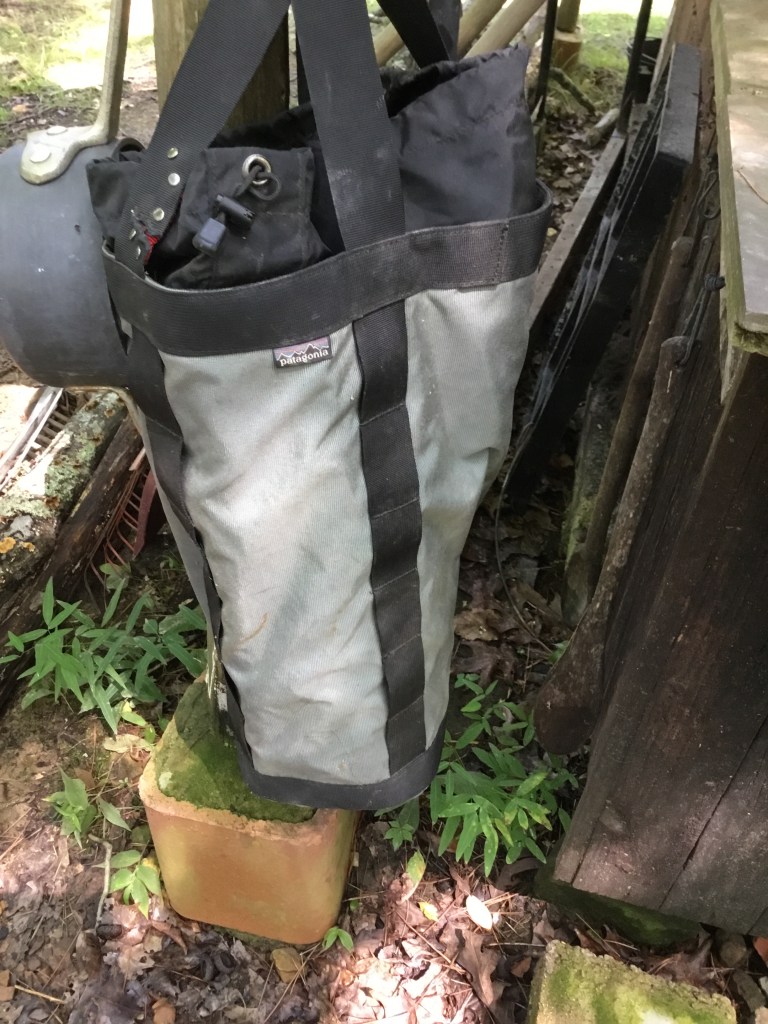
Article in evidence, a probably twenty year old Patagonia Tool Sak (they like purposely mis-spelling words as much as I do.) It’s a beastly bag, and currently it is the home of my DeWalt 20v electric circular saw. That and a speed square barely fill up a third of this bag.

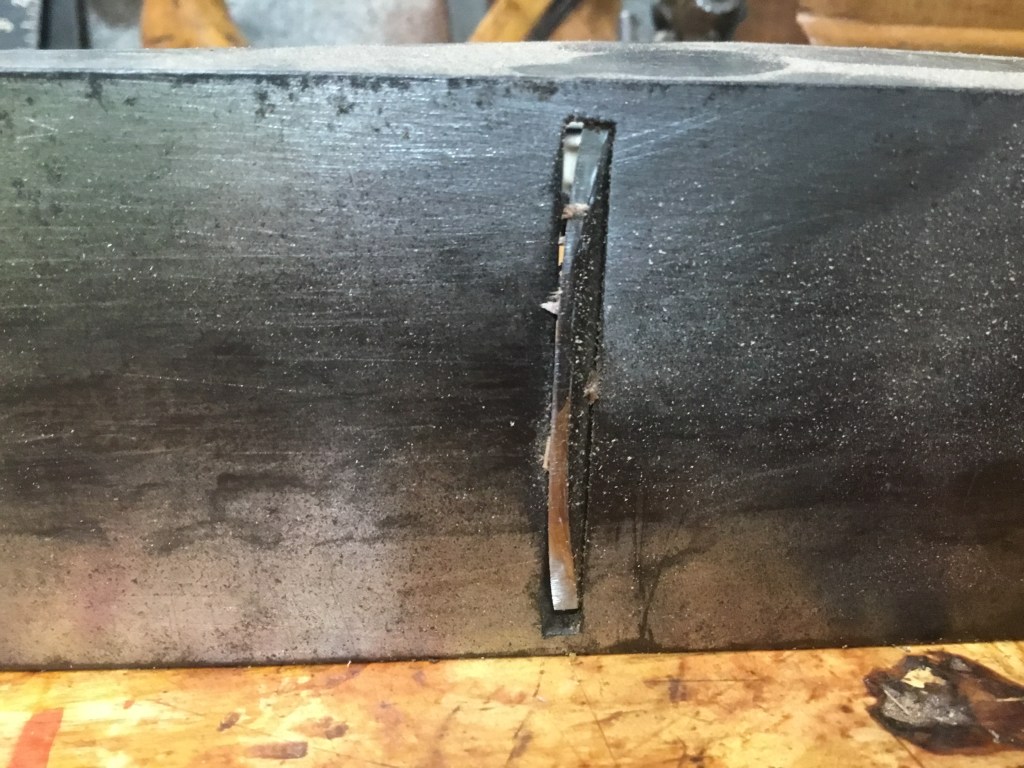
The repair is courtesy of our late lamented old Aussie named Karl, who decided to see if he could chew nylon webbing in half. I caught him before he could complete his doggy mission, and fixed the cut with rivets, and yet more nylon webbing. That stuff really is strong enough to tow a truck with.

Besides the webbing on the front, the back straps also serve as backpack straps, making the bag something of a pack bag. It was originally marketed as a climbing bag, a label that most people rightfully ignored. Mine is a woodworking, catch it all bag, but it has had more uses than I can remember.

There is usually one of these on fleabay at any given time, often for less than the original retail price. As they are next to indestructible, they are a completely safe purchase, even used.
Smoke House, Part Two–How Firm a Foundation

I Need Cement

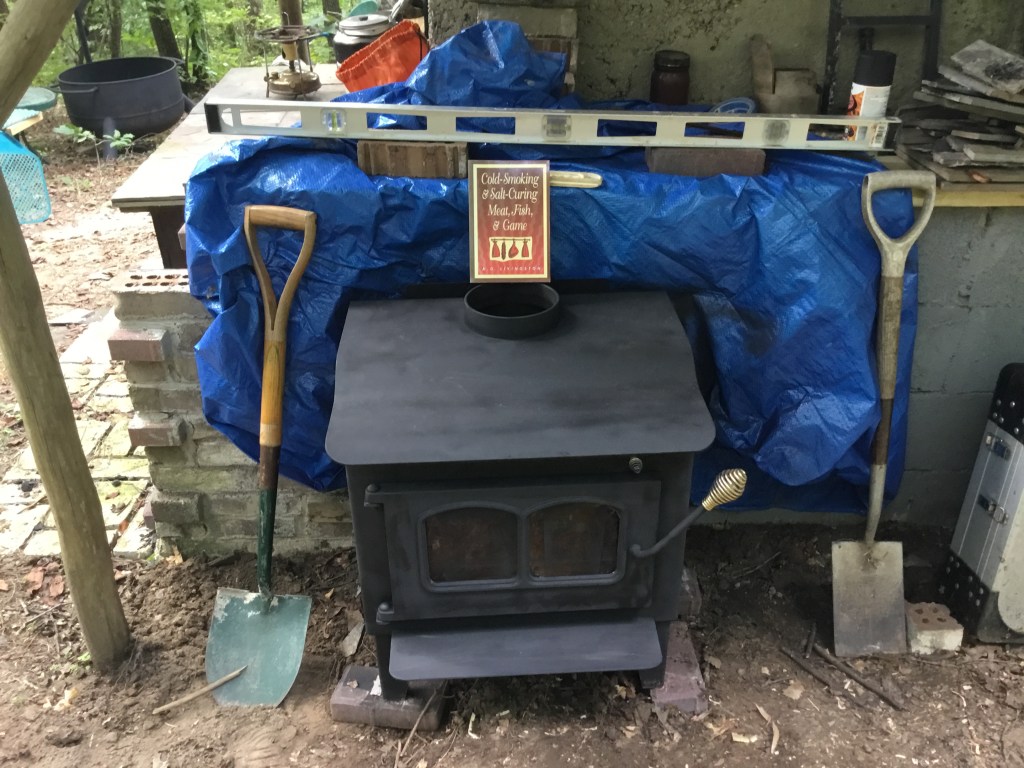
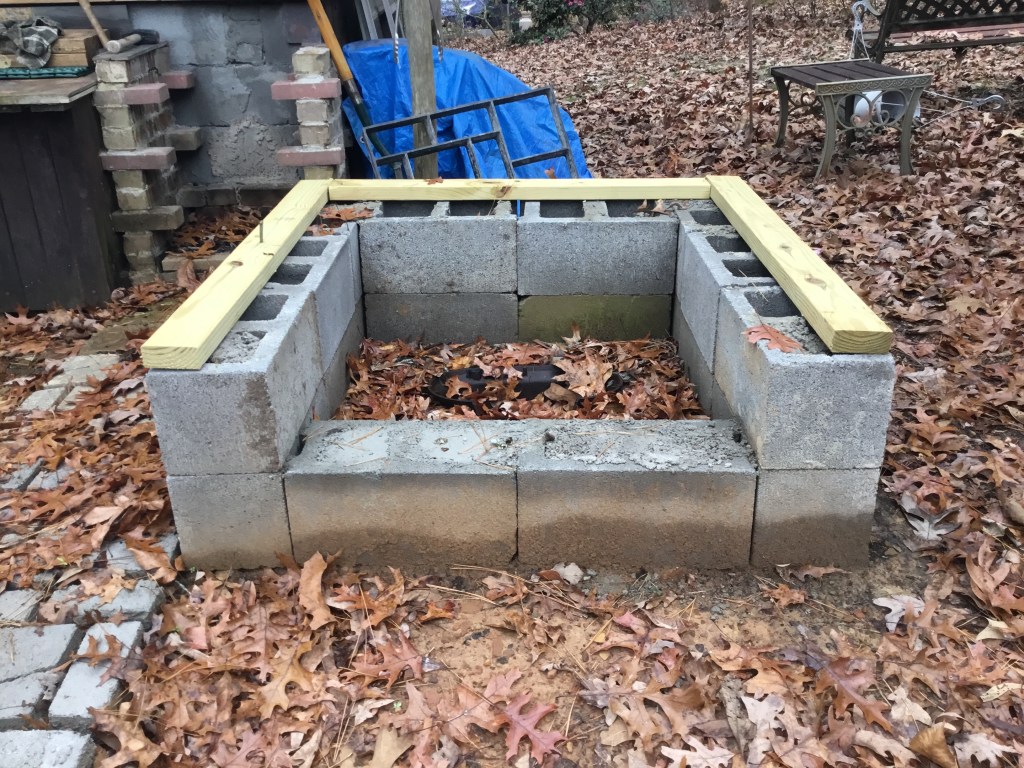
The smokehouse continues to grow. It is now completely framed (just like me), but here it is in infancy. Instead of laying every run of block with cement, I just put rebar into all four corners, hammered them into the ground, and filled the holes with cement. This foundation is not going anywhere.

The Fire Pit

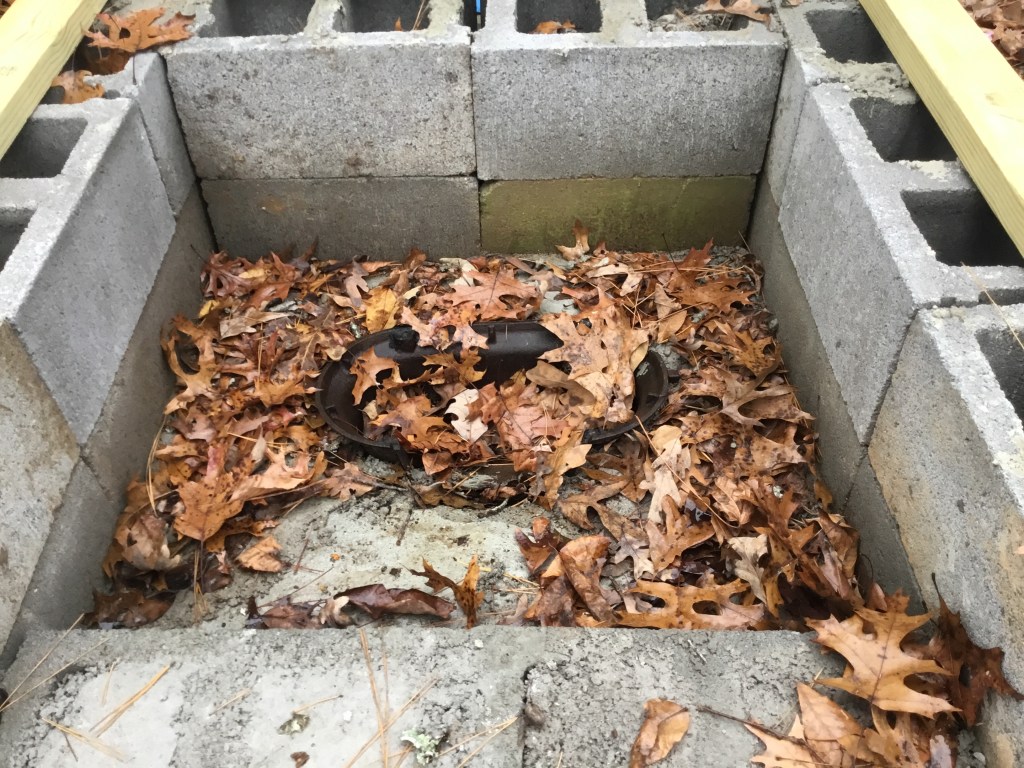
As this is to be a cold smoke/hot smoke machine, I re-used a rusted out old Lodge cast iron grill as a fire pit. Under all those leaves is a nice thick layer of concrete, into which the old grill is buried.

We’ll break this in this spring and summer hot smoking some trout and a turkey or two, and connect the cold smoking stove next fall. I am considering hanging a sign above the door that says, “Smoke ’em if you got ’em.”

Smokehouse, Part 1–The Cold Smoke Machine

The Things You Find in the Scrap Pile

The game is afoot, as Sherlock liked to say to Watson. I am finally finishing off my brick oven, AND building a smokehouse to go along with it. There’s some history to go along with this plan.

Back in the day, every farmer in our area had a smokehouse. MJ’s grandfather’s was a beauty. He built a fire right in the middle of it, but only smoked meat during “hog killing weather,” which began in November when it formerly became very cold.. In short, cold smoking was the only smoking he did, which meant that the temps inside the smokehouse never topped ninety degrees.

I’m going for one that will cold smoke and hot smoke. I will be able to build a fire in the smoke house, and one outside of the smoke house, thanks to the steel wood stove that was buried under my scrap pile. Moving it also helped clean out my workroom.

Be that as it may, the foundation is also completed now, and I am ready to frame this thing. Check back in another week or two, as we are about to have some very good weather for working outdoors.

Favorite Woodworking Planes, Part Ten and 31/64–Gage Self-Setting Planes

The GOAT of Production Planes?

I have been off of WordPress for a month, as I have been setting up a new MacMini, a task somewhere in between cleaning the Augean Stables and finding the last digit of Pi. I am back with all new passwords, and projects delayed for too long. For example, look at that slab of Eastern Red Cedar the Gage plane sits upon. 6′ 7″ long, 14″ wide, and 2″ thick. It has new workbench written all over it.

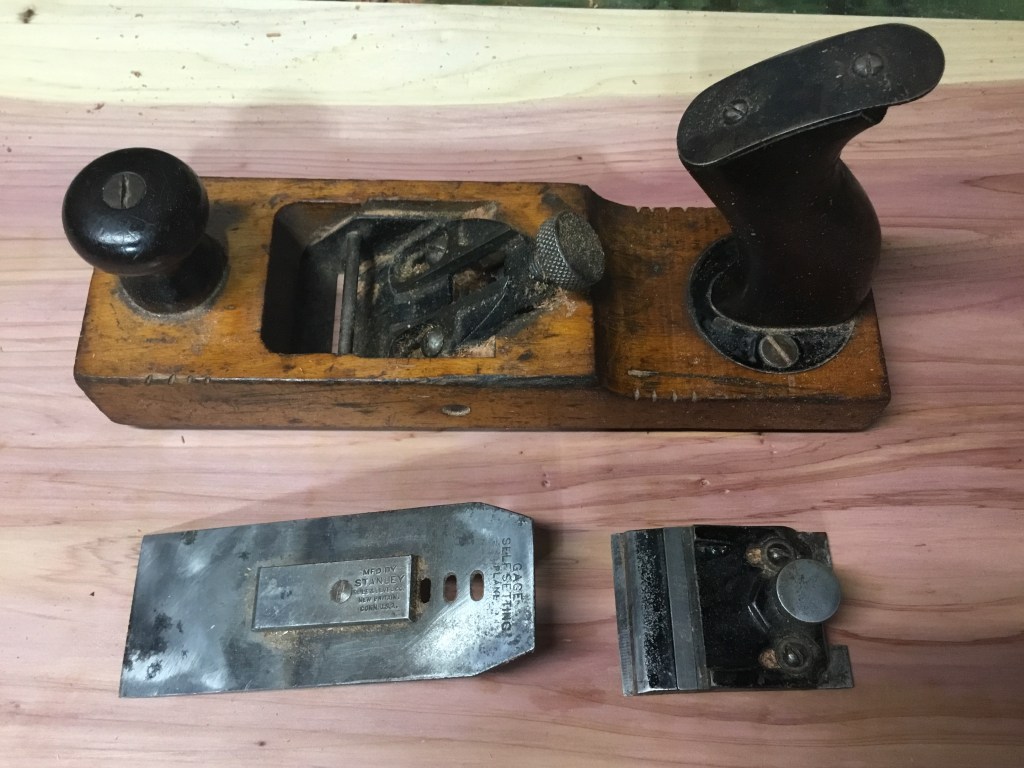
Now back to that Gage G35 plane. It took over thirty years to corral all the parts. The last part was the combo cap iron and chip breaker, bought from the top tool seller in the country (he had several of them). I think my total investment in this plane was $29. A mint version of the same plane sold for $1700 plus.

Why so much Jack for a production plane? It is essentially an absolute masterpiece of late nineteenth century industrial design. Let me list a a few of the innovations.

The Parts

To start, the plane blade/frog Combo is rock solid. The iron slides into the frog via a slot in the built in frog. The depth adjustment is far more accurate than a comparable Stanley one, and the slot means no floppy lateral adjustment. And that is not even the best part.

The trick shot is the union of the cap iron with the chip breaker. The chip breaker is essential another plane iron, turned around bevel up–thereby creating a double iron, twice as stiff as a Stanley plane. The cap iron is also adjustable up and down, and is tightened without the need of any tools, such as a screwdriver.

The final result of this is to create a “self setting” plane. Loosen the cap iron combo, take out the iron and sharpen it, and then re-assemble. No fiddling about with the chip breaker when the iron is put back in the plane. It is almost exactly the same depth every time.

Why didn’t this company crush the competition? Stanley bought them out, and after two decades of ownership, closed down the company. Just another example of rotten American business practices. Thankfully these champs are still in circulation on auction sites, though the prices vary wildly. Timing is everything–my retirement looms, and Melanie Jane bought me a G36 Jack plane for $49. Soon I will be officially “retard,” for all of you Borat fans. Sacha Baron Cohen introduced that term in Mt. Brook, Alabama, a place he loves to jape. The scene from Bruno in Mt Brook is even better than that.

Eastern Red Cedar Bench

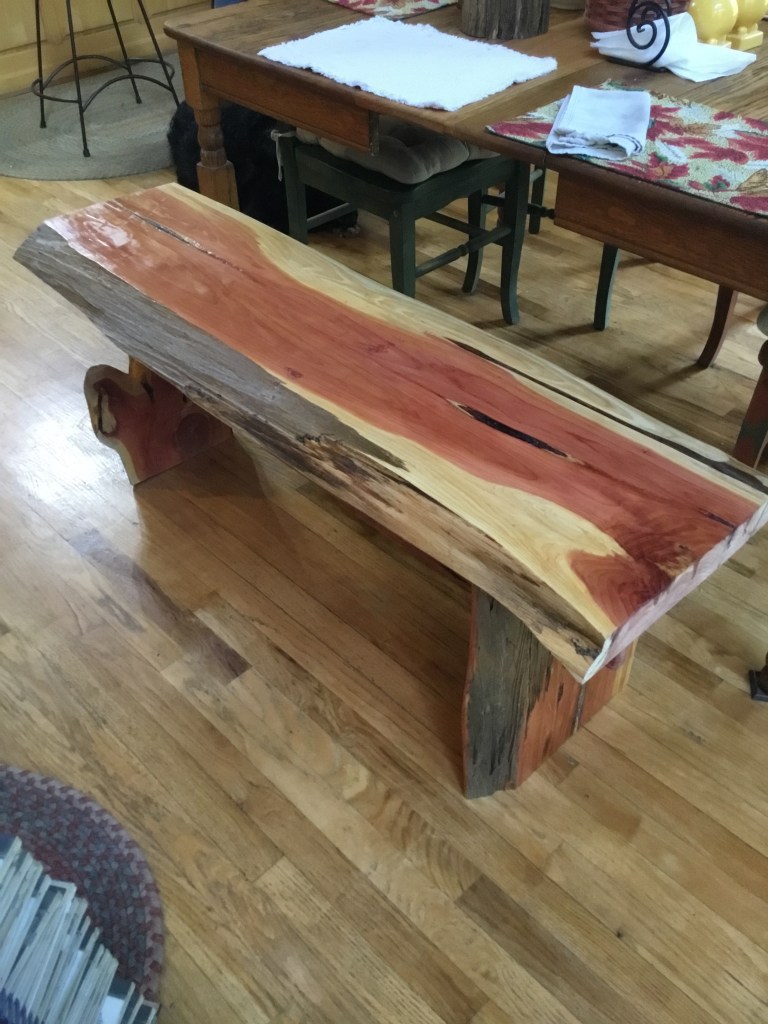
Karma is being unkind to the unvaccinated, and rightly so, but gave us a truck load of Eastern Red Cedar lumber. Actually, it was my in-laws, who we have practically buried with free eggs. This tree grew on the same property where Melanie Jane grew up.

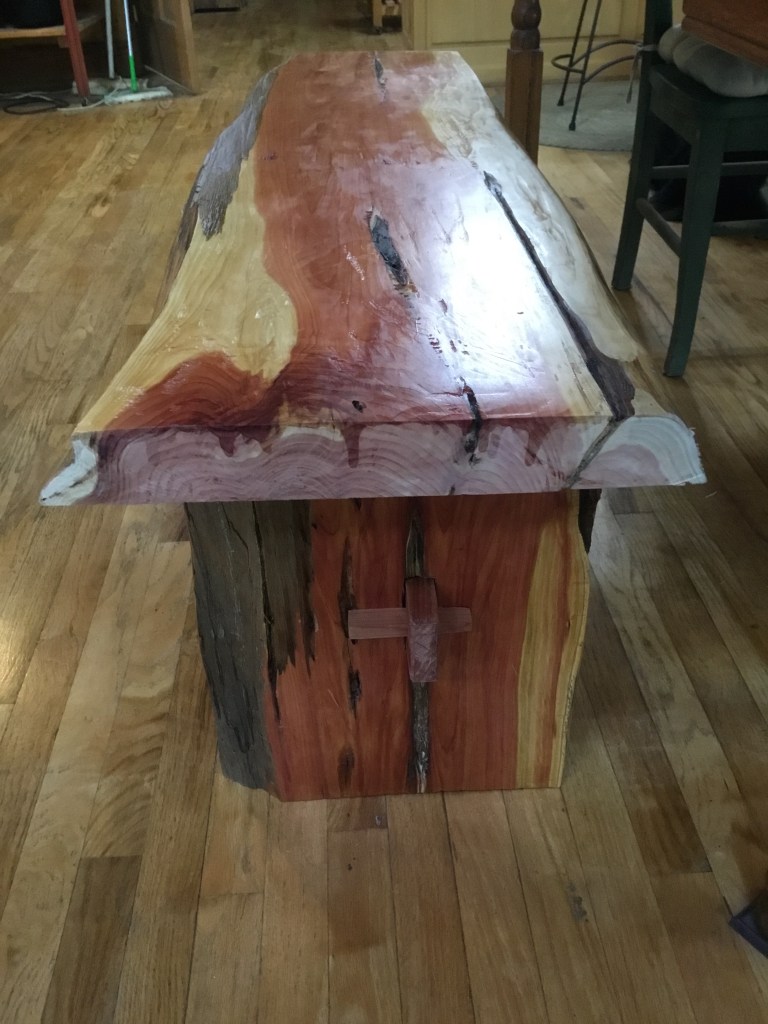
I’ve never made something this large from slab lumber, so I made sure it would not fall apart–the stretcher is through tenoned and held together with a tusk wedge.

It Really Came with that Burl

I still have to finish the ends of the slab. The other leg on the bench is full of heavy-osity.

Not Going Anywhere

The finish is super blonde shellac, though I think super blonde is Melanie’s nickname at her office. ESPN has a similar looking coffee table made of red cedar in their main studio, but they painted the live edge with gold glitter paint. There really is no accounting for taste.

Hop Hornbeam Knife Block

Live Edge or Free Edge?

After this piece of Hop Hornbeam log rolled around on the floor of my shop for a good couple of years, I had had enough. Then we began buying these French made Laguiole utensils, and the answer appeared. Make a knife block out of it.

A few vertical cuts with the miter saw, and some walnut spacers, and the job was done. I had just bought a Swiss-designed Bessey web clamp, and it will hold practically any shaped object tight while the glue dries. The Swiss, they are so clever.

Hop Hornbeam grows on our property, and this is from one specimen that expired during a two month drought. It’s incredibly strong and heavy as a sea anchor, so this is not likely to tip over. Those are steak knives and cheese knives, and one sliced my finger open while making this. That’ll learn me.

Sjobergs Workbench, and Sloyd in Sweden and the USA

Woodworking Utopia or Dystopia?

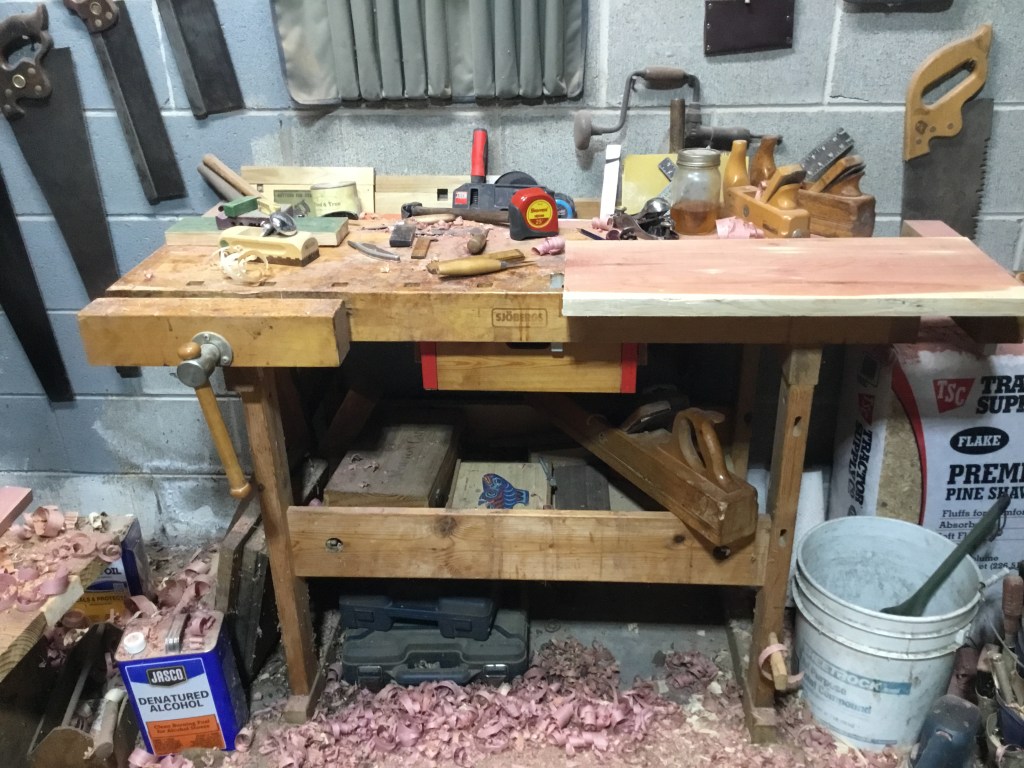
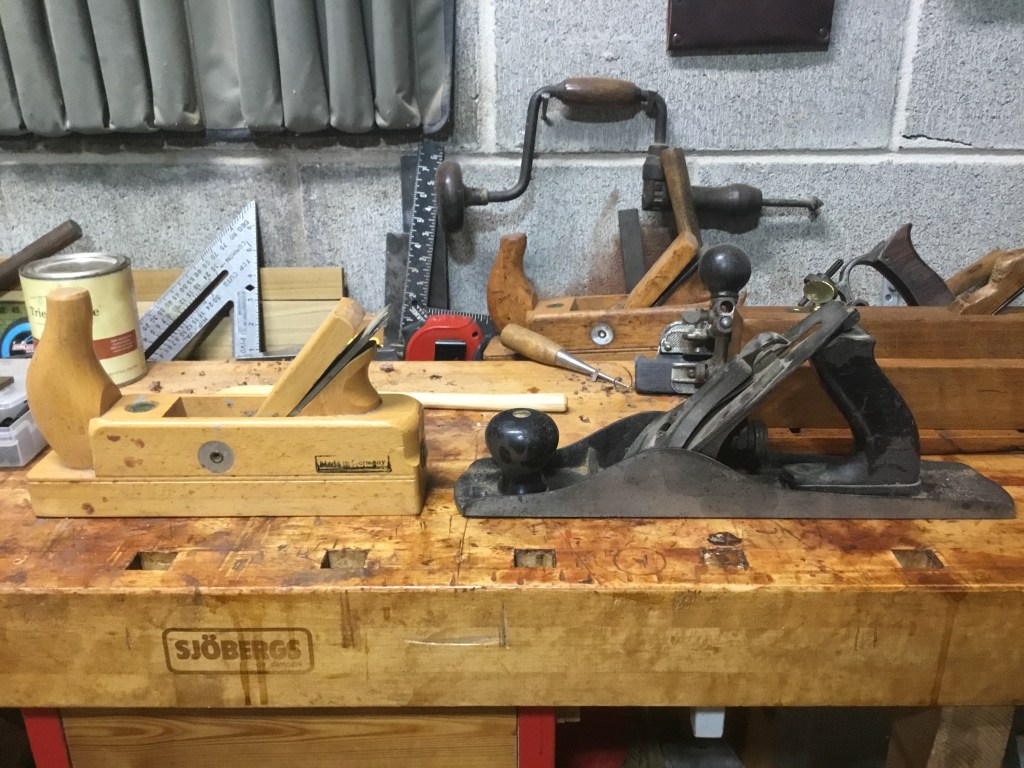
Sjobergs of Sweden makes literally thousands of benches and go alongs every year. This one is headed for its forth decade soon, and still has many years left in it. Professional woodworkers prefer mortise and tenoned benches the size of a Buick or a beached whale, but this has had at least four different homes, and it was easily moved. Was–it is now bolted to concrete in four places by lag bolts.

This is a realistic picture of the condition my bench stays in, as I am always making something. It would probably cause laughter from the nine year olds in Sweden, which is when they begin studying sloyd (sljöd in Swedish), which is the Swedish word for crafts. This study continues until after the child is fifteen.

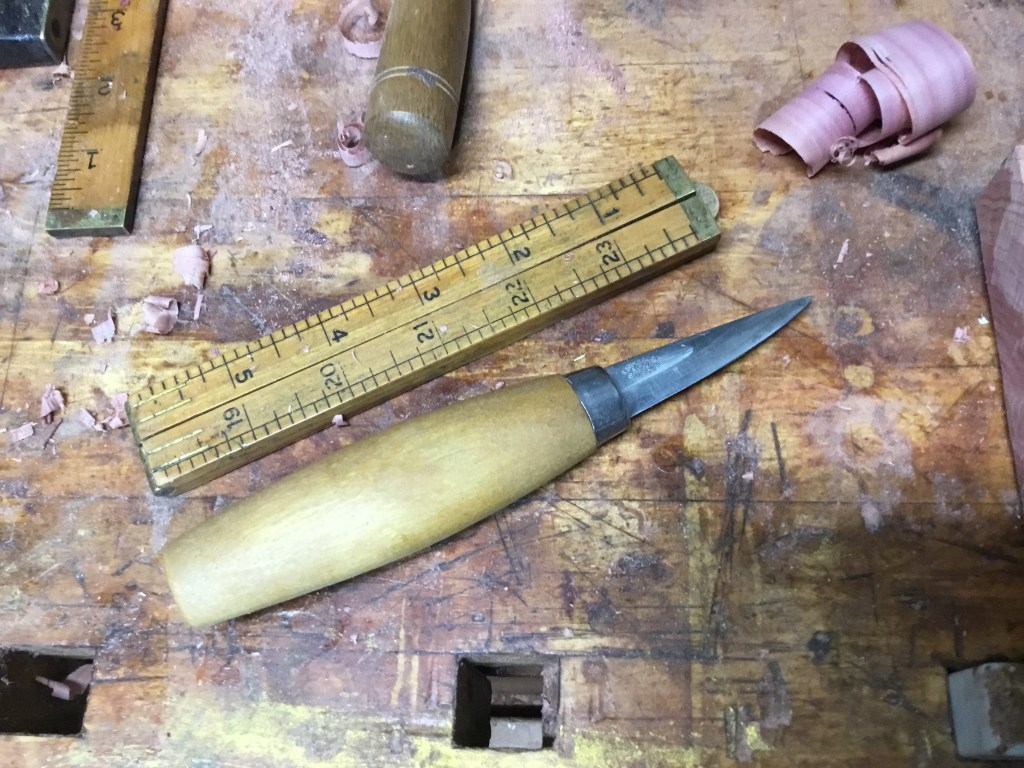
Here’s the kind of thing that Swedish public education gives to nine year olds.

Not the Shavings, but the Knife

That’s a Sloyd knife, in this case a quality Swedish knife made of laminated steel. Instilling quality and character into students is what Sloyd is all about. Sloyd is also a good substitute for physical education, as all I learned in PE was how to become a tolerable free throw shooter.

Alas, the US hierarchy chose to follow “the Russian system,” which is vocational training. The current system here is not to build character and intelligence, but to churn out workers to make some greenback dollars for somebody. As an anecdote, I was the chair of the English department at a “Liberal Arts” University, where the school’s VP told me that English was a department that was a “service” department, there to help departments like the nursing school. So much for building character. My bench has more character than that.

I really should stop using it as a place to mix my various home made paints. If you look close enough, you can see gold glitter paint, that I spilled while mixing it. That’s too much character.

“Leftover” Wood Spoon Rack

The Camera was Crooked

I have changed my terminology so that my vocabulary no longer contains “Scrap Pile.” My two substitutes are “Leftover Wood” and “Firewood.” Recycling small off cuts and shavings, and other odd pieces in the bread oven, and turning them into food, may be the new cycle of life.

–Which naturally brings me to the brick oven. When the trim is almost done, and the decoration begins, the end of the project is near. Anna Napoletana looked a little lonely hanging on the back of the oven by herself, so I made a very fast useful item with Leftover Wood–a Spoon Rack.

This is the end cuts of the picture frame next to it, and as soon as I saw them, I thought–spoon rack. This has four 1/2″ holes, so it will accommodate four spoons. Three cuts with the miter saw, and then assembly with finishing nails, and a couple of deck screws. It needed some of the gold glitter paint, to match Anna’s frame, and then it was attached to the oven with deck screws. It took far longer for the paint to dry than it took to build it.

Leftover wood, like left over food, can be as good as fresh.

Favorite Woodworking Planes, Part 9 and 15/32–Scrub Planes

I Need Something to Scrub

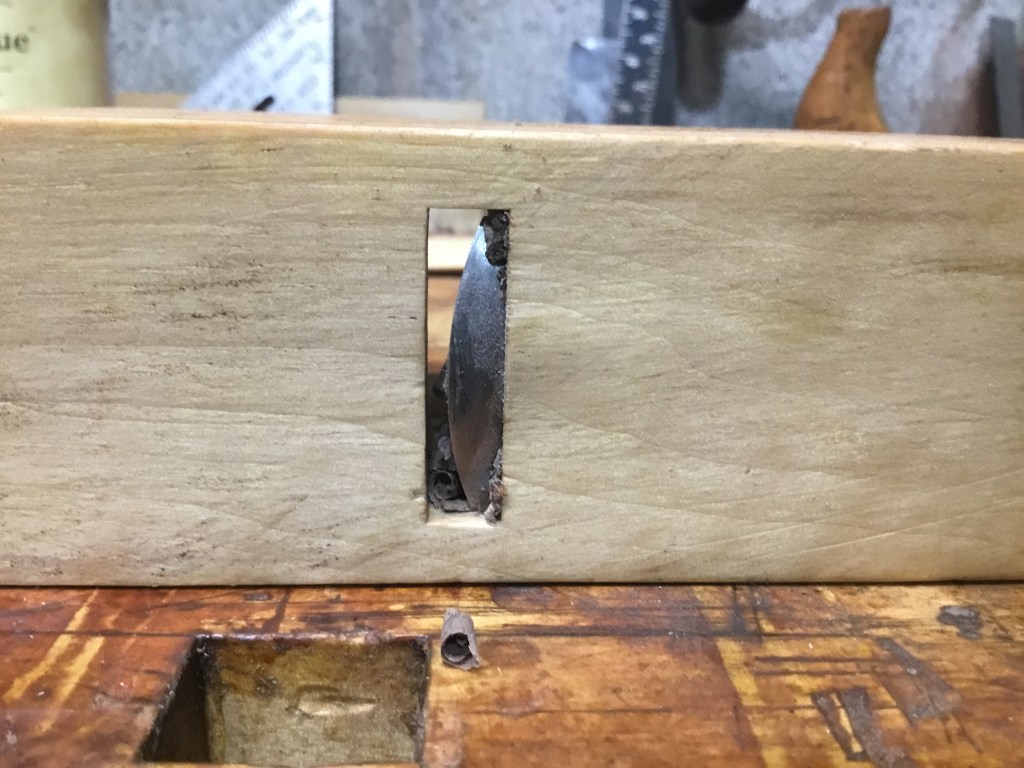
Scrub plane are essential tools for anyone who uses split or rough sawn wood. These will quickly flatten and dimension boards, as they remove thick pieces of wood with every pass. How do they do that? With a little engineering.

Feed Me

The classic German scrub plane–this one is an Ulmia–with a wide throat and a highly convex blade. This is designed to take off a good deal of stock in a hurry, and it does. Now for a home made scrub.

Jack of All Trades

Stanley #5 Jack planes used to be about the price of a High School lunch, and some of the older ones were the cheapest. This is a pre-1902 plane made without a Frog adjustment screw, which is pretty much useless for a scrub plane anyway. I just ground the cheap Stanley blade into a convex cutting machine. I do need to file the throat wider, so those Walnut shavings don’t clog as often.

So scrub away. These planes will save hours of time, and many obscenities.

Amish Made Berry Basket

Blueberry Muffins for Breakfast this Week

It’s always a pleasure to know where a product or ingredient comes from–I think it’s called accountability. Not only did this come from the Amish region of Ohio, but its maker was proud enough to sign his name to the basket–a Mr. Jonas Miller. We liked this so much we bought a matching piece to use on the center of our dining room table.

The uprights of the basket are nailed to a solid wood bottom with brass nails. Then the splints are used to shape the piece.The top is a piece of woven Raffia sandwiched between to splints. The belt loops are made of some very nice leather.

We purchased these from the best of the old school hardware stores, Lehman’s in Ohio, which was originally founded to serve the Amish community. If it isn’t top quality, Lehman’s will not sell it.

This basket is in for a long hot summer, as this was only the first picking from our eight Blueberry bushes. We leave some berries for our winged friends, and throw some to the chickens. There is no better way to start a chicken riot than to throw ripe blueberries into the chicken run.

OffGuardian

because facts really should be sacred

Ruth Blogs Here

Or not, depending on my mood

A Haven for Book Lovers

I am just a girl who loves reading and talking about books

what sandra thinks

because I've got to tell someone.

LadiesWhoLunchReviews,etc

a little lunch, a little wine, a LOT of talking!

Margaret and Helen

Best Friends for Sixty Years and Counting...

talltalesfromchiconia

Tales of quilting, gardening and cooking from the Kingdom of Chiconia

Cyranny's Cove

Refuge of an assumed danophile...

Exiled Rebels

Serving BL since 2017

this is... The Neighborhood

the Story within the Story

Beauty lies within yourself

The only impossible journey in life is you never begin!! ~Tanvir Kaur

Southern Fusion Cooking

Country Living in the Southern Appalachians, USA--A little of this, a lot of that

Discover WordPress

A daily selection of the best content published on WordPress, collected for you by humans who love to read.

The Atavist Magazine

Country Living in the Southern Appalachians, USA--A little of this, a lot of that

Longreads

Longreads : The best longform stories on the web

WordPress.com News

The latest news on WordPress.com and the WordPress community.