I stumbled across this design after buying a used copy of Early American Wooden Ware for $1 from an Amazon seller. It was first published in 1942, but I have the revised edition done twenty years later. This well illustrated book was written by Mary Earle Gould.
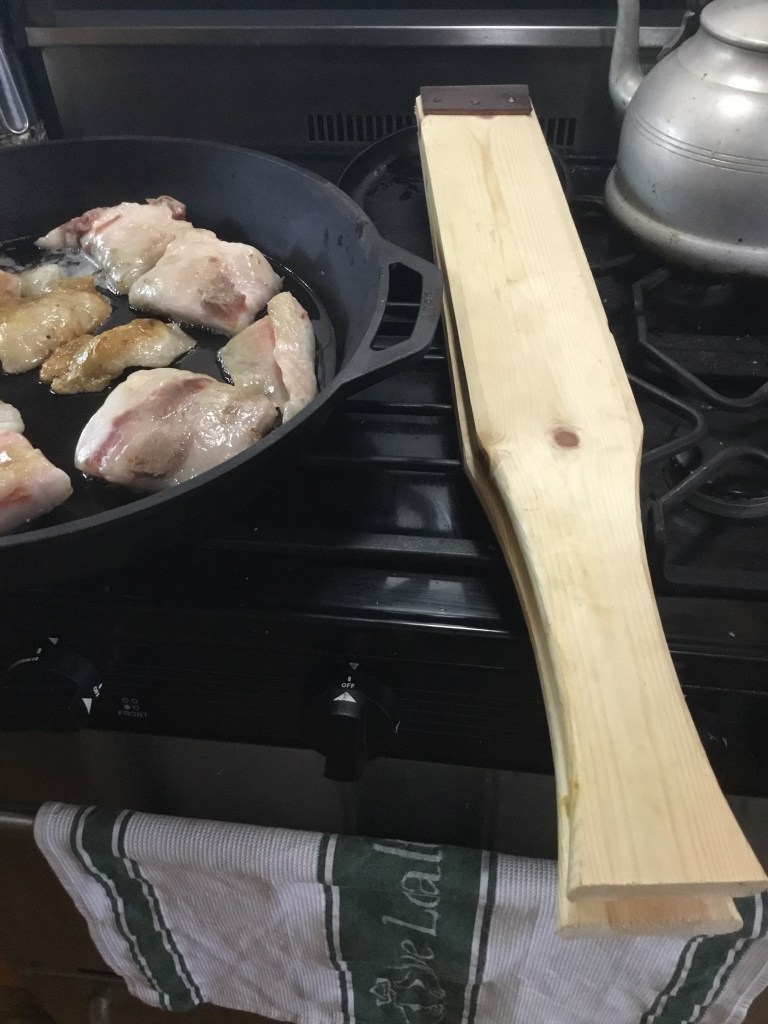
The squeezer was an industrial design from the time when lard rendering was a standard farm household affair. The hinge at the top is a scrap piece of leather, nailed to the two boards. The process is simple enough–heat the pork fat on low heat, and squeeze the fat out with the gizmo. It works inpressively well.
According to the French, there are five varieties of pork fat. Those include leaf lard, back fat, bacon fat, caul fat, and scraps. The finest is leaf lard, internal fat from near the kidneys. Two and a half pounds of local leaf lard yeilded three pints of lard.
I really used primarily one tool making these–a spokeshave. It is a quick and easy project, which will make you free from buying disgusting supermarket lard ever again.
Way back in the 1970’s Neil Young had it right with his song “Homegrown.” Here are the first few lines:
Homegrown’s alright with me Homegrown is the way it should be Homegrown is a good thing Plant that bell and let it ring
“Homegrown”
We didn’t start out with the idea that we were going to ring in the New Year with an all local feast, but it just turned out that way. I’ll start at the top, and go left to right around the plate, and then right to left.
Top: Baked Sweet Potato. That’s half of a big one, purchased from the Festhalle Farmer’s Market. These were grown by long time family friends, and are probably the variety “Porto Rican.” These are very sweet, and are served with lots of butter–a dessert substitute.
Left Center: Corn Bread. This is an all corn meal recipe, using McEwan and Sons Fine Ground Cornmeal. I doubt that the Certified Organic Corn was grown in Alabama, but their business, Coosa Valley Milling, just south of Birmingham, has some national fame. Their meal and grits are used at multiple James Beard award winning restaurants, and you can buy their products online–all around good stuff.
Bottom: Collard Greens. These are local as well, purchased at the Festhalle, and then frozen by yours truly. I like mine with lots of home made pepper sauce. The inheritance of bottles of such has been the subject of legal battles.
Right Top: Locally grown fresh Ham. Until this year, this was practically impossible to find. The ham pictured was home brined as well, and I will give the process of home brining, “curing,” in an upcoming post.
Center: Black-eyed Peas. More than likely these were grown by my in-laws, Melanie Jane’s sister and her husband, who brought us bags of them. That’s the way to pay a visit to some one. Southern folklore has it that every pea consumed is worth a dollar. I should be a millionaire.
The wine to wash this down with is local, if you live on the Rhône river in France. It’s a Côtes du Rhône, which has just enough pink tinge to call it a rosé.
This is as classic a Southern New Year’s meal as can be put together. People in NYC would probably label it “Soul Food.” Down here, we just call it food.
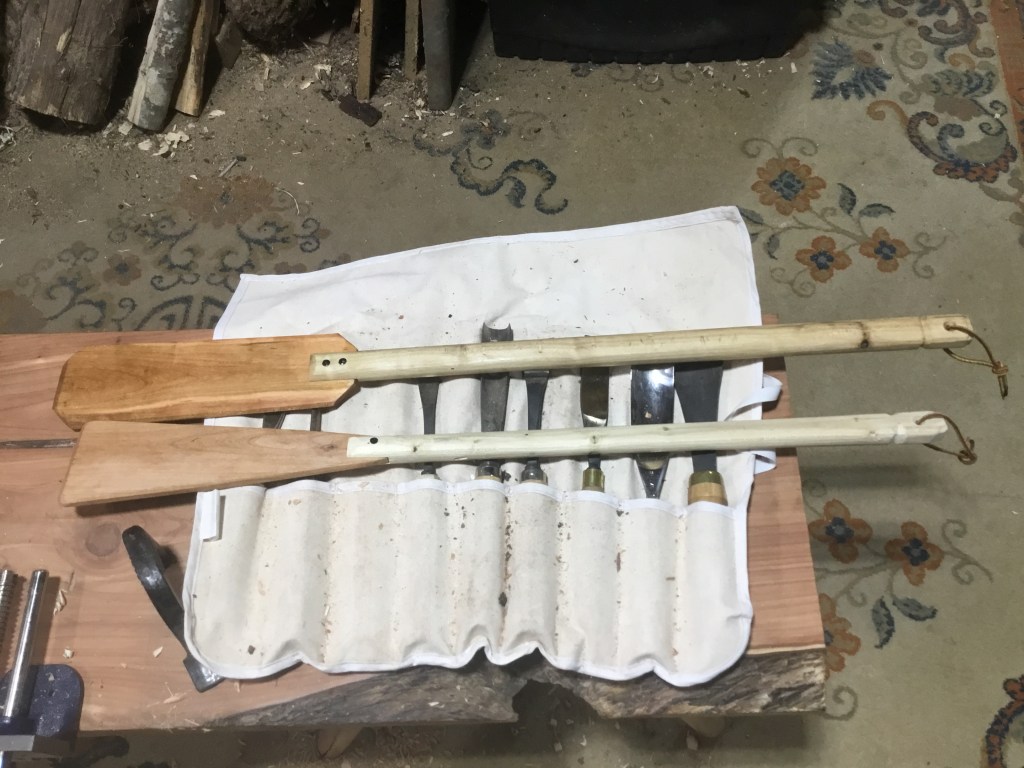
Having finally found a decent quality bandsaw (Rikon) that cost less than a car payment, I decided to break it in by making three Gumbo paddles. The handles on all three are Yaupon holly, a Gulf coast species, and the paddle blades are Black cherry. I made two of the bottom ones, for myself and one Brother in law. The large one is for another Brother in law, who cooks ten and twenty gallon batches of gumbo for St John’s Church in Cullman, which was founded by town father Johann Gottfried Cullman. Said Brother in law’s Son in law just happens to work there.
The paddles blades were cut with the bandsaw from the stump of Cherry tree in our front yard. It had been wind blown for about a year, so it didn’t need much drying. The handles as well were band sawn from wind blown Yaupon, and then turned into ovals by planing first with a Jack plane, and finishing with a Block plane. They were left smooth enough that they needed no sanding.
The mortises in the handles were likewise sawed out with the band saw, and then the waste was chiseled out. Final attachment was with a glue joint held into place with French diamond head nails, which serve a double purpose as decoration.
The larger paddle was finished with straight Walnut oil, while mine was finished with a Walnut oil wax finish. I broke mine in on Sunday cooking Beef stew in our fire pit in the Outdoor Kitchen. The paddle is long enough to have kept me away from the heat, and more importantly the smoke, which was whipped up by a ten mile an hour Southwest wind. The final addition was an accessory cord hanger, which in the case was made from some old worn out boot laces. Waste not, want not.
Most gardeners in USDA Zone 7 or higher could easily have a set up like this.
For our Winter garden this year I went with all container plantings. It was a good thing too–when the bomb cyclone hit in December, and our temps went down to 8.9 degrees F, I just wheeled three cart loads of plants into our 60 degree basement, left them there for a couple of days, and then brought them back out. We will now have fresh greens until spring planting, which actually begins this week.
Pictured is a mixed planting of lettuces, spinach, boy choy, radishes, onions, chard, collards, kale, and one container with a mesclun mix that includes arugula. The potting soil is 95% composted chicken manure, a by product of our egg layers, that produce a more than steady supply of it. The spinach quiche we made was the perfect combination of their products.
Grand total of the expenses for this garden was $20 for seeds. I’m going to splurge and spend $40 on the summer version, which will easily be double this size. You won’t hear any complaints about the price of lettuce from me.
Tasso ham is not really ham, in the common sense of the word, as it is usually made with pork shoulder, aka Boston butt. Going back in time, this Louisiana seasoning product was made from any trimming leftover from a hog killing. The only constant is the combination of spices and smoke, that make this a red beans and rice all star.
Ingredients
Sliced Pork Shoulder Strips
Paprika
Cayenne Pepper
Cinnamon
Salt and Pepper
This constitutes the dry rub, and the amount of each spice depends on the quantity of pork strips. At this point the pork strips need to dry uncovered in the refriginator a minimum of three days. Then it’s time to crank up the smoke house.
More Smokin’
This old school smokehouse, right down to the hanging strip of fly paper, is now fully operational. The external smoke source is an old steel wood stove connected via a stove pipe. This Tasso was smoked for two and a half hours with green Maple at about 150 degrees F. The char patterns on the Tasso in the photo are from the smoke, not heat. The big piece of pork shoulder in the pic was destined to be barbecue.
After the Tasso has cooled, cut it into cubes and chunk it into a freezer bag. Like the frugal ant in the ant and grasshopper fable, we will have smokey dishes all winter, while the grasshoppers have to dine on McRib mystery meat barbecue sandwiches.
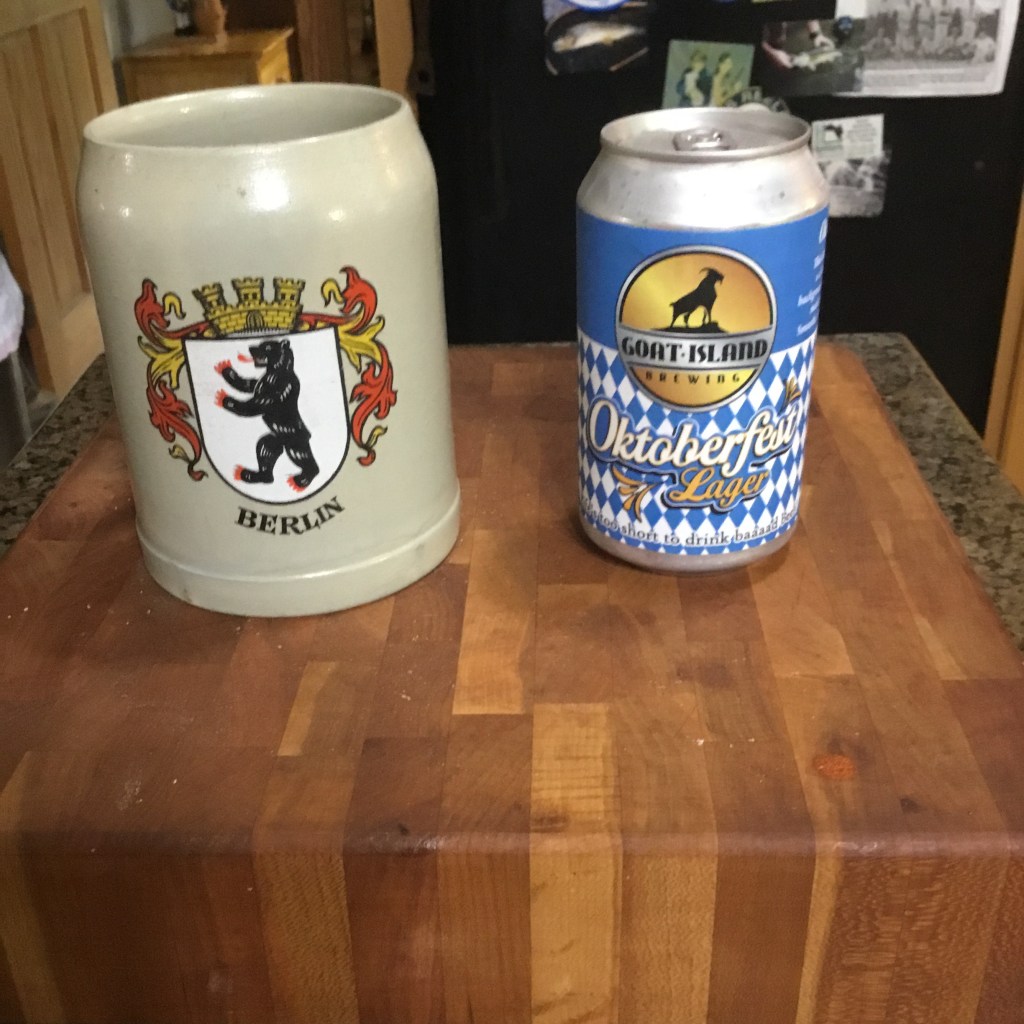
Goat Island Brewing’s Oktoberfest beer is not actually made in the community of Berlin, Alabama–locals call it “Bur-lin”–but just a few miles to the west, in the town of Cullman. Cullman is in fact named after founder Johannes Gottfried Kullman, who was a “Colonel” in one of the many German revolts against royalty in 1848-1849. After revolt after revolt in Germany failed, Kullman thought it wise to relocate to the constitutional Republic of the USA.
Goat Island is becoming another craft brewery that is growing every year. The Oktoberfest is a well behaved lager, that could easily be drunk by the pint. It doesn’t hurt that they have beers with clever names, like Peace, Love and Hippieweisen, a wheat beer made with Alabama summer weather in mind. It also doesn’t hurt that their Duck River Dunkel won a silver medal at the Great American beer Festival in Denver in 2018. Not bad for a small Southern brewery.
Goat Island is an actual place, a small island just offshore in the Smith Lake impoundment. Legend has it that a single goat was marooned there as the waters rose, and spent a solitary life as the only one of his kind on the island. Someone could at least have taken him a beer.
This bread is definitely Southern, although more Southern France than Southern US. Strangely enough, it is only a couple of ingredients away from being identical to Creole French bread, which, as I have noted, is more Italian than French.
Ingredients
1 tablespoon Olive Oil
1/2 teaspoon Salt
1 1/2 cup Flour
1 tablespoon non-fat dry Milk
3/4 cup warm Water
Mix these by hand or with a stand mixer. Also mix together in a measuring cup-
2 teaspoons dry Yeast
1 tablespoon warm Water
1 tablespoon Maple Syrup (this is a substitute for Malt Syrup)
Let the yeast mixture rise in a measuring cup, until it reaches a volume of about one cup , then mix thoroughly with the flour mixture. Knead by hand or with a stand mixer. When the dough stops sticking to your oiled fingers, transfer to a bowl to rise–a wooden dough bowl is traditional in the South. After an hour or more of rising, form the loaves into the shape of your choosing–I like baguettes. Lately I have been cooking mine at 450 degrees F.
The recipe comes from the The Breads af France by Bernard Clayton Jr, and it has replaced the Picayune Creole Cookbook on my kitchen cookbook stand. It’s that good. As Clayton notes, Monaco, all 400+ acres of it, is highly influenced by its proximity to Italy, and thus we have the addition of oil to the bread, which fortifies it. Take away that and the milk powder, and you have Creole bread. However, when it comes to this style of French/Italian/New Orleans bread, there is only one thing to say about it–it’s all good.
Wait–Those are anti-war Russian Kids who were Sent to the Slammer this Week–see the NPR Story about Them
There were no midgets in this group of clergy–alphabetically, they were Ralph Abernathy, Martin Luther King Jr, and Fred Shuttlesworth. I learned about this incident reading the brilliant book Carry Me Home by Diane McWhorter. Here’s the cover.
Looks Familiar–Birmingham Kids Headed to the Slammer in 1963
The brains of the group, Shuttlesworth of Birmingham, had gone to Georgia to propose a protest, that was to become one of the most famous in world history, which he called Project C. It involved occupying the lunch counters in Birmingham, using his trademark tactic of “direct action.” Neither of the other two had ever participated in a direct action protest. Unfortunately, Shuttlesworth missed his plane back to Alabama.
I’ll quote McWhorter from this point:
Chafing to catch his flight back to Birmingham, Shuttlesworth asked King and Abernathy to drive him to Savannah. Arriving at the airport just as the plane for Birmingham was taking off, King said with humorous sympathy, “Ralph, I believe Fred has missed his plane.” Inside the terminal, Shuttlesworth said, “Gentlemen, I’m powerful hungry,” and led them into the all-white lunch room, instructing them, “Leave some stools between us. Some white folks may want to sit down.” To the waitress who was sullenly ignoring the leaders of the civil rights movement, Shuttlesworth called, “Little lady, if you don’t want your airport to make the history books, you better serve me.” But the only record for posterity was the rolls of surveillance film that the FBI shot of the SCLC member’s coming and goings at the airport, assuming the revolutionary plot being hatched at Dorchester to be Marxist-Leninist.
Carry Me Home
J. Edgar Hoover was something like the Putin of American history–that is, when he wasn’t playing dress up with his boyfriend. The line between the Klan, the FBI, and the police was practically invisible in Birmingham in the early 60’s, which was often compared to Berlin in the late 1930’s. All wanted to portray the civil rights movement as being communists, who wanted to take away white people’s places at the lunch counter. Thus few of the fifty bombings that happened there were ever solved, the last notable one claiming the life of Federal Judge Robert Vance. His daughter in law Joyce is now a news analyst for MSNBC.
I have to admire all the kids in those two pictures, but my favorite is the girl wearing the toboggan. She looks like she is mad enough to eat Putin’s lunch. I hope she does.
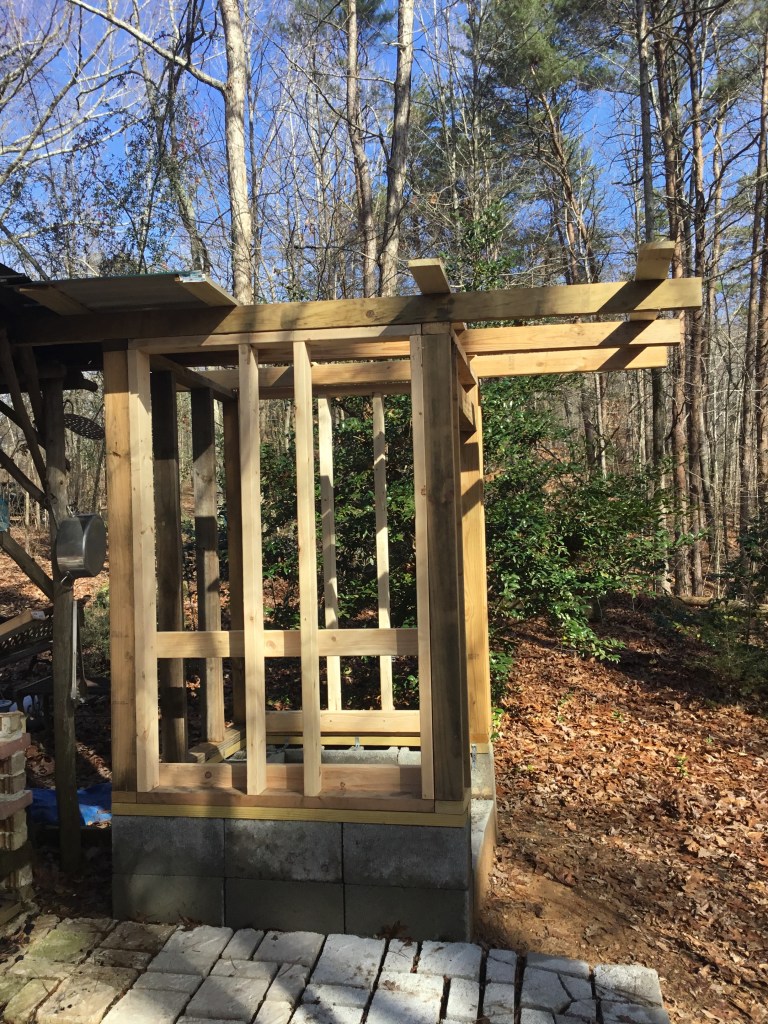
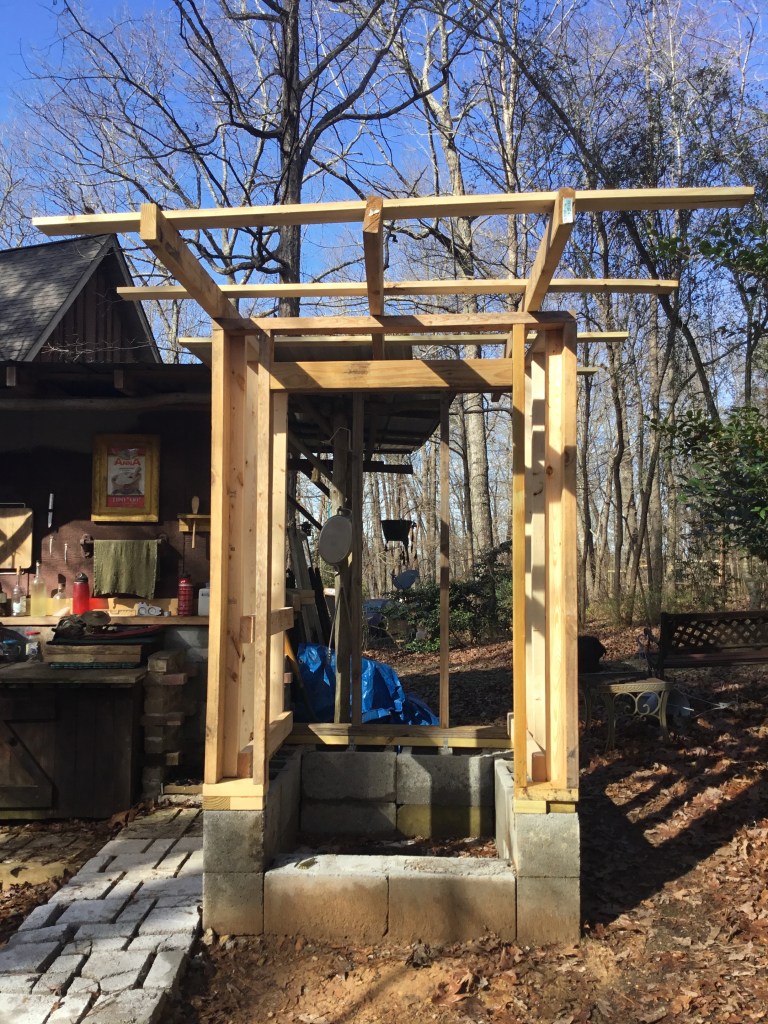
This project began with the gift of a bunch of cinder blocks, and a couple of wooden pallets–all unsolicited, naturally (I should add that cinder blocks are known as “see-mint” blocks locally). These came from BIL (brother in law) #1, who then added a few pressure treated 2x4s as well, which you can see as the sill boards on the smokehouse.
Not long thereafter BIL #2 got in on the action, giving us the lumber for the front and back walls, as well as the rafters, and some tin roofing. He really really wants this thing to be finished, as he has a whole list of meat smoking projects. We (gasp) actually bought the lumber for the two side walls. I have plans for a fancy door as well.
No Door Yet
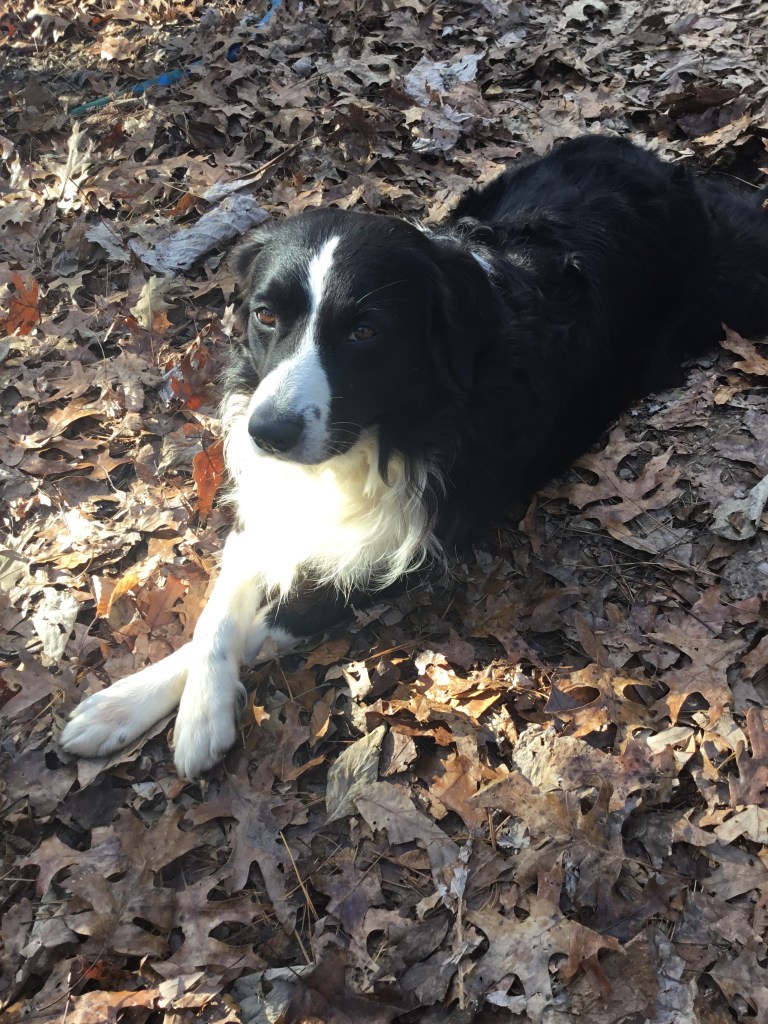
I did all the work myself, with the exception of Melanie Jane helping me hoist up the first rafter. But, as my labor is free, as always, I did all the rest of it by my lonesome. That is, if you don’t count my actual supervisor on this project.
Get Back to Work
That’s Siegfried, more commonly known as Ziggy D. Dog. A finer nor a lazier Aussie has ever been birthed. The combination of the two traits makes him perfect for a middle management position.
MJ says that 16 square feet, the size of this structure, is big enough to sit in and smoke a couple of packs. My counter was that I would rather puff on a Bob Marley sized fattie (that’s a joint of Mary Jane, in case you just fell off the turnip truck). Truthfully, neither of us has ever smoked vegetable matter of any kind. I suppose we will have to stick with smoking meat instead.
The game is afoot, as Sherlock liked to say to Watson. I am finally finishing off my brick oven, AND building a smokehouse to go along with it. There’s some history to go along with this plan.
Back in the day, every farmer in our area had a smokehouse. MJ’s grandfather’s was a beauty. He built a fire right in the middle of it, but only smoked meat during “hog killing weather,” which began in November when it formerly became very cold.. In short, cold smoking was the only smoking he did, which meant that the temps inside the smokehouse never topped ninety degrees.
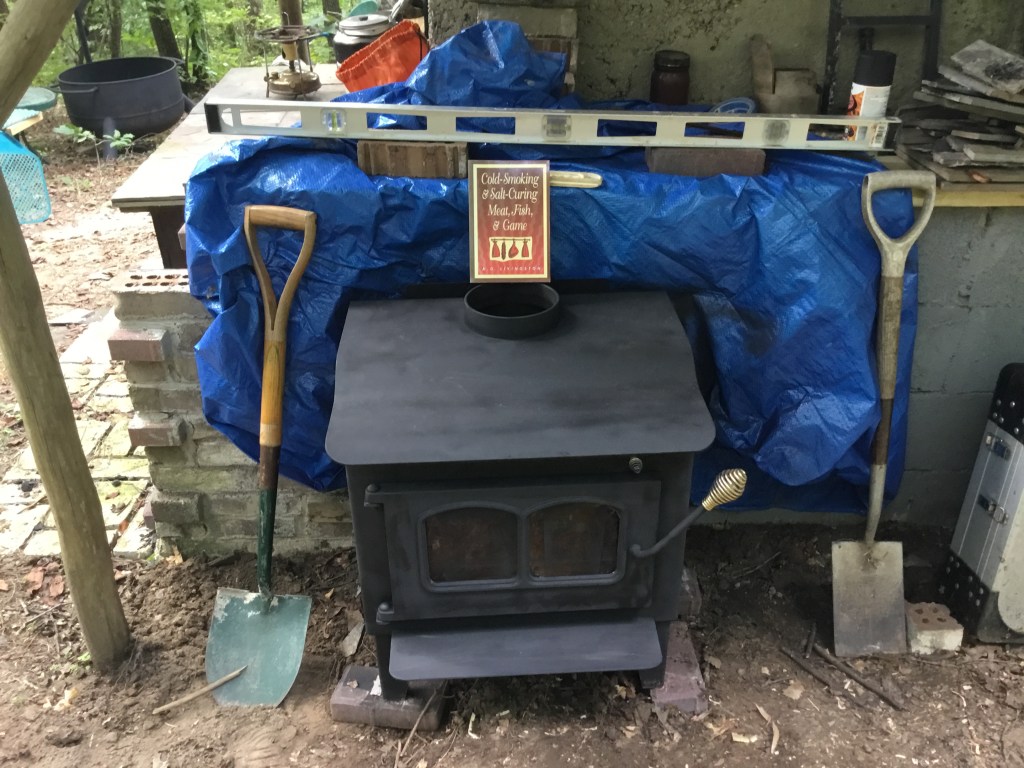
I’m going for one that will cold smoke and hot smoke. I will be able to build a fire in the smoke house, and one outside of the smoke house, thanks to the steel wood stove that was buried under my scrap pile. Moving it also helped clean out my workroom.
Be that as it may, the foundation is also completed now, and I am ready to frame this thing. Check back in another week or two, as we are about to have some very good weather for working outdoors.






 Southern Fusion Cooking